Category Archives: Conservation Status

Polar bear habitat update and attempts to spoil the good news for kids

The trolls are out in force at Amazon, posting negative reviews of my new book, Polar Bear Facts & Myths – they just hate it when credible scientists won’t promote a message of doom. It seems folks of this ilk truly want children to have nightmares about drowning, starving polar bears; they encourage kids to frantically turn out lights in a vain attempt to “Save The Sea Ice” while unbeknownst to them, the polar bears and seals prosper.

I expect those same fear-mongers will really hate my next book, due to be released early next week, because it presents the evidence in a way all readers will understand with the references to back it up. Polar bears and ringed seals are thriving despite recent losses of summer sea ice and there is seemingly a huge body of activists and scientists who don’t want people to know that simple fact.

Coming soon    Polar Bears: Outstanding Survivors of Climate Change

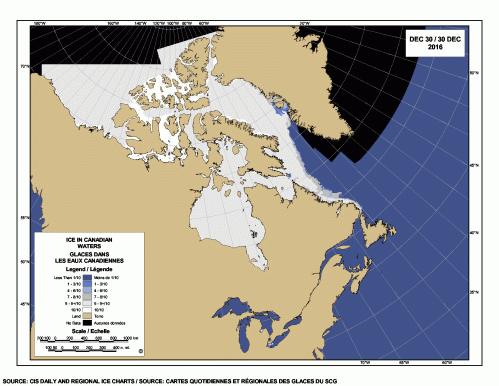
Back to polar bear habitat news, here is the sea ice map for 30 December 2016: Hudson Bay iced-over and lots of ice moving down southern Davis Strait:

Sea ice extent Canada 2016 Dec30_CIS.gif

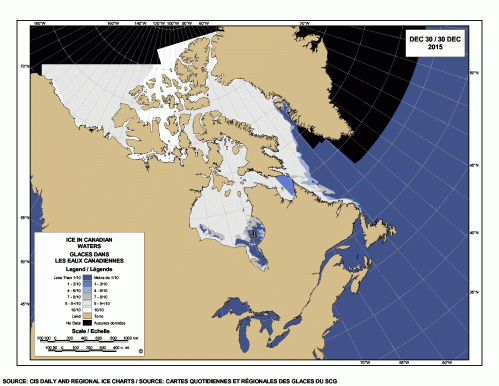
Compare to last year at this time, when polar bears did not die off in droves anywhere in Canada (or we would have heard about it) – remember that 2/3 of the word’s polar bears live in Canada:

canadian-arctic-dec-30-2015_cis

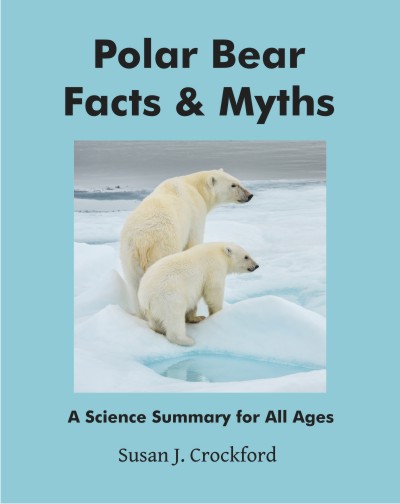
Polar Bear Facts & Myths now available and may arrive in time for Christmas

The first science book suitable for kids that tells the whole truth about polar bears and climate change is now for sale at Amazon.

fm_small

This beautiful, full color summary (44 pages, 8 x 10 inches) explains in simple terms why polar bears are thriving despite the recent loss of Arctic sea ice. It’s written in a question and answer format, in language that readers of all ages can understand (age 7 and up). The book takes a sensible, big-picture approach that many readers will appreciate and is based on the most up-to-date information available.

This is the perfect gift for some of the polar bear lovers on your gift list and if you act quickly (order here), your book may arrive before the 25th. At this time, only the paperback is available but some ebook versions should be out shortly. 

For purchasers for which a pre-Christmas delivery isn’t going to work (publication will be later in Europe; shipping is faster to eastern Canada and the US than to the west), I have provided a gift card you can download to print off and give in lieu of the physical book (kind of a placeholder until it arrives).

UPDATE: 18 Dec. 2016 Now listed at Amazon Canada and Amazon UK

Download gift card PDF HERE for Polar Bear Facts & Myths

Download gift card PDF HERE for Polar Bears: Outstanding Survivors of Climate Change  (coming soon, see below).

[Download Christmas gift cards, one per page, for both books here]

Check my book website for updates.

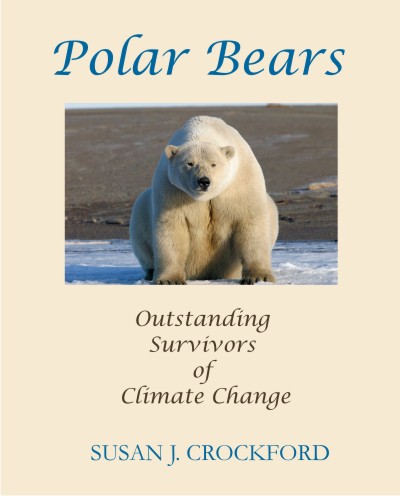
For adults & high school students (coming soon Now available)

os_small

This color, fully-referenced polar bear science book is aimed at adults and high school students. Polar Bears: Outstanding Survivors of Climate Change is fashioned after the popular lecture with the same title I have given since 2009, which has been enthusiastically received by audiences with diverse backgrounds.

My book website now has full details of these new non-fiction books (along with a revised author biography) and will be updated regularly regarding formats and venues as they become available. Details for EATEN on that site has moved to its own fiction page.

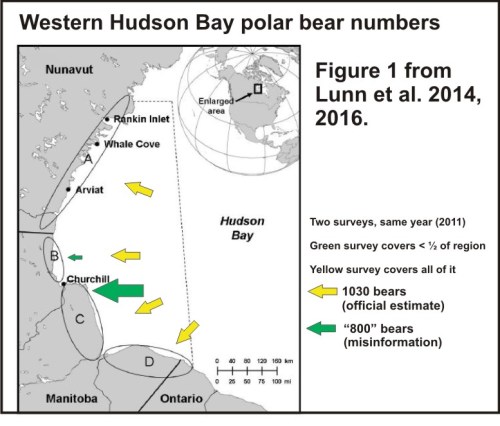
W. Hudson Bay had 1030 polar bears at last count and that is the official number

The IUCN Polar Bear Specialist Group, the IUCN Red List, and Environment Canada (see below) agree that the population size of Western Hudson Bay subpopulation is 1030 or about 1000 bears, based on surveys conducted in 2011.

western-hudson-bay-surveys-2011-compared_polarbearscience-16-dec-2016

For the last few months (most recently, here and here), Andrew Derocher has been telling anyone who will listen that that the number is 800. And no one challenges him – not a single reporter asks where the number comes from, not a single research colleague who knows the truth has publicly stated that Derocher is spreading misinformation.

UPDATE 16 December 2016, half an hour after posting: Add The Atlantic to those accepting Derocher’s misinformation on WHB polar bear numbers without question, and failing to see that because patrols in Churchill were stepped up considerably after a serious mauling occurred in 2013 (because several bears got through their Halloween dragnet), more “problem” bears in Churchill since then only mean the Polar Bear Alert folks are doing their jobs.

But what does The Atlantic conclude, after talking to Derocher?

The Churchill bears…are probably doomed.

Never was a rational book on the science and conservation status of polar bears more desperately needed – it will be available soon.
Continue reading

Polar bears that didn’t die from recent sea ice loss will die in 35 yrs, say ‘sperts

Yesterday, the DailyMail (among others) was suckered into running virtually the same story The Guardian (among others) hyped last year about this time.

Using a science journal version of the 2015 IUCN Red List assessment report, polar bear data collectors and their fortune-teller colleagues have managed to get polar bears back in the news.

crystalball_468x317_predictions_sq

I wrote about this last year – it’s actually good news, although you wouldn’t know it from the headlines.

Let me paraphrase the ‘sperts:

“After 10 years of ice conditions we didn’t expect would happen until mid-century (a worst-case scenario we said would cause more than 30% of the world’s polar bears to die – except they didn’t), we have now determined (using a new model and a brand new definition of sea ice specific to polar bears) that by mid-century, there is only a 70% chance that 30% of polar bears will die.”

This is how they explain away all the bears that didn’t die as they should have when summer sea ice declined to about 5 mkm2 and below after 2006.

Continue reading

An El Niño year late start to freeze-up on Hudson Bay: bears gearing up to hunt

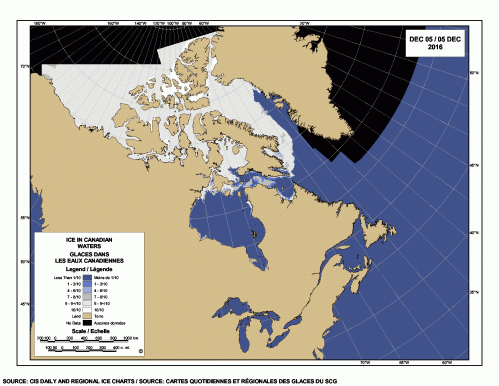
There is no serious ice on the west shore of Hudson Bay yet (as the map below shows) but the winds have just shifted – instead of coming from the south, they are now blowing in from the north.

Freeze-up and a resumption of seal hunting for Western and Southern Hudson Bay polar bears looks imminent. The bears get out on the ice as soon as they are physically able, when the ice is about 3-4 inches thick (about 10 cm).

sea-ice-extent-canada-2016-dec-5_cis

I’m going to let Kelsey Eliasson from PolarBearAlley, on shore at Churchill, convey the gist of the freeze-up situation on the Bay.

Recall that freeze-up was late in both 1998 and 1999 – during the height of that strong El Niño warmth as well as the year following. Continue reading

No correlation between freeze-up dates for Hudson Bay & total Arctic ice cover

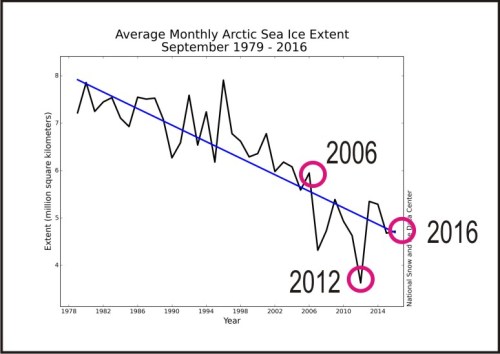
Guess which year between 2006 and 2016 had the latest start to freeze-up on Hudson Bay, given that 2012 had the lowest September average and 2007 and 2016 tied for second-lowest (see graph below, from NSIDC), and that sea ice in the Arctic right now is the lowest it’s been for this date since 1979?

sea-ice-sept-averages-graph-only-marked-for-2006-up

If you guessed anything other than 2010, you guessed wrong – in addition, 2006 (not 2016) was second latest.

There is no correlation between Arctic sea ice coverage and freeze-up dates for Western Hudson Bay.

Yet, Polar Bears International (“Save Our Sea Ice”) –  who were surely in and around Churchill in 2010 and 2006 watching polar bears – just posted an alarming statement about local conditions, implying that slow freeze-up of Hudson Bay this year is a reflection of the fact that “sea ice is at a record low across the Arctic.”

They also claim that “…the weather is the warmest we’ve ever seen at this time of year.” That may be true, but if so, it is also meaningless with respect to the progress of freeze-up.

Does no one at PBI remember the very late freeze-up of 2010 or 2006? Odd, that.

Continue reading

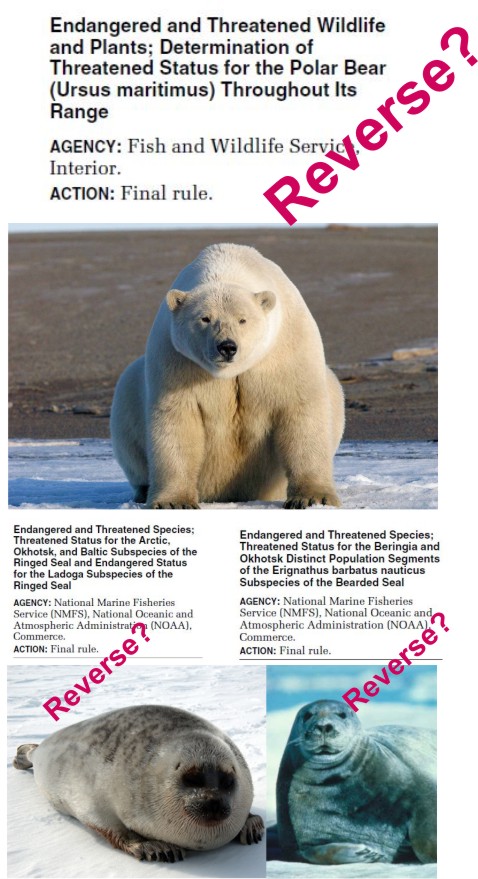
Will Trump reverse ESA decisions listing polar bears & Arctic seals as threatened?

The New York Times reported this morning: “Donald Trump Is Elected President in Stunning Repudiation of the Establishment.”

I’ve never been very interested in politics but this result has me wondering. Could the new president reverse the Endangered Species Act (ESA) decisions listing polar bears and other species as ‘threatened’ with extinction due to future threats from global warming?

future-of-arctic-species-status-under-trump-presidency-9-nov-2016
Continue reading

IUCN Polar Bear Specialist Group website still silent on 2015 Red List assessment

It’s now been 11 months since the IUCN Red List announced the completion of a new conservation assessment for polar bears – but you wouldn’t know that if you visited the website of the IUCN Polar Bear Specialist Group (PBSG).
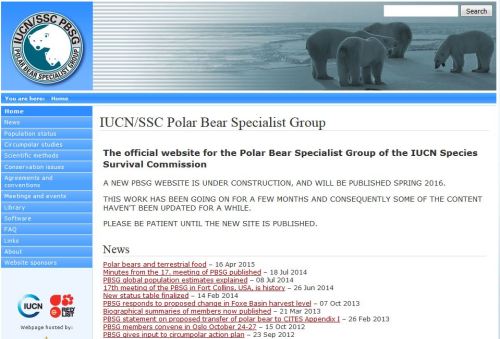
pbsg-website-notice_home-page-2016-oct-18

Back in May 2016, I wrote to the folks at the IUCN Red List asking them why the PBSG had not yet added a link to their website regarding the 19 November 2015 update to the Red List polar bear assessment (submitted by PBSG members in July 2015), a shortcoming I first notice in December 2015. I also inquired why the IUCN Red List folks were not taking the PBSG to task for their failure to keep the public informed of this new development.

After a wait of more than 6 weeks (23 June), I finally received a reply. The Red List official accepted as reasonable the PBSG excuse that since a link to the IUCN Red List was present on their home page as an icon (here), a direct link to the actual Red List polar bear assessment was not necessary. He was informed by the PBSG that the website upgrade had simply taken longer than expected but that it would be completed by the end of July.

And yet, here it is – almost three months later and still no revised website – and more importantly, still no mention of the 2015 Red List assessment update, see screencap above taken 18 October 2016 (which has been up since 14 January 2016).

Note that my complaint is not that the website upgrade has taken longer than expected (doesn’t it always?) – it’s about the continued refusal to provide a simple link to the 2015 Red List assessment at the top of their “News” feature which sits prominently on their home page.

The PBSG is considered the scientific authority on polar bears and in my opinion, the fact that for 11 months their website has lacked a link to the 2015 Red List assessment (which contains many significant changes, including a larger population estimate, a revised population trend, and a prediction of future change with error bars) raises concerns about transparency, potential bias, and lack of accountability of the PBSG organization – and displays a similar kind of contempt for the public that its chairman revealed back in 2014 when he said that population size estimates were “simply a qualified guess given to satisfy public demand.”

Copies of my email exchange with the Red List associate who answered my inquiry are below – decide for yourself if I’m over-reacting.

UPDATE 22 Nov. 2016: A cursory check of the PBSG website today revealed that a few days ago (16 Nov. 2016) the PBSG Chairman finally did what I have been suggesting for almost a year: post a simple notice and link to the 2015 IUCN Red List polar bear assessment.

A simple line in the NEWS section of the home page:

pbsg-website_home-page-2016-nov-16-news-red-list

They even added a short notice with links to the documents (screen cap below).
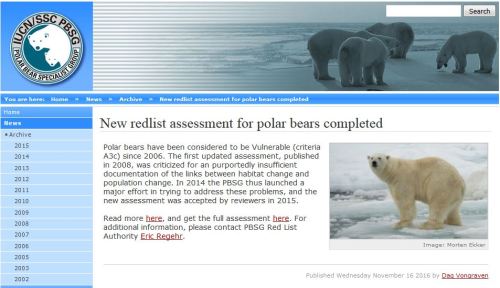
pbsg-website-redlist-news-notice_2016-nov-16

Yes, pretty much exactly what I suggested in January. I’d hazard a guess I wasn’t the only one complaining.

Continue reading

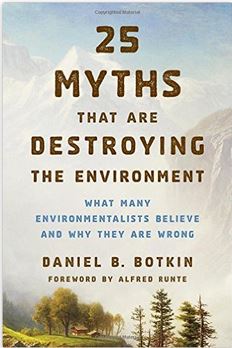
New ecology book: 25 MYTHS THAT ARE DESTROYING THE ENVIRONMENT

Veteran Yale University research ecologist Dan Botkin has a new book coming out tomorrow (Saturday 15 October) that you might want to look at:

botkin-2017-25-myths-cover

A number of chapters are relevant to polar bears, including these three:

“Myth 11: Without Human Interference, Earth’s Climate is Stable”

“Myth 13: Climate Change Will Lead to Huge Numbers of Extinctions”

“Myth 25: Compared to Climate Change, All Other Environmental Issues Are Minor”

I found the book clearly written in a readable style (Table of Contents here). It provides timely insight into critical issues related to conservation and species extinction, with many real-world examples that counter theoretical assumptions (polar bears are discussed in the Overview). I found the energy issues (Myths 23 and 24) an awkward distraction but others might find them of interest. It’s a good companion to Bjorn Lomborg’s The Skeptical Environmentalist (an excellent reference from 2001 but much more detailed).

Pre-0rders now being taken:

Twenty-five Myths That Are Destroying the Environment: What Many Environmentalists Believe and Why They Are Wrong. Daniel B. Botkin 2017. Rowman & Littlefield Publishers, Inc., Lanham, MD 20706. $12.71 PAPERBACK; $7.51 KINDLE

Peak inside via Amazon, more about Dan Botkin and his publication record, and the book below.

Continue reading

Arctic sea ice grows & Churchill polar bears into their 4th month of fasting

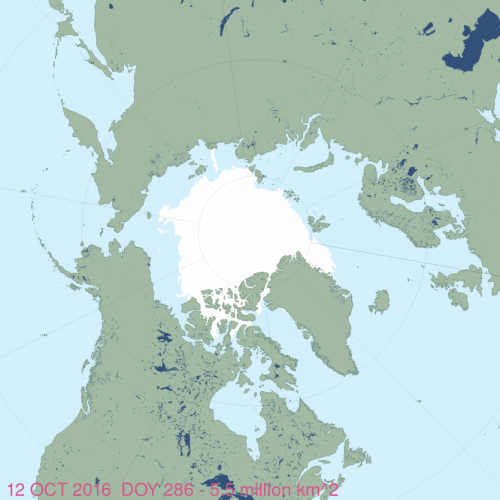
A quiet year for problems in the polar bear capital of the world (Churchill, Manitoba) so far – despite this year tying for the second-lowest minimum since 1979 – and the ice is growing fast. In fact, Arctic ice growth in the second half of September was rapid and there is now more ice than there was at this date in 2007 and 2012 (when polar bears in those regions considered most at risk did not die off in droves).

masie_all_zoom_4km-2016-oct-12

Pessimistic polar bear specialists are wrong  – polar bears are much more resilient to low sea ice levels in summer than they assume: their own data from low summer ice years proves it.  If you’ll recall from my previous post, polar bears seem to have barely survived the extensive sea ice coverage during the Last Glacial Maximum – in other words, too much ice (even over the short term) is their biggest threat. Polar bear numbers, as confirmed by the latest estimates in the 2015 IUCN Red List assessment, are higher now than they have been since the 1960s, despite almost 10 years of summer sea ice minimums below 5.0 mk2.

Churchill Polar Bear Alert reports and Arctic sea ice comparisons at this date, in detail below.

Continue reading