Category Archives: Conservation Status

Polar bear researchers – are they protecting the bears or their own jobs?

Poor polar bear researchers: there are few full time jobs worldwide and research is underfunded.

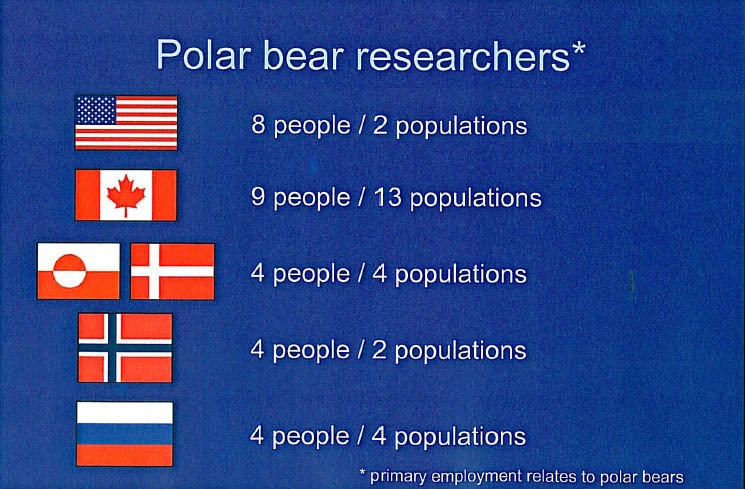
This is not my opinion but the facts according to Andrew Derocher and Ian Stirling (2011) — see Fig. 1 and 2 below. I do not dispute them.

Figure 1. The distribution of full-time polar bear researchers worldwide. Graduate students carry out much of the field work, funded by research grants – but eventually, they are going to want full-time jobs too. Where will the money come from? From Derocher and Stirling 2011. Slide 8 from “Conservation status, monitoring, and information gaps.” Invited speaker presentation to the 2011 Polar Bear Meeting in Nunavut, USA contingent. Oct 24-26, 2011.

Figure 1. The distribution of full-time polar bear researchers worldwide. From Derocher and Stirling 2011, invited speaker presentation to the 2011 Polar Bear Meeting in Nunavut, Oct 24-26.

Figure 2. The sad state of polar bear research. From Derocher and Stirling 2011. Slide from “Conservation status, monitoring, and information gaps.” Invited speaker presentation to the 2011 Polar Bear Meeting in Nunavut, USA contingent. Oct 24-26, 2011.

Figure 2. The sad state of polar bear research. From Derocher and Stirling 2011, Invited speaker presentation to the 2011 Polar Bear Meeting in Nunavut, Oct 24-26.

Since Derocher and Stirling have raised the issue, I contend it’s perfectly valid to ask: are polar bear biologists who proclaim their heartfelt fear for the future of polar bears at every opportunity behaving as advocates for polar bears or protecting their own careers?

Continue reading

Canada again under international pressure to list polar bears as threatened

There was a story in The Guardian on Friday (November 21) about an issue I covered earlier this year (in January): Canada under international pressure to list polar bears as threatened, so far holds out.

This time, Suzanne Goldenberg’s headline proclaims “Canada’s refusal to protect polar bears comes under scrutiny.

The story is all about a petition filed by the ever-litigious Center for Biological Diversity (CBD) to the North American free trade organization, the Commission for Environmental Co-operation (CEC), pdf here. The CEC, it seems, has now agreed to investigate the CBD claims.

At issue here is the fact that Canada hasn’t done exactly what the US has done in terms of enacting formal legislation to protect polar bears. Canada, home to 2/3’s of the worlds polar bears (as well as a relatively large Arctic human population) vs. the USA, with the fewest bears in the world but perhaps the loudest, “we know best” attitude. Canada has not declared polar bears to be a species threatened with extinction but the Center for Biological Diversity not only thinks otherwise but thinks someone should force Canada to change its opinion.

It’s more of the same bullying of governments by environmental groups that we’ve come to expect, aided and abetted by activist polar bear biologists.

That said, I suggest you brace yourselves: it’s only going to get worse. We can expect even more of this over the next few weeks, because an important international polar bear meeting is coming up in early December. I expect that the propaganda, aided by an all-too-willing-media, is going to get intense.  Continue reading

Polar bear cannibalism and sea ice, the spring of 1976

Remember Ian Stirling’s claim that late freeze up in Western Hudson Bay in 2009 was forcing polar bears to resort to cannibalism (here and here), with gut-wrenching images and video provided for the media? Or Steve Amstrup’s claim for a similar phenomenon in the Southern Beaufort in 2004?

I pointed out that Stirling’s claim was way overblown and that Amstrup’s incidents were almost certainly the result of heavy ice in the spring (not low ice in summer), similar to the heavy ice conditions and polar bear starvation documented in the same region back in 1974-1976.

It turns out that the heavy ice conditions documented in the Eastern Beaufort in the mid-1970s had much broader effects on polar bears and ringed seals than has been appreciated.
Continue reading

Lancaster Sound – a rarely-mentioned region with a large polar bear population

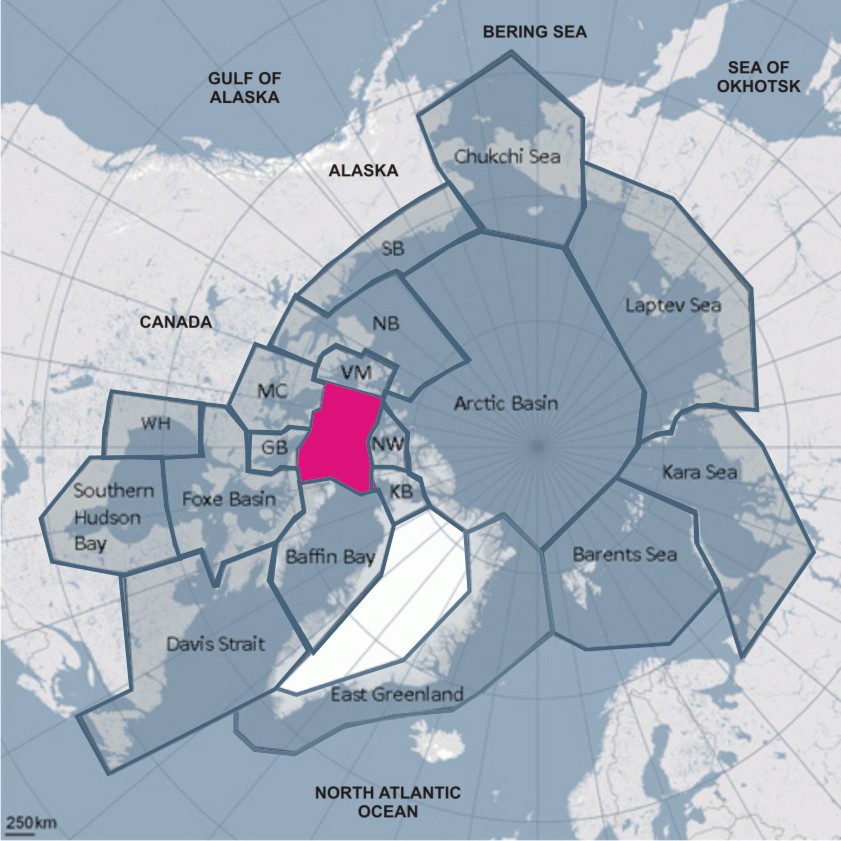
The polar bear subpopulation designated as Lancaster Sound lies at the eastern entrance to the Northwest Passage in the Canadian High Arctic (Fig.1). We rarely hear about it but this region has one of the largest polar bear populations anywhere in the Arctic – only the Barents Sea and Foxe Basin have higher estimated population sizes.

Figure 1. Lancaster Sound, magenta. Map courtesy Polar Bear Specialist Group, additional labels added.

Figure 1. Polar bear subpopulations with Lancaster Sound marked. Map courtesy IUCN Polar Bear Specialist Group, additional labels added.

Lancaster Sound includes the communities of Arctic Bay on northwestern Baffin Island and Resolute Bay on Cornwallis Island. Devon Island, which lies on the northern boundary, has no permanent communities, although two research stations are present (see here and here). A more detailed map showing the exact boundaries is available in Vongraven and Peacock (2011).

The eastern portion of Lancaster Sound is generally clear of ice by late summer (hence the Northwest Passage) but the western third of the region not only retains pack ice later in the season but some multiyear ice remains throughout the year.

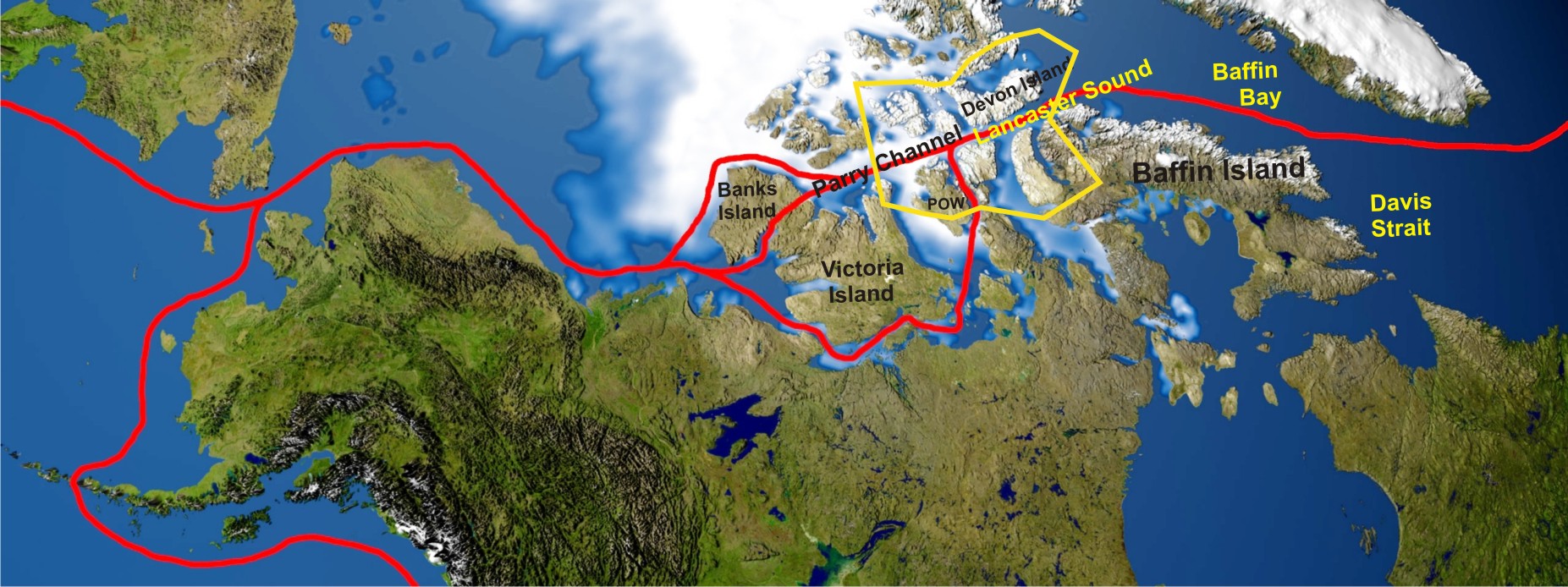
The proximity of Lancaster Sound to Baffin Bay and the eastern Northwest Passage (Fig.2) undoubtedly exposed polar bears there to hunting by European whalers during the 1800s and early 1900s (see previous post here, especially Fig. 5), from which the population appears to have recovered.

On the other hand, the proximity of Lancaster Sound to oil and gas reserves further north in the High Arctic generated much-needed funds for polar bear biologists in the mid-to-late 1970s to collect essential baseline data for the entire region (Schweinsburg et al. 1982; Stirling et al. 1979, 1984; Stirling and Latour 1978).

Figure 2. The main Northwest Passage route starts at Lancaster Sound and runs east through Parry Channel because these waterways routinely clear of ice in late summer. The approximate boundary of the Lancaster Sound polar bear subpopulation (area ~490,000 km2) is marked in yellow; POW is Prince of Wales Island. Map from Wikipedia, labels added.

Figure 2. The main Northwest Passage route starts at Lancaster Sound and runs east through Parry Channel because these waterways routinely clear of ice in late summer. The approximate boundary of the Lancaster Sound polar bear subpopulation is marked in yellow; POW is Prince of Wales Island. Map from Wikipedia, labels added. Click to enlarge.

Continue reading

Barents Sea polar bear status and sea ice declines

So far, I’ve not discussed the Barents Sea subpopulation in very much detail, except in comparison to other groups. For example, the Barents is considered to be the same type of sea ice “ecoregion” as the Chukchi Sea and the Southern Beaufort (discussed here). Previous studies on the Barents Sea polar bear population (Derocher 2005) indicate it may have recovered from extreme levels of overhunting (discussed here) and had stabilized, or was increasing very slowly, as early as 2002 (discussed here) — similar to what has happened in Davis Strait (discussed here).

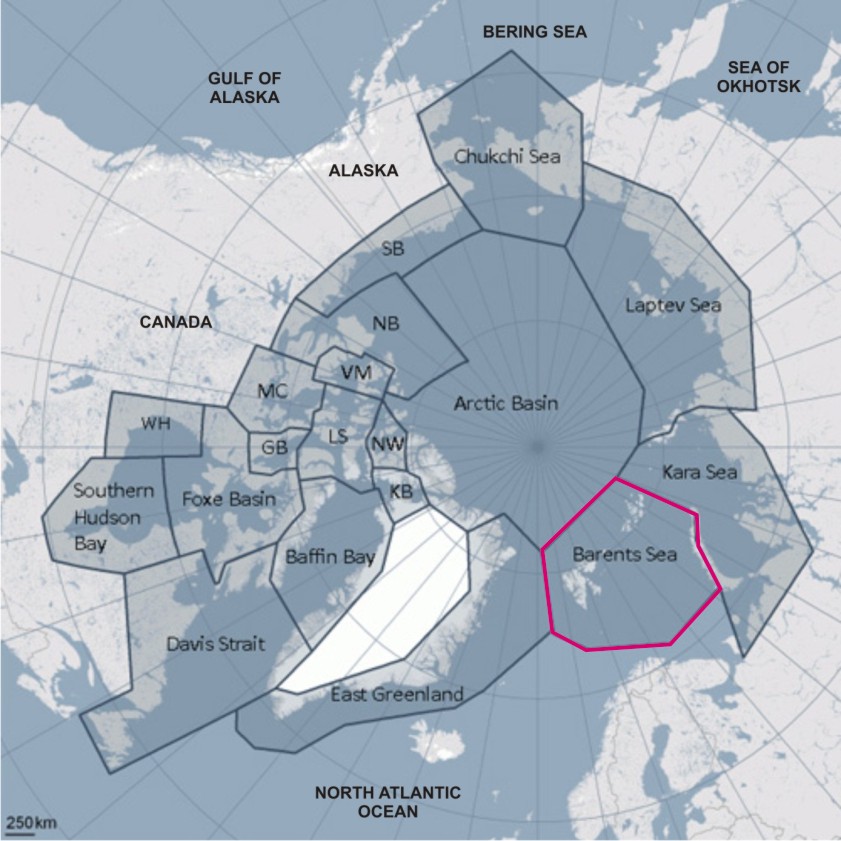
Figure 1. Polar bear subpopulations, with the Barents Sea region highlighted; map courtesy the IUCN Polar Bear Specialist Group (PBSG), extra labels added.

Figure 1. Polar bear subpopulations, with the Barents Sea region highlighted; map courtesy the IUCN Polar Bear Specialist Group (PBSG), extra labels added.

The most recent Barents Sea population estimate was done in 2004 (2,650; range ~1900-3600), based on an aerial survey (Aars et al. 2009). Aerial surveys are the only practical method of establishing population counts in regions like this where many bears never set foot on land. The previous estimate for the Barents (1982) was “2,000-5,000” but its accuracy was considered “poor” (discussed here).

The IUCN Polar Bear Specialist Group (PBSG), in their most recent report, lists the Barents Sea population as “data deficient” for status, current trend and estimated risk of decline within 10 years (Obbard et al. 2010:62, Table 1) and the “notes” for this entry say:

Population estimate is based on a new aerial survey. There was likely an increase in the subpopulation size after 1973 until recently. Current growth trend is unknown.

This 2004 estimate is now almost a decade old and potentially no longer an accurate representation of what’s happening in the Barents Sea. The most up-to-date information has not yet been published but it is available online. It’s eye-opening to say the least, if only that it appears to be yet another example of a polar bear population that is so far not showing signs of being harmed by sea ice declines, as I’ve discussed before (here).

[Update October 15, 2013: I’ve simplified the text discussion and figure regarding the Aars and Andersen denning study from the original posted]

Continue reading

Polar bears at Kaktovik, Alaska not stranded due to retreating ice

“I’ve lived here all my life and there are more bears every year. I read stories about polar bears being on the brink of extinction because of global warming, look out of my window and start to laugh.” Tori Sims, Kaktovik (Mail on Sunday, Sept. 28, 2013).

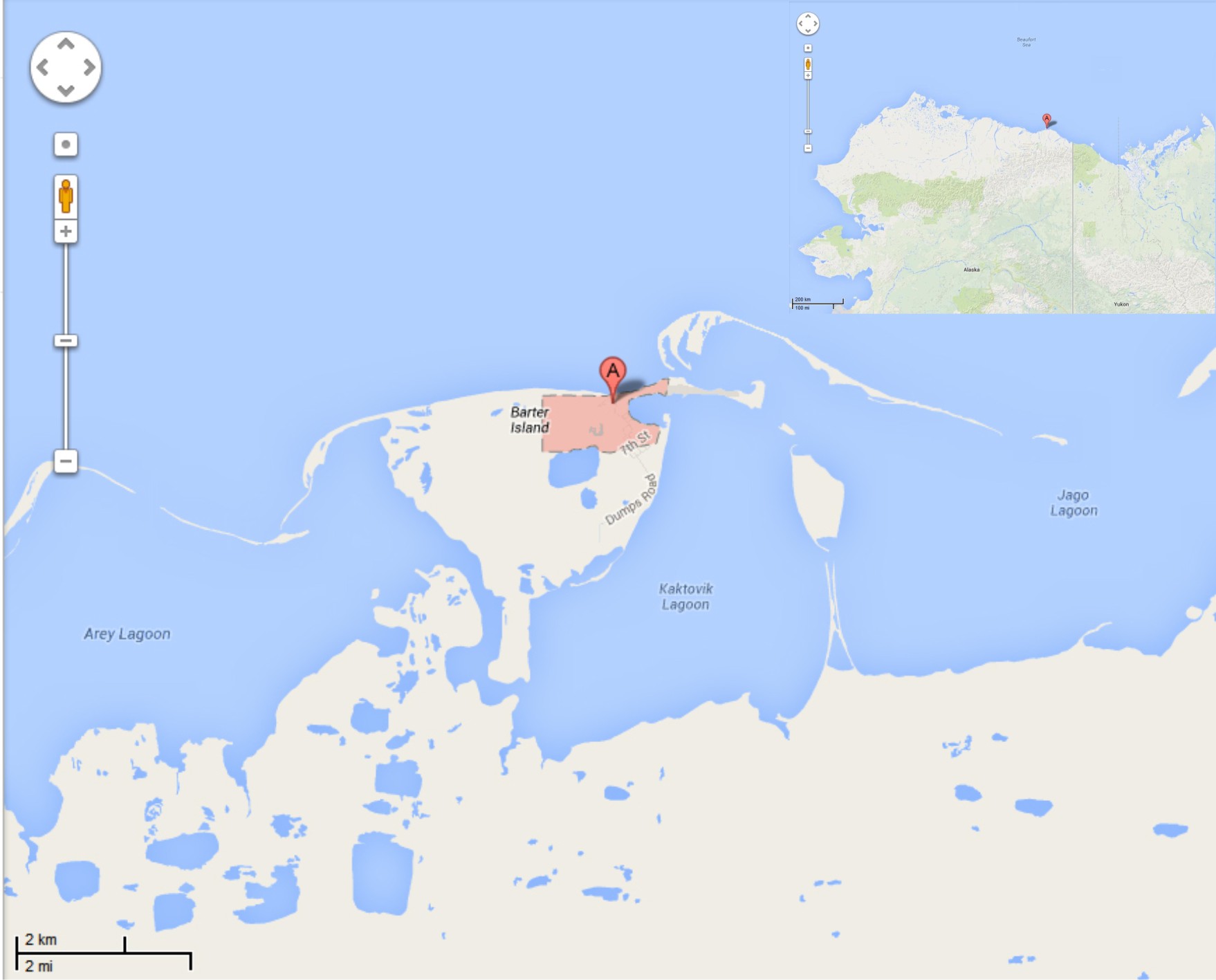
As you can see, Kaktovik is in the news again. This tiny community sits on the edge of the Beaufort Sea, on Barter Island on the North Slope of Alaska (Fig. 1). It lies within the Southern Beaufort polar bear subpopulation, which has been classified as “declining” by the IUCN Polar Bear Specialist Group (Obbard et al. 2010).

The determination of “declining” was based on a small dip in population numbers between 2001 and 2006 (not statistically significant), plus a decline in body size and condition, and smaller litter sizes documented between 1986 and 2006 (Rode et al. 2010). A new population survey is underway.

Figure 1. Kaktovik, Alaska, from Google maps.

Figure 1. Kaktovik, Alaska, from Google maps. Click to enlarge.

There have been suggestions that bears become “stranded” along the Alaska coast near Kaktovik because of retreating sea ice, and that more bears present in this area in recent years are an indication that they are in trouble due to global warming.

I’ve compiled some quotes, maps, and links to stories, photos and videos about Kaktovik polar bears to show that this claim is false.

Continue reading

What about the polar bears? Disconnect between predictions and observations

With all the talk this week about future climate – the global warming imagined by IPCC crystal ball models, that is – the focus for many is rightly on the gulf between predictions and observations that have taken place so far. This follows on reminders a few weeks ago of the many failed predictions that we would have seen an “ice-free Arctic” by now.

[by “ice-free” they mean “nearly ice-free,” or “when ice coverage is less than 1 million square kilometers, or about 386,000 square miles.”]

But what about the polar bears? Is there a similar disconnect between predictions and observations for polar bear survival? Yes, indeed.

Many Arctic biologists insist that polar bears are not just threatened by future global warming and a “melting ice cap.” They contend polar bears are already being harmed by declines in summer sea ice coverage, or will be shortly.

The problem is, the results of scientific studies show otherwise. Virtually all of the evidence generated by polar bear researchers shows that polar bears are not being harmed by declines in summer sea ice, and in some cases, they are doing very well indeed. In other words, they are not responding as expected.

A few weeks ago, I summarized these studies, which reveal that:

Less summer ice ≠ few bears (evidence from Davis Strait; S. Hudson Bay; Barents Sea; S. Beaufort; W. Hudson Bay).

Less summer ice ≠ “skinnier” bears (evidence from Chukchi Sea; S. Hudson Bay).

“Skinnier” bears ≠ fewer bears (evidence from S. Hudson Bay; S. Beaufort; Davis Strait).

Less summer ice ≠  lower cub survival (evidence from S. Hudson Bay; Chukchi Sea).

Less summer ice ≠ more cannibalism & hybridization

Have a look if you missed it (August 18, 2013, with pdf copies to download), “Polar bears have not been harmed by sea ice declines in summer – the evidence.”

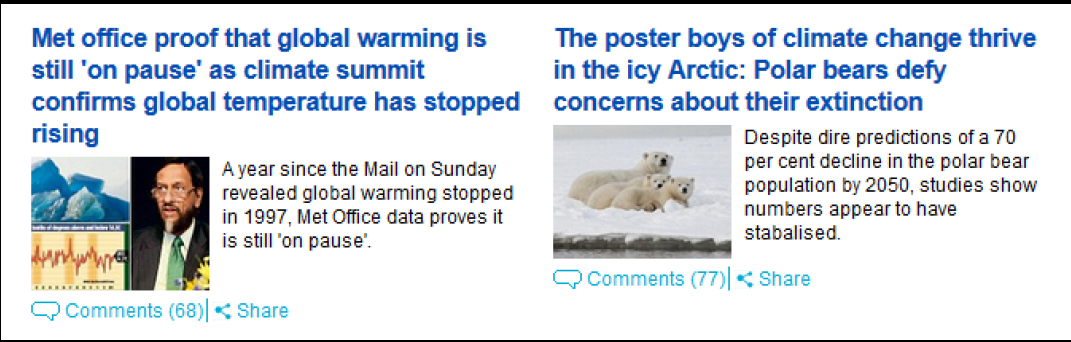
[Update Sunday Sept 29 2013: these two stories (on the temperature pause and polar bears thriving (in which I get a mention), just out in the Mail on Sunday (UK)]

Mail on Sunday_Temp pause and polar bears_Sept 29 2013

Record sea ice loss in 2007 had no effect on polar bears, Chukchi study confirms

One aspect of the recently published study on Chukchi Sea polar bears (Rode et al.2014 [now in print] 2013; see here and here) has not been stressed enough: their finding that the differences in overall condition between bears in the Chukchi and Southern Beaufort Seas came down to disparities in spring feeding opportunities and therefore, the condition of spring sea ice.

The fact that spring — not summer — is the most critical period for polar bears is something I’ve pointed out before (see here and here, for example) but it’s worth repeating at this time of year, when all eyes are on the annual ice minimum. It is often treated as a given that the decline in extent of summer sea ice in the Arctic since 1979 has been detrimental to polar bears. However, this is an assumption that we can now say is not supported by scientific evidence (see summary of that evidence here).

The results published by Rode et al. (2014 2013) not only add further support to the conclusion that declines in summer sea ice have not harmed polar bears, but should put the matter to rest – unless new evidence to the contrary is produced.

Chukchi bears, the report tells us, had more food available in the spring than Southern Beaufort bears (see map below) and this was the primary reason that bears were doing very well in the Chukchi and not quite as well in the Southern Beaufort. And because the polar bears for this study were captured and measured in mid-March to early May, from 2008 to 2011, they reflect spring-time conditions for 2008-2011 as well as year-round conditions from 2007 through 2010.

This means that the annual low ice extent for 2007 (record-breaking at the time), in the fall before this study began, had no discernible negative effect on either Chukchi or Southern Beaufort polar bears – and neither did similarly low annual minimums in two of the three remaining years of the study (Fig 1).

Figure 1. Sea ice extent at August 27, 2007 – the lowest extent that year (downloaded September 15, 2013 from IARC-JAXA, Arctic Sea-ice Monitor). At the time, it was the lowest extent recorded since 1979 (2012 broke that record). This (2007) was the fall before the Rode & Regehr study on Chukchi/Southern Beaufort polar bears began (2008-2011). The ice was almost as low in September 2008 and 2010, while 2009 was more like 2013.

Figure 1. Sea ice extent at August 27, 2007 – the lowest extent that year (downloaded September 15, 2013 from IARC-JAXA, Arctic Sea-ice Monitor). At the time, it was the lowest extent recorded since 1979 (2012 broke that record). This (2007) was the fall before the Rode & Regehr study on Chukchi/Southern Beaufort polar bears began (2008-2011). The ice was almost as low in 2008 and 2010, while 2009 was more like 2013.

Continue reading

How and why great news about Chukchi polar bears has been suppressed

A new peer-reviewed report (Rode et al. 2014 [in print] 2013, accepted), released last month (announced here), documents the fact that polar bears in the Chukchi Sea are doing better than virtually any other population studied, despite significant losses in summer sea ice over the last two decades – even though the Polar Bear Specialist Group (PBSG) said this population was declining (Obbard et al. 2010).
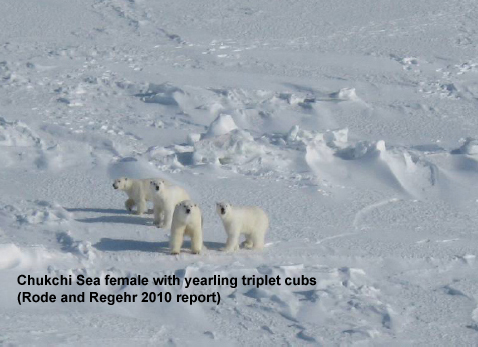
Rode and Regehr 2010_Chukchi_report2010_Fig1_triplets_labelled

Rather than this good news being shouted far and wide, what we’ve seen so far is a mere whisper. The strategy for suppressing the information appears to have several parts: make it hard to find; don’t actively publicize it; down-play the spectacularly good nature of the news; minimize how wrong they were; keep the focus on the future.

Something similar happened with the newly-published paper on Davis Strait bears (Peacock et al. 2013, discussed here and here) but the news there wasn’t quite so shockingly different from expected. The suppression of good news stands in marked contrast to anything with a hint of bad news, which gets reported around the world — for example, Andrew Derocher and colleagues and their prepare now to save polar bears” policy paper in February, 2013.

US Fish & Wildlife biologist Eric Regehr, co-investigator of the Chukchi study and co-author of the newly-published report, wrote an announcement about the paper. It wasn’t a real press release, since it was not actually sent to media outlets. It was a statement, with a brief summary of the paper, posted on a regional US Fish & Wildlife website, with no mention of lead author Karyn Rode. Not surprisingly, lack of active promotion = no media coverage.

The posted announcement also down-played how well the Chukchi bears are doing. In fact, the news documented in the paper is much better than any of them let on: Chukchi polar bears are doing better than virtually all other populations studied.

But Regehr also had to do some damage control to counter the evidence this paper contains of how wrong they had all been — not only about the Chukchi population today but about their predictions for polar bears in the future.

After all, the computer models used to predict a dire future for polar bears combined the Chukchi Sea with the Southern Beaufort, as having similar ice habitats (“ice ecoregions”). The published paper and Regehr’s statement now say these two regions are very different and that polar bear response to loss of sea ice is “complex” rather than a simple matter of less summer ice = harm to polar bears. Regehr goes on to say that polar bear scientists expected this would happen. I call total BS on this one, which I explain in full later (with a map).

Finally, Regehr’s statement emphasizes that good news for 1 subpopulation out of 19 today should not be celebrated because the overall future for polar bears — prophesied by computerized crystal balls — is bleak. Focus on the future, they say. Did they forget that for years they’ve been telling us that polar bears are already being harmed and that this foreshadows what’s to come? Now we have the results of yet another peer-reviewed study showing bears not being harmed by declines in summer ice (see the full list here).

So, in the end, all of this double-talk and contradiction is not just about suppressing this particular paper. There’s much more at stake.

The Rode et al. Chukchi paper is strong evidence that their predictions of a grim future for polar bears – based on theoretical responses to summer sea ice declines that should already be apparent – have been refuted by their own studies. It’s no wonder they want to keep the media away from this story.

Details below.  [Update September 11, 2013: another news outlet picks up the story, see Point 2 below]

Continue reading

Good news about Chukchi Sea polar bears whispered by US Fish & Wildlife Service

Just out: the “accepted” version of the Rode et al. paper discussed here last month — detailing just how well polar bears in the Chukchi Sea subpopulation are doing, despite recent declines in sea ice.

However, what was decidedly odd was how I found out about it.

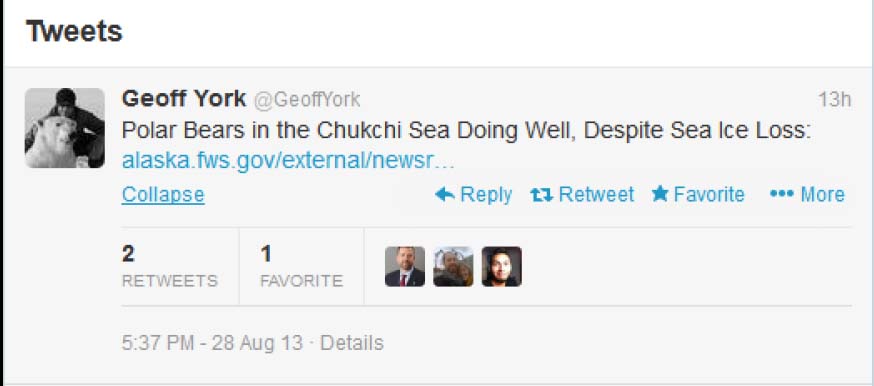
Yesterday (Aug 28), while looking for something else, I found a “press release” tweeted by World Wildlife Fund (WWF) employee Geoff York, who is now also a full voting member of the Polar Bear Specialist Group (PBSG).

Chukchi bears press release tweet_Geoff York Aug 28 2013

The announcement that York tweeted is listed as “alaska.fws.gov/external/newsroom/pdf/cs_polar_bear_article.pdf” and I found a stand-alone copy of the pdf with that title on Google.

However, FWS has so far (Aug. 29, 7:00 am PT) not mentioned this item on their [central] website, their twitter account, or their Facebook page (pdf here, with its original title). The “press release” has no date and is not on FWS letterhead but is authored by “Eric V. Regehr, U.S. Fish & Wildlife Service.” [I guess FWS employees can issue their own press releases?] UPDATE: Found it finally in the “FWS Alaska region” (Alaska FWS, posted Aug. 22, 2013, which included the Eric Regehr summary tweeted by York), via a news report at SitNews dated Aug. 27. Mystery solved]

Also odd that so far, no one except Geoff York himself seems to have picked it up (nothing so far on WWF website or Facebook page, Polar Bears International pages, or at ScienceDaily. [Update: see news report at SitNews dated Aug. 27. Still odd that the FWS report has been sitting there quietly since the 22nd (Thursday of last week)]

Not exactly how I’d choose to spread good news, but perhaps that’s the point.

Nevertheless, not too much new in the paper itself [contact me if you’d like a copy] – no population size estimate, for example – other than what I included in the summary provided last month (based on a March presentation by lead author Karyn Rode), except this: spring litter sizes [1.90 in 2007 and 2.17 in 2009 on Wrangel Island] were “are among the highest reported for 18 of 19 polar bear populations” and were similar to litter sizes 20 years earlier.

I guess the picture of the Chukchi female with a litter of triplet yearling cubs included without mention in the 2010 Rode and Regehr report (pdf here, copied below, discussed previously here) was significant after all.

Rode and Regehr 2010_Chukchi_report2010_Fig1_triplets_labelled

Continue reading