Category Archives: Life History

New paper provides no evidence that polar bears ate whale carcasses to survive Eemian interglacial

Contrary to what the misleading press release implies, an entirely speculative new paper by polar bear specialists Kristin Laidre and Ian Stirling (among others) presents zero evidence that polar bear consumed whale carcasses during the last warm Interglacial (Eemian, ca. 115-130kya). And contrary to the impression that Eemian conditions were very challenging for polar bears, simulations from the single paleo sea ice simulation paper these authors cite show the ice-free season over most of the Eemian was less severe than today in the polar basin, with no reason for polar bears to scavenge extensively on large whale carcasses.

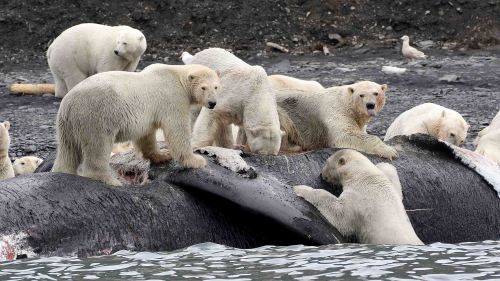
LaidreFEE_Wrangel Island scavenging_smaller

Polar bears are shown scavenging on the carcass of a dead bowhead whale that washed ashore on Wrangel Island, Russia. Credit: Chris Collins/Heritage Expeditions

This is yet another paper posing as science co-authored by Stirling that uses anecdotal accounts of behaviour to send a message about evolutionary capabilities of polar bears (Stirling and van Meurs 2015). With little or nothing to back it up, the paper’s real purpose is to convey Stirling’s opinion that past polar bear survival is irrelevant to understanding future polar bear survival — and that all the bears are gonna die unless we do something about carbon dioxide emissions generated by fossil fuel use.

Is it a coincidence that the Summary for Policy Makers was issued by the IPCC over the weekend (not the report with the science in it but the document that all politicians agreed were acceptable)? Look no further than the last sentence of National Geographic’s article on this story, which includes a quote from lead author Laidre and a link to the magazine’s interpretation of the new IPCC report:

“Laidre put it even more bluntly: “If you want polar bears around we need sea ice, and loss of sea ice closely tied to our activities and our fossil fuel emissions.” (Learn about the IPCC’s dire new climate report.)” 

Continue reading

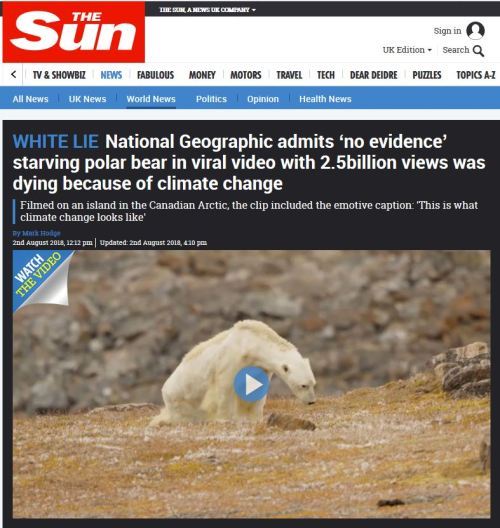
White Lie: Polar bear starvation is virtually never caused by sea ice loss

Starvation due to natural causes is the leading cause of death for polar bears and loss of body condition (getting thinner) is therefore the first symptom of impending death for virtually all polar bears that die naturally. However, polar bear specialist Andrew Derocher claims that loss of body condition is also the first symptom of climate change for polar bears.

white-lie_the-sun-on-ng-apology-2-aug-2018-headline.jpg

But how do you tell the difference between polar bears made thin by man-made climate change and those who are thin due to natural causes?

You can’t. Even a necropsy will not be conclusive because there are so many natural reasons for a bear to lose weight — and even starve to death — that’s it’s virtually impossible to say that any thin bear is skinny due to a lack of sea ice.

Emaciated polar bears like the one above from Somerset Island in the Canadian Arctic,1 captured on camera in August 2017, are being used to promote the idea that polar bears are already dying of starvation due to climate change. That’s a big white lie, as the headline above suggests: seven months later, National Geographic has admitted as much. Here I show why it could not have been true in the first place (with references from the scientific literature).

UPDATE: 29 August 2018: See my op-ed in the National Post (29 August 2018) and the GWPF video below on this issue:

Continue reading

Before National Geographic apologized for hyping the starving polar bear video they exploited it to promote a message of doom

Back in early February this year, National Geographic used their “this is what climate change looks like” video to promote a newly-published polar bear study and endorse conservation activist Steven Amstrup’s debunked and abandoned prediction of polar bear catastrophe due to global warming. Even with this revelation, the starving polar bear video fiasco is not yet over.
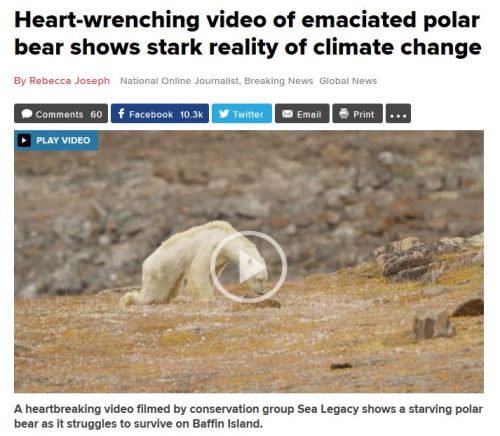
Baffin Island starving pb headline_GlobalNews_8 Dec 2017

Polar Bears Really Are Starving Because of Global Warming, Study Shows (National Geographic, 1 February 2018).

The initial focus of the February 2018 National Geographic article was a study published that week by Anthony Pagano and colleagues (Pagano et al. 2018; Whiteman 2018), suggesting that a few polar bears in the Southern Beaufort Sea were not getting enough to eat in early spring from 2014-2016 (with no reference to sea ice conditions; see my critique of that study here).

Then, Steven Amstrup, spokesman for activist organization Polar Bears International, is quoted as saying (my bold):

“If these results hold up [from Pagano’s study], then it shows that the loss of sea ice may have a bigger impact on the bears than previously thought, said Amstrup, a former USGS polar bear expert. Amstrup’s own 2010 study projected that continued decline in sea ice would reduce the global population of bears by two thirds, to less than 10,000 by 2050.

Seriously, no one except Amstrup and his Polar Bears International fanbase are citing his outlandish 2010 prediction, which is just a rehash of his 2007 USGS internal report and its 2008 journal version (Amstrup 2007, 2008, 2010). Amstrup’s prediction is not only a failure (Crockford 2017, 2018; Crockford and Geist 2018) but it’s been abandoned by his colleagues for vaguer or more moderate predictions of population decline (e.g. Atwood et al. 2015, 2016; Regehr et al. 2016).

National Geographic has now apologized for saying that the emaciated bear in the SeaLegacy video they so heavily promoted was “what climate change looks like” (and replaced the caption with “this is what starvation looks like,” even though there is no evidence the bear was starving from lack of food rather than from severe illness).

But the damage is done. By endorsing the discredited polar bear survival predictions of Amstrup along with the video, National Geographic degraded itself even further in the eyes of rational and informed readers. I’ll have more to say on the SeaLegacy video exploited by National Geographic and its message that starving polar bears are victims of climate change in a subsequent post: we haven’t yet reached the end of this debacle.

References

Amstrup, S.C., Marcot, B.G. & Douglas, D.C. 2007. Forecasting the rangewide status of polar bears at selected times in the 21st century. US Geological Survey. Reston, VA. Pdf here

Amstrup, S.C., Marcot, B.G., Douglas, D.C. 2008. A Bayesian network modeling approach to forecasting the 21st century worldwide status of polar bears. Pgs. 213-268 in Arctic Sea Ice Decline: Observations, Projections, Mechanisms, and Implications, E.T. DeWeaver, C.M. Bitz, and L.B. Tremblay (eds.). Geophysical Monograph 180. American Geophysical Union, Washington, D.C. http://onlinelibrary.wiley.com/doi/10.1029/180GM14/summary and http://alaska.usgs.gov/science/biology/polar_bears/pubs.html

Atwood, T.C., Marcot, B.G., Douglas,D.C., Amstrup, S.C., Rode, K.D., Durner, G.M. and Bromaghin, J.F. 2015. Evaluating and ranking threats to the long-term persistence of polar bears. USGS Open-File Report 2014–1254. Pdf here.

Atwood, T.C., Marcot, B.G., Douglas, D.C., Amstrup, S.C., Rode, K.D., Durner, G.M. et al. 2016. Forecasting the relative influence of environmental and anthropogenic stressors on polar bears. Ecosphere, 7(6), e01370.

Crockford, S.J. 2017. Testing the hypothesis that routine sea ice coverage of 3-5 mkm2 results in a greater than 30% decline in population size of polar bears (Ursus maritimus). PeerJ Preprints 2 March 2017. Doi: 10.7287/peerj.preprints.2737v3 Open access. https://doi.org/10.7287/peerj.preprints.2737v3

Crockford, S.J. 2018. State of the Polar Bear Report 2017. Global Warming Policy Foundation Report #29. London. pdf here.

Crockford, S.J. and Geist, V. 2018. Conservation Fiasco. Range Magazine, Winter 2017/2018, pg. 26-27. Pdf here.

Pagano, A.M., Durner, G.M., Rode, K.D., Atwood, T.C., Atkinson, S.N., Peacock, E., Costa, D.P., Owen, M.A. and Williams, T.M. 2018. High-energy, high-fat lifestyle challenges an Arctic apex predator, the polar bear. Science 359 (6375): 568 DOI: 10.1126/science.aan8677

Whiteman, J.P. 2018. Out of balance in the Arctic. Science 359 (6375):514-515. http://science.sciencemag.org/content/359/6375/514

Sea ice silly season: Wadhams spouts fake facts about polar bears of northern Greenland

As the seasonal minimum for Arctic sea ice approaches, the media get carried away by hyperbole. Tha’t been true since 2007. This year, other outlets will need to work hard to beat yesterday’s bit of nonsense from The Independent trying to out-do The Guardian: it not only includes false polar bear facts (from sea ice researcher Peter Wadhams) but leads with last year’s controversial SeaLegacy video of an emaciated polar bear. Sea ice silly season has truly begun.

East Greenland Scorsby Sound March 2011 on Kap Tobin_Rune Dietz_press photo

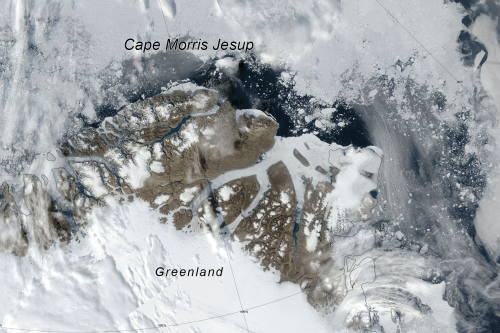
Wadhams (described as “one of the UK’s leading sea ice scientists” although not a particularly respected one) was interviewed about the small area of open water that opened up over the last few days in northern Greenland (see NSIDC photo below), driven by offshore winds (not melt). This region is the eastern-most part of the area that is considered the “last holdout” for Arctic sea ice: an immense band of very thick (4-20m) multiyear ice that stretches across the Arctic Ocean shores of the Canadian Arctic Archipelago.

The open water is expected to last a few days at most but Wadhams was absolutely breathless with dire warnings of what this might mean for the future of polar bear in the region (about which he knows nothing), rhetoric ramped up even further by the news outlet with quotes from co-director of the Grantham Institute (London), Martin Siegert, and predictions on how low the sea ice minimum might be.

Greenland north open water_13 Aug 2018 NASA_NSIDC 15 Aug 2018 report

Cape Morris Jesup on 13 August 2018. W. Meier, NSIDC/NASA.

I think this is a truly spectacular example of the ignorance of scientists speaking outside their area of expertise used to mislead the public but decide for yourself.

Continue reading

Busy week for Churchill Polar Bear Alert Program in week 6, more problems than 2017

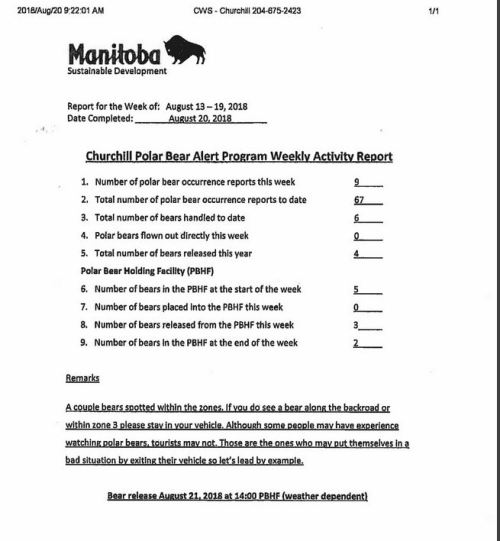
The Churchill Polar Bear Alert program has been busy in week 6 (Aug.13-19), with 67 occurrences to date: slower than last year but not quite as brisk as 2016. Some bears have already been released from the holding cells of “polar bear jail,” transported outside of Churchill and marked with a green dot to identify them as problem bears to residents of communities further north.

churchill-pb-reports_week-6_-aug-13-19-2018.jpg

Compare the above to other years below, as welll as weeks 4 and 5. Previous weeks here and here.

Continue reading

Brace yourself: more starving polar bear news stories in the pipeline from Svalbard

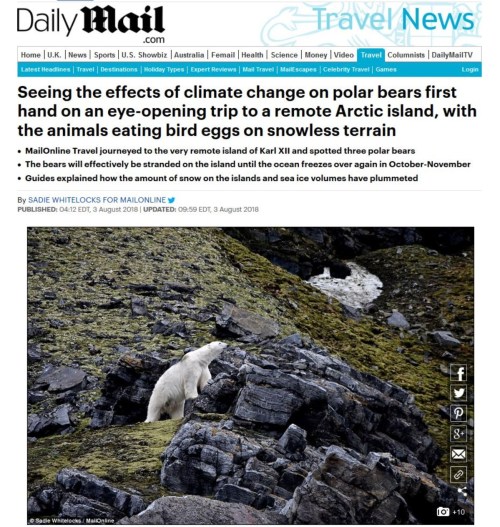
A few polar bears have become stranded on small islands north of Svalbard since the local sea ice retreated — of which the bear that mauled a cruise ship guard last month was but one — and if return of the ice is as late as last year, those handful of bears are likely doomed to die of starvation. This is not due to climate change but rather bad judgment on the part of these few bears. They were not forced ashore: if they’d stayed on the ice like the rest of the population, they’d have likely been just fine.

Daily Mail stranded bear headline_3 Aug 2018 all

Similar to the bear in northwestern Hudson Bay that fatally mauled a young father in early July, these bears were likely lured ashore by the prospect of masses of bird eggs present on island rookeries. But they overstayed their window of opportunity and the ice retreated without them.

Fledgling birds and bird eggs are not replacements for seals in a bear’s diet but when the season of easy seal kills winds down, as it does in late spring, easy-picking sea bird eggs may be enticing enough to lure a few bears ashore when they’d be better off on the ice.

That is not the fault of climate change.

Unlike bears in Hudson Bay and many other regions — including the Lancaster Sound area of Canada where the National Geographic “starving” bear was filmed last summer — these bears were not forced ashore by retreating ice: they chose to do so.
Continue reading

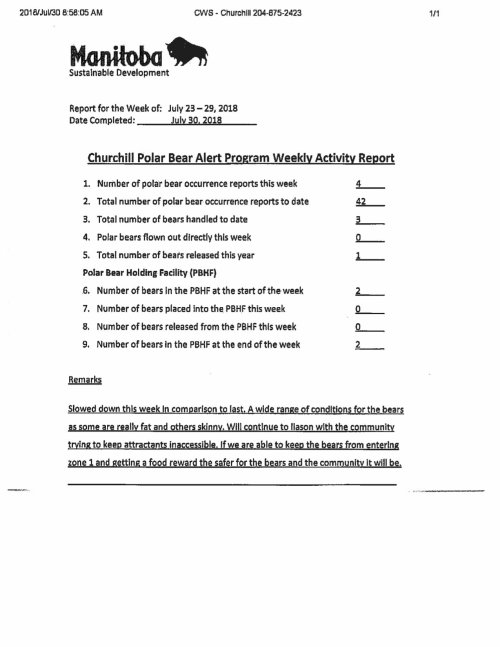
Churchill problem polar bear report for week 3, July 23-29 2018

Polar bears that have come off the sea ice of Hudson Bay near Churchill, Manitoba in Western Hudson Bay are apparently in a wide variety of conditions, from very fat to skinny.  So, not all skinny despite the relatively early breakup of ice in the northwest.

Churchill PB reports_week 3_ July 23-29_July 2018

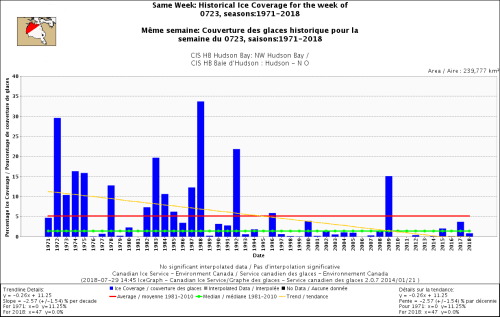
Most of the ice was gone from the NW of Hudson Bay for the week of 23 July 2018 and the graph below shows that this is a new pattern that began in 1997, with only 2009 being an outlier:

Hudson Bay NW same week_ ice coverage 23 July 1971-2018 with trend

Continue reading

Tracking polar bears in the Beaufort Sea May and June updates

At the end of June, there were nine bears remaining from the original 14 that were tagged with glue-on ear transmittors in April 2018 near Kaktovik, Alaska by US Geological Survey biologists.

putting_collar_on_polar_bear_slider_USGS

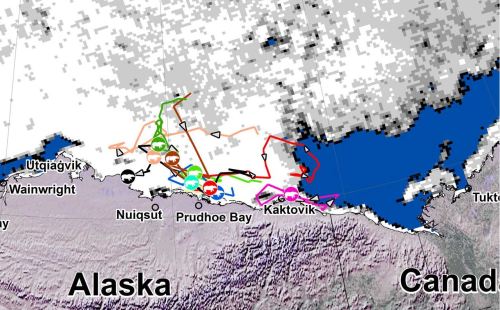
Below is the June 2018 tracking map (high resolution image is here):

Beaufort tracking USGS bear-movements-June 2018 sm

Original caption: “Movements of 9 satellite-tagged polar bears for the month of June, 2018. These bears received satellite eartag transmitters in 2018 on the spring-time sea ice of the southern Beaufort Sea. Polar bear satellite telemetry data are shown with AMSR2 remotely-sensed ice coverage for 30 June, 2018.”

See the close-up for June 2018 below:

Beaufort tracking USGS bear-movements-June 2018 closeup

As ear tags are notoriously short-lived, there may not be any remaining by the end of July but if there are, I will post the tracks. The map for May 2018 is below.
Continue reading

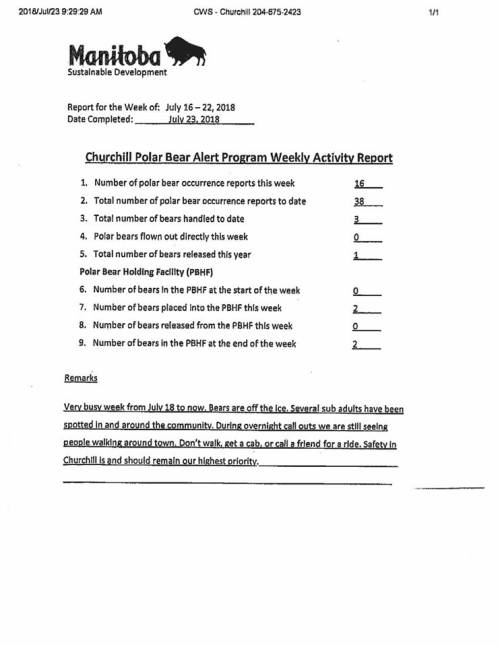
Churchill area polar bears off the ice as of third week in July say problem bear reports

Second week of Polar Bear Alert Activity reports (16-22 July) for 2018 and already two bears are in jail, making it the busiest 3rd week in July since 2015:

churchill-pb-reports_week-2_-july-16-22_july-2018-e1532401430601.jpg

Continue reading

New information on the fatal polar bear attack at Arviat, Western Hudson Bay

Additional information is available regarding the fatal mauling of a young Arviat father two weeks ago that may answer the question of why the bear left the Hudson Bay sea ice well before it was necessary. Was it lack of sea ice (blamed on global warming), as biologist Ian Stirling recently insisted — or did natural food attractants lure the bear ashore prematurely?

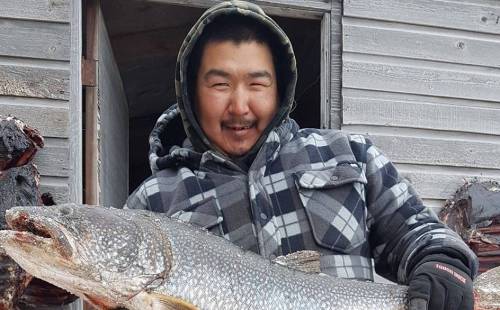
Aaron Gibbons_fishing_Gibbons family photo

I would also like to appeal to readers to consider a donation to the Go Fund Me campaign set up to support the widow and children of Aaron Gibbons, who was only 31 years old. So far, there has not been an overwhelming response (less than 1/2 of the modest goal of $5,000 met after two weeks) and that saddens me deeply.

I have contributed myself but each individual can only do so much. Imagine losing your spouse in this most vicious manner (the children witnessed the attack and were the ones that called for help) and think of the challenges of healing your family and keeping it afloat financially. Please see the GO FUND ME page and contribute if you can.

What I’ve learned over the last week is that the polar bear that killed Aaron Gibbons was a big male in poor condition but he was not the only bear onshore at the time. In addition, the Arctic tern nesting colony on Sentry Island was undoubtedly an enticing natural attractant that seems to have encouraged these bears to leave the ice far north of where they might otherwise have come ashore.

UPDATE 20 July 2018: I’ve added the most recent (19 July) map of collared WH polar bear locations on Hudson Bay to the “Condition of the Sea Ice” discussion below. Also, I am pleased to see that the GO FUND ME campaign has now gone above the half-way mark (~$2800.00 as of 2:00 PM Pacific time). My personal thanks to every one who was able to contribute. I hope to see the goal reached within the next few days.

UPDATE 6 September 2018: A news announcement today revealed that the necropsy done on the bear that attacked Aaron Gibbons was an adult male in “fair” condition (thin but not skinny). See my report here and the news story here. And I’m pleased to report that the GoFundMe goal of $5000 for Aaron’s family has been reached: thanks to all PolarBearScience readers for their support.
Continue reading