Category Archives: Life History

Amstrup’s comment on his starving polar bear article and my response

Steve Amstrup has left a comment below his January 20, 2014 “starving polar bears’ article at The Conversation, which I discussed in my last post.

I’ve copied his comment below and the response to his comment that I left this morning, which is copied below his. See the entire comment sequence here.
Continue reading

Polar bear gives birth in Munich zoo, with photos and video

Fabulous photos of 3 week old twin polar bear cubs (born December 9, 2013), have been released by the Hellabrunn Zoo in Munich, Germany. There’s video of the births as well. The newborn cubs are so tiny  — it’s hard to imagine them being born in the dead of winter in a snow den!

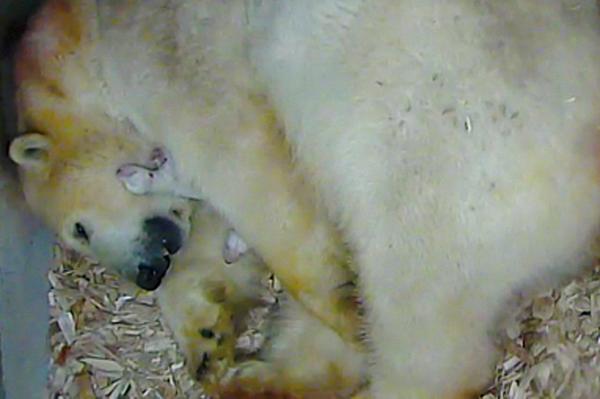
PB newborn with mother Munich Zoo Dec 2013

All but one of the photos shown here, including the one above, are of the newborns at 3 weeks of age. The one below is a screen cap taken from the video of the birth, and is the only one that shows the cubs just hours old. They seem to have grown a bit in 3 weeks.

PB newborns birth_11PolarBearTwins2_Zoo screen cap

From this January 1, 2014 account (Hellabrunn Zoo Welcomes Polar Bear Twins”):

“On December 9, a Polar Bear named Giovanna gave birth to two cubs at Munich’s Hellabrunn Zoo. Both births were seen on cameras installed in the birthing den and the connecting corridor to the main den. This is remarkable on two counts: for both births, Giovanna positioned herself so that she was directly in the cameras’ field of view. Secondly, this is the first time that a Polar Bear birth has been filmed in color worldwide!

The cubs were born at 08:39 and 09:43 respectively, to parents Giovanna (7) and Yogi (14). The zoo’s director, Dr. Andreas Knieriem, enthused, “It is as if we were there live watching the labour and birth of a Polar Bear and, as if that weren’t enough, Giovanna showed us not one, but two very different births!”

Continue reading

Polar bears in winter: starving bears and attacks on humans

Winter in the Arctic can be a tough time for polar bears. Between the cold, darkness and ever-thickening sea ice with fewer open leads, polar bears often find that seals are hard to come by.

So it should not be surprising to find out that polar bears are at their lowest body weight at the end of winter (Ramsay and Stirling 1988:613; Stirling 2002:68).

In other words, polar bears lose weight over the winter – not just during the ice-free summer period. That’s why the spring and early summer feeding period is so critical: gorging on young seals rebuilds the polar bears’ fat reserves lost over the winter and packs on even more fat to tide them over the late summer/early fall ice-free period.

Last fall, a potentially serious attack by a polar bear on a Churchill, Manitoba resident on Hallowe’en night (early hours of November 1) got a lot of attention worldwide. Some media outlets suggested that the bear involved in this attack was either starving or so hungry that he was driven to attack. However, this assertion was not supported by any evidence — we simply don’t know whether he was in poor condition or not. While the bear was undoubtedly leaner at the end of October than he was in July, that doesn’t mean he was actually ‘starving.’

So, here’s the question: given that polar bears have a tough time finding seals to eat during the dark and cold Arctic winter and are presumably at their hungriest then, do serious polar bear attacks on humans also happen in winter?
Continue reading

Tracking polar bears in the Beaufort Sea: December map

Here is the December 2013 follow-up to my post on the July track map for female polar bears being followed by satellite in the Beaufort Sea by the US Geological Survey (USGS) – Ten out of ten polar bears being tracked this summer in the Beaufort Sea are on the ice.

See that post for methods and other background on this topic, and some track maps from 2012 (also available at the USGS website here).

The track map for December 2013 is copied below (Figure 1).

There has been little change from November: six of the bears that were being tracked in October were still present (down from ten in July) and one bear that went Arctic walkabout in October has returned and is still in the area. The same seven bears present in November were still being tracked in December but did not move very much. Continue reading

Polar bear winter: a spectacular Northern Lights video from Finland

polar bear aurora_borealis_3-t2 freeWith the winter darkness in the Arctic comes the splendor of the Northern Lights — Aurora Borealis.

Yesterday, a short video clip of photographer Thomas Kast’s time-lapse Northern Lights video “Aurora – Queen of the Night” was posted at Alaska Dispatch, Time-lapse images show northern lights over Finland. There are no polar bears in the film but it is evocative of Arctic landscapes this time of year — when only the Northern Lights and the moon brighten the sky: Continue reading

Kaktovik polar bear photos, again no “starving” bears

A Southern Beaufort female with cubs, from the fall of 2007. Note how fat they all are.

A Southern Beaufort female with cubs, from the fall of 2007.
Note the non-starving condition.

Twenty-one amazing photos of polar bears feasting on the remains of a bowhead whale carcass outside of Kaktovik, Alaska, taken by wildlife photographer Michal Tyl, have been posted by the UK Daily Mail (December 12, 2013): Now that’s what you call a spare rib! Pack of bloody-faced polar bears spend day and night stripping a beached whale to its bones.”  Have a look and see if you can spot any “starving” bears! 

What you will see is the relative size of the bears: notice how much larger males are than females, how small cubs-of-the-year are relative to big males. Oh, and notice all the big fat polar bear butts. I can’t include any of the photos here because of copyright rules (the one above is from 2007) but I have included a map showing the location of Kaktovik, a quote from the article, and a link to my previous post on Kaktovik bears, which has a wealth of background information. Continue reading

Hudson Bay freeze-up has not been a day later each year since 1981

[Update Nov. 23, 2013: I’ve added a few comments, noted, in the text]

This is a follow-up to an earlier post, Polar bear problems in N Hudson Bay not due to late freeze-up, to counter some misinformation that’s being circulated about the history of Hudson Bay freeze-up dates.

Polar bear biologists working in Western Hudson Bay published new definitions of breakup and freeze-up earlier this year. The new method better reflects how polar bears interact with seasonal changes in sea ice on the bay.

Formerly, 50% ice coverage levels were used to assign the date when major ice change phenomena were reached each year (breakup in summer, freeze-up in fall (e.g. Gagnon and Gough 2005). The new method (Cherry et al. 2013, see discussion here) defines breakup at 30% ice coverage and freeze-up at 10%.

Cherry and colleagues had a fairly complicated method of defining 30% coverage for breakup in Western Hudson Bay. However, freeze-up in the fall is much simpler because ice always forms first along the western shore, starting in the north.

This means that the weekly graphs of ice development provided by the Canadian Ice Service for Hudson Bay, which are expressed as a percentage (just like the Cherry et al. study), can be used to compare freeze-up dates historically.

These graphs refute the absurd claim that freeze-up on Hudson Bay has been “one day later each year” over the last 30 years – an assertion repeated just the other day at PBI. Let’s take a closer look, shall we?
Continue reading

Polar bear problems in N Hudson Bay not due to late freeze-up

The myth that northern Hudson Bay communities are having problems with polar bears this year because freeze-up is later than usual just won’t go away.

I discussed the well publicized craziness in Churchill last week (here and here), but there’s more. Polar bears are already leaving the shore of Northern Hudson Bay as the ice rapidly forms but I saw a story yesterday (dated late last week) that quoted a local official in Repulse Bay blaming their polar bear problems on late freeze-up.

I’ve written before about the peer-reviewed paper by polar bear researchers Seth Cherry and colleagues published earlier this year on breakup and freeze-up dates between 1991 and 2009. But perhaps the freeze-up data needs more emphasis. I’ve copied that graph again below, with notes, and added some ice maps. See for yourself.

Bottom line: A “late freeze-up” for northwestern Hudson Bay occurs when ice formation is delayed until early December or beyond. Freeze-up was nowhere near “late” this year, nor was the ice “slow to freeze.” It wasn’t last year either.
Continue reading

Amstrup compares climate change to a Titanic for polar bears

Steven Amstrup, spokesperson for Polar Bears International, has ramped up his “save the polar bear” rhetoric over last week’s nonsense.

Last night (November 13), the NBC News online story (here) that accompanied their evening news clip (h/t DB) included this appalling analogy:

“…Amstrup said greenhouse gases created by humans threaten future generations of bears by threatening their ice. He said he likes to compare climate change’s effect on polar bears to the infamous Titanic ocean liner.

“[It] didn’t matter how many people were on the Titanic or how well they were doing,” he said. “When the Titanic slipped beneath the waves and they lost their habitat, that was it. So polar bears will also go away because of their dependence on sea ice.” [my bold]

Amstrup really wants people to believe that all the polar bears in the world will die some day, all at once, in some mega ice-loss catastrophe!
Continue reading

Tracking polar bears in the Beaufort Sea: October map

Here is the October follow-up to my post on the July track map for female polar bears being followed by satellite in the Beaufort Sea by the US Geological Survey (USGS) – Ten out of ten polar bears being tracked this summer in the Beaufort Sea are on the ice. See that post for methods and other background on this topic, and some track maps from 2012 (also available at the USGS website here).

The track map for October is copied below (Figure 1).

By the end of October, ice reached the coast in several areas. The ten bears from July were down to seven – their collars might have stopped working or fallen off (most likely), they might have left the area entirely (also possible) or they might have died (the researchers don’t say which).
Continue reading