Category Archives: Sea ice habitat

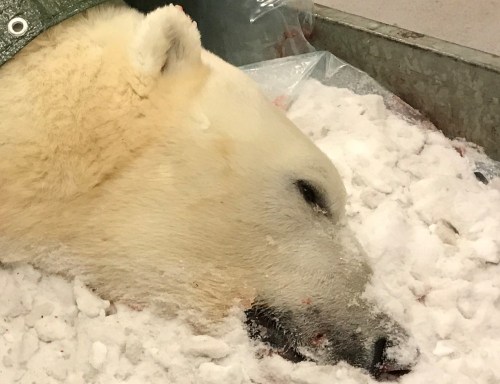
Fat adult polar bear shot in Svalbard New Years Eve after persistent visits to Longyearbyen

Another rare winter visit by a polar bear on New Year’s Eve, this time in Svalbard, comes with far more detail than the sighting in Newfoundland that I wrote about yesterday.

Svalbard 7 yr old male polar_bear shot 31 Dec 2019_photo_sysselmannen

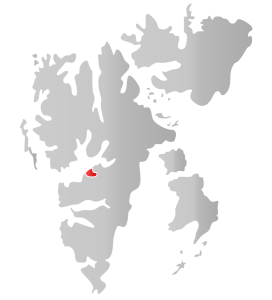
The Svalbard problem bear was shot over safety concerns after repeated visits to the downtown streets of the main town of Longyearbyen on the west coast (see map below). Neither of the reports bothered to mention that this was not a starving juvenile bear but a fat, healthy young adult – and no one blamed global warming for the incident because Svalbard has had extensive ice on the west coast this fall for the first time since 2010. The shooting of course sparked an outburst of social media outrage.
Longyearbyen_location_Wikipedia

UPDATED 16 January 2020: As I predicted would happen (see below), there has been another polar bear incident about 10 km outside of Longyearbyen in Bolterdalen. On Wednesday 15 January, a bear attacked a dogteam loaded with tourists near the end of their trip. The bear was advancing so fast there was no time for the driver to grab his rifle, so he used the heavy rope used to brake the sled to hit the bear across the muzzle several times. This stopped the attack and made the bear run off.  Svalbard officials are now chasing the bear well out of the area. From this report:

“Starinsky, a guide for Green Dog Svalbard, located about 10 kilometers east of Longyearbyen, told the newspaper there was no time to grab his rifle as they stopped the sleds within seconds, and the bear got within yards of a sled carrying a mother and her daughter. He grabbed “the first and best” thing he could think of – the noose-shaped brake rope hanging on the front of his sled.”

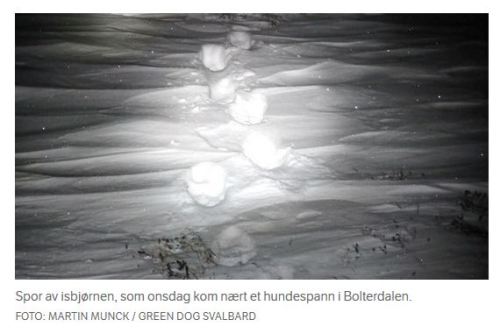
It turns out the bear’s tracks were spotted the day before just south of town. All that remains of the attack are the tracks of the bear near the dog kennel, below, and the nightmares of the people involved in the days ahead. They were very lucky indeed.

Svalbard polar bear encounter 15 Jan 2020_footprints

Continue reading

Rare winter polar bear visit to northern Newfoundland New Years Eve 2019

Although ice coverage along the Labrador coast this fall has been well below average, there was a report today of a polar bear on shore on the north west coast of northern Newfoundland. The media seem to be treating this as an every-day sort of thing rather than the true rarity it is. As far as I know, there are no records of polar bears onshore in Newfoundland in late December and for it to happen this year is especially surprising given that ice coverage so far has been below average on the East Coast. It’s a more rare event than the early January attack last year by a polar bear in Alaska that had traveled more than a hundred miles inland. Will 2020 be another active polar bear season for Newfoundland? Time will tell – stay tuned over the new year.

polar-bear-black-tickle_Edwin Clark submitted to CBC no date

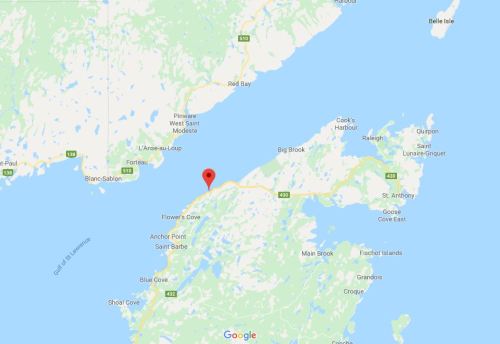
Few details have been provided about this year’s late December sighting at Green Island Cove, just north of the ferry port of Saint Barbe (where the ferry to Labrador docks, see below). No photos or descriptions of the bear were made public and so far the bear does not seem to have caused any trouble: the photo above is from another sighting in Labrador a few years ago.

Green Island Cove Newfoundland map Google

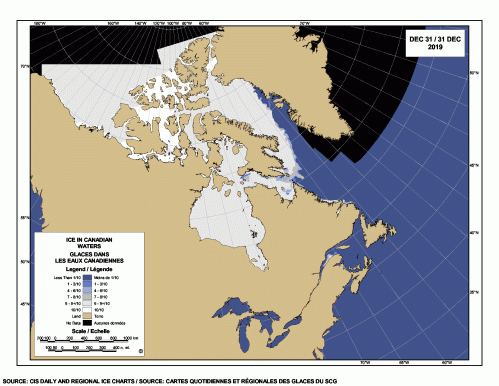
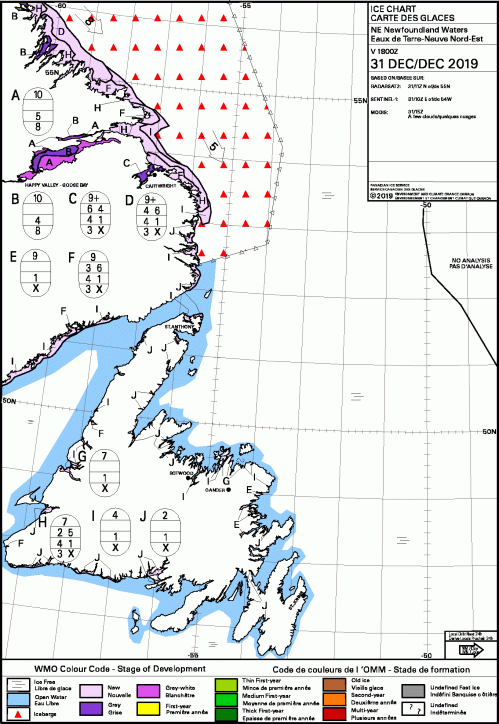
Sea ice this year has been scarce on the East Coast, but obviously enough for at least one determined bear to have made its way down from Davis Strait, swimming part of the way. See the two charts below:

Sea ice Canada 2019 Dec 31 HB caught up

Newfoundland East daily stage of development 2019 Dec 31

Continue reading

Polar bear cubs play on the thin ice that supposedly threatens them with extinction

This video tweet deserves a post of its own: two relatively inexperienced cubs-of-the-year in Russia deliberately break through thin ice, fall into the icy water and crawl back out – over and over again, for fun, as their mother watches in the background. Play is one way animals learn important survival lessons and for polar bears, this is one of them:

Thin ice was a natural component of the Arctic long before polar bears evolved to live there: it is nothing new but dealing with it requires a strategy that cubs must learn.

UPDATE 1 August 2020: here is the same video, better quality, on Youtube:

Continue reading

New video shows Attenborough & Netflix falling walrus deception as revealed by BBC

A new video with clips of critical footage not available outside the UK shows that Sir David Attenborough and Netflix producers (who insisted earlier this year that climate change – not polar bears – were to blame for Russian walrus falling to their deaths) had deceived audiences around the world.

Falling walrus deception video 19 Dec 2019

Falling Walrus: Attenborough Tacitly Admits Netflix Deception (Susan Crockford/GWPF).

As I explained last month, footage from the Attenborough/BBC TV series Seven Worlds, One Planet (Asia) showed conclusively that events precipitating the walrus tradegy porn sequence in the Netflix film was a deception. It means that Attenborough, director Sophie Lanfear, cameraman Jamie McPherson, WWF in Chukotaka, and scientific advisor Anatoli Kochnev all knew this to be so.

In case you missed it, another episode of the same BBC One Planet TV series falsely claimed that polar bears hunting whales from shore are unprecedented effects of climate change.

Ryrkaypiy ‘over-run’ by >50 polar bears is probably due to more Chukchi Sea bears

A scary-sounding headline from the BBC today screams “Ryrkaypiy: Far-north Russian village overrun by polar bears“. A little research would have shown (as I do below) that this sort of event is not unusual for this village, there is adequate sea ice off the coast to allow polar bears to hunt for seals if they choose to do so, and the photos provided do not support the claim that almost all of the polar bears “appeared to be thin” (see photo below and others). Similar incidents happened in 2013 and 2006. Increasing numbers of Chukchi Sea polar bears is the most plausible explanation for the recent abundance of bears at this village.

BBC Russian village Chukotka over run by polar bears BBC 5 Dec 2019 headline

BBC headline, 5 December 2019. Does that look like garbage these fat bears are feeding on or the frozen remains of dead walruses at the base of the Cape Schmidt cliff?

UPDATE 8 December 2019: A Daily Mail version of the same story (6 Dec) confirms the photo above is of bears feeding on walrus remains (not garbage) and has many more photos (plus a video) of a large number of bears, not a single one of which that I saw was ‘skinny’ (see quotes from the story below). See also the Siberian Times version (6 Dec) with the same pictures. My source for the story was an article published by the BBC, which ran the day before (5 Dec).

UPDATE 9 DECEMBER 2019: Now it’s apparently 63 polar bears threatening the village of Ryrkaypiy on the Chukotka coast, according to the Siberian Times yesterday and repeated by the Daily Mail (with more pictures and video). Russian media getting lots of mileage out of this one. The story now says the bears are feeding on “seals”, not walrus (to deflect attention over their long history of walrus/polar bear problems? Or just a bad translation?). Both stories repeat the claim that most of the bears are “skinny” despite the photos showing just the opposite: lots of fat, healthy bears.

Also, uniquely (and rather bizarrely), the Daily Mail piece claims the bears are being deprived of the “fish” they should be consuming:

Instead of hunting for fish in deeper waters , the bears are eating seal carcasses left in autumn.

Last year army servicemen cleared the village’s shore of remains of dead seals on which the bears are feeding.

Obviously written by someone who knows absolutely nothing about polar bears, who rarely, if ever, eat fish and certainly would not be eating fish at this time of year. Sea ice map below for 8 December 2019 from the Alaska Sea Ice Program for 8 December shows, as noted below, that there is enough ice offshore for the bears to hunt seals if they chose to do so (since eating long-dead walrus is much easier than going hunting):
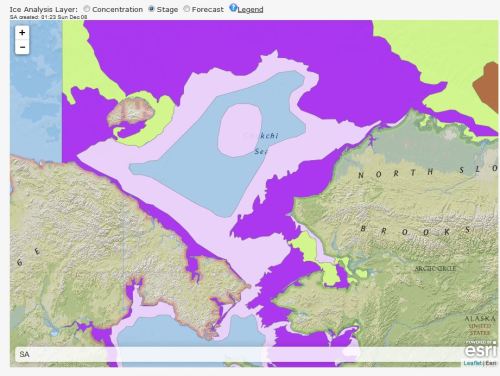
Chukchi Sea ice stage of development 8 Dec 2019 Alaska Sea Ice program

UPDATE 14 December 2019: Apparently, the number of invading bears is now 72 (number gets higher every time someone asks, even though they are still talking about “about a week ago”: who exactly is doing the counting?), according to a story today in The Times (UK). Residents say they move walrus carcasses “away” from the village to a “feeding point” for the bears but it’s apparent the distance is insufficient to prevent problems with bears coming into town. While a local cleaner working for the polar bear patrol (well indoctrinated by the WWF who sponsor the program), proclaims the problem is “definitely” due to climate change, there is finally the admission in this article that the bears coming into town are young bears driven away from the walrus carcasses by larger, older animals (i.e. intra-specific competition). This piece also has a few new photos, including one (below) of fat bears getting into garbage (still no photos of the so-called “skinny” bears said to dominate this “invasion”) and also is the first I’ve seen that doesn’t state that there is no sea ice (only that the ice extent is lower than usual). Some progress, but balanced by the hype promoted earlier this week (at “Treehugger” – what a surprise) by former WWF activist Geoff York (now at Polar Bears International), who is still blaming this incident on lack of ice.
Ryrkaypiy bears in local garbage_The Times UK 14 Dec 2019

Continue reading

BBC’s One Planet falsely claims that polar bears hunting whales from shore is an unprecedented effect of climate change

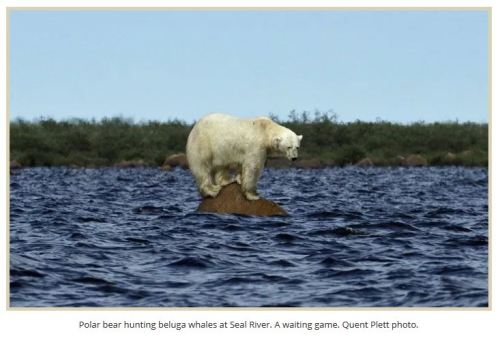
Polar bears leaping on the backs of belugas off Seal River, in western Hudson Bay, is being falsely promoted by the BBC’s new “Seven Worlds: One Planet” TV special as an unprecedented effect of climate change.

Bear hunting beluga Seal River Sept 2017 Quent Plett photo

More specifically, the Daily Mail (30 November 2019) this morning quoted the documentary, narrated by Sir David Attenborough, as saying:

‘This extraordinary behaviour has only been recorded here, in this remote corner of North America, and only in the last few years.’

Poppycock. More climate change hyperbole from Attenborough’s seemingly never-ending litany of nonsense that’s easily refuted. There is scientific literature documenting such behaviour in Canada’s far north in the 1980s, which I included in the blog post I wrote about this phenomenon a few months ago (after National Geographic published a similar scare-story), which I have reposted below.

And from the sounds of it, there was no mention in the BBC special that freeze-up along western Hudson Bay was early again this year: for the third year in a row. So if the footage was filmed any time since 2017, the claim of accelerating sea ice loss in this region and bears on land for longer than ever is pure fantasy. PS. Fat bears are not ‘starving’.

Continue reading

Western Hudson Bay freeze-up earlier than average for 1980s for the third year in a row

This is the third year in a row that freeze-up of Western Hudson Bay (WH) ice has come earlier than the average of 16 November documented in the 1980s. Reports by folks on the ground near Churchill confirm polar bears are starting to move onto the sea ice that’s developing along the shore after almost 5 months on land. After five good sea ice seasons in a row for WH polar bears, this repeat of an early freeze-up means a sixth good ice season is now possible for 2019-2020.

Sadly for the tourists, however, it means the polar bear viewing season in Churchill will be ending early this year, just like it did last year and the year before.

Churchill pbs checking the ice 10 Nov 2019 Amanda Atarling photo

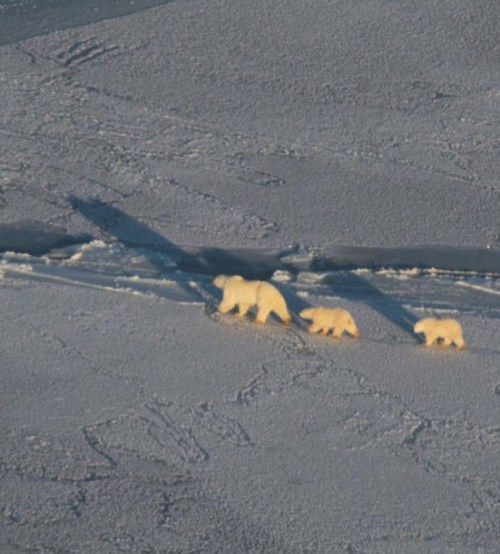
Polar bear family on the ice off Churchill Manitoba (taken from a helicopter), courtesy Explore.org

When mothers with cubs are out on the ice (see photo above), it’s pretty certain the mass movement from land to sea ice is well underway because these family units are usually the last to leave.

UPDATE 19 November 2019: Polar Bear Alert report for 11-17 Nov (week 20) confirms that freeze-up is underway, bears are heading out on the ice and problem bears held in the ‘jail’ were released 13 November. See below.
Continue reading

Canadian Inuit file court documents stating polar bears are thriving

UPDATE 6 Nov 2019: I have substantially modified this post based on receipt of the actual court documents describing the case, which is much more complicated than it appeared from the news reports quoted. Many thanks to Donna LaFramboise for passing it along! Clarifications in red, incorrect statements crossed out.

The Inuit fight in Canada with the federal government over polar bear conservation status continues. The government, led by Environment and Climate Change Minister Catherine McKenna, reduced polar bear hunting quotas in Southern Hudson Bay only from 28 to 23, based on the results of the 2011-2012 survey. In response, Inuit groups have submitted affidavits in federal court stating that polar bears are thriving. The court dismissed the Inuit challenge even though polar bears in Canada are not considered threatened or vulnerable to extinction, and encouraged the two parties to resolve the dispute outside the court. This arbitrary political decision by the government undermines the scientific assessment done by the Committee on the Status of Endangered Wildlife in Canada (COSEWIC) and tramples Inuit rights. The dispute was about Inuit treaty rights vs. conservation concerns regarding sustainable harvest levels, not conservation impacts from climate change, and the decision did not resolve the issues of sex-selective harvesting and defense of life kills counting against harvest quotas.

James Bay female and cub_Ontaro Govt

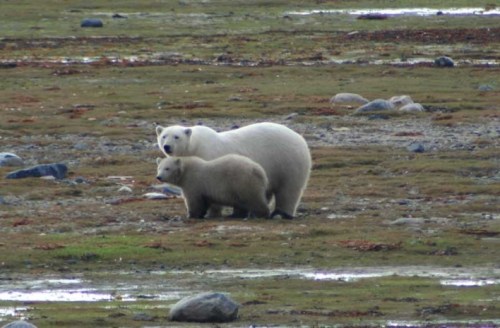
Fat healthy polar bears from Southern Hudson Bay

Continue reading

Polar bears precipitated Netflix walrus deaths, new Attenborough TV special shows

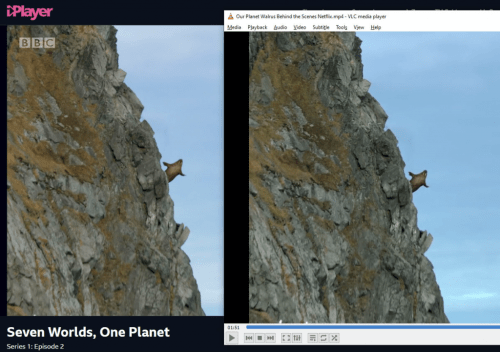
Concerns I raised earlier this year – see here and here – regarding the Sir David Attenborough’s Netflix walrus tragedy porn episode have been vindicated by a new Attenborough BBC TV special called Seven Worlds, One Planet (Asia). It shows film footage of polar bears – taken by drones – driving walrus off the same Siberian cliff that was shown in the Netflix documentary film released in April.

BBC One Planet Asia vs Neflix screencaps

Few of the reporters who covered this story bothered to investigate further despite the evidence provided by myself and others that polar bears and drones were the likely triggers for these deaths: they simply took Attenborough and the film crew at their word.

Netflix director Sophie Lanfear and cameraman Jamie McPherson insisted there were no polar bears in the vicinity at the time they shot their film footage but this was clearly not the case. They knew that bears were involved because they filmed them menacing the walrus!

It is now evident that McPherson filmed the 20 or so polar bears stalking walrus at the top of the Ryrkaypiy cliff and driving them over the edge for the BBC episode only a few days prior to filming a few walrus falling with no bears present on the cliff top for the Netflix film in September 2017. The bears were close enough when the Netflix sequence was filmed to converge immediately on the rookery to feed on carcasses once the walrus herd left the beach.

Fat, healthy polar bears (not desperately hungry ones) were indeed involved in these walrus deaths and so were drones. Lack of sea ice was not a significant factor.

 
UPDATE 6 November 2019: See Paul Homewood’s take on this here. Additional video added at the end.

Continue reading

My London lecture according to Josh

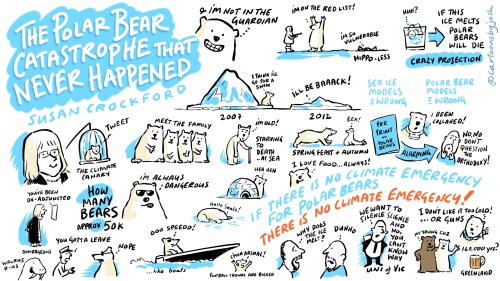
London lecture at the GWPF offices was splendid from my point of view and the audience seemed to enjoy themselves fully. Josh was there and sent his cartoonist’s perspective of the evening*:
Susan-Crockford-PolarBear-GWPF London 21 October 2019 Josh

*PS Thanks Josh and such a pleasure to finally meet you.