Category Archives: Sea ice habitat

Davis Strait polar bears again: body condition declined while population increased

This is a short follow-up to my last post on Davis Strait polar bears.

Today I’ll highlight a paper published last year (Rode et al. 2012) that had three of the same co-authors as the Peacock et al. (2012) paper I discussed on Monday – Lily Peacock, Mitch Taylor, and Ian Stirling contributed to both papers. Rode et al. (2012) deals with the issue of body condition (relative degree of fatness) in polar bears vs. changing levels of sea ice over time, and if you’ll pardon the pun, adds even more weight to the conclusion that declines in summer sea ice do not necessarily spell the disaster for polar bears we have been told is inevitable.

A polar bear near Thule, NW Greenland. Note the decidedly chubby back end on this bear, who looks well prepared for winter. Photo by Robin Davies. [details at my Quote Archive, Featured Quote #6]

A polar bear in the summer of 2012 near Thule, NW Greenland (part of the Baffin Bay subpopulation). Note the decidedly chubby back end on this bear, who looks well prepared for winter. Photo by Robin Davies.
[details at my Quote Archive, Featured Quote #6]

Continue reading

Signs that Davis Strait polar bears are at carrying capacity

Exciting news about polar bears in eastern Canada: the peer-reviewed paper on the Davis Strait subpopulation study has finally been published (Peacock et al. 2013). It concludes that despite sea ice having declined since the 1970s, polar bear numbers in Davis Strait have not only increased to a greater density (bears per 1,000 km2) than other seasonal-ice subpopulations (like Western Hudson Bay), but it may now have reached its ‘carrying capacity.’

This is great news. But where is the shouting from the roof-tops? This peer-reviewed paper (with its juicy details of method and analysis results), considered by some to be the only legitimate format for communicating science, was published February 19, 2013. No press release was issued that I could find and consequently, there was no news coverage. Funny, that.

There was a bit of shouting back in 2007 when the study ended and the preliminary population count was released – polar bear biologist Mitch Taylor is quoted in the Telegraph (March 9 2007) as saying:

“There aren’t just a few more bears. There are a hell of a lot more bears.”

There was also a CBC news item in January 2007 and a Nunatsiaq|Online report in October 2009 when the official government report was completed. But these were all based on preliminary information and focused on the population increase only.

This new paper (Peacock et al. 2013) reveals that the story in Davis Strait is about more than simple population growth. Small wonder no one is drawing attention to it. Continue reading

Buffet time for polar bears – spring/early summer is for eating baby seals

Spring is the busiest and most important season for polar bears: it is the most important feeding period and it is also when mating occurs. The fat that polar bears put on during the spring and early summer is critical for their survival over the rest of the year and for females, determines whether they can successfully produce cubs the following year.

Mothers and new cubs emerge from their winter dens in late March to early April and those who have chosen to den on land soon head towards the sea ice. For a fabulous photo of a polar bear female and her two young cubs, just out of their winter den, feeding on a bearded seal pup, pop over here. All other bears, including females with older cubs, will already be on the ice, feeding on the first newborn ice seals of the season and any other seals they can catch.

It’s buffet time for polar bears but the most dangerous time for cute baby seals. Continue reading

Not much has changed in polar bear country since the sea ice maximum

I’ve been busy with work-related activities lately and will be for several more weeks. Until then…

Sea ice changes since March 15 [Update added May 10, see below]

Lots of ice everywhere – even in Hudson Bay. A bit less ice in the Barents Sea (north of Norway) than there was two months ago at the sea ice maximum March 15 (see Fig. 1 below compared to the extent at May 5 in Fig. 2: both from NSIDC). But there is still quite a bit around Svalbard – that group of islands between NE Greenland and NW Norway (see Fig. 3 below a MASIE image, where this situation is more apparent).

Polar bears are eating and mating at this time of year (early May being the tail-end of the season in most areas) – and right now, they have a huge, circumpolar ice platform for those activities.

Continue reading

Polar bear-sea ice relationships: what biologists knew in ’72

1972 – a bit over 40 years ago. Seven years before we had reliable sea ice extent data from satellites and the year before the international agreement was signed by Arctic nations to protect polar bears from overhunting.

In 1972, a bear biologist by the name of Jack Lentfer was working for the Alaska Department of Fish and Game, stationed at the Naval Arctic Research Lab in Barrow. Lentfer was one of the founding delegates of the Polar Bear Specialist Group, where he represented US interests until 1981.

In the proceedings of the 1972 PBSG meeting (Lentfer 1972a), Lentfer stated the following in his report to the group:

“Long term warming and cooling trends occur in the Arctic and probably affect polar bear distribution and numbers. Climatic trends should be considered when assessing bear distributions and population data on a long term basis.” [my bold]

Warming and cooling, not just warming.

He also had a paper published that year (Lentfer 1972b), entitled “Polar bear: Sea ice relationships.” Forty years on, I thought it was worth having a look at what Lentfer told his fellow polar bear biologist colleagues back then. Continue reading

Sea ice maximum reached March 15: what it means for polar bears

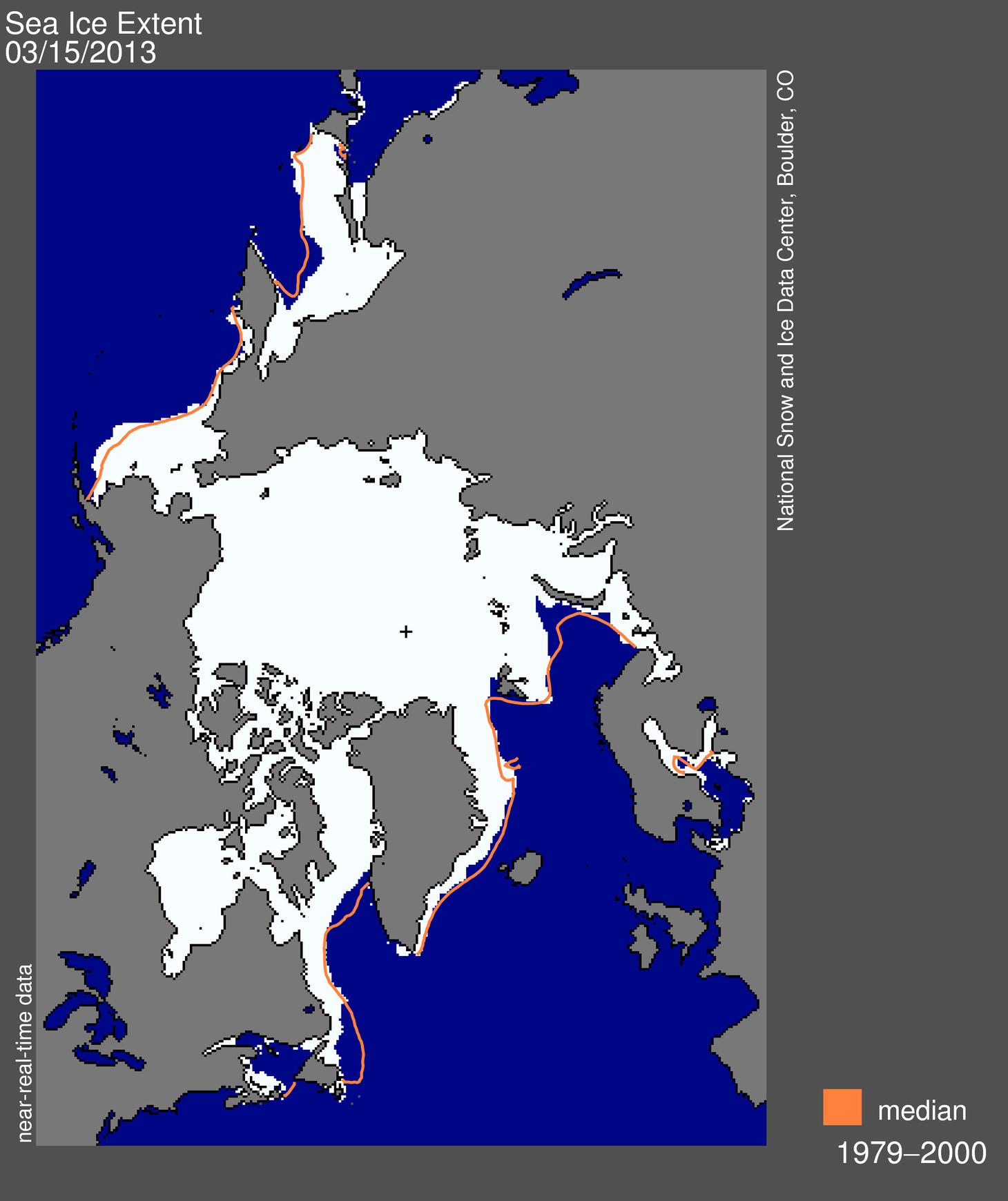
On Monday, March 25, the National Snow and Ice Data Center (NSIDC) announced that March 15 2013 was likely the maximum extent reached this winter. Note that just a few days ago, I discussed the relationship between maximum extent of sea ice and the global distribution of polar bears around the Arctic (see March 20th post here).

NSIDC says: “Arctic sea ice extent on March 15 was 15.13 million square kilometers (5.84 million square miles). The orange line shows the 1979 to 2000 median extent for that day. The black cross indicates the geographic North Pole.”

NSIDC says: “Arctic sea ice extent on March 15 was 15.13 million square kilometers (5.84 million square miles). The orange line shows the 1979 to 2000 median extent for that day. The black cross indicates the geographic North Pole.” Click to enlarge.

Continue reading

Polar bear spin reaches new heights as geneticists promote their work

A new paper out in the journal PLoS Genetics proposes that a hybridization event between female polar bears and male brown bears (aka grizzlies) occurred in Southeast Alaska at the end of the last ice age. I’ll get to a discussion of the paper itself (coming in a day or two) but first I have a few things to say about the global warming hyperbole generated by the people promoting the paper. I found it simply mind-boggling.

While the paper itself (Cahill et al. 2013: “Genomic Evidence for Island Population Conversion Resolves Conflicting Theories of Polar Bear Evolution”) contains only one short phrase that could possibly be interpreted as linking the results to future scenarios of catastrophic global warming, some of the co-authors have made statements (for the press release and in media interviews) that spin the global warming mantra right over the top. Continue reading

Polar bears of W. Hudson Bay came ashore in 2009 as late as in 1992

It’s like pulling teeth, getting up-to-date information on breakup dates of Hudson Bay sea ice. You’d think with the importance of this seasonal event to the polar bears of Hudson Bay (some of which, we’re told, face the most perilous future of all polar bears worldwide), we’d get a press release every summer alerting us to the precise date of sea ice breakup and the subsequent arrival of the bears onshore. I’m thinking of something similar to the dispatches we get from the National Snow and Ice Data Center (NSIDC) when Arctic sea ice reaches its yearly maximum (e.g. March 2012) and its yearly minimum extent (e.g. September 2012).

Sadly, this is not the case.

So I was intrigued to see that a new paper just out in the Journal of Animal Ecology, by Seth Cherry (a Ph.D. student of Andrew Derocher) and colleagues, dealt with Hudson Bay breakup dates. I was hoping for some data beyond 2007, which has been the limit of information provided so far by polar bear biologists (see previous posts here and here). Unfortunately, because the methods for determining breakup dates in this paper are so different from previous ones (more detail below), the new data (1991-2009) can’t be compared to earlier studies that go back to 1979. But there is some good news.

Although you wouldn’t know it by the author’s conclusion, the results of the study confirm for this region my previously stated contention that polar bears need spring and early summer ice (March through June) for gorging on young, fat seals and documented declines in sea ice have rarely impinged on that critical feeding period – by which I meant, bears have seldom, if ever, been forced off the ice of Hudson Bay as early as June.

The study also confirms that there has not been any kind of spectacular retreat of sea ice breakup dates – coming earlier and earlier in the season – over the last 19 years and that polar bears did not arrive on shore in 2009 until very late – approximately 22 August – the same date they came ashore in 1992.

Below are two figures from the paper: one (the map) necessary to understand the new “Cherry method” of calculating breakup dates for Hudson Bay (no disrespect intended) and the other (the graph), which presents the data collected. The table with my converted breakup dates is below them. A few quotes from the study and some comments on it follows.

UPDATE (March 21 2013; 6:12 PM PST). A typo in the table has been fixed (2001 is Jun 21 not Jul 21) and the post amended accordingly.
UPDATE 2 (July 7, 2013) The Cherry et al. paper is now in print, the references have been updated accordingly.

Continue reading

Polar bear distribution shows they are limited by winter ice extent

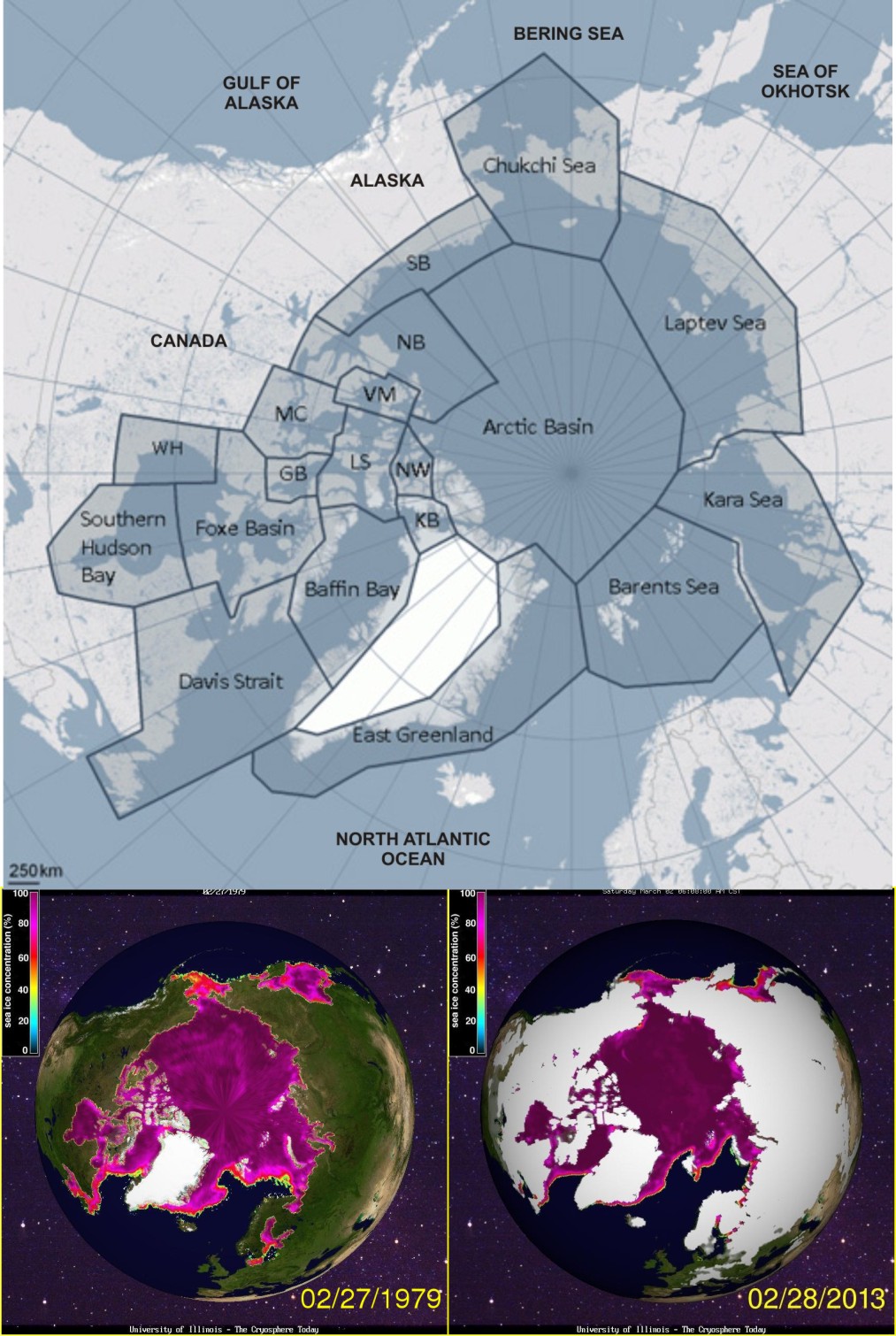
I’ve said it before but it’s worth saying again now that the sea ice in the Arctic is approaching its seasonal maximum extent and thickness: polar bears are limited by winter sea ice extent (Fig.1), not by the minimum extent of ice in the summer. Otherwise, their distribution would resemble the summer sea ice minimum (Fig. 2), not the winter maximum.

Despite the hue and cry about “declining sea ice,” polar bears are still as well distributed throughout their available winter habitat as they were in 1979, when detailed sea ice records began – see the map below. See further details on polar bear distribution here.

Figure 1. Polar bear distribution map (adapted from the one provided by the PBSG) compared to sea ice concentration at Feb 28 (at or near the seasonal maximum extent) 1979 and 2013. I can’t see a difference – can you see a difference? The only place there is consistently sea ice in winter but not polar bears is the Sea of Okhotsk, but there is no evidence that polar bears have ever lived there despite the presence of seals. Click to enlarge

Figure 1. Polar bear distribution map (adapted from the one provided by the PBSG) compared to sea ice concentration at Feb 28 (at or near the seasonal maximum extent) 1979 and 2013. I can’t see a difference – can you see a difference? The only place there is consistently sea ice in winter but not polar bears is the Sea of Okhotsk, but there is no evidence that polar bears have ever lived there despite the presence of seals. Click to enlarge

Continue reading

Polar bear spin reaches epic proportions at Bangkok CITES meeting

As I mentioned here in an update to my March 7th post, Damian Carrington at the Guardian Environment blog had this telling quote about the CITES deliberations that took place prior to the vote to ban polar bear trade (by uplisting its status from Appendix II to Appendix I):

As the debate raged, national delegates from other countries got confused by the strident but conflicting claims. “Where is the truth? Is it true that the polar bear is declining. Is it true that trade is increasing? We need to know,” said the Egyptian delegate.[my bold]

Indeed. Was there “truth” in the presentations heard by delegates? By that I mean, honest presentations of facts so that delegates could make up their own minds, or facts loaded with spin to sway the decision one way or another? I wasn’t there so I can’t say. But we can get some impression of what might have been said from two press releases statements issued after the vote failed by two parties that were actively promoting acceptance of the US-led proposal.[Update: Humane Society Press Release is here] Continue reading