Category Archives: Summary

Dennis Prager radio interview and the sleaziness of the New York Times

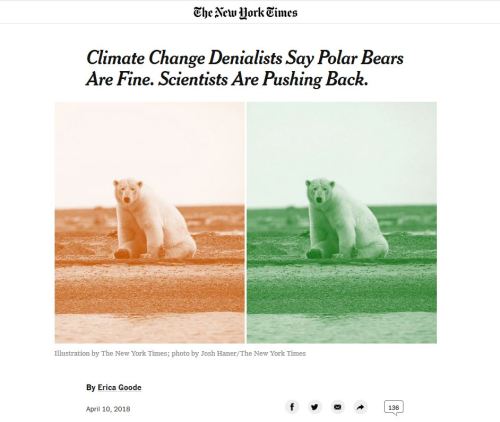
I spent an hour earlier today talking to radio show host Dennis Prager about my new book and the corruption of polar bear science in the name of climate change. Having read the book, he was properly outraged to learn about the New York Times hit piece on me from April of last year, as were others at the time (see here and here).

New York Times_10 April 2018_Headline Climate Change Denialists Say Polar Bears Are Fine

The interview today took up the last hour of Prager’s time slot, for those who want to listen can find it here.

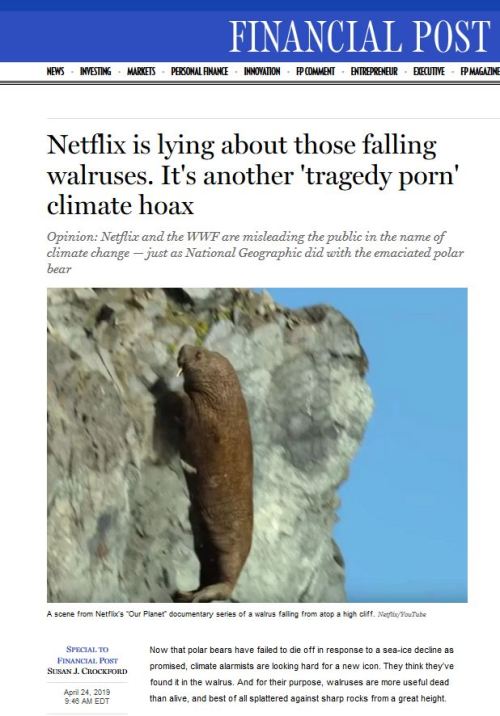
In case you missed it, the text of my Financial Post essay on Netflix false walrus message

For those who missed it on Wednesday, here is the text of my essay on the walrus fiasco published in the Financial Post section of Canada’s National Post. A map of the region under discussion is here.

Netflix is lying_FP headline 24 April 2019

Special to Financial Post

Susan J. Crockford    April 24, 2019   9:46 AM EDT

Now that polar bears have failed to die off in response to a sea-ice decline as promised, climate alarmists are looking hard for a new icon. They think they’ve found it in the walrus. And for their purpose, walruses are more useful dead than alive, and best of all splattered against sharp rocks from a great height. Continue reading

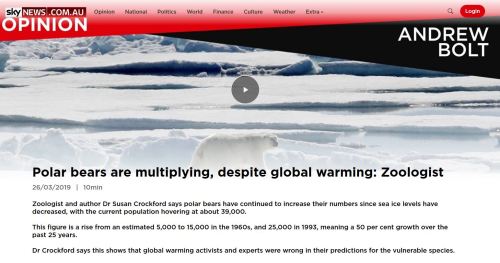
Full podcast of TV interview with Andrew Bolt in Australia talking about polar bears

This 10 minute television interview aired a few hours ago on The Bolt Report (Sky News Australia, 26 March 2019). A short excerpt was made available as a tweet but a link to the full length podcast is below.

Bolt report interview intro_26 March 2019

Ironically, despite the huge effort made by polar bear specialists and climate change activists to silence and discredit me over the last year or so, all it’s done is made more people willing to listen to what I have to say. My new book is selling phenomenally well and getting great reviews: if you haven’t ordered your ebook or paperback copy, you can do so here.

Continuereading

Latest global polar bear abundance ‘best guess’ estimate is 39,000 (26,000-58,000)

It’s long past time for polar bear specialists to stop holding out for a scientifically accurate global estimate that will never be achieved and determine a reasonable and credible ‘best guess’. Since they have so far refused to do this, I have done it for them. My extrapolated estimate of 39,000 (range 26,000-58,000) at 2018 is not only plausible but scientifically defensible.

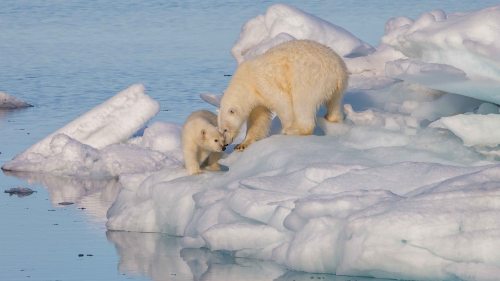
Polarbear1_wikimedia_Andreas Weith photo Svalbard sm

In 2014, the chairman of the IUCN Polar Bear Specialist Group (PBSG) emailed me to say that their global population size number ‘has never been an estimate of total abundance in a scientific sense, but simply a qualified guess given to satisfy public demand.’

In my new book, The Polar Bear Catastrophe That Never Happened, I contend that this situation will probably never change, so it’s time to stop holding out for a scientifically accurate global estimate and generate a reasonable and credible ‘best guess’. Recent surveys from several critical polar bear subpopulations have given us the information necessary to do this.

UPDATE: I have made this a sticky post for a while: new posts will appear below.

Continue reading

The Polar Bear Catastrophe That Never Happened is now for sale

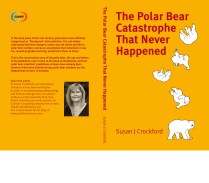
On sale at Amazon today, my new full-length science book, The Polar Bear Catastrophe That Never Happened, published by the Global Warming Policy Foundation.

Paperback and ebook versions are available. See the GWPF press release here.

The official book launch is 10 April in Calgary, details below.

About the book

Final cover 15 March 2019 imageThe Polar Bear Catastrophe That Never Happened explains why the catastrophic decline in polar bear numbers we were promised in 2007 failed to materialize. It’s the layman’s story of how and why the polar bear came to be considered `Threatened’ with extinction and tracks the species rise and fall as an icon of the global warming movement. The book also tells the story of my role in bringing that failure to public attention – and the backlash against me that ensued.

For the first time, you’ll see a frank and detailed account of attempts by scientists to conceal population growth as numbers rose from an historical low in the 1960s to the astonishing highs that surely must exist after almost 50 years of protection from overhunting. There is also a discussion of what thriving populations of bears mean for the millions of people who live and work in areas of the Arctic inhabited by polar bears.

Title: The Polar Bear Catastrophe That Never Happened
Author: Susan J. Crockford
Publisher: Global Warming Policy Foundation
Publication date: 17 March 2019
Distrbutor: Amazon
Formats: Papberback and Ebook
Number of pages: 209

Order it here.
Continue reading

This week: New book release & Glenn Beck interview talking about polar bear numbers

The Polar Bear Catastrophe That Never Happened is almost here! The book is scheduled for release (in paperback and ebook formats) on Tuesday 19 March 2019. Tuesday is also the day I’ll be talking to Glenn Beck on his radio show (11 am ET) about polar bear population numbers and my book. How many polar bears are really out there now, you ask? My book has a credible new answer that may surprise you.

Beck interview blog post header DRAFT 12 March 2019

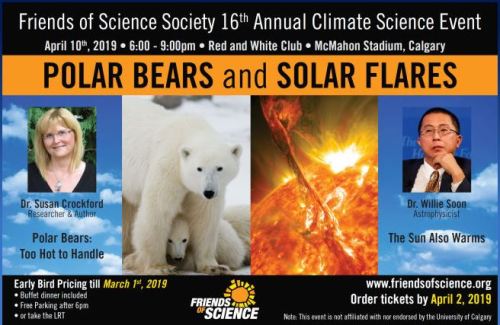
The official book launch event will be 10 April in Calgary, just ahead of the annual Friends of Science Climate lecture evening, where I’ll be presenting alongside astrophysicist Willie Soon. You can pick up an autographed copy of The Polar Bear Catastrophe That Never Happened there.

2019 Friends of Science lecture announcement April 10

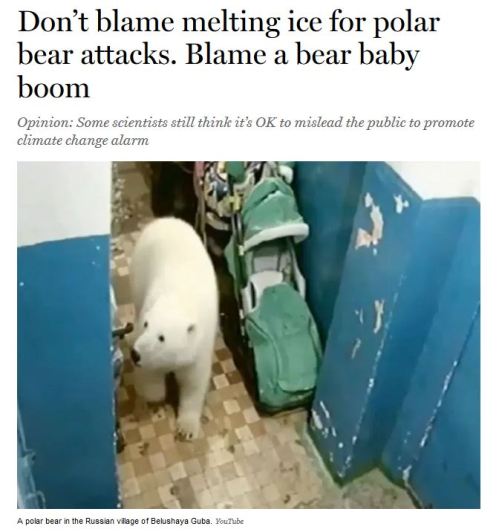
My International Polar Bear Op-Ed at the Financial Post on 27 February 2019

In case you missed it back on 27 Februrary 2019. See the original here (with photos).**

Crockford Financial Post Opinion_photo_27 Feb 2019

Continue reading

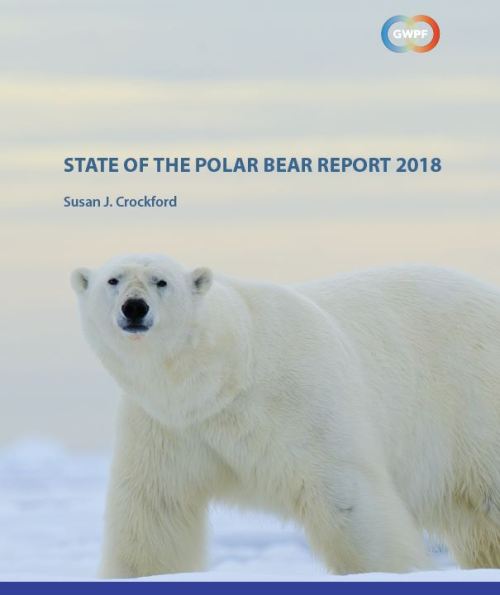
State of the Polar Bear Report 2018: Polar bears continue to thrive

Press Release 27 February 2019, International Polar Bear Day

New Report: Polar Bears Continue To Thrive
State PB 2018 cover 27 Feb 2019

Inuit paying the price of rising bear populations

The State of the Polar Bear Report for 2018, published today by the Global Warming Policy Foundation, confirms that polar bears are continuing to thrive, despite recent reductions in sea ice levels. This finding contradicts claims by environmentalists and some scientists that falls in sea ice would wipe out bear populations.

The report’s author, zoologist Dr Susan Crockford, says that there is now very little evidence to support the idea that the polar bear is threatened with extinction by climate change.

We now know that polar bears are very resourceful creatures. They have made it through warm periods in the past and they seem to be taking the current warming in their stride too”.

In fact, it is the human residents of the Arctic who seem to have most to worry about. With more and more bears on the landscape at all times of year, there have been worrying reports of people being threatened, mauled and even killed, particularly from Nunavut, in the Canadian north.

As Dr Crockford explains,

The people of Nunavut are not seeing starving, desperate bears – quite the opposite. Yet polar bear specialists are saying these bears are causing problems because they don’t have enough sea ice to feed properly. The facts on the ground make their claims look silly, including the abundance of fat bears. Residents are pushing their government for a management policy that makes protection of human life the priority.

UPDATE: Read my opinion piece in Canada’s Financial Post here.

Key findings [Read the whole thing here]

· Data published since 2017 show that global polar bear numbers have continued to increase slightly since 2005, despite the fact that summer sea ice in 2018 was again at a low level not expected until mid-century: the predicted 67% decline in polar bear numbers did not occur.

· Despite marked declines in summer sea ice, Chukchi Sea polar bears continue to thrive: reports from the first population-size estimate for the region, performed in 2016, show bears in the region are abundant (almost 3000 individuals), healthy and reproducing well.

· National Geographic received such a profound backlash from its widely viewed ‘this is what climate change looks like ’ starving polar bear video, released in late 2017, that in 2018 it made a formal public apology for spreading misinformation.

· In Canada, where perhaps two-thirds of the world’s polar bears live, the Committee on the Status of Endangered Wildlife (COSEWIC) decided in 2018 to continue to list the polar bear as a species of ‘Special concern’ rather than upgrade to ‘Threatened.’

· Polar bear attacks made headlines in 2018: two fatal attacks in Nunavut, Canada and a narrowly averted death-by-mauling in northern Svalbard caught the world by surprise.

Citation: Crockford, S.J. 2019. State of the Polar Bear Report 2018. Global Warming Policy Foundation Report 32, London.

 

My fabulous polar bear science book for kids now also available in Norwegian

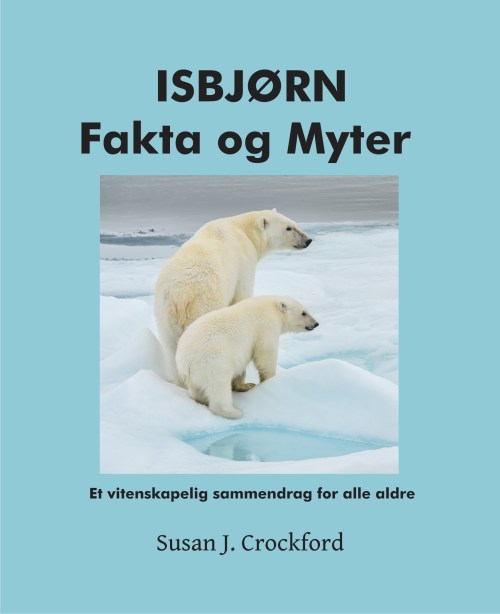
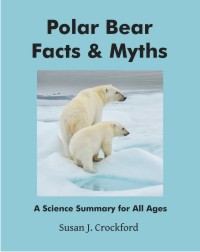
Polar Bear Facts and Myths (for children aged 7 and up) is now avaiblable in Norwegian!

The same day as a glowing review of the Dutch translation of my popular children’s science book appeared in de Telegraaf (front page and all of page 5, 19 November 2018, pdf here), I am thrilled to announce that this important book is now available in Norwegian via Amazon worldwide, including European outlets.

Crockford FM front cover Norwegian FINAL 18 Nov 2018 3 inch

The translation was done by native Norwegian speakers Arve Tunstad and Morten Jødal. In Norwegian the book is called ISBJØRN Fakta og Myter.

Please pass along to your friends, relatives, and colleagues in North America and abroad (calling all Sons of Norway). The English version is still available in paperback and ebook formats. Other translations in French and German are already available: five languages in all, including Dutch.

shutterstock_473571037 (2) purchased 3 November_smaller

Details below on the Norwegian version. Continue reading

Climate mauling, polar bears, and the self-inflicted wounds of the self-righteous

The BioScience paper “Internet blogs, polar bears, and climate-change denial by proxy” (Harvey et al. 2018) is a smack-talk response to my pointing out that polar bear numbers did not plummet as predicted when mid-century-like sea ice conditions arrived unexpectedly in 2007 (Crockford 2017). Here is why this shoddy piece of work will go down in history as a self-inflicted wound for the polar bear community (and biologist co-authors Ian Stirling and Steven Amstrup) and an own-goal for their wanna-be climate-hero friends, Stephan Lewandowsky, Jeff Harvey, and Michael Mann.

idea 1 final…absolutely the stupidest paper I have ever seen published” tweeted climate scientist Judith Curry, Emeritus Professor of Earth and Atmospheric Sciences at Georgia Institute of Technology (“Georgia Tech”).

Dr. Curry is a favourite target of colleague Michael Mann’s penchant for derogatory name-calling. Ironically, Mann often promotes something he calls the “Serengeti Strategy,” which he described to US Congress in 2017 in presenting himself as a victim of abused by others [my bold]:

“I coined the term “Serengeti Strategy” back in 2012 in “The Hockey Stick and the Climate Wars” to describe how industry special interests who feel threatened by scientific findings—be it tobacco and lung cancer, or fossil fuel burning and climate change—single out individual scientists to attack in much the same way lions of the Serengeti single out an individual zebra from the herd. In numbers there is strength, but individuals are far more vulnerable. Science critics will therefore often select a single scientist to ridicule, hector, and intimidate. The presumed purpose is to set an example for other scientists who might consider sticking their neck out by participating in the public discourse over certain matters of policy-relevant science.” Michael Mann, 2017 Congressional testimony.

Mann thinks others are using this strategy against him but if he had half an ounce of self-awareness he’d see it’s exactly what he and his long list of colleagues are doing with the Harvey et al. BioScience attack on me. Intimidation by numbers is the only rational explanation for a roster of 14 when two incompetent researchers could have produced a similar result.

Polar bear specialists Ian Stirling and Steven Amstrup knew they didn’t have a valid argument to refute my paper (Crockford 2017; Crockford and Geist 2018) on their failed polar bear survival model (Amstrup et al. 2007), which their responses to my International Polar Bear Day (27 February 2018) Financial Post op-ed revealed to the world (see here and here with references).

So when ignoring me didn’t work – or, more accurately, when the world started paying too much attention to me, by their own admission (Harvey et al. 2018:3) – they teamed up with Michael Mann, Jeff Harvey, and Stephan Lewandowsky (all with previous form attacking colleagues who don’t share their views) to publish an academic paper attacking my scientific integrity. In the words of Terence Corcoran, I was “climate mauled.”

Judith Curry stated recently (14 February 2018), regarding the Mann lawsuit against Rand Simberg, Mark Steyn and the National Review vs. the attacks on her integrity:

“Mann’s libelous statements about me (because he is a scientist with many awards) are far more serious than say Rand Simberg’s statements about Mann.”

In other words, like the attack on me in the Harvey paper (used to libel other internet bloggers by association), when senior scientists like Mann, Stirling, and Amstrup use derogatory and defamatory language against a colleague it’s a serious breach of professional ethics that impacts careers. Harvey et al.’s attack against me may be worse than those against Curry at a Congressional Hearing because it has been entered into the scientific literature in my own field.1

However, I expect BioScience (read mostly by teachers, students, and the general public, and therefore widely subscribed to by public libraries) was the only outlet willing to publish such unprofessional tripe. The editor’s refusal to retract the paper after numerous complaints about the language and the quality of the scientific content, tells you all you need to know about the journal’s low, sectarian standards. For example, the notice showing the two corrections they were willing to make at the end of March 2018 had to be pulled because such an egregious error occurred (it was posted to the wrong journal) it got the attention of online watchdog Retraction Watch! [Still not fixed as of 8 April]

Polar bear paper correction retraction_5 April 2018

It also tells us quite a lot about the bias of its publishers, the American Institute of Biological Sciences.

Did you know, for example, that this organization has an “actionbioscience” program that provides free idealogically biased content aimed at kids and teachers that’s not particularly different from the biased content produced (without references) for kids and teachers by activist conservation outfit Polar Bears International (employer of Harvey et al. co-author Steve Amstrup)? The AIBS actionbioscience program currently includes an out-of date, alarmist essay by litigious Center for Biological Diversity employee Shaye Wolf on the plight of penguins (from 2009) as well as one by pessimistic polar bear specialist Andrew Derocher (from 2008) .

If you are able, please support the work I do here at PolarBearScience, some of which will go to Josh for these fabulous cartoons:

Here is a list of issues regarding the Harvey et al. paper as well as responses to it: some of these you won’t have heard before. Because this is a long summary post, for convenience I offer it here also in pdf form (latest version with a few typos/spelling errors corrected): Climate mauling, polar bears, and self-inflicted wounds of the self-righteous.”

Continue reading