Hungry polar bear attacks: why my novel “Eaten” is set in early March

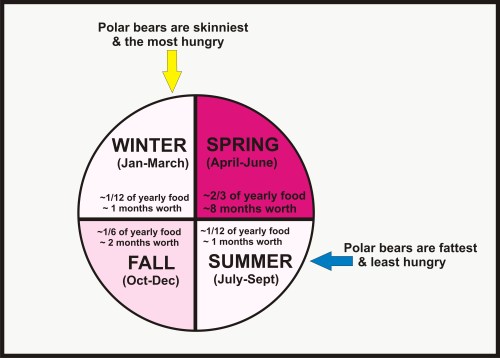
As I’ve pointed out previously, polar bears are leanest – and thus, hungriest and potentially the most dangerous to humans – at the end of winter (i.e. March).

Polar bear feeding by season simple_Nov 29 2015

That is why the unexpected prospect of hundreds of lean and hungry polar bears coming ashore in early March hunting available human prey would be a truly terrifying and daunting experience. Such a speculative scenario stands in marked contrast to an actual incident in July that involved a single well-fed bear that attacked a man asleep in a tent because he and his companions had chosen to dismiss the known risk.

Any predatory attack by a polar bear is terrifying but which is potentially the more deadly? One you can reasonably expect (and thus prepare for) or one that comes out of the blue and catches everyone unprepared?
Continue reading

Ian Stirling uses lifetime award to repeat flawed predictions for polar bears

It has been less than a month since the 2015 IUCN Red List assessment for polar bears was announced, which emphasized that the population trend for polar bears is unknown and that there is only a 70% chance that polar bear numbers could decline by 30% over the next 35 years.

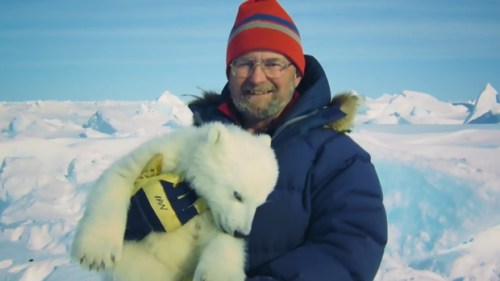
ian-stirling_full

Yet, in a press release announcing the Weston Family Prize for lifetime achievement in northern research (along with $50,000) to Ian Stirling for his work on polar bears (Newswire, December 9, 2015), Stirling is quoted repeating an out-of-date prediction:

“Dr. Stirling estimates that about half of the polar bear population around the circumpolar Arctic could disappear by 2050 to 2060, if climate warming continues as is currently projected…”

I’d have thought that if Stirling did not agree with the IUCN assessment prepared by his colleagues, he would have said so last month when the report was released to international fanfare. Instead, he seems to be deliberately ignoring the 2015 IUCN Red List assessment and pretending that the flawed predictions he had a hand in making are still plausible.  Continue reading

Amazon reviewer said of my new polar bear attack novel: “I couldn’t put it down”

And another emailed me to say of EATEN:

“Your explanation of the relationship of seals, bears and ice was a treat. Congratulations, “Eaten” is a real page turner.”

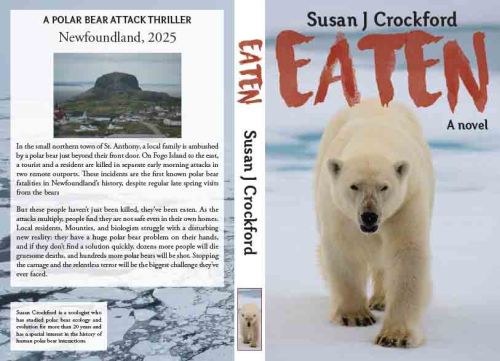
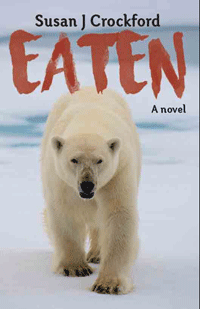
EATEN_cover full sm

Update: The review referred to in the title is from the UK store, which has not (a.m. 8 December) been added to the Amazon.com site.

The perfect gift for those fiction readers on your list that love a good scary story. Speculative fiction of the horrifying kind – it could happen, it just hasn’t yet.

Find the paperback at Amazon  and Barnes & Noble

Amazon Kindle ebook

Barnes & Noble NOOK ebook

Kobo bookstore ebooks

Apple device ebook (via iTunes, under “Suspense and Mystery”)

Overdrive ebooks for libraries (see if your library has it: if not, suggest they get it).

Paris climate change deal will not stop polar bears dying due to thick ice in spring

Thick spring ice due to natural causes is currently the single biggest threat to polar bears. Not declining summer sea ice – thick spring ice. That could change in the future but right now, the evidence supports that statement.

polar_bear with collar_USGS

Polar bear deaths due to cyclical changes in Arctic sea ice thickness in the spring have continued despite rising CO2 emissions and declining summer sea ice extent (last major incident, 2004-2006): there is no reason to expect this will not continue. Unwarranted attention on summer ice extent has deflected attention from this major cause of local polar bear population decline.

Sea ice models do not address past or future changes in spring ice thickness and predictive models of polar bear survival blame all population declines on summer sea ice declines despite strong evidence to the contrary (Crockford 2015: The Arctic Fallacy). Continue reading

Spring sea ice prediction for next year off Newfoundland: extensive ice coverage

EATEN – my new polar bear attack novel – is set in Newfoundland 2025 for a reason. I wondered: what if sea ice coverage 10 years from now is as high or higher than it has been for the last two years, with inevitable positive effects on Davis Strait harp seal and polar bear populations?

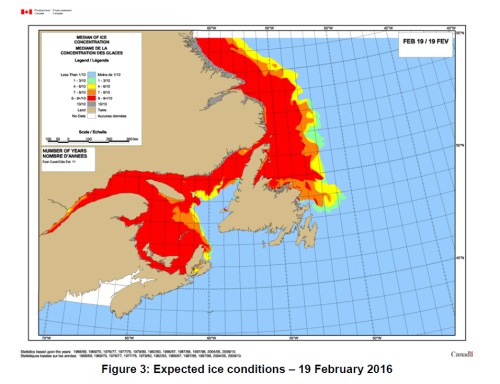
The Canadian Ice Service prediction for this region, released earlier this week (1 December 2015, see references for link), is that 2016 is set to meet my “what-if” scenario handily. Nine years to go! See the CIS expected ice coverage for 19 February 2016 below (CIS fig. 3):

2016 Newfoundland Ice outlook for 19 Feb 2016_at Dec 1 2015

How does the above ice map compare to the last two years? At least as high or higher. Have a look below.

Continue reading

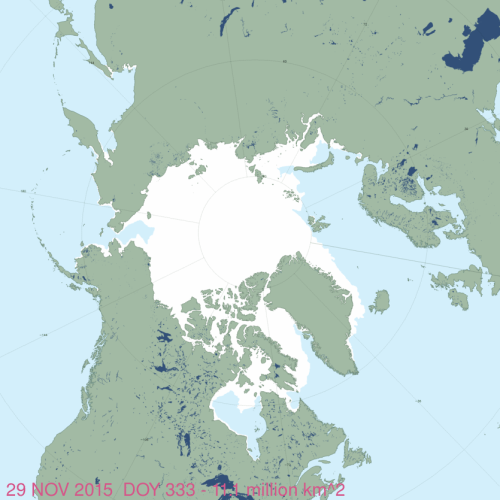
Polar bear habit update – day 333 Arctic sea ice hits 11.1 mkm2

It’s just past the height of fall in the Arctic (Oct-Dec) and polar bear habitat is expanding day by day: according to NSIDC Masie ice charts, the ice has now surpassed 11 mkm2 in extent. Fall is the second most important feeding period for polar bears after spring.

masie_all_zoom_4km 2015 day 333_Nov 29

Only the Barents and Kara Seas (north of Norway and western Russia) are short of ice right now, similar to conditions seen in the fall of 2013. Last fall (2014), conditions were much better and as a consequence, researchers saw a lot of females with healthy cubs in the spring of 2015.

Continue reading

Perfect time to buy EATEN: 30% discount

Amazon.com is having a Black Friday sale and paperbacks are 30% off, one per customer.

Great time to buy your copy of “Eaten” if you haven’t ordered it already. Save some cash, get a great read. Details here – a terrifying polar bear attack thriller set in 2025.

EATEN-cover-front_thumbnail

Use promo code HOLIDAY30 at checkout, from 26 November 2015 12:00 am EST to 30 November 2015 02:59am EST only.

W Hudson Bay polar bears now on the ice hunting but killer whales could be trapped

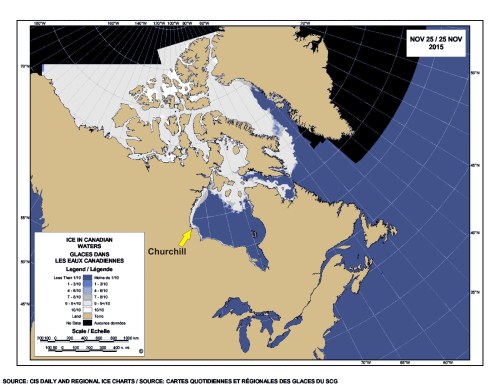
According to reports from folks on the ground in Western Hudson Bay, most polar bears were out on the ice resuming seal hunting by the 20th or 21st November at the latest (some got started quite a bit earlier). That’s less than 2 weeks later than the average date in the 1980s (which was November 8).

Sea ice Canada 25 Nov 2015_with Churchill

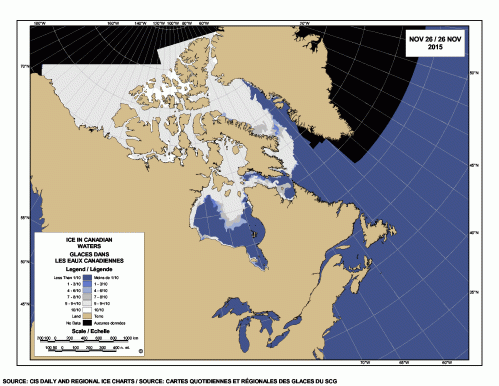
However, the rather odd pattern of freeze-up this year may not be good news for any killer whales still remaining in Hudson Bay – their access to the open ocean is already virtually blocked by ice.

UPDATE 26 November 2015: What a difference a day makes! Look at the spectacular ice development overnight along the west coast of Hudson Bay and in the central portion of the bay since yesterday (below).

Canadian Arctic Nov 26 2015_CIS

Continue reading

Russian polar bear scientist critical of using radio collars

In an update to an earlier story from last month about a male polar bear spotted near Kaktovik with a tight satellite radio collar, a Russian biologist has voiced some some serious criticisms of the use of these devises.

polar-bear-radio-collar_CBC Oct 28 2015

In another news outlet, Andrew Derocher has finally admitted publicly that the Kaktovik bear with the tight collar is a male and is”likely his” (Global News, 23 November 2015; “Is this polar bear really being choked by a research collar?”). The male bear appears to have been fitted with a collar some time between 2007 and 2011. The collar should have fallen off by now but hasn’t. Derocher suggested maybe the collar isn’t really too tight and the blood might not belong to the bear. And that if the bear really wanted the collar off, he “…will be able to remove it himself.”

The criticisms of the use of collars are well worth reading.

UPDATE 25 November 2015: Another CBC report, not much more useful information except confirmation this is a male bear.
Continue reading

IUCN Red Book officials forced scientific standards on polar bear predictive models

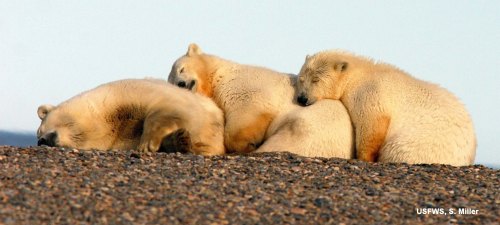
As I reported Thursday, the IUCN announcement of a new Red List assessment for polar bear got the usual overwrought attention from international media outlets. However, not one of these contained a quote from a polar bear biologist.
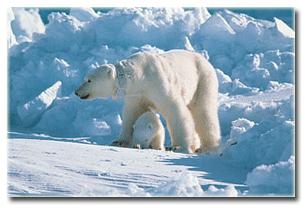
polarbears-arcticnatlwildliferefuge-suzannemiller-usfws_labeled_sm

Steven Amstrup, science spokesperson for activist conservation organization Polar Bears International, has so far had nothing to say to the media. Yet, Amstrup was a co-author of the IUCN Red List report. Not until late in the day following the release of the report did his his organization’s website post a short, bland news report (“Climate Change Still Primary Threat to Polar Bears”).

Similarly, Ian Stirling, Andrew Derocher, Nicholas Lunn (also a co-author of the IUCN Red List report), and former WWF employee Geoff York – who are usual go-to guys for polar-bears-are-all-going-to-die media frenzies – have so far been silent and invisible on this issue.

In addition, while the IUCN press release [backup here: 2015 IUCN Red List press release_Nov 19 2015] included a quote from IUCN Polar Bear Specialist Group (PBSG) chairman Dag Vongraven, as of this morning (21 November, PST), the website of the PBSG contains no mention of this decision – no item in the “News” category  and, more importantly, no update of the status table  or global estimates to reflect the changes contained in the report  (even though they obviously knew it was coming months ago: the report was submitted to the IUCN Red List 27 August 2015).

In my opinion, this silence says it all: polar bear specialists know this assessment is a severe de facto critique of their 2008 assessment (as well as Amstrup’s predictive models) and it’s a big step backwards for their conservation activism. I expect they are silent because they are royally pissed off.

However, this assessment is good news because finally, some standards of scientific rigor have been applied to polar bear predictive models – even though the PBSG were still been allowed to pretend that summer sea ice coverage is critical to polar bear health and survival (Crockford 2015).  Continue reading