Week 17 (I’ve been counting) for 31 October – 6 November (Week 1 was 11-17 July):
“Most bears are still out at Cape Churchill.” [see map below]

See previous reports here, and here. Ten-day sea ice animation, CIS.
Continue reading

Week 17 (I’ve been counting) for 31 October – 6 November (Week 1 was 11-17 July):
“Most bears are still out at Cape Churchill.” [see map below]
See previous reports here, and here. Ten-day sea ice animation, CIS.
Continue reading
Comments Off on Polar Bear Alert report for 1st week of November 2016, Churchill Manitoba
Posted in Life History, Polar bear attacks, Sea ice habitat
Tagged alert, attacks, Churchill, patrol, polar bear, problem bears
Could polar bears trump sharks at the theatre? Does the fact that unlike sharks, polar bears make house calls, give it better odds than most?
Take a walk down memory lane and give some thought to what has made films starring big animal predators a hit (or not), like JAWS, THE SHALLOWS, THE BIRDS, GRIZZLY, and a number of others, both classics and bombs. What do these predator attack films tell us (if anything) about the probability of EATEN becoming a terrifying motion picture?
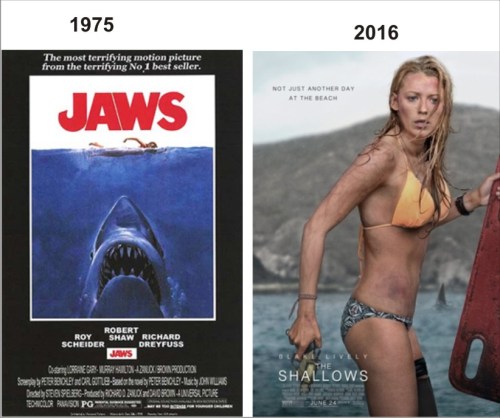
Read the rest here.
Comments Off on EATEN the movie – what are the odds?
Posted in Polar bear attacks
Tagged attacks, block-busters, film, grizzly, JAWS, killer, movie, novel, polar bears, predators, The Birds, The Shallows, thriller
A quiet year for problems in the polar bear capital of the world (Churchill, Manitoba) so far – despite this year tying for the second-lowest minimum since 1979 – and the ice is growing fast. In fact, Arctic ice growth in the second half of September was rapid and there is now more ice than there was at this date in 2007 and 2012 (when polar bears in those regions considered most at risk did not die off in droves).
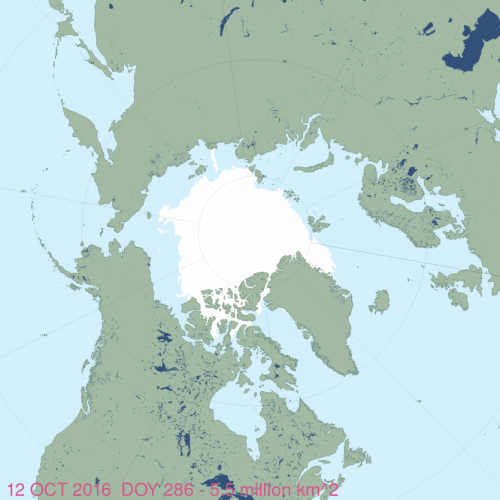
Pessimistic polar bear specialists are wrong – polar bears are much more resilient to low sea ice levels in summer than they assume: their own data from low summer ice years proves it. If you’ll recall from my previous post, polar bears seem to have barely survived the extensive sea ice coverage during the Last Glacial Maximum – in other words, too much ice (even over the short term) is their biggest threat. Polar bear numbers, as confirmed by the latest estimates in the 2015 IUCN Red List assessment, are higher now than they have been since the 1960s, despite almost 10 years of summer sea ice minimums below 5.0 mk2.
Churchill Polar Bear Alert reports and Arctic sea ice comparisons at this date, in detail below.
Comments Off on Arctic sea ice grows & Churchill polar bears into their 4th month of fasting
Posted in Conservation Status, Polar bear attacks, Sea ice habitat
Tagged Arctic, attacks, biggest threat, Churchill, facts, ice growth, last glacial maximum, minimum, polar bear, polar bear alert, population size, problem bears, Refuge, resilience, sea ice, September, summer, thick spring ice
From Saturday 8 October, English journalist, author and broadcaster James Delingpole (via his Breitbart column) writes about polar bears:
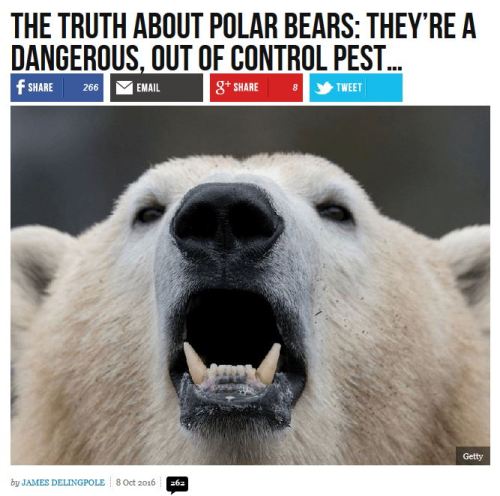
The Truth About Polar Bears: They’re a Dangerous, Out of Control Pest…
“Crockford is the author of a Jaws-style thriller on ravenous polar bears killing humans called Eaten. At least one polar scientist who has read it considers its “science-based scenario” to be frighteningly plausible.
In field-level polar bear management circles, people don’t talk about the kind of scenario that forms the premise of this novel as an “if”. Instead, they describe it as a “when” and they are not looking forward to it.
Eek.“
Eek is right! The book has been nightmare-inducing for many readers. Put EATEN on your Christmas shopping list (all purchase options here). It makes a great gift and supports the work I do here. Colleagues have said their young adult children really enjoyed it.
[I’m reminded of Christmas since we had turkey for Canadian Thanksgiving this weekend – a fabulous gathering of all the local family at my place, including the two (!!) grandbabies, both of whom are now walking. I’ll be sending Nico to Churchill before you know it]
[And FYI, I’ve updated the Svalbard “problem no one is talking about” post with statistics by year (1974-2015) for polar bears killed to protect life and property]
Comments Off on In case you missed it…writer James Delingpole puts my novel in context
Posted in Book review, Polar bear attacks, Population
Tagged attacks, christmas, conflicts, Eaten, facts, polar bear, predators, readers, review, young adults
A report from the CBC this morning (with video) of a large polar bear wandering about the village of Tuktoyaktuk on the (Canadian) shore of the Eastern Beaufort Sea on Thursday (29 September) that got very close to a group of children playing outside. Fortunately, no one was hurt.
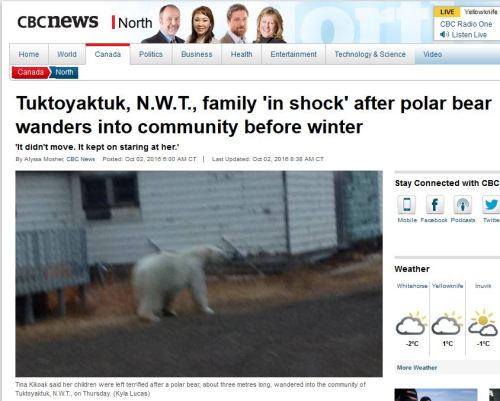
That this was a rare event is evident in the awe and excitement in the voices of the residents as someone recorded the movements of the bear through town (picture quality is not the best, but clear enough).
As I’ve said before, with more bears we can expect more interactions with people and more sightings like this that haven’t happened in decades. Map and quotes below.
Continue reading
Comments Off on Polar bear onshore in Tuktoyaktuk got so close to kids they heard it breathing
Posted in Polar bear attacks, Sea ice habitat
Tagged attacks, Beaufort Sea, conflicts, declining sea ice, encounters, polar bear, sea ice, sighting, summer, thick spring ice
At least a dozen polar bears that besieged a remote Russian weather station on an island in the Kara Sea during the first two weeks of September prompted a few media pundits to suggest that loss of summer sea ice due to global warming may be forcing polar bears to hunt humans for food. Headlines like the one below, from the IB Times, fueled such notions:
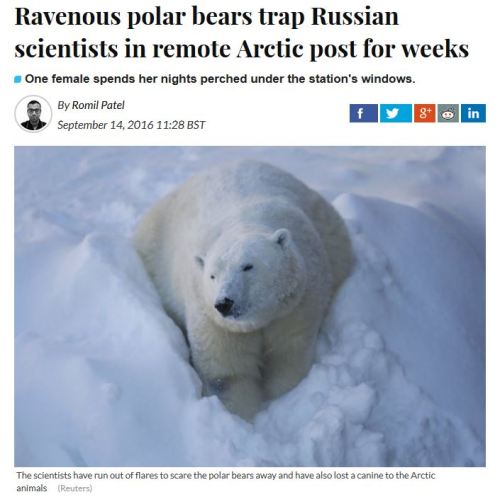
Eye-catching though such headlines might be, this is more sensationalism than reality. These particular bears have been onshore since early July this year (about the time some Western Hudson Bay bears come ashore) and sea ice conditions have been similar this time of year since 2007. In other words, despite what some writers are claiming, sea ice conditions this year are nothing new.
A few bears usually visit this station each summer when the sea ice leaves – but this year there were more than a dozen bears rather than a few. My opinion as a scientist is that more bears – more bears that are increasingly unafraid of people – are likely the cause of the sudden increase in numbers of bears being a problem at this location. Note that of the 14 bears, four were cubs, which is a good crop of youngsters.
In addition, hunting polar bears is banned in Russia and this incident shows to what lengths people must go to avoid killing them – the population must be booming and may be higher yet than the last population count (in 2013) of about 3,200 bears. More bears means more competition for food, which means more assertive bears get the goods. None of these bears were described as thin or starving – see more photos, like the one below, from the Russian weather station (Daily Mail, 18 September 2016).
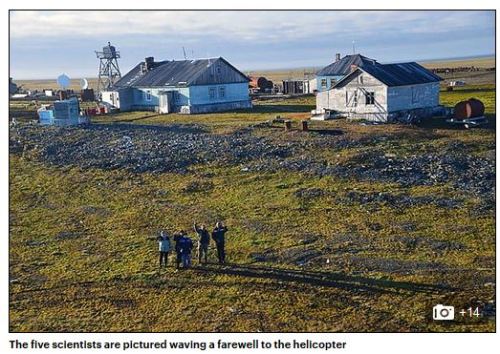
While polar bears are always on the look-out for food (and thus always a potential threat to humans), they are most apt to be truly dangerous in winter (when they are at their lowest body weight) and in spring if seals are in short supply.
That’s why my new polar bear attack thriller EATEN is set in early spring, in a year when seals happen to be scarce. Imagine the damage those Russian polar bears could have done if they’d been truly desperate for food – a mere door or window would not have stopped them.
Imagine if dozens of truly ravenous polar bears stalk and ambush people across a great frozen landscape, taking them by complete surprise because no one considers a bear attack in spring to be a real possibility. What if dozens of people have been killed and eaten by hungry polar bears and there is no end in sight? That is the premise of EATEN – a science-based novel set in Newfoundland that will scare your pants off.
This is a great read for fall, when polar bear encounter stories abound. Hopefully the reports this year won’t include the kind of serious mauling that happened in 2003.
Comments Off on Climate change not forcing polar bears to hunt humans but lack of baby seals might
Posted in Polar bear attacks
Tagged attacks, besieged, climate change, facts, global warming, Kara Sea, polar bear, Russia, scientists, sea ice, weather station
A report last week that a polar bear dug a human cadaver out of a coffin buried in the cemetery on the west coast of Hudson Bay did not get the media attention it perhaps deserved: it takes the term ‘grisly’ to a new level.
Early arrival of polar bears at Nunavut hamlet prompts early monitoring: One bear digs into burial plot at Arviat cemetery (NunatsiaqOnline, 29 August 2016).
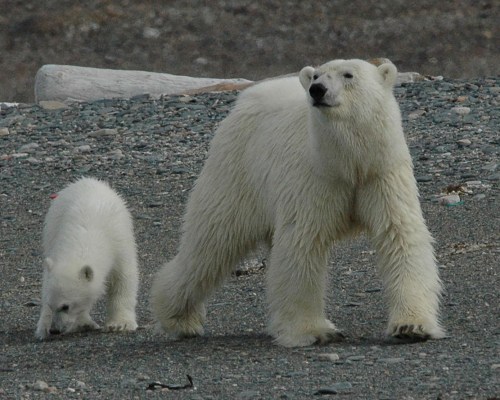
Quotes from the story, a map, and comments on problem bears below.
Continue reading
Comments Off on Add human graves to the list of things that attract polar bears to communities
Posted in Polar bear attacks, Population, Sea ice habitat
Tagged Arviat, attacks, attractants, body condition, breakup, cadavers, cemetary, Churchill, feeding, garbage, patrol, polar bear, problem bears, sea ice, seal meat, starving, zero tolerance
A polar bear female accompanied by a cub recently attempted to board a small sailboat anchored in a remote harbour off central Labrador – giving the two American boaters below deck a mighty big surprise.
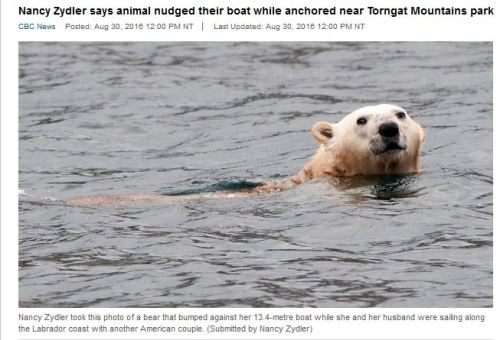
‘He said ‘it’s a bear, it’s right on the boat, make some noise.'” – Nancy Zydler
The encounter occurred south of the same national park where a much-publicized attack occurred in July 2013 (see previous posts here and here) but had a happier ending. See more below from a CBC report released this morning (based on a radio interview) and some ecological context for the sighting not mentioned by the reporter.
Continue reading
Comments Off on Most polar bears easily deterred this time of year, lucky Labrador boaters discover
Posted in Polar bear attacks, Population, Sea ice habitat
Tagged attacks, Davis Strait, encounters, harp seals, Labrador, Meltdown, polar bear, prey, problem bears, sailboat, sightings, summer, summer fast, swimming, Torngat Mountains National Park
This week (Tuesday 9 August), British Columbia’s Knowledge Network is re-running the 2015 documentary about the revitalization of Fogo Island, the Newfoundland location featured in my polar bear attack thriller, EATEN. It’s called Strange and Familiar: Architecture on Fogo Island and highlights the Fogo Island Inn, where our recently elected Prime Minister Justin Trudeau apparently spent a weekend earlier this year – gambling he could avoid a lethal encounter with a hungry polar bear when fictional others haven’t been so lucky.

The Prime Minister and his family stayed at the Fogo Island Inn over Easter (25-28 March 2016). Did Justin Trudeau know they could have been EATEN by a polar bear at that time of year? Were members of his security detail actually prepared for a polar bear attack?
Did Trudeau’s advisors do any preparatory reading? I mean, seriously: aside from reading my terrifying science-based novel (where polar bear attacks take place right outside the Fogo Island Inn where the Trudeaus were staying), Fogo (see maps below) has a recent history of polar bear visits.
Most bears come ashore on Newfoundland in late March-early April, although this year one came ashore on Fogo in late January. Another was shot in early May this year as it advanced on an RCMP officer near one of the artist’s studios on Fogo. I guess I’ll have to send a complimentary copy to Ottawa…because next time, what with polar bear numbers increasing in that region, this high-profile family might not be so lucky.
“What-if” indeed…the risks they took are mind-boggling. Continue reading
Comments Off on Canadian Prime Minister risked being EATEN by polar bears on Fogo this year
Posted in Polar bear attacks, Uncategorized
Tagged architecture, Arctic, attacks, Davis Strait, documentary, Eaten, ferry, Fogo, Fogo Island Inn, harp seals, Newfoundland, novel, polar bear, prime minister, thriller, Trudeau
Sea ice breakup is always a little bit different year to year but since I have the maps archived, take a look at the differences and similarities at this date for this year compared to 2014…
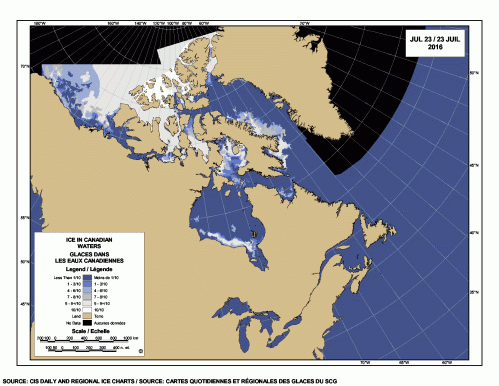
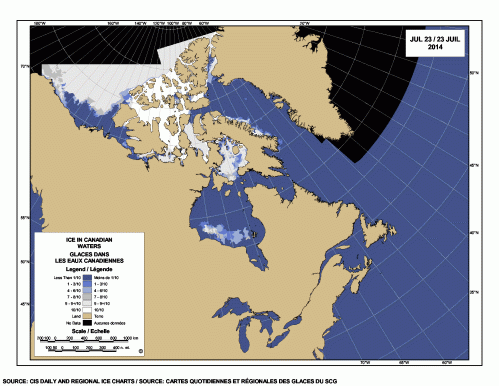
Is there evidence that any polar bears – say Western Hudson Bay bears, for example – were negatively affected by sea ice levels in 2014? Not that I’ve heard. In fact, quite the opposite.
Polar bear guide and blogger Kelsey Eliasson, writing from Churchill, Manitoba, had this to say about the condition of bears and freeze-up that year (16 Nov. 2014):
“With these families appearing [heading out to the ice], it really sums up at just what a productive season this has been for the western Hudson Bay population. Any guide who knows their stuff will tell you this was a banner year for cubs, one we haven’t seen in a long time.”
Meanwhile, bears are starting to come ashore and cause a bit of grief:
Southern Hudson Bay (two days ago): “Polar bear shot after wandering through Kashechewan” [see map below for location: the bear shot was a cub that appears to have been separated from its mother and sibling, who were spotted several km away not causing any trouble]
Iqaliut, Baffin Island (this morning): “Polar bear rips 6 tents pitched in Iqaluit park”
Comments Off on Sea ice habitat Canada update for 23 July 2016 vs. 2014 & the start of bear problems
Posted in Conservation Status, Polar bear attacks, Sea ice habitat
Tagged attacks, breakup, Churchill, encounters, polar bear, problem bears, sea ice, summer, threatened, western hudson bay






 polarbearscience
You must be logged in to post a comment.