This year is a different story completely. It’s only early January and already there is abundant ice along the west coast of Novaya Zemlya; ice in the Barents Sea in general is well up over recent averages and the pack is already converging on Bear Island (Bjørnøya) to the south of the Svalbard archipelago. Ice this far south often brings polar bear visitors to the weather station there but that doesn’t usually happen until March or April.
You’ll find references in previous posts linked here.
Posted onDecember 16, 2021|Comments Off on Mid-December polar bear habitat update
Compared to last year, polar bear habitat at 15 December 2021 is way up in the Barents and Bering Seas but way down in Hudson Bay but nothing any polar bear has to worry about.
Posted onSeptember 8, 2021|Comments Off on Svalbard polar bear paper falsely assumes that loss of genetic diversity has negative consequences
A new paper published today deals with an animal conservation issue I’ve addressed twice before: the theoretical assumption that loss of genetic diversity must be detrimental to species survival despite there being little evidence that this has been the case in real life. For this new study, the authors carried out some complicated measuring of genetic diversity loss and inbreeding amongst and between Svalbard region polar bear populations between 1995 and 2016 (see map below), and then modelled what this could lead to in 100 generations (1210 years), with the over-anxious hand-wringing we’ve all come to expect from such prophesies. As far as I can see, it’s all meaningless number-crunching without relevance to the real world of polar bears.
To support their claim of harm from loss of genetic diversity, the authors of this paper (Maduna et al. 2021) cite four theoretical papers that assume as fact that loss of genetic diversity is harmful but not the evidence to back up the claim. They apparently never bothered to look at species that have actually suffered dramatic loss of genetic diversity. Northern elephant seals, for example, reduced to 20-30 animals more than 100 years ago, have rebounded to a population of about 170,000 with extremely low genetic diversity but no apparent health or survival repercussions. Similar genetic bottlenecks and recoveries have been documented in Guadalupe fur seals, San Nicolas Island foxes, mouflon sheep, and North Atlantic right whales (among others), which I discussed in detail here (with references). I discussed the issue again in regards to a similar polar bear ‘genetic diversity’ paper in 2016.
Conspicuous by its absence in this new publication is a citation of the recent paper that revealed the body condition of female Svalbard polar bears had increasedsignificantlybetween 2004 and 2017 despite a pronounced decline in summer and winter sea ice extent (Lippold et al. 2019: 988). Nor did the paper cite data collected by the Norwegian Polar Institute that show the body condition of adult males in Svalbard has not changed since 1993 or that population numbers have not declined. Instead, the authors mention only that reduced numbers of pregnant females have reached traditional denning areas due to lack of ice and that bears have spent less time feeding at glacier fronts than they used to do (Maduna et al. 2021: 2), as if the only polar bear data available in relation to sea ice decline was negative.
Figure 1 from Maduna et al. 2021
Population bottlenecks during the Last Glacial Maximum when suitable habitat was scarce and another in the late 1800s/early 1900s due to wanton overhunting left polar bears with remarkably low genetic diversity but no apparent ill-effects to their overall heath. Oddly, this recent work by Maduna and colleagues assumes without evidence that a bit less genetic diversity could be devastating to Svalbard bears more than 1000 years from now. While the media expectedly promote this as scary new evidence of what climate change has wrought (here and here), I am not impressed.
This is conservation biology done WWF-style: loss of genetic diversity sounds bad to people who don’t know better, but real-world evidence shows it isn’t.
References
Lippold, A., Bourgeon, S., Aars, J., Andersen, M., Polder, A., Lyche, J.L., Bytingsvik, J., Jenssen, B.M., Derocher, A.E., Welker, J.M. and Routti, H. 2019. Temporal trends of persistent organic pollutants in Barents Sea polar bears (Ursus maritimus) in relation to changes in feeding habits and body condition. Environmental Science and Technology 53(2):984-995. https://pubs.acs.org/doi/10.1021/acs.est.8b05416
Maduna, S. N., Aars, J., Fløystad, I., Klütsch, C. F. C., Zeyl Fiskebeck, E. M. L., Wiig, Ø. et al. 2021. Sea ice reduction drives genetic differentiation among Barents Sea polar bears. Proceedings of the Royals Society B 288 (1958): 20211741. https://doi.org/10.1098/rspb.2021.1741 OPEN ACCESS
Comments Off on Svalbard polar bear paper falsely assumes that loss of genetic diversity has negative consequences
Posted onJuly 1, 2021|Comments Off on Barents Sea polar bears thriving despite huge summer ice loss: spring research results are in
After being locked out last year, fieldwork monitoring polar bears in the Svalbard region of the Barents Sea resumed this spring. The results show that despite having to deal with the most extreme loss of summer sea ice in the entire Arctic, polar bears in this region continue to thrive. These facts show no hint of that impending catastrophic decline in population size we keep hearing is just around the corner. No tipping point here.
Posted onMarch 1, 2021|Comments Off on More polar bear catastrophe hype: bears use four times more energy than expected
Last week (24 February 2021), The Guardian was promoting a study that claims polar bears now use four times more energy than expected to survive because of ‘major ice loss’ in the Arctic, as a way of suggesting that the animals are already on their way to extinction.
But like many papers of this type, this study by Anthony Pagano and Terri Williams (Pagano and Williams 2021) is yet another model describing what biologists think may be happening based on experimental data collected from individual bears, not a conclusion based on evidence collected from subpopulations with the worst amounts of ice loss.
Posted onFebruary 10, 2021|Comments Off on Polar bear sea ice habitat highs and lows in early February
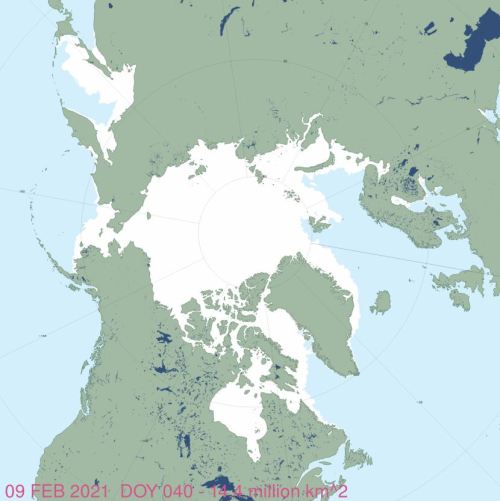
Sea ice across the Arctic in the first week of February is a mix of highs and lows. Bering Sea is back up to almost normal coverage, as is the Barents Sea. However, ice coverage on the East Coast of Canada is the lowest its been in four decades. This is not yet a worry for polar bears because harp seals don’t pup until mid-March in this region so there is at least four weeks of potential ice growth that can happen before the seals are forced to pup on much reduced ice – where polar bears are sure to find them.
Here is a close-up look at sea ice conditions by region at the edges of the Arctic. Continue reading
Comments Off on Polar bear sea ice habitat highs and lows in early February
Posted onOctober 17, 2020|Comments Off on Some surprises in polar bear sea ice habitat at mid-October 2020
Arctic sea ice has been growing steadily since the minimum extent was reached a month ago, with shorefast ice now developing along the Russian and Alaskan coastlines as ice cover expands in the Central Canadian Arctic. So while it’s true that the main pack of Arctic ice is far from the Russian shoreline, rapidly developing shorefast ice will allow bears to begin hunting seals long before ice in the central Arctic Basin reaches the Siberian shore, as they do in Western and Southern Hudson Bay every fall.
Cropped sea ice extent at 15 October 2020(Day 289), NSIDC Masie.
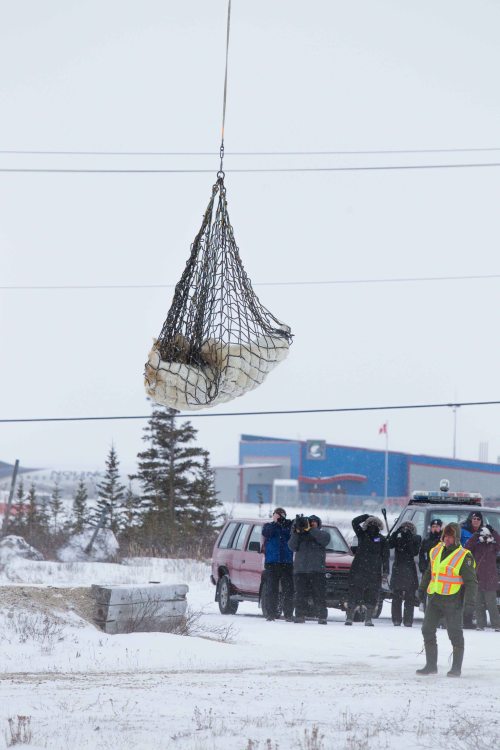
And speaking of Western Hudson Bay, it’s a very slow season around Churchill for problem polar bears (photo below) – the quietest mid-October for the Polar Bear Alert Program in the last five years and perhaps the quietest in decades (which I could say for sure if I had the records but I do not).
Posted onMay 15, 2020|Comments Off on Still pack ice around Bear Island in the Barents Sea on 15 May: last time was 2003
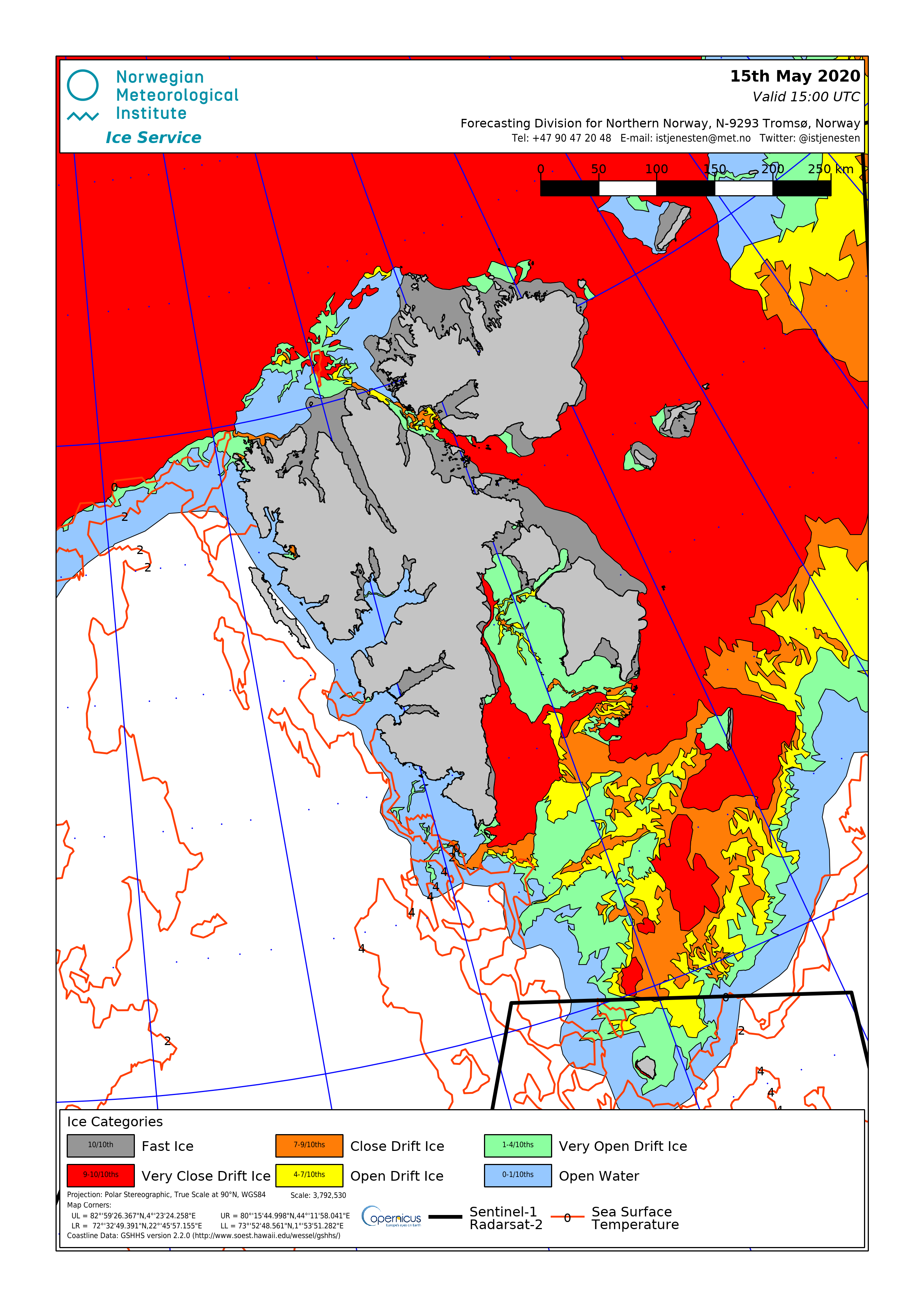
It’s very open drift ice (1-4/10th concentration) but still: Bear Island (Bjørnøya) in the southern Barents Sea was still surrounded by pack ice at 15 May 2020. As far as I can tell from the Norwegian Ice Service archived ice charts, this hasn’t happened since 2003.
And last week, the island was surrounded by heavy drift ice, which hadn’t happened on 8 May since 1977.
Posted onMay 5, 2020|Comments Off on New Paper: Body condition of Barents Sea polar bears increased since 2004 despite sea ice loss
A recent paper that attempted to correlate pollution levels and body condition in Barents Sea polar bears reports it found body condition of female bears had increased between 2004 and 2017 despite a pronounced decline in summer and winter sea ice extent.
“Unexpectedly, body condition of female polar bears from the Barents Sea has increased after 2005, although sea ice has retreated by ∼50% since the late1990s in the area, and the length of the ice-free season has increased by over 20 weeks between 1979 and 2013. These changes are also accompanied by winter sea ice retreat that is especially pronounced in the Barents Sea compared to other Arctic areas” [Lippold et al. 2019:988]
Posted onApril 30, 2020|Comments Off on Svalbard at end of April again has 6th-7th highest sea ice extent & a lot of very thick ice
For the second time this month, sea ice around Svalbard Norway was the 6th or 7th highest since records began in the late 1960s. Pack ice at the end of April still surrounds Bear Island (Bjørnøya) at the southern end of the archipelago, which is a rare occurrence at this date. These conditions document a recurrent pattern of high ice extent and especially extreme ice thickness in the Barents Sea since last summer.
Watch polar bear habitat reform in the Canadian Arctic: “last 10 days” Canadian Ice Service animation (works anytime) HERE.
See Quote archive for details.










 polarbearscience
You must be logged in to post a comment.