The state of emergency in Belushya Guba on Novaya Zemlya is over, according to a report yesterday from the Russian news agency TASS (18 February 2019), as no bears had been spotted over the previous 24 hours.

The state of emergency in Belushya Guba on Novaya Zemlya is over, according to a report yesterday from the Russian news agency TASS (18 February 2019), as no bears had been spotted over the previous 24 hours.
Comments Off on Polar bears driven out of Novaya Zemlya town onto the ice by persistent harassment
Posted in Advocacy, Polar bear attacks, Sea ice habitat
Tagged attack, Barents Sea, climate change, invasion, Kara Sea, Novaya Zemlya, polar bear, Russia, sea ice, seige, state of emergency
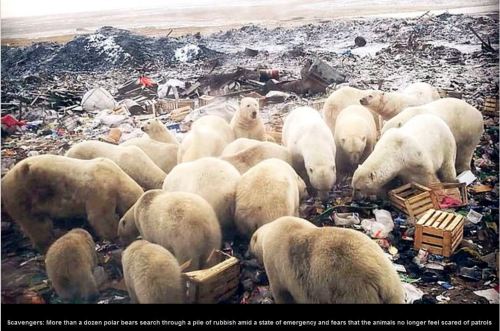
Since early December, a group of 52 polar bears have terrorized the Russian village of Belushaya Guba on southern Novaya Zemlya. The aggressiveness of some of the bears, their boldness in entering local buildings and fearlessness in the face of the usual deterrents has caused the local government to call a state of emergency to help the town residents. Global warming is blamed for the problem but as is so often the case, that claim does not stand up to scrutiny.
Large group of polar bears at the Belushya Guba town dump on Novaya Zemlya, Russia. From the 11 Feb. 2019 story at The Daily Mail.
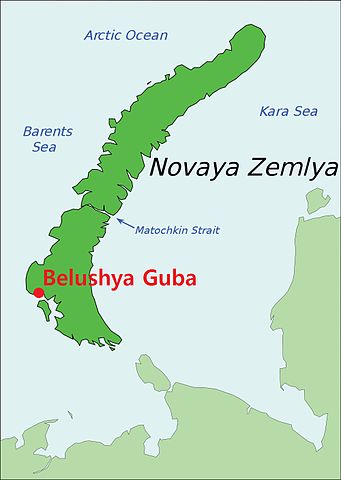
Belushaya Guba is located on the southwest coast of Novaya Zemlya in the eastern Barents Sea. It is a town of mostly military personnel and their families:
The predictable claims that this situation is due to global warming are confounded by the fact that the region has not had abundant sea ice by December in more than 30 years, yet this is the first time the town has had such a problem with polar bears. Polar bears in winter can be very dangerous, as they are often lean and desperately hungry. [except these ones are not, see update below]
UPDATE 11 February 2019: The international media have gone mad for this story and some photos are now available. Best series of photos and video is at The Daily Mail, UK (11 Feb 2019: State of emergency is declared after more than 50 polar bears invade Russian town and ‘chase terrified residents’). No new information is available on the story itself but plenty of hyperbole has been added. The photos show how fat and healthy these so-called ‘desperate’ bears are, which makes the claims that global warming is to blame for the crisis even more ludicrous (see the ice charts below). So far, the most over-the-top take on this goes to the Washington Post (11 Feb 2019: A ‘mass invasion’ of polar bears is terrorizing an island town. Climate change is to blame): they went to the most trouble to make the link to climate change and bring up the vilified ‘starving polar bear’ video that National Geographic was forced to apologize for last August and the debunked 2007 prediction that 2/3 of the world’s bears would be gone by 2050 (Crockford 2017). The Guardian‘s effort is weak by comparison, as is CNN‘s. The news outlet (not a blog) Daily Caller has some quotes from this page. Competition amongst bears for scarce natural resources in winter makes dump sites and stored food available around Arctic communities all the more attractive. When polar bear numbers are high, as they are now, this competition can get fierce. It’s no wonder the bears don’t want to leave.
Comments Off on Polar bears have been terrorizing a Russian town on the Barents Sea since December
Posted in Advocacy, Polar bear attacks, Sea ice habitat
Tagged attacks, Barents Sea, climate change, crisis, emergency, fearless, global warming, invasion, Novaya Zemlya, polar bear, problem bears, sea ice, terror, William Barents
January is the first month of the Arctic winter, the season when most polar bears really struggle to find enough to eat.
Here is what the sea ice looked like around the Arctic at the end of this month.

Compare to last year:
Comments Off on Abundant polar bear habitat across the Arctic at the start of winter
Posted in Advocacy, Conservation Status, Life History, Sea ice habitat
Tagged Arctic, Barents Sea, Canada, denning, Derocher, East Coast, Franz Josef Land, polar bear, sea ice, Svalbard, winter
“…despite the loss of good denning areas and a shrinking habitat for hunting, Svalbard’s bears seem to be doing fine.…The sea ice season is now several months shorter, and the ice edge typically lies several degrees further north than what was normal 20-40 years ago….Polar bears can survive long periods without food, provided they have accumulated a good fat reserve during the few months in spring and summer when sea ice is present, and seals are abundant.” [Jon Aars, Norwegian Polar Institute, 2018]
Jon Aars from the Norwegian Polar Institute has written an update on the status of Svalbard polar bears for the general public (The Barents Observer, 8 January 2019, republished from a story published by The Fram Centre in their newsletter: Population changes in polar bears: protected, but quickly losing habitat).
Read the whole thing below (original has awesome photos). It reports the truth of the current situation with the usual caveats about what might happen decades into the future. Continue reading
Comments Off on Svalbard polar bears doing fine with much less sea ice say Norwegian biologists
Posted in Conservation Status, Sea ice habitat
Tagged Aars, Barents Sea, fat, Norwegian Polar Institute, polar bears, sea ice, seals, spirng, Svalbard
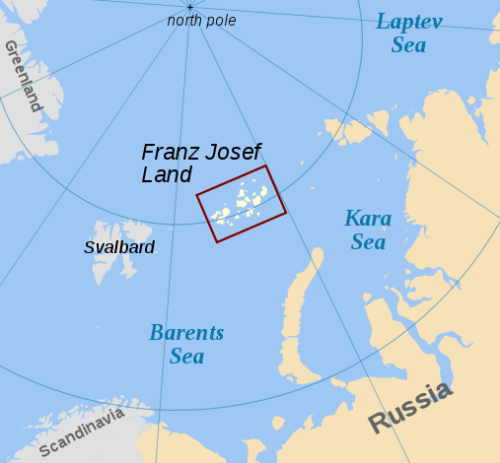
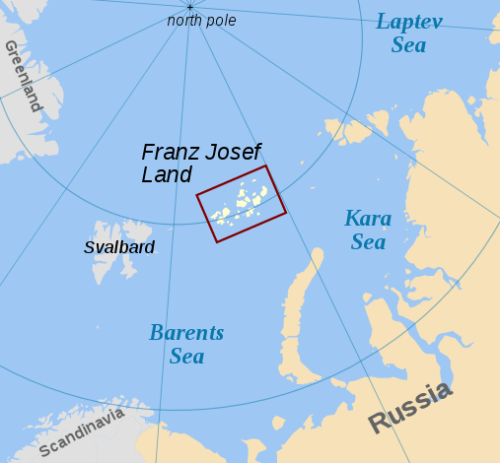
Despite a wild claim that a “slow Arctic freeze” this year increases the risk that polar bears will become extinct, sea ice charts show ice returning earlier than it has for decades everywhere except the Svalbard area of the Barents Sea. That’s good news for pregnant polar bears. Although Svalbard is without ice, that’s been true for so many years that pregnant Svalbard females long ago abandoned the use of islands they used in good ice years and now make their dens in the Franz Josef Land archipelago to the east (which is still within the Barents Sea subpopulation region).
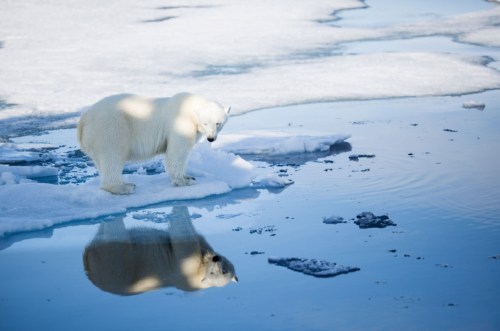
Polar bears give birth around 25 December each year, so pregnant females prefer to be snug in a safe den by around the end of November at the latest. That’s been possible for all regions of the Arctic this year, including the Barents Sea — because sea ice returned to Franz Josef Land weeks ago, even though Svalbard is still ice-free.
Major denning areas in Russia, including Wrangel Island, have been surrounded by ice since the middle of the month, allowing pregnant females that did not remain on shore over the summer to return to make maternity dens. Elsewhere, bears that have been confined to shore over the ice-free season (such as along Hudson Bay and Baffin Island in eastern Canada) returned to the ice to hunt seals weeks ago after the earliest freeze-up in more than two decades.
Comments Off on No extirpation looms for Svalbard polar bears: no pending catastrophe in Norway
Posted in Advocacy, Conservation Status, Life History, Sea ice habitat
Tagged Aars, Barents Sea, Derocher, extinction, extirpation, polar bear, Russia, sea ice, Svalbard
What a difference two weeks make! When the seasonal minimum Arctic sea ice extent occurs in September, polar bear doom-mongers always forget to tell you that within two months, sea ice will return to virtually all regions where polar bears have spent the summer on land, including Hudson Bay. Just as it did in 2007, when polar bears did not die by the thousands due to lack of fall sea ice, polar bear habitat is reforming.
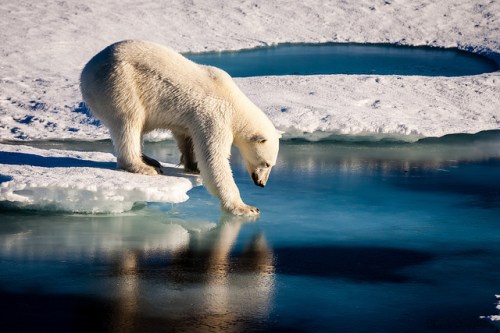
This year, the seasonal minimum came on 23 September. Despite the fact that the US National Snow and Ice Data Center proclaimed that “unusual warmth” in the Arctic continued during October, over the last two weeks sea ice expanded from 6 mkm2 to 9 mkm2. At the current rate of ice growth documented by sea ice charts (see below), Arctic sea ice will be wide-spread by 23 November.
Comments Off on Fall polar bear habitat update: 3 mkm2 Arctic sea ice increase in the last two weeks
Posted in Conservation Status, Sea ice habitat
Tagged Barents Sea, Chukchi Sea, fall, freeze-up, Hudson Bay, polar bear, sea ice, Svalbard
A few polar bears have become stranded on small islands north of Svalbard since the local sea ice retreated — of which the bear that mauled a cruise ship guard last month was but one — and if return of the ice is as late as last year, those handful of bears are likely doomed to die of starvation. This is not due to climate change but rather bad judgment on the part of these few bears. They were not forced ashore: if they’d stayed on the ice like the rest of the population, they’d have likely been just fine.
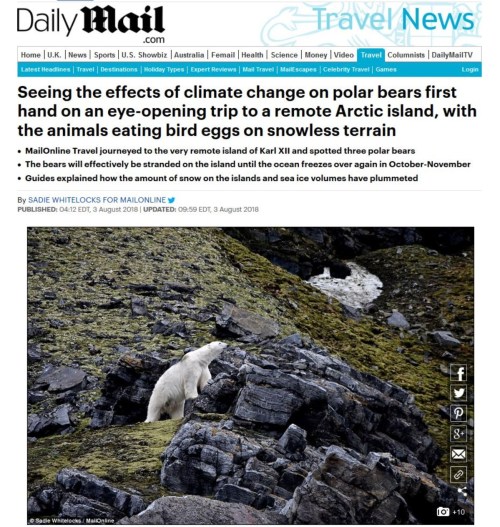
Similar to the bear in northwestern Hudson Bay that fatally mauled a young father in early July, these bears were likely lured ashore by the prospect of masses of bird eggs present on island rookeries. But they overstayed their window of opportunity and the ice retreated without them.
Fledgling birds and bird eggs are not replacements for seals in a bear’s diet but when the season of easy seal kills winds down, as it does in late spring, easy-picking sea bird eggs may be enticing enough to lure a few bears ashore when they’d be better off on the ice.
That is not the fault of climate change.
Unlike bears in Hudson Bay and many other regions — including the Lancaster Sound area of Canada where the National Geographic “starving” bear was filmed last summer — these bears were not forced ashore by retreating ice: they chose to do so.
Continue reading
Comments Off on Brace yourself: more starving polar bear news stories in the pipeline from Svalbard
Posted in Life History, Polar bear attacks, Sea ice habitat
Tagged attack, Barents Sea, climate change, polar bear, Refuge, sea ice, stranded, summer, Svalbard
It is often said that there are more polar bears than people in Svalbard, Norway (see BBC, “Polar bear shot dead after attacking cruise ship guard” 29 July 2018). But that isn’t true now and probably hasn’t been for a very long time. This pseudo-fact (a misunderstanding made by tourism promoters) continues to be quoted as the story about the Svalbard polar bear shot by a cruise ship bear guard last week evolves in the online and print media. The media continue to focus on social media backlash against ecotourism, which is nothing like the pushback about the starving polar video from last year.
Comments Off on Polar bears do not outnumber people in Svalbard and the backlash against ecotourism over a justified defensive kill
Posted in Advocacy, Polar bear attacks, Population
Tagged animal rights actists, attack, backlash, Barents Sea, correctiong errors, Facebook, facts, polar bear, population numbers, Ricky Gervais, sea ice, social media, starving bear, Svalbard, twitter
Less than a month after a fatal polar bear attack near Arviat, Western Hudson Bay, European media reported this morning that one of two German polar bear guards escorting a group of tourists on a shore visit in northern Svalbard was mauled on 28 July by a polar bear before the second guard could kill it.
The man was air-lifted to hospital in Longyearbyen with non-life-threatening head injuries. Whether the bear was fat or thin was not mentioned but a necropsy will be performed.
More details are likely to be available within the next few days. The guards and tourists were from the German cruise ship MS Bremen, which apparently is operating a live web cam. The group landed on the Sjuøyane Islands, the northernmost group of islands in the Svalbard archipelago (see the top of the black box on the map below).
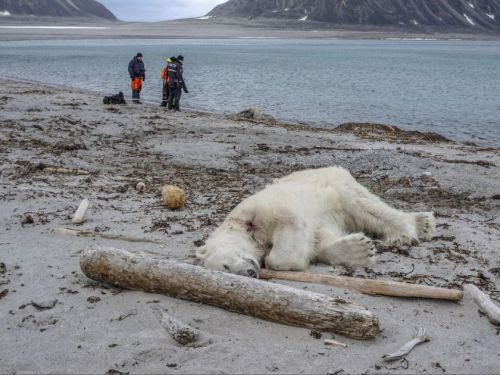
UPDATE 28 July 2018 11:00 pm PT: The photo of the dead bear (above, provided by the Governor of Svalbard), shows the animal was in poor condition. See my comments below regarding sea ice coverage for the area: the bear had likely been on the islands since early May and if he was not in good condition when he left the ice, he would have been desperate by now. However, we still do not know if he was sick or injured, young or old. That information will come with time.
UPDATE 29 July 2018: The cruise ship line has released a statement on Facebook that includes further details about the attack, see below.
Comments Off on Cruise ship bear guard survives being mauled by polar bear in Svalbard
Posted in Polar bear attacks, Sea ice habitat
Tagged attack, Barents Sea, mauling, polar bear, sea ice, Svalbard
Last week, the Norwegian Polar Institute updated their online data collected for the Svalbard area to include 2017 and 2018 — fall sea ice data and spring polar bear data. Older data for comparison go back to 1993 for polar bears and 1979 for sea ice, showing little to no impact of the reduced ice present since 2016 in late spring through fall.
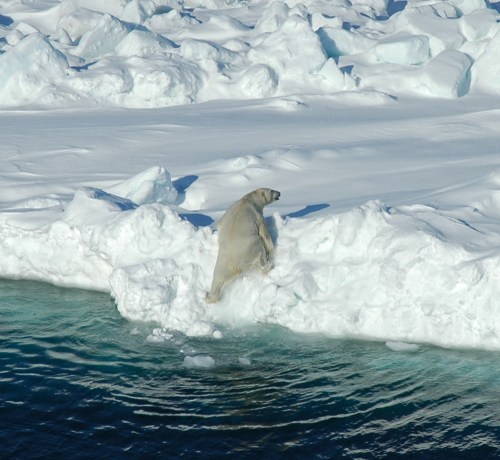
Here’s what the introduction says, in part [my bold]:
“…The polar bear habitat is changing rapidly, and the Polar Basin could be ice-free in summer within a few years. Gaining access to preferred denning areas and their favourite prey, ringed seals, depends on good sea ice conditions at the right time and place. The population probably increased considerably during the years after hunting was banned in 1973, and new knowledge indicates that the population hasn’t been reduced the last 10-15 years, in spite of a large reduction in available sea ice in the same period.”
See Aars et al. 2017 for details on the 2015 Svalbard polar bear population count, keeping in mind that the subpopulation region is called “Barents Sea” for a reason: only a few hundred individuals currently stick close to Svalbard year round while most Barents Sea bears inhabit the pack ice around Franz Josef Land to the east (Aars et al. 2009; Crockford 2017, 2018).
Continue reading
Comments Off on Svalbard polar bear data 2016 through 2018 shows no impact of low ice years
Posted in Advocacy, Conservation Status, Sea ice habitat
Tagged Barents Sea, body condition, decline, denning, Derocher, Franz Josef Land, litter size, mothers with cubs, polar bear, population, sea ice, Svalbard






 polarbearscience
You must be logged in to post a comment.