Tag Archives: Churchill

Sea ice habitat Canada update for 23 July 2016 vs. 2014 & the start of bear problems

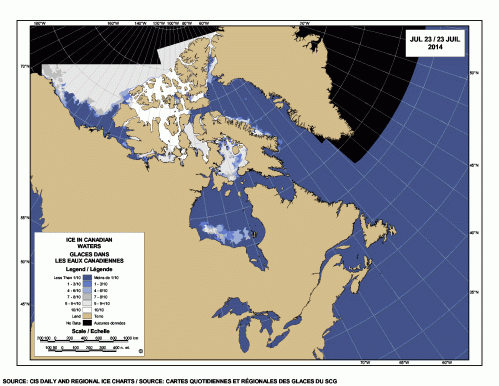
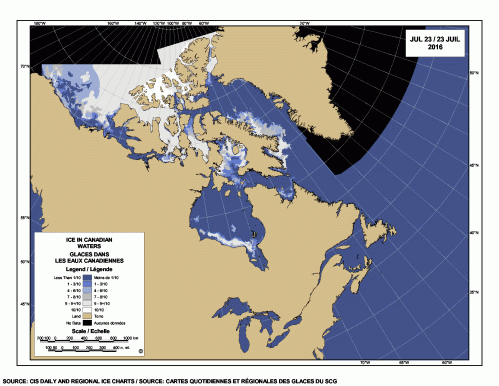
Sea ice breakup is always a little bit different year to year but since I have the maps archived, take a look at the differences and similarities at this date for this year compared to 2014…

Sea ice extent Canada 2016 July 23_CIS

Sea ice extent Canada 2014 July 23 CIS

Is there evidence that any polar bears – say Western Hudson Bay bears, for example – were negatively affected by sea ice levels in 2014? Not that I’ve heard. In fact, quite the opposite.

Polar bear guide and blogger Kelsey Eliasson, writing from Churchill, Manitoba, had this to say about the condition of bears and freeze-up that year (16 Nov. 2014):

“With these families appearing [heading out to the ice], it really sums up at just what a productive season this has been for the western Hudson Bay population. Any guide who knows their stuff will tell you this was a banner year for cubs, one we haven’t seen in a long time.”

Meanwhile, bears are starting to come ashore and cause a bit of grief:

Southern Hudson Bay (two days ago): “Polar bear shot after wandering through Kashechewan” [see map below for location: the bear shot was a cub that appears to have been separated from its mother and sibling, who were spotted several km away not causing any trouble]

Iqaliut, Baffin Island (this morning): “Polar bear rips 6 tents pitched in Iqaluit park”

Continue reading

Polar bears and W. Hudson Bay sea ice breakup 2016

Breakup for Western Hudson Bay (WHB) is looking to be later than usual this year, given that the average breakup date since 1991 has been July 1 (using a 30% threshold) – only a few days from now – and the ice in WHB is nowhere near 50% coverage, let alone 30%.

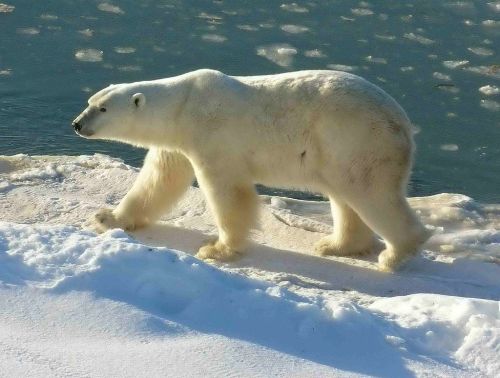
Churchill_Polar_Bear_2004-11-15 Wikipedia

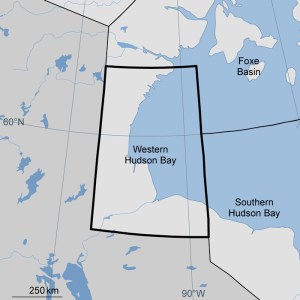
Note that few WHB bears come off the ice around Churchill – most come ashore along the southwest coast of Hudson Bay (almost into SHB) and make their way north over the course of the summer to meet the ice as it reforms in the fall north around Churchill – that’s why it’s called a “migration.”

map-WesternHudsonBay

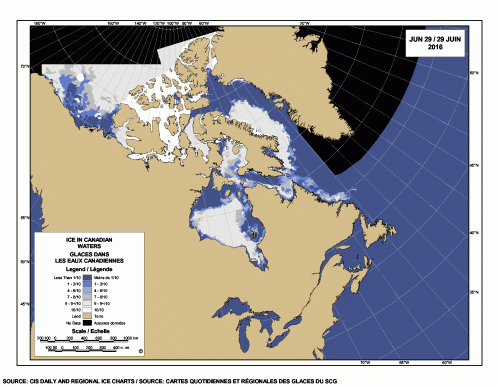
There’s still a lot of ice left in Hudson Bay, as the Canadian Ice Service map for 29 June 2016 (below) shows: Sea ice extent Canada 2016 June 29 CIS

It seems to me that breakup for WHB this year is looking rather like 2014, which was something like a week later than the average since 1991, but time will tell. See below for comparison to 2009 (a late breakup year), 2015, and 2013 (lots of variability!), as well as a discussion of when bears come ashore in relation to this sea ice breakup benchmark.

Continue reading

More Churchill polar bear captures due to increased vigilance not global warming

Polar bear specialists just don’t get it: virtually no one except the ever-gullible media believes their exaggerated stories of doom. Yet they keep trying and with every lie and misrepresentation of fact, they erode the confidence of the public. Unfortunately, it’s not just trust in polar bear specialists that’s being eaten away, it’s trust in science generally.

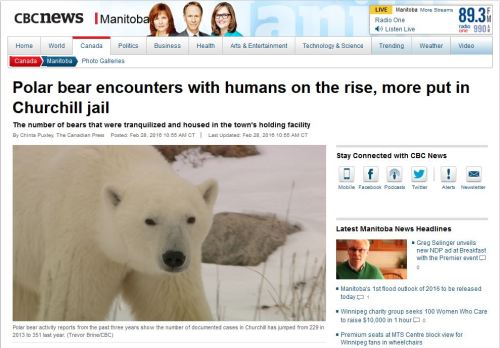
Churchill polar bear encounters up in 2015_CBC headline Feb 28 2016

This time, it’s a head-line grabbing piece about the number of problem polar bears in Churchill, Manitoba (written by Chinta Puxley) that made the usual media rounds yesterday (CBC News, CTV News, Global News, Huffington Post, Winnipeg Sun, The Globe and Mail). The main culprits are Daryll Hedman, regional wildlife manager for Manitoba Conservation, and polar bear biologist Andrew Derocher.

However, it’s hard not to see that the increased number of bears captured by Manitoba Conservation officers around Churchill can be best explained as a natural reaction by officials to a particularly frightening polar bear attack in 2013. Continue reading

Polar bear capital of the world stuck between fear-mongering and science

CBS News published a predictably one-sided “Cover Story” this morning (14 February 2016) about Churchill, Manitoba – the self-proclaimed Polar Bear Capital of the World. 

This is the online version of a Sunday morning TV special that’s not available where I live. It’s yet another example of how the media feeds the politics of polar bears and prevents the advancement of science. Here’s my take on this CBS effort.

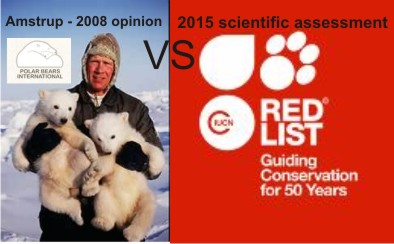
Amstrup vs IUCN science_Feb 14 2016_PolarBearScience

Continue reading

W Hudson Bay polar bears now on the ice hunting but killer whales could be trapped

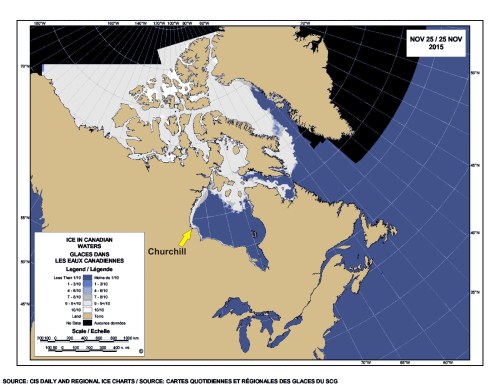
According to reports from folks on the ground in Western Hudson Bay, most polar bears were out on the ice resuming seal hunting by the 20th or 21st November at the latest (some got started quite a bit earlier). That’s less than 2 weeks later than the average date in the 1980s (which was November 8).

Sea ice Canada 25 Nov 2015_with Churchill

However, the rather odd pattern of freeze-up this year may not be good news for any killer whales still remaining in Hudson Bay – their access to the open ocean is already virtually blocked by ice.

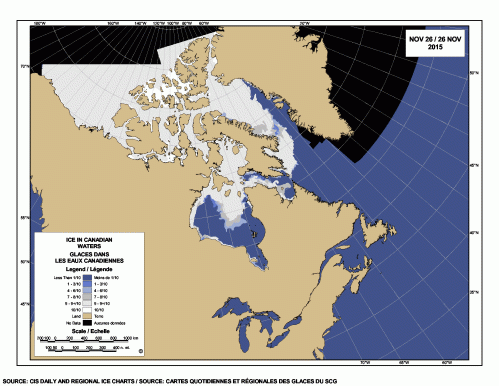
UPDATE 26 November 2015: What a difference a day makes! Look at the spectacular ice development overnight along the west coast of Hudson Bay and in the central portion of the bay since yesterday (below).

Canadian Arctic Nov 26 2015_CIS

Continue reading

Hudson Bay freeze-up moving faster than recent years, WHB polar bear habitat imminent

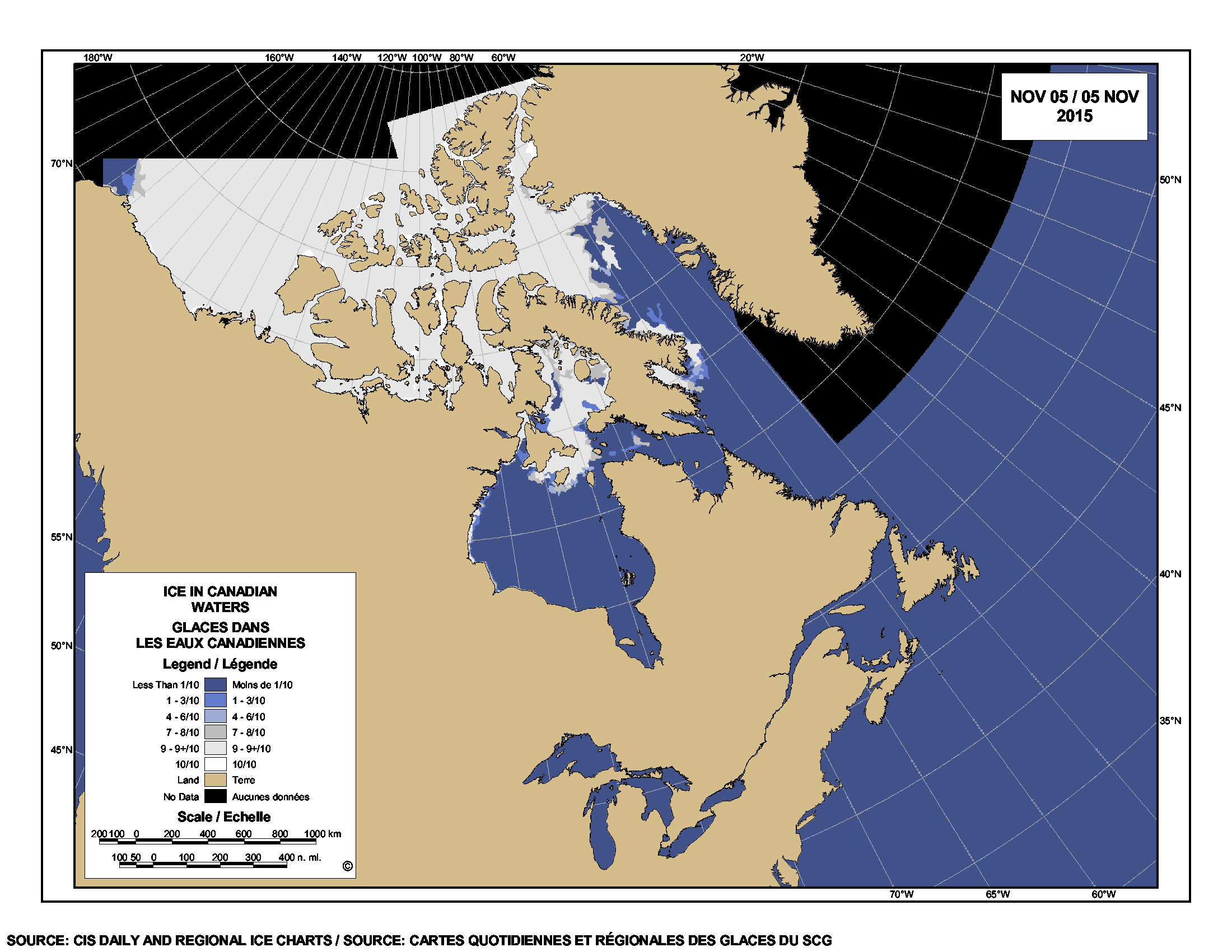
There may not be ice for Western Hudson Bay polar bears to walk on yet but there is still more ice forming along the northwest shore of the bay than last year at this time or even the year before. The Canadian Ice Service (CIS) map for 5 November shows this early formation.

Canadian Arctic Nov 5 2015_CIS

What’s present is mostly grey ice defined by CIS as:

“Young ice 10-15 cm thick, less elastic than nilas [a kind of new ice] and breaks on swell. It usually rafts under pressure.”

Polar bears generally need ice about 30 cm thick to support their weight, which could take a day or two – or a week or two, depending on the weather in northwestern Hudson Bay. For Churchill, along the central coast of western Hudson Bay, ice thick enough for walking will not likely be far behind, given the long-range forecast of freezing weather. In recent years, most Churchill polar bears have left the ice by around 20 November. More maps and graphs for this week below.
Continue reading

Discovery News spreads old misinformation about W. Hudson Bay polar bears

In a just-released Discovery News piece, Kieran Mulvaney (4 November 2015, “In the polar bear capital, an uncertain future) repeated three misleading statements about Western Hudson Bay polar bears that keep making the rounds, despite the fact they have been laid to rest by the latest scientific reports on  (Lunn et al. 2013, 2014; Stapleton et al. 2014). I reviewed these just a few weeks ago.
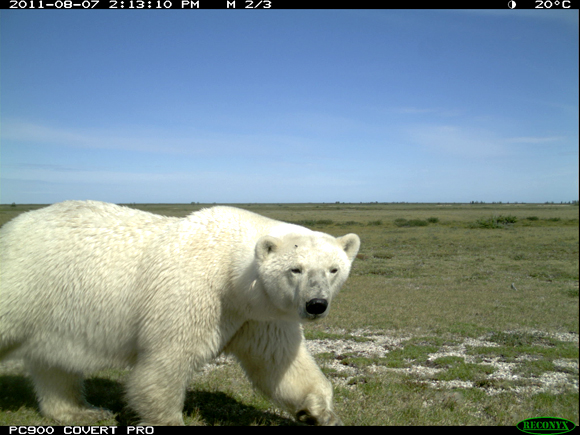
Western Hudson Bay bear, Wakusp National Park, August 2011.

Western Hudson Bay bear, Wakusp National Park, August 2011.

1) “Climate change is causing the bay’s ice to melt earlier and freeze later, causing bears to spend longer a shore.”

Not true. Lunn and colleagues stated explicitly that there has been no trend in either break up or freeze-up of WHB sea ice since 2001. Although there has been large variability in dates, that lack of trend that has continued to this year.

2 & 3) “As a consequence, Churchill’s polar bears are decreasing in number (from approximately 1,350 three decades ago to roughly 900-1,000 now) and in physical condition.”

This deliberately misleading statement avoids the fact that the latest surveys found roughly the same number of bears in 2011 as in 2004 (the estimate used by the IUCN Polar Bear Specialist Group for WHB is 1030) when different counting methods were taken into account. The ~900 bear estimate came from the mark-recapture survey, which left out a portion of the range that the aerial survey covered, hence the official estimate of 1030.

In addition, there has been no scientific assessment of body condition or cub survival since before the last population estimate in 2004 – polar bear “experts” keep telling journalists there are declines but have yet to produce any data to support those claims. The latest surveys did not collect data on body condition or cub survival.

Mulvaney’s misinformation is almost certainly the result of spending time in Churchill with activist Polar Bears International spokesperson Steve Amstrup and activist climate scientist Katherine Hayhoe doing webcasts (e.g. “Challenges of communicating climate change”).  

Mulvaney is clearly not a journalist or a science writer: if he was, he would do some research of his own and stop believing as gospel every word that activist scientists feed him. They are using him as a mouth-piece and sadly, Discovery News is buying it all and presenting it as science.

[Hayhoe, by the way, blocked me on twitter earlier this morning for making one observational comment, my first-ever to her account, in response to a conversation about polar bear population numbers. This is what I said that Hayhoe does not want her followers to know:

“Stop wanton slaughter, #’s go up, works for all species. S Beaufort #polarbear #s dipped due to thick spring #seaice”

Both statements are true and supported by scientific literature. But Hayhoe is all about “climate communication” which appears not to allow science to intrude.]

References
Lunn, N.J., Regehr, E.V., Servanty, S., Converse, S., Richardson, E. and Stirling, I. 2013. Demography and population assessment of polar bears in Western Hudson Bay, Canada. Environment Canada Research Report. 26 November 2013. PDF HERE

Lunn, N.J., Servanty, S., Regehr, E.V., Converse, S.J., Richardson, E. and Stirling, I. 2014. Demography and population assessment of polar bears in Western Hudson Bay, Canada. Environment Canada Research Report. July 2014. PDF HERE [This appears to be the version submitted for publication]

Stapleton S., Atkinson, S., Hedman, D., and Garshelis, D. 2014. Revisiting Western Hudson Bay: using aerial surveys to update polar bear abundance in a sentinel population. Biological Conservation 170:38-47. http://www.sciencedirect.com/science/article/pii/S0006320713004618#

Churchill problem polar bear report for 13-18 October 2015

Latest report on problem bears in Churchill, Manitoba, from the town’s Facebook page.

2015 Oct 13_18_at Oct 19_lg

Polar Bear Alert Program Activity Report as of Oct. 19 (click to enlarge):

30 polar bears handled to date this year; 11 bears in the holding facility this week (6 released, including a sow and two cubs). As mentioned in the new Polar Bear Town reality TV show, Churchill officials have been more vigilant and pro-active since the two polar bear attacks in 2013 than they were previously, capturing any bears than come close to the town.

See previous post here for map and background. Last week’s report here.


Churchill problem polar bear report for 14-20 September 2015

Latest report on problem bears in Churchill, Manitoba, from the town’s Facebook page. See previous post here for map and background. Last week’s report here.

Polar bear-TRANSPORTED-TO-POLAR-PRISON_w Huff Post 2011

Photo above: A bear is transported to Churchill’s polar bear holding facility (from a 2011 Huffington Post article, “Polar Bear Prison”).

22 polar bears handled to date this year; 15 bears in the holding facility this week. See also last post on Polar Bear Town – a new TV reality show about Churchill polar bears.

Polar Bear Alert Program Activity Report as of Sep 21 (click to enlarge):

2015 Sept 14_20_at Sept 21

Polar Bear Town – Churchill bear stories on TV without gloom and doom propaganda

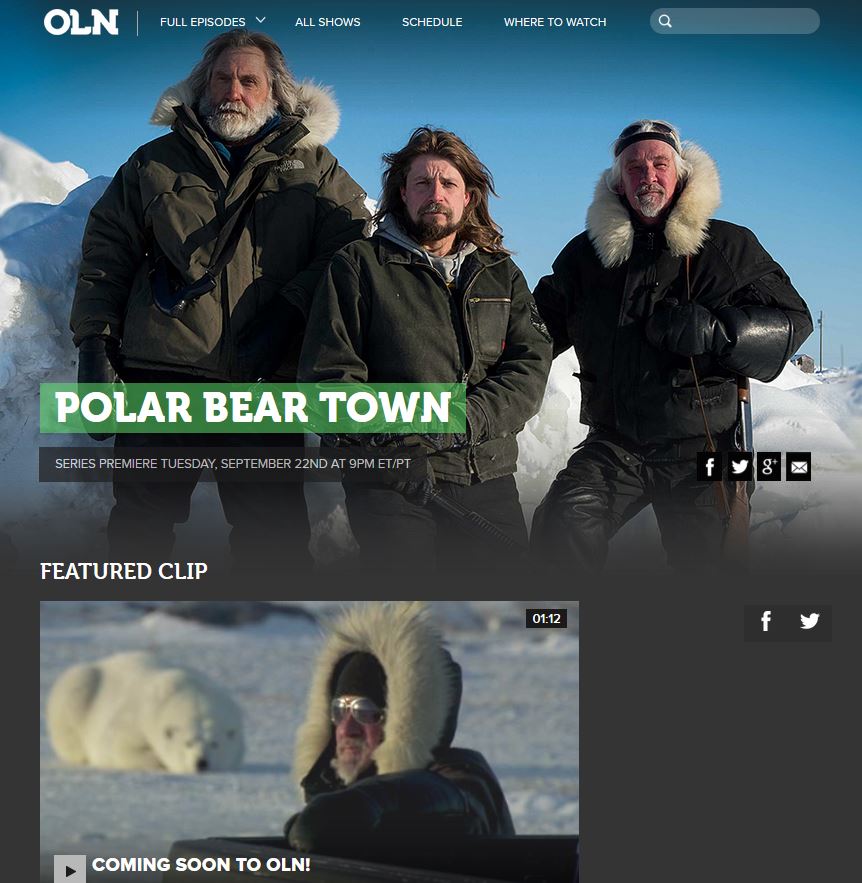
This was kind of fun – featuring the Churchill polar bear guiding trials and tribulations of PolarBearAlleys Kelsey Eliasson, Dennis Compayre, Brian Ladoon, which premiered Tuesday 22 September in Canada and the US. Supposedly, you can watch online episodes that have aired already (wouldn’t work for me).

Polar Bear Town premiere Sept 22 2015

This is a ‘reality’ TV series, not a documentary. It won’t be to everyone’s taste. But by focusing on independent polar bear guides, you see the bears in their element (and the goings-on in the town) without the constant lectures about global warming and predictions that the bears are all going to die that are, I understand, a feature of Tundra Buggy tours operated by the largest outfit, Frontiers North, due to its partnership with Polar Bears International, a strongly activist organization that many polar bear biologists belong (including Steven Amstrup, Ian Stirling, Andrew Derocher, former WWF employee Geoff York).

So far, anyway – perhaps the lectures are to come? YouTube Trailer below.

UPDATED 29 September 2015: OLN has posted the first episode on Youtube, copied below.
Continue reading