Tag Archives: conservation

Ten dire polar bear predictions that have failed as global population hits 22-31k

Grim predictions of the imminent demise of polar bears – their “harsh prophetic reality” as it’s been called – have been touted since at least 2001. But such depressing prophesies have so widely missed the mark they can now be said to have failed.

Rode and Regehr 2010_Chukchi_report2010_triplets redone PNG


While polar bears may be negatively affected by declines in sea ice sometime in the future, so far there is no convincing evidence that any unnatural harm has come to them. Indeed, global population size (described by officials as a “tentative guess“) appears to have grown slightly over this time, as the maximum estimated number was 28,370 in 1993 (Wiig and colleagues 1995; range 21,470-28,370) but rose to 31,000 in 2015 (Wiig and colleagues 2015, [pdf here] aka 2015 IUCN Red List assessment; range 22,000-31,000).

These ominous prophesies have been promoted primarily by Ian Stirling, Steven Amstrup, Andrew Derocher and a few other IUCN Polar Bear Specialist Group (PBSG) members but ironically, it’s data collected by their colleagues that’s refuted their message of doom.

Here are the predictions (in no particular order, references at the end):
Continue reading

The old ‘website revision’ excuse for not updating polar bear status changes

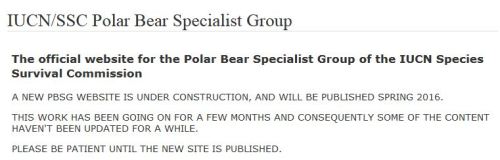
Apparently, the IUCN Polar Bear Specialist Group (PBSG) thinks that it’s OK to mislead the public on the conservation status of polar bears for half a year because its website is being revamped. This conservation organization is of the opinion that people landing on their website while searching for official polar bear status information don’t need to know right away that a new IUCN Red List document was published in November 2015. We know this because the message below appeared on the PBSG homepage 14 January 2016 (text in bold was there previously: the new message is in CAPS), screencap of entire page at 16 Jan 2016 pdf here:

PBSG website notice_2016 Jan 14 update

It appears that the PBSG feels that the public can wait to be told about 2015 Red List decision until the PBSG are ready for them to be told, which could be anywhere from March to the end of June 2016, depending on what definition of “spring” they use. Anyone (like moi) suggesting this tactic is paramount to withholding unpleasant information is just being “impatient.”

Decide for yourself but to me, this PBSG message speaks volumes: it says the 2015 IUCN Red List assessment is bad news for polar bear predictions of gloom and doom. Polar bear specialists don’t want to talk about it because it is a slap-down of all previous attempts at predicting a grim future for the bears (see the summary at the end of this post).
Continue reading

IUCN Red Book officials forced scientific standards on polar bear predictive models

As I reported Thursday, the IUCN announcement of a new Red List assessment for polar bear got the usual overwrought attention from international media outlets. However, not one of these contained a quote from a polar bear biologist.

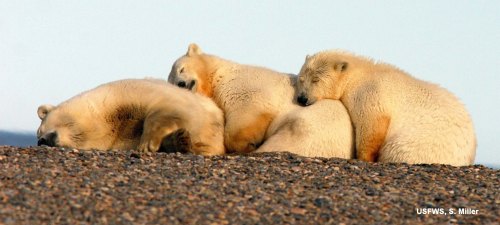
polarbears-arcticnatlwildliferefuge-suzannemiller-usfws_labeled_sm

Steven Amstrup, science spokesperson for activist conservation organization Polar Bears International, has so far had nothing to say to the media. Yet, Amstrup was a co-author of the IUCN Red List report. Not until late in the day following the release of the report did his his organization’s website post a short, bland news report (“Climate Change Still Primary Threat to Polar Bears”).

Similarly, Ian Stirling, Andrew Derocher, Nicholas Lunn (also a co-author of the IUCN Red List report), and former WWF employee Geoff York – who are usual go-to guys for polar-bears-are-all-going-to-die media frenzies – have so far been silent and invisible on this issue.

In addition, while the IUCN press release [backup here: 2015 IUCN Red List press release_Nov 19 2015] included a quote from IUCN Polar Bear Specialist Group (PBSG) chairman Dag Vongraven, as of this morning (21 November, PST), the website of the PBSG contains no mention of this decision – no item in the “News” category  and, more importantly, no update of the status table  or global estimates to reflect the changes contained in the report  (even though they obviously knew it was coming months ago: the report was submitted to the IUCN Red List 27 August 2015).

In my opinion, this silence says it all: polar bear specialists know this assessment is a severe de facto critique of their 2008 assessment (as well as Amstrup’s predictive models) and it’s a big step backwards for their conservation activism. I expect they are silent because they are royally pissed off.

However, this assessment is good news because finally, some standards of scientific rigor have been applied to polar bear predictive models – even though the PBSG were still been allowed to pretend that summer sea ice coverage is critical to polar bear health and survival (Crockford 2015).  Continue reading

Discovery News spreads old misinformation about W. Hudson Bay polar bears

In a just-released Discovery News piece, Kieran Mulvaney (4 November 2015, “In the polar bear capital, an uncertain future) repeated three misleading statements about Western Hudson Bay polar bears that keep making the rounds, despite the fact they have been laid to rest by the latest scientific reports on  (Lunn et al. 2013, 2014; Stapleton et al. 2014). I reviewed these just a few weeks ago.
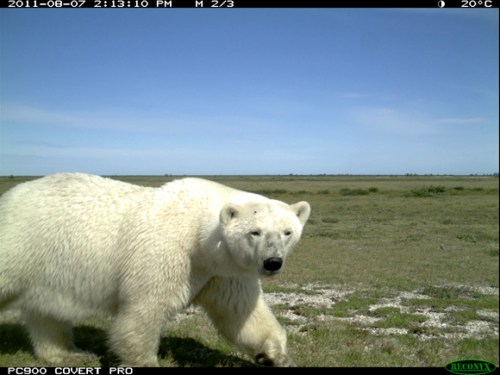
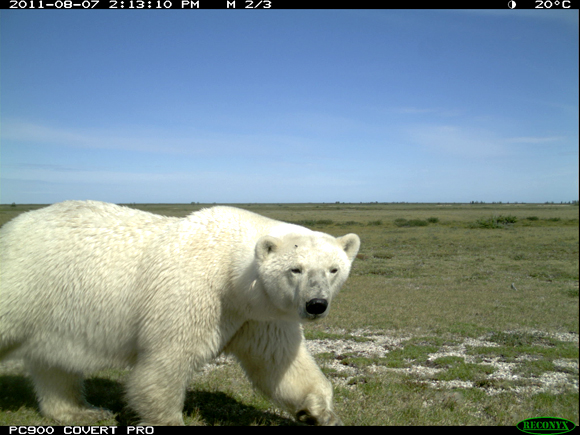
Western Hudson Bay bear, Wakusp National Park, August 2011.

Western Hudson Bay bear, Wakusp National Park, August 2011.

1) “Climate change is causing the bay’s ice to melt earlier and freeze later, causing bears to spend longer a shore.”

Not true. Lunn and colleagues stated explicitly that there has been no trend in either break up or freeze-up of WHB sea ice since 2001. Although there has been large variability in dates, that lack of trend that has continued to this year.

2 & 3) “As a consequence, Churchill’s polar bears are decreasing in number (from approximately 1,350 three decades ago to roughly 900-1,000 now) and in physical condition.”

This deliberately misleading statement avoids the fact that the latest surveys found roughly the same number of bears in 2011 as in 2004 (the estimate used by the IUCN Polar Bear Specialist Group for WHB is 1030) when different counting methods were taken into account. The ~900 bear estimate came from the mark-recapture survey, which left out a portion of the range that the aerial survey covered, hence the official estimate of 1030.

In addition, there has been no scientific assessment of body condition or cub survival since before the last population estimate in 2004 – polar bear “experts” keep telling journalists there are declines but have yet to produce any data to support those claims. The latest surveys did not collect data on body condition or cub survival.

Mulvaney’s misinformation is almost certainly the result of spending time in Churchill with activist Polar Bears International spokesperson Steve Amstrup and activist climate scientist Katherine Hayhoe doing webcasts (e.g. “Challenges of communicating climate change”).  

Mulvaney is clearly not a journalist or a science writer: if he was, he would do some research of his own and stop believing as gospel every word that activist scientists feed him. They are using him as a mouth-piece and sadly, Discovery News is buying it all and presenting it as science.

[Hayhoe, by the way, blocked me on twitter earlier this morning for making one observational comment, my first-ever to her account, in response to a conversation about polar bear population numbers. This is what I said that Hayhoe does not want her followers to know:

“Stop wanton slaughter, #’s go up, works for all species. S Beaufort #polarbear #s dipped due to thick spring #seaice”

Both statements are true and supported by scientific literature. But Hayhoe is all about “climate communication” which appears not to allow science to intrude.]

References
Lunn, N.J., Regehr, E.V., Servanty, S., Converse, S., Richardson, E. and Stirling, I. 2013. Demography and population assessment of polar bears in Western Hudson Bay, Canada. Environment Canada Research Report. 26 November 2013. PDF HERE

Lunn, N.J., Servanty, S., Regehr, E.V., Converse, S.J., Richardson, E. and Stirling, I. 2014. Demography and population assessment of polar bears in Western Hudson Bay, Canada. Environment Canada Research Report. July 2014. PDF HERE [This appears to be the version submitted for publication]

Stapleton S., Atkinson, S., Hedman, D., and Garshelis, D. 2014. Revisiting Western Hudson Bay: using aerial surveys to update polar bear abundance in a sentinel population. Biological Conservation 170:38-47. http://www.sciencedirect.com/science/article/pii/S0006320713004618#

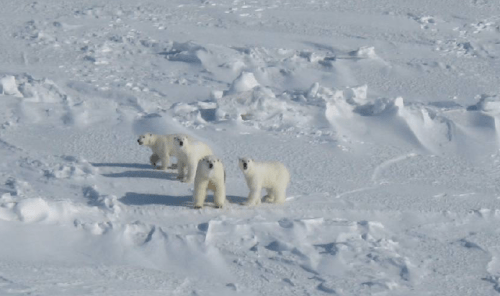
Churchill problem polar bear report for 7-13 September 2015

Latest report on problem bears in Churchill, Manitoba, from the town’s Facebook page. See previous post here for map and background.

19 polar bears handled to date this year; 12 bears in the holding facility.

Polar bear-TRANSPORTED-TO-POLAR-PRISON_w Huff Post 2011

Photo above: A bear is transported to Churchill’s polar bear holding facility (from a 2011 Huffington Post article, “Polar Bear Prison”).

Activity report for 7-14 September 2015 copied below (click to enlarge):

2015 Sept 7-13_at Sept 14

Polar bears will not be considered for severe CITES trade restrictions

The CITES working group meeting that just concluded in Tel Aviv, Israel a few days ago decided it would not recommend a vote to move polar bears from Appendix II, where they are now, to Appendix I, at the next general CITES meeting in 2016.

CITES 2015 meeting logo

It appears, however, that the US – which was behind failed petitions in the past (in 2010 and 2013) and voiced an official objection to this 2015 decision – is threatening to raise the issue again at the next all-nations meeting of CITES in September 2016 (probably with a petition at that meeting).

The USA is trying to bully Canada and the international community to adopt its own shaky interpretation of what constitutes good polar bear science and it looks like it may refuse to give up until it has won.

UPDATE: 7 September 2015,  CITES press release (pdf here, relevant passage marked by me):

“The Committee’s Review of Significant Trade concluded that the current level of trade in polar bears, amongst others, is not detrimental to the survival of the species in the wild.
Continue reading

Designated critical habitat for Alaskan polar bears offers no protection from thick spring ice deaths

The Obama administration is apparently attempting to overturn a previous ruling that rejected proposed Alaskan “critical habitat” for polar bears in 2013 – as if “critical habitat” would protect the bears from the repeated episodes of thick spring ice that develop in this region every 10 years or so.

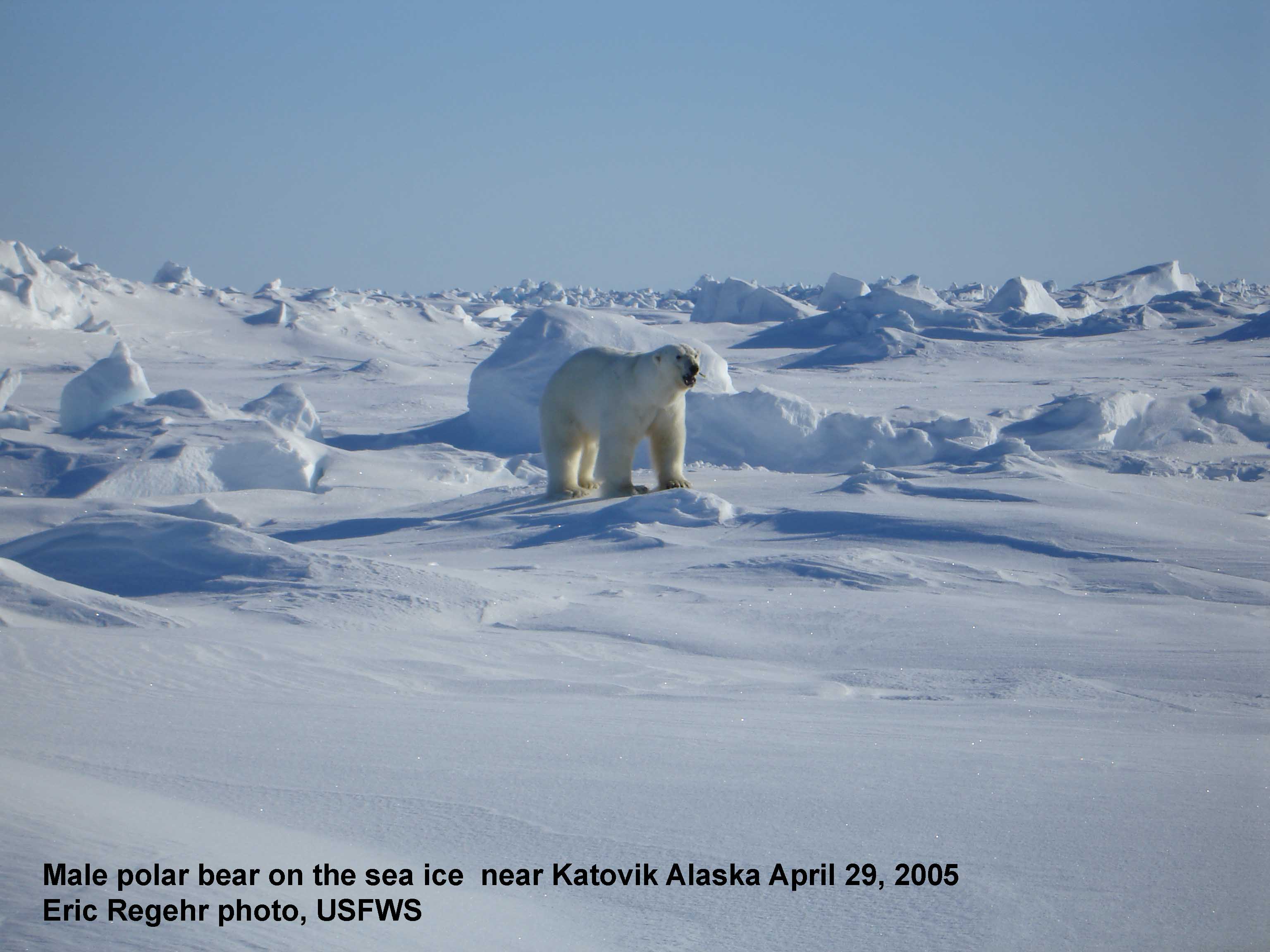
Polar_Bear_male on sea ice_Alaska Katovik Regehr photo_April 29, 2005_sm labeled

According to a Reuters report today (5 May 2015):

Seeking to reverse a ruling throwing out its designation of critical habitat for polar bears, the Obama administration has defended its decision to list large swathes of the Arctic as necessary for the conservation of the threatened species.

A coalition of oil industry groups and Alaska Natives, represented by Stoel Rives and Holland & Hart, successfully persuaded the U.S. District Court for Alaska to vacate the government’s polar bear habitat designation in 2013.” [my bold]

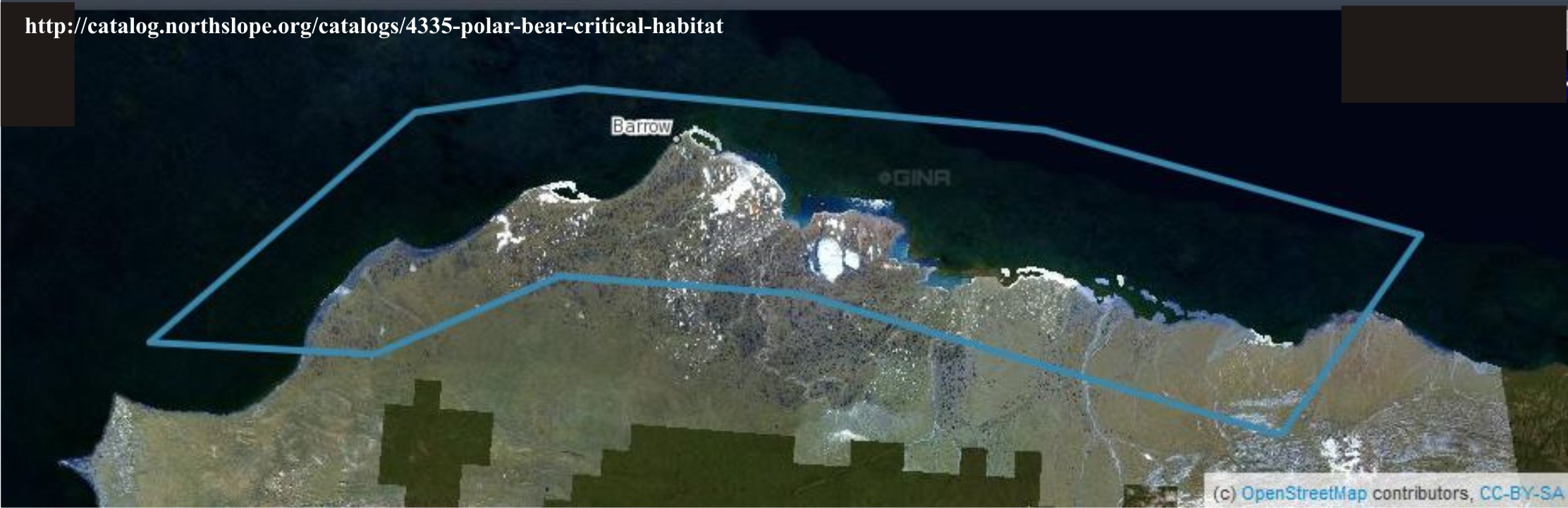
If they succeed, it would put most of the north coast of Alaska under special ESA rules, as the map below shows (click to enlarge).

Critical habitat Polar Bears US_NorthSlopeOrg map_labeled_PolarBearScience

As I commented previously, regarding the Obama administration’s recommendation to congress that they approve a proposed Arctic wildlife refuge area on Alaska’s North Slope, this move (if implemented) would not protect polar bears from the starvation deaths due to thick spring ice conditions that have occurred in this region for 2-3 years out of every 10 since 1960 at least.

The other issue is how much additional, biologically meaningful protection a critical habitat designation would provide for Southern Beaufort and Chukchi Sea polar bears – over and above that already provided by the Marine Mammal Protection Act.
Continue reading

US biologists used same flawed models for listing walrus and polar bears as ‘threatened’

More bad science: US biologists successfully used a scientifically flawed model to get polar bears listed as ‘threatened’ and thus emboldened, went on to do the same for walrus.

Walruses_USFWS photo_030515_March 2015

The intricate US Geological Survey model of ‘expert opinion’ that was used to support the listing of polar bears as ‘threatened’ under the US Endangered Species Act (ESA) has been soundly rejected by the world’s leading conservation organization, the IUCN,1 which has has tightened its rules for using “future conditions” (e.g., effects of global warming) in generating Red List assessments. That IUCN condemnation means the USGS model was never “the best available science” for evaluating the status of polar bears  ̶  it was (and still is) substandard, inadequate science that makes a mockery of serious conservation efforts.

However, not only has this flawed model continued to be used by the USGS for polar bears, it has also been used to assess the conservation status of Pacific walrus, which are now officially “candidates” for being listed as ‘threatened’ (US Fish and Wildlife Service 2011).2

Continue reading

Twenty good reasons not to worry about polar bears

PB  logo coloured Here’s a new resource for cooling the polar bear spin, all in one place. I’ve updated and expanded my previous summary of reasons not to worry about polar bears, which is now two years old. In it, you’ll find links to supporting information (including previous blog posts of mine that provide background, maps and extensive references), although some of the most important graphs and maps have been copied into the summary. I hope you find it a useful resource for refuting the spin and tuning out the cries of doom and gloom about the future of polar bears — please feel free to share. Pdf here of the text below.

This is the 1st anniversary of Canada providing population estimates and trends independent of the pessimistic prognostications of the IUCN/SSC Polar Bear Specialist Group (PBSG) — so let’s celebrate the recent triumphs and resilience of polar bears to their ever-changing Arctic environment.

AK PB N Shore-USFWS Barrow_labeled
Continue reading

‘Threatened’ status for Arctic ringed seals under ESA makes no sense

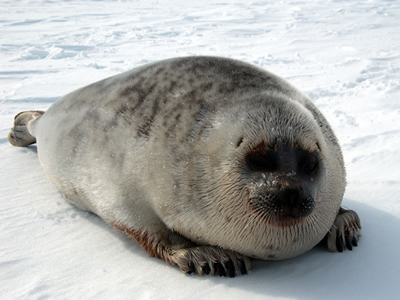
Recent research (Crawford and Quakenbush 203; Rode et al. 2014) has shown that sea ice declines in the Chukchi and Beaufort Seas have made life better for ringed seals, not worse (as predicted) – ringed seals are in better condition and reproducing better than they were in the 1970s. Why? Ringed seals do most of their feeding in the open-water period (Young and Ferguson 2013), so a longer open-water season means fatter, healthier seals and more fat pups for polar bears to hunt the following spring.

Ringed_seal_2_NOAA

However, Arctic ringed seals (as well as bearded seals) were designated as ‘threatened’ by the USA in 2012 under the Endangered Species Act, based on predicted ice and snow declines due to prophesied global warming. These listings are all about future threats, with no pretense of on-going harm.

Virtually no other Arctic nation has taken this step for Arctic seals — see previous discussion here. There are lots of ringed seals — an estimated 3-4 million world-wide and about 1.7 million within the critical habitat proposed by NOAA (see below).

As weak as the case for listing polar bears as ‘threatened’ has proven to be, the case for listing ringed and bearded seals is even more feeble (a judge has already sent the bearded seal listing back to the drawing board).
Continue reading