Tag Archives: polar bear

Five years of polar bear habitat at June 20 around the Arctic

Five years worth of sea ice maps for the same date is hard to come by in this country, since the Canadian Ice Service does not archive their daily sea ice maps. However, due to some forethought, I have at hand ice maps going back to 2012 for the longest day of the year for Canada and archives for other regions provide similar perspective at the solstice.
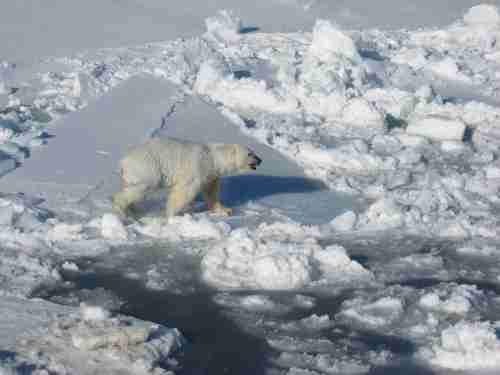
Polar_Bear_male on sea ice_Regehr photo_March 21 2010_lg

Few photos of polar bears in June likely exist – too early for most bears to come ashore and the ice too unstable for humans to be offshore [photo above is dated March].

Compare the five maps for Canada and eastern Alaska below. Notice the differences for Hudson Bay: it may seem ironic, but 2012 (which had the lowest September minimum since 1979 due to an August storm) had the most typical Hudson Bay breakup/melt pattern compared to previous years. [Keep in mind this recent post about how much ice can remain even when almost none is visible on the ice maps]

In many regions, polar bear hunting efforts are seldom successful after early June because young-of-the-year seal pups have taken to the water to feed, which means the only prey still on the ice are predator-savvy adults and subadults that have an easy time escaping in the rapidly breaking up ice fields. Bears that come ashore in June likely are not missing much – a little less ice than usual at this time of year is not going to make much difference.

Overall, despite doom and gloom predictions we heard in March 2016 (“wintertime extent hits another record low”), sea ice extent (courtesy NSIDC) at 20 June 2016 was the same at this date as it was in 2010 and 2012 at this time of year – which essentially marks the end of the primary feeding period for polar bears (except for those that live in the Canadian Arctic Archipelago, where seals give birth a bit later in the spring).
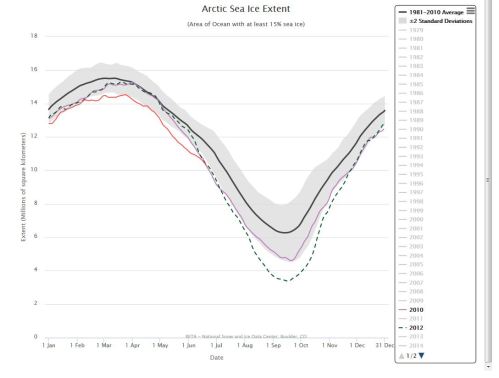
Sea ice at 20 June_2016 vs 2012 and 2010_NSIDC interactive

And did polar bears die in droves due to conditions in 2010 or 2012, in any subpopulation around the Arctic affected by low sea ice levels? No, they did not. In fact, the subpopulation that had the most recent survey done (Svalbard portion of the Barents Sea – 2015) was not only found to be thriving but numbers had increased markedly (42%) over 2004 levels. Now that’s resilience!
Continue reading

Terrestrial food fight amongst polar bear researchers reflects political differences

With a few big guns on one side and some fringe folk on the other, a dichotomy of opinion has developed amongst polar bear researchers regarding whether or not consumption of land-based foods is making a difference to polar bear survival (or is likely to in the future).

Polar bears eating terrest foods WHB_Rockwell press release

It’s been going on for a while now. Last year, two US Geological Survey members of the IUCN Polar Bear Specialist Group (PBSG) apparently got fed up with the scatter-shot of papers promoting terrestrial foods as a possible salvation for polar bears (e.g. Iles et al. 2013;  Iverson et al. 2014; Rockwell and Gormezano 2013a, 2013b). In April, they published a canon volley of a paper meant to blow all that ‘polar-bears-might-survive’ talk out of the water once and for all (Rode et al. 2015).

Note that although the PBSG didn’t bother to update their website with the IUCN Red List assessment when it came out last November, they had a link up to the USGS terrestrial feeding paper within 16 days (with an editorial summary in the “NEWS” section as well as a listing of the paper in the “RECOMMENDED READING” section). As I suggest below, this difference in treatment may not be a coincidence.

However, another group of non-PBSG researchers  haven’t given up just yet, as shown by the title chosen for the most recent news report (Alaska Dispatch News, 16 June 2016) on the just-finished International Bear Conference:

Want to know how a changing climate is affecting polar bears? Look at what they’re eating.

Apparently, Jeff Welker, a University of Alaska Anchorage researcher who is co-author on two recent papers on the subject of polar bear consumption of terrestrial foods (Tartu et al. 2016 and Rogers et al. 2015), gave a presentation at the conference that raised this topic yet again. His talk came on the heels of an earlier presentation by Todd Atwood, who suggested Southern Beaufort polar bears might benefit from staying onshore to eat left-over whale scraps instead of staying on the sea ice during the summer (even though he had no data to support that opinion – as I discussed in this post).

Here’s the question: is this dispute really about what polar bears eat or don’t eat when they’re on land – or is it symptomatic of the underlying politics of polar bears? [CBC documentary video by that name here]
Continue reading

PBSG failure to acknowledge 2015 IUCN polar bear update drives the public here

It is now past the 15 June 2016 mark and the IUCN Polar Bear Specialist Group (PBSG) has still not acknowledged the 2015 IUCN Red List update on the status of polar bears. See the screencap below, taken this morning.

PBSG at 16 June 2016

This notice has been up since 14 January 2016 and no reference or link to the November 2015 IUCN Red List update has been posted, even though PBSG members authored the report (pdf here)!

What they may not realize is that their silence just drives people who search the internet looking for up-to-date population and conservation status info on polar bears to this site. My posts on population size and conservation status have been the most popular posts since November.

It’s that kind of attention that has made this site so popular: PolarBearScience will reach 750,000 views within the next couple of weeks (see “Blog Stats” lower right) – that’s right, 3/4 million views in less than four years. More than 400,000 readers have come here since the end of July 2012 to find out what’s really going on in the world of polar bears. Continue reading

Polar bears are not bloodthirsty killers, says biologist [just don’t forget your gun]

According to records compiled by James Wilder, a US Forest Service biologist, there were only 20 fatal polar bear attacks (out of 73 total attacks) between 1870 and 2014.

That’s what the 14 June 2016 account in the Anchorage Daily News says (“Sea ice has been keeping polar bears and humans apart — until now”). But I think it’s kind of delusional to suggest that a list of recorded attacks, spanning 145 years throughout the Arctic (including Russia), have captured more than a fraction of all actual polar bear attacks – given that many Arctic communities didn’t have reliable communications in the 1970s (let alone the 1870s). How about all the Inuit and Siberian hunters over the years who failed to return home because they were killed and eaten by a polar bear – unbeknownst to anyone?

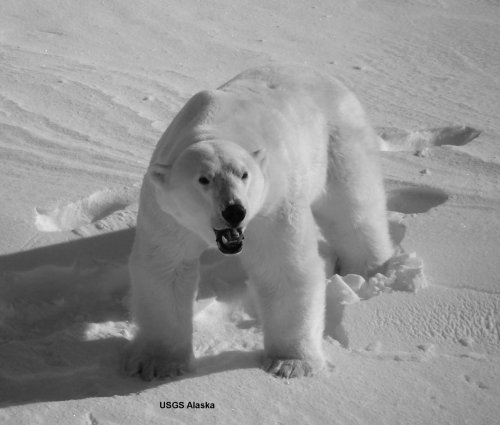
Alaska PB USGS_marked

Wilder presents these numbers as a basis for saying how concerned he is that a longer open-water season in the Arctic could increase the number of attacks by polar bears – and he’s right, that’s a valid concern now that the global population of bears is so high. Many polar bears plus people in a confined area is never a comfortable situation, as the people of Churchill, Manitoba have learned.

But declining sea ice is not the only scenario that could lead to an onslaught of hungry bears and a slew of fatal attacks, as my new science-based novel EATEN highlights. The truth is that if polar bears don’t get enough food in the spring – for any reason – the ice off the beaches of Arctic communities gives polar bears easy access to human prey. If that happens, people had better be prepared – because doors and windows won’t necessarily stop a determined polar bear.

EATEN ebook sale 2016 susancrockford_dot_com

Continue reading

New paper shows no harm from more time on land for S. Beaufort polar bears

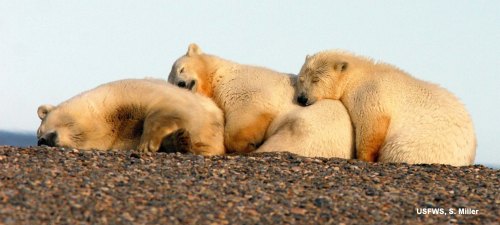
polarbears-arcticnatlwildliferefuge-suzannemiller-usfws_labeled_smTake-home quote from a new polar bear paper by Todd Atwood and colleagues (2016):
“…there is no causal link between the patterns in polar bear vital rates and increased use of terrestrial habitat…”

In other words, there was no information to link the increased time polar bears spent onshore with either an increase or a decrease in body condition, survival or cub production. The authors did find that polar bears were strongly attracted to the bone piles that accumulated in the fall from 2010-2013 after Inuit bowhead whale (Balaena mysticetus) hunting at Barrow, Cross Island, and Kaktovik. Isn’t that a surprise?

The results also appear to confirm previous work that showed terrestrial (land-based) foods are not important to polar bears – a conclusion I totally agree with and which I discussed last year here. No wonder there was no press release issued by USGS about this study. It’s only “news” because someone the Anchorage Daily News interviewed lead-author Atwood yesterday as a way of promoting the International Bear Conference (see previous post here, now updated with a link to the Talk of Alaska radio podcast). Atwood implied there could be advantages to bears from feeding on the bone piles but admitted he had no data to support that assumption.
Continue reading

Some inconvenient polar bear facts supported by scientific literature

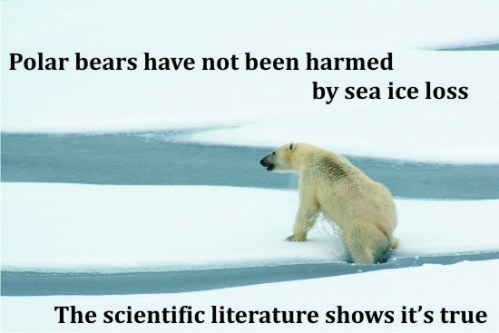
The evidence that polar bears have not been harmed by recent declines in sea ice is contained in the scientific literature, no matter what some researchers say when they talk to the media.

USGS w_polarbearscience_caption 2016

Here’s a few of those facts (not all, by any means), with the references to back them up:
Continue reading

WWF and the International Bear Conference

The 24th International Conference on Bear Research and Management is coming up mid-month (12-16 June, 2016) in Anchorage, Alaska, and local media outlets are already gearing up. This conference is about all species of bears but the Arctic icon is apt to get most of the attention.

APM_The Science of Bears_June 7 2016 radio screencap_at 5 June marked


First up on the media roster appears to be an APRN Talk of Alaska radio talk show entitled The Science of Bears that will feature, among others, Steve Amstrup (spokesperson for Polar Bears International, of “Save Our Sea Ice” fame) and Margaret Williams (WWF, with a Masters in Environmental Studies), scheduled for Tuesday, June 7 at 10:00 AM Alaska time (that’s 11 AM Pacific).

Calls will be taken from the public and comments via email are invited (see below). It could be worth a listen, so mark your calendars. I’ll post a link to the audio podcast here if and when one gets published.

As for the ethics of such a close relationship of international bear scientists with the environmental activists at WWFone of the richest ‘charities’ around (and one might suppose, plans to stay that way), you’ll have to make up your own mind. Maybe the radio host will ask…

UPDATE 8 May 2016: Here’s the link to the podcast of this Talk of Alaska program from yesterday, which is provided in iTunes format (if you don’t have an iPhone or Apple tablet, you’ll need to down the iTunes program to your PC – a link for which is provided automatically. I did it and it works just fine. On the list of programs provided at the link, just click on the forward arrow to the left of “The Science of Bears”): https://itunes.apple.com/podcast/talk-of-alaska/id264469515?mt=2
Continue reading

Tracking polar bears in the Beaufort Sea and the issue of open water in May

A map posted by USGS shows that the 13 polar bears with tags or collars tracked during April 2016 in the Beaufort Sea were down to 9 in May (7 females with collars, 2 subadult or adult males with tags). As two rather large patches of open water formed last month in the Beaufort – mostly due to winds and currents, rather than melt (see animation below, original post here) – a reasonable question is this: how have polar bears dealt with this somewhat unusual condition?

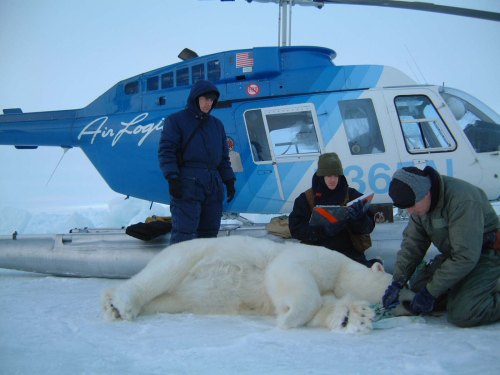
Polar_Bear_Biologist_USFWS_working_with_a_Bear_Oct 24 2001 Amstrup photo

Beaufort Sea breakup in April due to the effects of the Beaufort Gyre (NASA video):

There is also fairly extensive open water in Hudson Bay, so the same question can be asked for that region as well – but fortunately, we have data on tagged bears from both regions to give us a clue as to how the bears are faring.
Continue reading

Most polar bear hybrids said to exist have not been confirmed by DNA testing

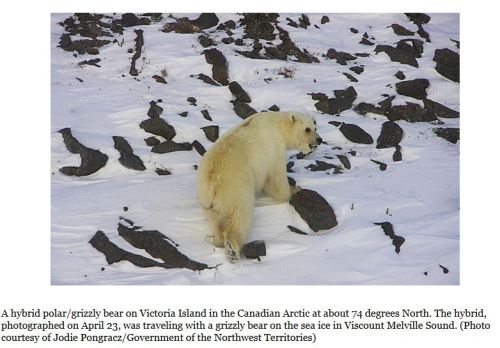
Although there are only two confirmed polar bear X grizzly hybrids (see recent posts here and here) – one in 2006 and a 2nd generation back cross in 2010 – there have been a few other unconfirmed sightings and/or hunters reports in addition to the Arviat animal shot last week, but how many?

Hybrid sightings Victoria Island spring 2012 Jodie Pongracz_GNWT

In a CBC radio interview today (27 May 2016), polar bear biologist Andrew Derocher claimed there have now been 9 polar bear/grizzly hybrids reported in Canada (with the Arviat animal shot last week being the 9th).

I think I’ve tracked down the details on those six unconfirmed Canadian sightings, plus another from Alaska. But as you will see, some of the reports are so vague it’s hard to know whether these are the animals Derocher counts as hybrids or not.
Continue reading

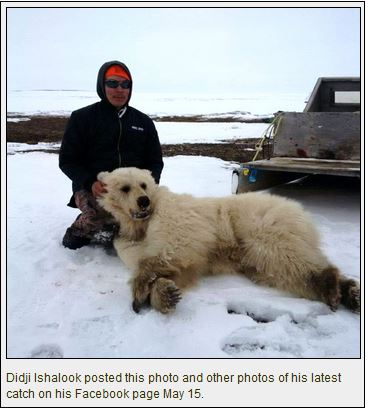
Polar bear hybrid update: samples sent for DNA testing to rule out blonde grizzly

That putative polar bear hybrid shot in Arviat last week has been sent for DNA testing.

hybrid-bear_didji-ishalook-15 May2016_facebook

Just out from NunatsiaqOnline (24 May 2016): Nunavut biologist sends possible “grolar” bear DNA for analysis: Unusual bear killed in Arviat could just be a blonde grizzly bear

Additional details confirm the animal shot was a female, which could account for the fact it was described as “small”. The Nunavut biologist who sent in the sample for testing warned it could also be a blonde grizzly, as I pointed out last week.

UPDATE 24 May 2016: Comments added below from a Toronto Star news report below on the hybrid identity of this animal.

UPDATE 28 May 2016: See this 27 May 2016 follow-up post (Most polar bear hybrids said to exist have not been confirmed by DNA testing) for details on unconfirmed sightings or reports of hybrids.
Continue reading