Tag Archives: polar bear

Five facts that challenge polar bear hybridization nonsense

It was inevitable, I suppose, that the putative hybrid shot in Arviat, Nunavut last week (see my post here) would initiate the global warming blame game.

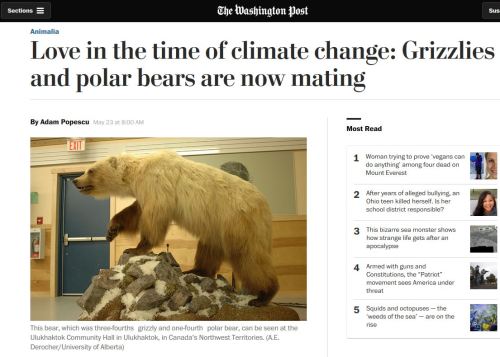
Hybrids again_Washington Post 23 May 2016_title screencap

Washington Post, 23 May 2016, Adam Popescu: “Love in the time of climate change: Grizzlies and polar bears are now mating

Here are the five points you need to know about polar bear hybridization, as there are several nonsense statements contained in this Washington Post article.

UPDATE 24 May 2016: References adding below regarding grizzly sightings south of Churchill on the west coast of Hudson Bay (H/T Doug Clark).

UPDATE 28 May 2016: See this 27 May 2016 follow-up post (Most polar bear hybrids said to exist have not been confirmed by DNA testing) for details on unconfirmed sightings or reports of hybrids.

Continue reading

More polar bear habitat in Hudson Bay region at mid-May than in 2006 & 2011

What a difference a bit of historical perspective can make to one’s attitude on the annual Arctic sea ice breakup.
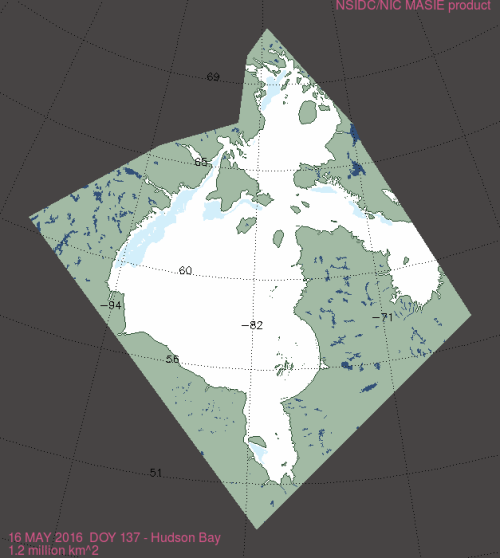
masie_all_r10_v01_2016137_4km

The usual recent pattern (since 1979) has been for breakup to begin on the east side. However, this year and last (below), it has begun in the NW (as it did in 1990 and a few other years).

Not all of the open water is due to melt, of course. As I discussed last week in relation to the Southern Beaufort Sea, winds and prevailing currents at this time of year start to fracture the ice and move it around well before much significant melt has begun.

Compare 2016 (above) to 2006 (below), when there was 0.1 mkm2 less overall – with much less ice in Hudson Strait and in the east of Hudson Bay than this year:
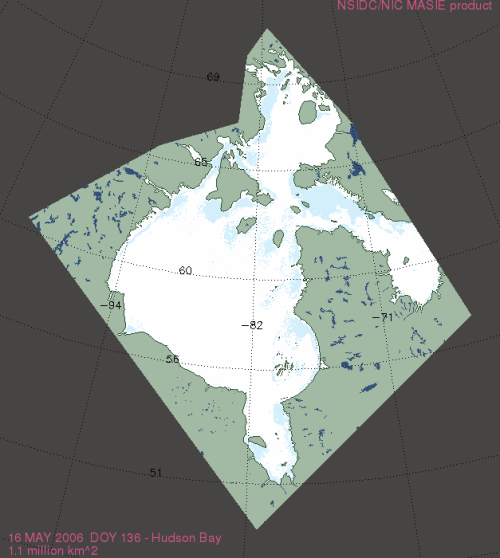
masie_all_r10_v01_2006136_4km

Compare to 2011, when there was also 0.1 mkm2 less overall than this year:
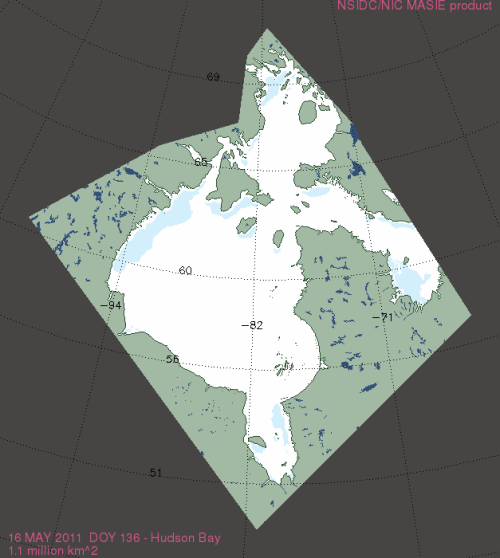
masie_all_r10_v01_2011136_4km

It’s important to keep in mind that the intensive feeding season for polar bears is drawing to a close – within another two weeks, most young-of-the-year seals will be in the water feeding and inaccessible to bears.

The only seals on the ice during June and July are predator-savvy adults and subadults that have hauled out to moult and for these seals the rapidly disintegrating ice creates many escape routes. That means that as long as the ice breakup sequence allows polar bears to get their fill of young seals before the end of May, even during early breakup years most bears should be fat enough to survive the coming summer and winter fasts (see more here). So we should expect to see some bears coming ashore within the next two weeks.

Continue reading

Silence of the IUCN Polar Bear Specialist Group on the 2015 IUCN Red List assessment

It’s been six months and still the IUCN Polar Bear Specialist Group has not updated its website with a link to the 2015 IUCN Red List assessment for polar bears, which was made public with some fanfare in November 2015. They are not the only group still ignoring the Red List decision but their silence is the most damning – the IUCN is the parent body of their organization.

On May 7th, I wrote to the IUCN Red List folks (redlist@iucn.org) about this situation (excerpt below) but as yet have received no reply.

PBSG website banner May 10 2016

Continue reading

Tracking polar bears in the Beaufort Sea in April 2016 and early polynya formation

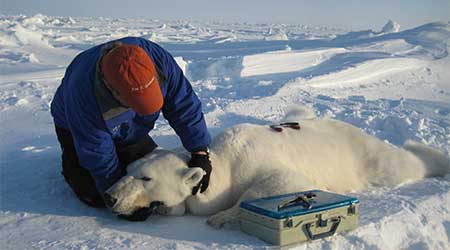
putting_collar_on_polar_bear_slider_USGS

Here’s the update on the polar bears fitted with satellite collars or ear tags in the Beaufort by USGS biologists over the last two years. Five new bears were added last month, which means there are now thirteen bears being tracked. Ice conditions are somewhat different than they have been in the past but concluding that such a situation means trouble is premature, I think (see here). Continue reading

Longest-swimming polar bear lost less weight than if she had stayed onshore

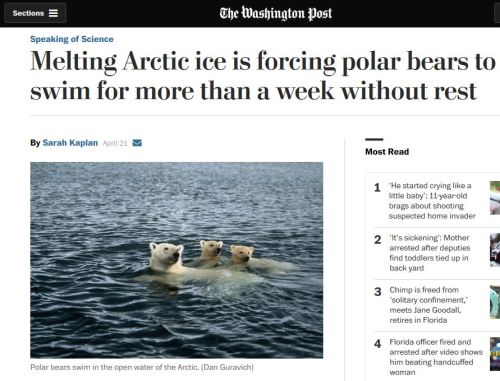
Recent media hype over swimming polar bears in the Southern Beaufort has been quite spectacular (still going strong today at the Washington Post here) but a close look at relevant data shows the message is bogus. Researchers admit (in their methods section) they couldn’t tell if bears said to have swum “non-stop” actually hauled out for half a day or more to rest on small ice flows invisible to satellites and astonishingly, the bear getting all the media attention – who swam the longest of any bear – lost less weight than a bear would have done simply sitting on shore for the same length of time.

Washington Post_swimming polar bears_snapshot 21 April 2016

Continue reading

RCMP shot fearless polar bear that came ashore on Fogo Island, Newfoundland

Just look at the polar bear on the cover of my new novel (right sidebar) and image that bear coming towards you with no intention of stopping. That’s what a Newfoundland RCMP officer faced yesterday – and he did what he had to do.

Fogo polar bear shot_CTV May 2 2016

This is the usual time for polar bear visits to northern Newfoundland but this one had a sad ending. The bear that came ashore at Deep Cove (where some of the action in my novel EATEN takes place, near the artist studio pictured in the photo shown above) on Fogo Island (map below) was killed by RCMP due to fears for public safety when it kept approaching officers even after warning shots were fired.

Maps and quotes from the 2 May CTV report below:

UPDATE 4 May 2016: more detailed (and accurate) information added below from a new CBC report – apparently, the bear was a large juvenile male, not an adult as originally reported, and was larger than initial reports indicated.

Continue reading

US finally abandons unscientific bid to ban international polar bear trade

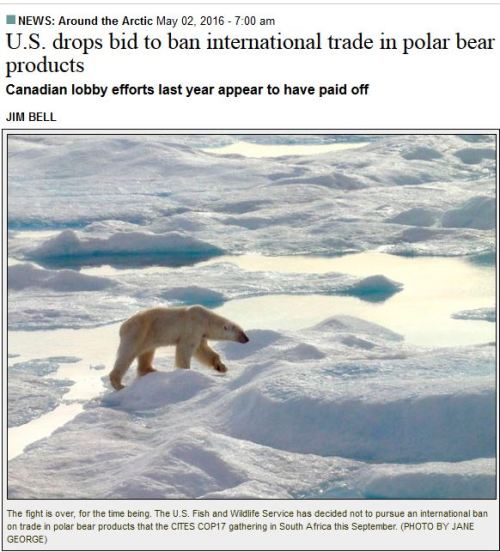
“The fight is over, for the time being. The U.S. Fish and Wildlife Service has decided not to pursue an international ban on trade in polar bear products that the CITES COP17 gathering in South Africa this September.”

CITES 2017 US drops bid to ban polar bear trade_2 May 2016

From a news report at NunatsiaqOnline this morning (2 May 2016) – the only news outlet so far that has carried the news (U.S. drops bid to ban international trade in polar bear products).

You may or may not agree with the practice of sport hunting for polar bears but this move is huge.  For years, the US has been trying to bully the international community  into accepting their warped perception of Arctic species conservation (where what computer models say  might happen by 2050 trumps what is true today). Polar bear numbers have not declined due to global warming or over-hunting, and face no immediate threat of extinction.

Here is the only “announcement” made by US Fish & Wildlife, which came buried at the end of a lengthy blog post (dated 27 April 2016), which seems to indicate they have not really changed their minds but may not want to lose face by loosing again:

Regarding polar bears, though we remain concerned about the commercial use of polar bear hides as an additional threat to the species, we are not pursuing increased CITES protections at this time. We are putting our resources into working in collaboration with other polar bear range states to address climate change and mitigate its impacts on the polar bear as the overwhelming threat to the long-term future of the species.” [my bold]

Continue reading

Climate Hustle knows: Ten dire predictions that have failed as global polar bear population hits 22-31k

[Reposted today from earlier this year in support of the 2 May release of the intentionally funny documentary, Climate Hustle (across the US and a few Canadian locations) because host Marc Morano knows that polar bear numbers have not declined as people have been led to believe, see the trailer below]

Climate Hustle_May 2 2016

Grim predictions of the imminent demise of polar bears – their “harsh prophetic reality” as it’s been called – have been touted since at least 2001. But such depressing prophesies have so widely missed the mark they can now be said to have failed.

While polar bears may be negatively affected by declines in sea ice sometime in the future, so far there is no convincing evidence that any unnatural harm has come to them. Indeed, global population size (described by officials as a “tentative guess“) appears to have grown slightly over this time, as the maximum estimated number was 28,370 in 1993 (Wiig and colleagues 1995; range 21,470-28,370) but rose to 31,000 in 2015 (Wiig and colleagues 2015, pdf here of 2015 IUCN Red List assessment; range 22,000-31,000).

Here are the failed predictions (in no particular order, references at the end):
Continue reading

Polar bear habitat update end of April 2016: Plenty of sea ice for feeding

So, here we are near the end of the first month of the Arctic spring and there is still more ice than usual off Labrador and conditions in the Barents Sea are improving daily. The fear-mongers can blather all they like about the potential risks of bears swimming in summer – but spring is the critical season as far as sea ice is concerned for polar bears and all polar bear biologists know it. Polar bears consume 2/3 of all the food they need for the year during April-June and so far, ice conditions are looking just fine.

Cambridge Bay_we re OK_from Joe Prins

There is enough ice where there needs to be ice for polar bears to gorge themselves on new-born ringed and bearded seals – and that’s really all that matters. More ice off Labrador means more hunting ground for the Davis Strait polar bears that depend on the tens of thousands of young harp seals born this year off the Front.

Harp seal pup_DFO Newfoundland
Continue reading

No evidence that long-distance swimming contributed to Beaufort Sea polar bear population crash of 2004-2006

The air is thick with desperation on the polar bear front:

“[Andrew] Derocher said the polar bear population in the Beaufort Sea has fallen more than 50 per cent in the past 10 years.

“So it is a concern that this is probably one of the factors associated with the population decline,” he said.

Derocher_CBC news 19 April 2016

As the CBC report in which this quote appears states immediately afterwards, there is no evidence for such a thing in the paper under discussion:

“The study found no direct evidence of that – all polar bears appeared to survive the swims recorded in the study.”

There is no truth to Derocher’s first statement either. Desperation – you don’t have to be a scientist to sense it. And the media wonder why people don’t trust them…

Continue reading