Posted onFebruary 29, 2016|Comments Off on More Churchill polar bear captures due to increased vigilance not global warming
Polar bear specialists just don’t get it: virtually no one except the ever-gullible media believes their exaggerated stories of doom. Yet they keep trying and with every lie and misrepresentation of fact, they erode the confidence of the public. Unfortunately, it’s not just trust in polar bear specialists that’s being eaten away, it’s trust in science generally.
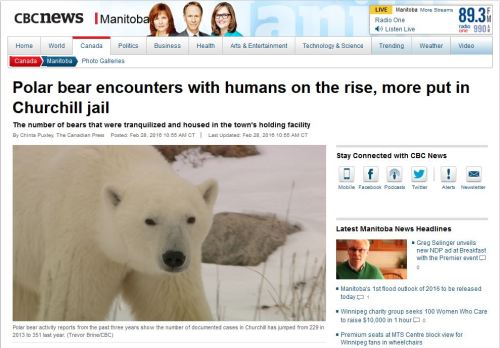
This time, it’s a head-line grabbing piece about the number of problem polar bears in Churchill, Manitoba (written by Chinta Puxley) that made the usual media rounds yesterday (CBC News, CTV News, Global News, Huffington Post, Winnipeg Sun, The Globe and Mail). The main culprits are Daryll Hedman, regional wildlife manager for Manitoba Conservation, and polar bear biologist Andrew Derocher.
Posted onFebruary 27, 2016|Comments Off on Biggest threat to polar bears reconsidered
What presents a bigger risk to current polar bear populations: natural hazards that have already proven deadly or potential, yet-to-be-realized threats prophesied to occur due to human activities? That’s a perfect question for International Polar Bear Day.
Dag Vongraven, chair of the IUCN Polar Bear Specialist Group, remarked last year that “until 2001, everything was fine.”
Polar bear researchers thus assume that 2001 was the year climate change became the new over-hunting – but is it true? What are the relative harms presented by proven natural causes, potential human-caused threats, and predicted threats due to sea ice declines blamed on global warming? Considered objectively, is climate change really the single biggest threat to polar bear health and survival right now? Continue reading
Comments Off on Biggest threat to polar bears reconsidered
Posted onFebruary 26, 2016|Comments Off on W. Hudson Bay polar bear numbers declined then stabilized, says new paper
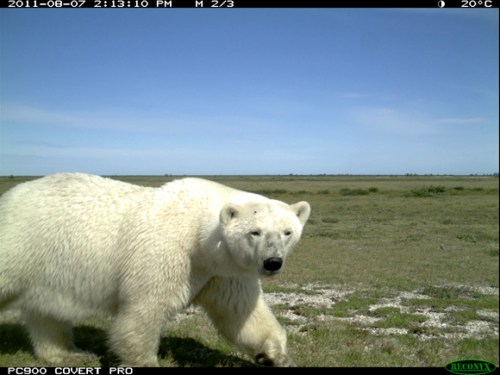
Western Hudson Bay bear, Wakusp National Park, August 2011.
In the just-published version of their Western Hudson Bay (WHB) population survey conducted in 2011, Nick Lunn and colleagues highlighted in the abstract:
“Our analysis suggested a long-term decline in the number of bears from 1,185 (993-1411) in 1987 to 806 (653-984) in 2011…”
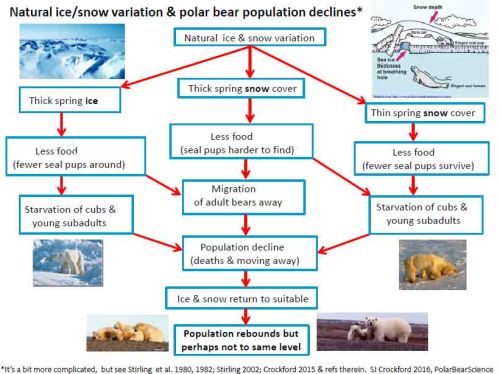
But they didn’t mention that the 806 estimate for 2011 was based on only a portion of the WHB region (Fig. 1) and has not been accepted by their peers as a valid estimate of the population size. They also failed to mention that the decline occurred due to thick spring ice and/or unsuitable snow conditions for ringed seals between 1989 and 1992 (Fig. 2), which resulted in reduced availability of polar bear prey (as I discussed in detail in Crockford 2015).
They know the “long-term” population decline is what the media will grab onto and run with – rather than the next sentence, which says “In the last 10 years of the study, the number of bears appeared stable due to temporary stability in sea ice conditions.”
In other words, their study shows there has been no decline in the population since 2004, which had been predicted to occur (see previous post, Prediction #1), and there has been no trend in either breakup or freeze-up dates between 2001 and 2010 (or since). See previous post on the government report on which this paper is based here.
The bottom line is this: no one is buying this population estimate of 806 bears for the Western Hudson Bay population – both the IUCN Polar Bear Specialist Group and Environment Canada are using Seth Stapleton and colleagues (2014) estimate from their aerial survey done the same year and that official population size number is 1030 bears.Continue reading →
Comments Off on W. Hudson Bay polar bear numbers declined then stabilized, says new paper
Posted onFebruary 24, 2016|Comments Off on Harp seal: most abundant Arctic seal is an undervalued polar bear prey species
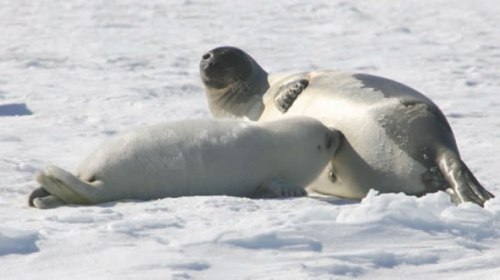
The harp seal is the most abundant seal species in the northern hemisphere (estimated to number more than 9 million animals – that’s more harps than ringed seals) but are found only in the North Atlantic. Partly because they give birth on mobile pack ice, harps have their pups earlier in the season than all other Arctic seals, which means that in some regions, they are a critical food source for polar bears that have eaten little over the winter months.
Although young ringed seals are considered the primary prey of polar bears throughout the Arctic, young harp seals undoubtedly represent an increasingly important resource for populations of Davis Strait, East Greenland and Kara Sea bears.
Most of the harp seals in the NW Atlantic/Atlantic Canada (about 80% of them) have their pups off Newfoundland and Labrador, an area known as the “Front” (the location of my polar bear attack novel, EATEN: special deals all this week). Harps seals at the Front now provide a huge prey base for polar bears of the large (and possibly still growing) Davis Strait subpopulation(photo below courtesy DFO Canada).
There are an estimated 7.4 million harps in Atlantic Canada today (range 6.5-8.3m), an exponential increase over the early 1980s, when perhaps only half a million so remained. Pagophilus groenlandicus was assigned a conservation status of ‘Least Concern’ by the IUCN Red List in June last year (Kovacs 2015), when it was estimated that the global population size of the harp seal was greater than 9 million animals and probably growing1, 2 due to reduced human hunting:
“…harp seals have been harvested for thousands of years but currently the population is large and the number of animals harvested is declining.” [my bold]
Posted onFebruary 23, 2016|Comments Off on Cannibalism video shot in 2015 did not involve a starving polar bear
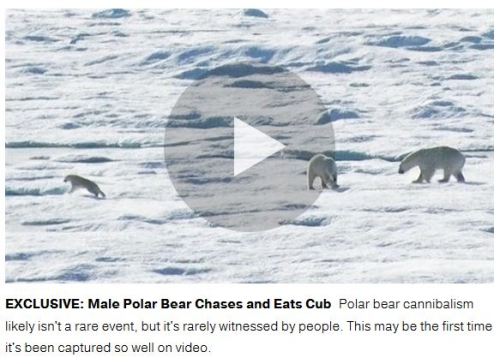
National Geographic has just posted an exclusive video shot mid-summer of 2015 of a male polar bear killing and eating a young cub.
It’s worth watching (23 February 2016; “Polar bear cannialzies cub“) [update: Youtube version posted below]. It was filmed in 2015 in Baffin Bay at mid-summer (during either their July 28-Aug 9 or Aug 7- 19 cruise; pdf of itinerary, dates and prices – oh my god, the prices! here). [Summer is 1 July-30 September]
You’ll soon realize the male bear was not thin or starving (as was true of a much-publicized 2011 event captured on film off Svalbard).
It is also obvious based on the dates listed above that this incident debunks the explanation that cannibalism by adult males is driven primarily by their desire to mate with the mother of the consumed cub: this incident occurred sometime between August 7 and August 19 (as I was informed via email, by a reader on one of those two cruises), which is well past the breeding season for polar bears. A male bear would not still have viable sperm by August and a female could not be forced into estrus. [added 26 February 2016]
National Geographic is already hyping this incident as more evidence of climate change harming polar bears, as the article accompanying the video suggests. However, this is just the typical oversell that accompanies much to do with polar bear these days.
The bear was not “driven to desperation” : he simply took advantage of a rare chance to eat during the summer:
“Without the ability to hunt seals, polar bears may be driven to ever more extreme cannibalism, if they’re not already.”
It’s clear to me that this was an opportunistic kill made at a time of year when few seals are available, as even Stirling admits. It reiterates the point I’ve made many times before, that polar bears on the sea ice in summer have few feeding opportunities.
Incidents of cannibalism cannot be said to be increasing because there is no scientific baseline for which recent occurrences can be compared. Scattered anecdotal reports of any behaviour cannot be touted as evidence for a trend even though they may be of interest and worth recording.
UPDATE 23 February 2016: Video now posted on Youtube, see it copied below:
Comments Off on Cannibalism video shot in 2015 did not involve a starving polar bear
Posted onFebruary 18, 2016|Comments Off on Only the gullible still buying ‘polar bear died of climate change’ nonsense
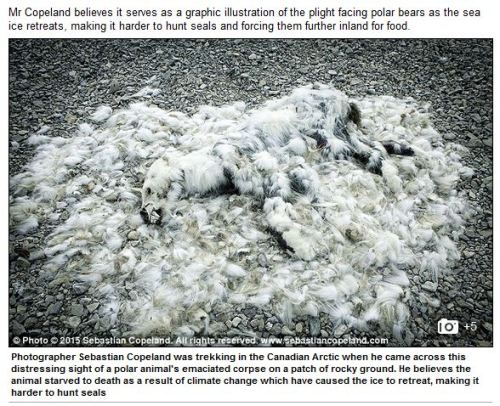
The media promote this ‘polar bear who died of climate change’ rubbish because it’s good for business but there is no evidence to support it. The Daily Mail todayis running a piece that encourages the self-serving, sensationalist claim made by a photographer trying to sell his book.
Read the whole thing here but remember this: the leading cause of death for all polar bears is starvation, in part because they have no natural enemies. Polar bears die of starvation every year, with or without ‘climate change.’
This bear might have died of starvation but that does not mean global warming is to blame. It’s bad enough when it’s a leading polar bear biologist making such a ridiculous claim but there is no reason at all to take the scientifically baseless word of Sebastian Copeland on this matter.
Previous posts where I have addressed similar claims:
Posted onFebruary 18, 2016|Comments Off on Polar bear habitat mid-winter update
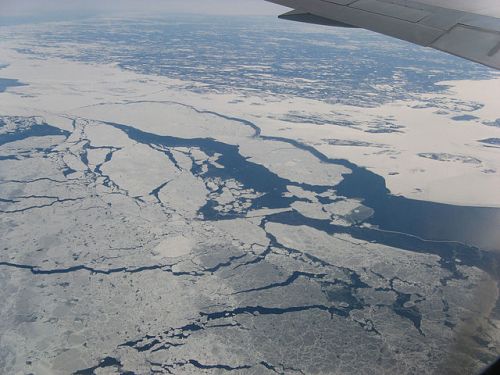
Sea ice extent in the Arctic is a bit below average this year at mid-winter but there are no data to suggest this situation will have a negative impact on polar bears.
[Photo above is sea ice off the coast of Labrador, Canada on 26 March 2007 (from Wikimedia): polar bears in the southern portion of the Davis Strait subpopulation have been particularly successful in recent years because in late March through May/June they hunt abundant numbersof young harp and hooded seals in this habitat]
This is the online version of a Sunday morning TV special that’s not available where I live. It’s yet another example of how the media feeds the politics of polar bears and prevents the advancement of science. Here’s my take on this CBS effort.
Actually, nothing could be further from the truth – this is all about pressuring people to care about climate change. Polar bears are merely a marketing tool to spur action on climate change. That’s not my opinion but the plan put in place in 2012 by the Association of Zoos and Aquariums and Polar Bears International.
Oddly, few animal rights activists are objecting (or at least, not objecting very strenuously) to zoo displays of captive polar bear cubs – obvious money-making drawsfor zoos – which were so vehemently condemned in the 1970s that mostzoos gave them up.
Now, the practice is defended and everyone seems to feel this is the greatest thing since the invention of the telephone. [Update 19 February 2016:courtesy the BBC, we can add Highland Wildlife Park in Scotland to the list of zoos using “we’re saving the polar bears” justification for breeding the bears in captivity]
The surprise is that disgraced climate scientist Michael Mann, promoter of the infamous hockey stick of global temperatures, is involved in all this.
Posted onFebruary 5, 2016|Comments Off on Polar bear myths perpetuate from the mouth of stuck-in-the-past Ian Stirling
In my last post, I complained about “vague and misleading statements” made by polar bear specialists and conservation advocates. Here’s a recent example of that phenomena, from veteran polar bear biologist Ian Stirling.
The magazine of Canada’s North, UpHere, published an interview with Ian Stirling this month. The piece begins:
“No fear-mongering. No exaggeration. For Ian Stirling, it’s purely about the science.”
Yeah, well – judge for yourself. Here’s a sample:
“We have lost on average about half the sea ice that we had in 1979, which is the first year that satellite coverage of the Arctic was taken [he’s talking about September ice here]. Places like Hudson Bay are breaking up three weeks earlier than they used to and freezing up a couple weeks later. We’re going to have even more significant effects over a much wider area in the Arctic. We’re likely to lose another 30 or 40 percent, or even half of the bears that we have today in the middle of the century, and unchecked, we will likely have very few bears left at the turn of the next century. In 2100, we’ll probably just have a few small remaining pockets in the northern Canadian Arctic islands and northern Greenland.”
Stirling’s opinion about polar bears and climate change hasn’t changed since at least 2004 despite the following scientific developments: Continue reading
Comments Off on Polar bear myths perpetuate from the mouth of stuck-in-the-past Ian Stirling
Watch polar bear habitat reform in the Canadian Arctic: “last 10 days” Canadian Ice Service animation (works anytime) HERE.
See Quote archive for details.






 polarbearscience
You must be logged in to post a comment.