Tag Archives: polar bear

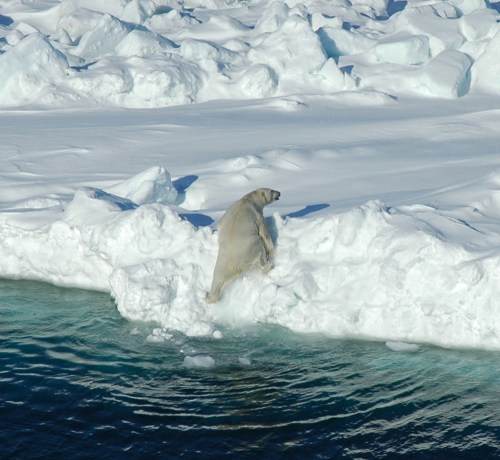
Most Beaufort polar bears swim from ice floe to floe during breakup, study shows

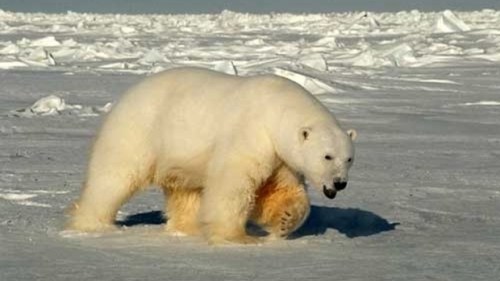
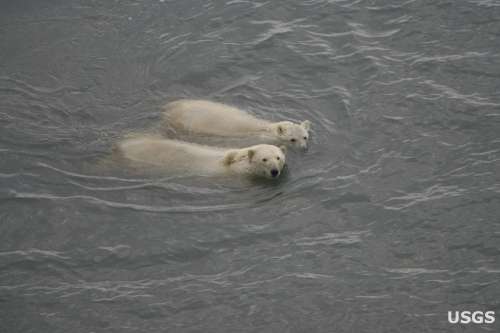
swimming3_USGS

You may have seen the headlines in Canadian news outlets over the last 2 days.
“Polar bears swimming farther as sea ice recedes, study shows”

“Melting sea ice forces polar bears to swim longer, farther: study”  [“Bear biologist Andrew Derocher says the forced swims are particularly hard on mothers with young cubs”]

“Polar bears swimming longer, farther because of melting sea ice, study finds”

Oddly, none of the above news reports said where the paper was published or mentioned the name of the lead author – only University of Alberta co-author Andrew Derocher was interviewed (see the only press release I could find here, issued by the San Diego Zoo where the lead author is now employed).[update: CBC ran another story a day later that corrected these omissions]

But what did the study actually say?

Significantly, no bears died while swimming during the two lowest sea ice extent summers since 1979 and no evidence was presented that swims were “particularly hard on mothers with young cubs.” The quotes from the paper below sum it up for Beaufort Sea (BS) bears (the inclusion of Hudson Bay (HB) bears in this study seems gratuitous and potentially misleading, since only a few swam anyway – only 15 out of 59):

“….91% (91/100) of the swims in the BS occurred before the annual September minimum sea ice extent had been reached.  In the BS, 81% (29/36) of swims started and ended in pack ice…

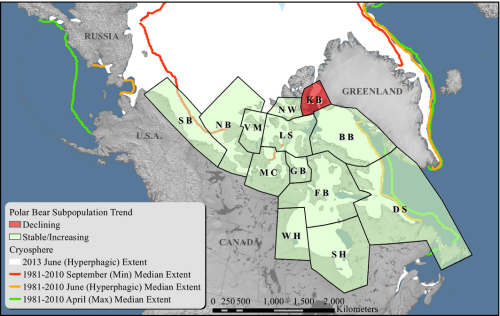
So, despite what may be implied during media moments, Beaufort Sea polar bears were  not frantically trying to reach the sea ice from land so that they could attempt to keep feeding over the summer – most of their swimming was done during breakup in July and August from one bit of pack ice to another and they showed no evidence of harm from doing so. Map from the study and more quotes below.
Continue reading
More politics of polar bears courtesy WWF: impaled polar bear sculpture

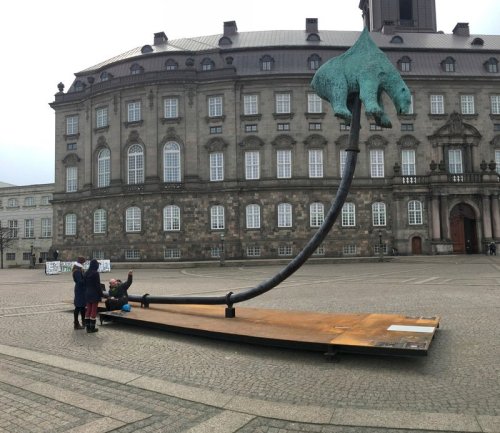
The offensively tasteless “art” produced by Danish sculptor Jens Galschiøt, in collaboration with the World Wildlife Fund, for the specific purpose of influencing politics has reappeared.

‘Unbearable’ is a portable exhibit originally designed for the Paris COP21 climate talks in December 2015 but here it is again in Copenhagen. [h/t Tom Nelson]

It’s simply the Politics of Polar Bears on a global scale that has no basis in science: polar bear numbers have not declined as CO2 has risen. Jens Galschiøt’s tasteless and costly message funded by WWF is not much better than Plane Stupid’s 2009 ad of polar bears falling from the sky (see below). It’s just about as asinine and not supported by science. Continue reading

Polar bear biologists imply “summer sea ice” and “sea ice” are synonymous

According to sea ice experts, winter sea ice habitat for polar bears is not expected to decline at all by 2050 and the critical spring sea ice that polar bears need for gorging on young seals and for mating is not predicted to change much (Durner et al. 2007, 2009), which is why computer modelled predictions about the dire future for polar bears only assessed the potential future effects of declining summer sea ice (e.g. Amstrup et al. 2007; Stirling and Derocher 2012). Note spring is April-June.

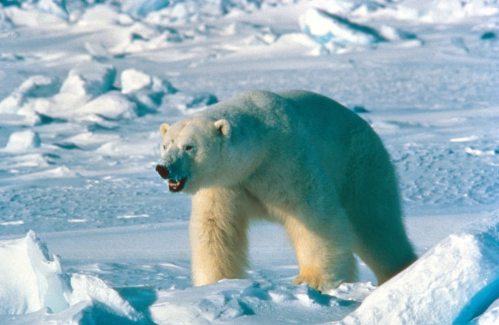
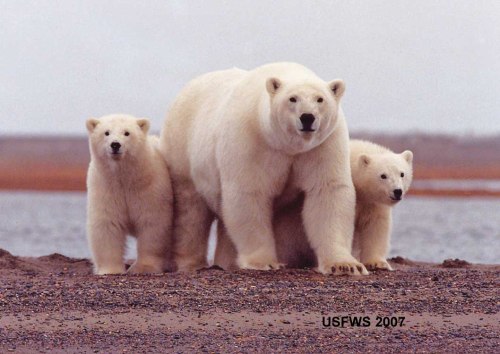
Female with cubs Beaufort_USFWS credit 2007 w label_sm

See if that fact is clear in the interview responses by out-spoken polar bear biologists that has just been published in the polar bear portion (“Beyond the polar bear”) of this year’s University of Alberta magazine spring climate change feature. If you can get past the “canaries in the coal mine” opener…
Continue reading

Late winter surge in sea ice habitat and the resilience of Svalbard polar bears

The Barents Sea – and Svalbard in particular – has had very little sea ice this winter but recent evidence suggests pregnant females adapted by moving east to Franz Josef Land to have their cubs. The surge in ice that’s come over the last few weeks will, however, be welcome habitat for the critical hunt of fat newborn seals that takes place primarily in April and May.

Svalbard polar bear_NP015991-isbjorn-JA

It was only last fall that Norwegian biologist Jon Aars (photo above taken by him in August 2015) was touting the fat condition of Svalbard-area polar bears he and his team saw in August and admitted the population had increased by a whopping 42% since 2004 – despite dire predictions of a drastic decline. In fact, 2014/2015 was a great year for the area’s polar bears.

However, in the fall of 2015 sea ice was so late forming around Svalbard that it seemed impossible that any females would get to traditional denning grounds on the east coast in time to give birth. There was no sea ice to speak of until late December, so it seemed virtually certain that all females had gone to Franz Josef Land further east (in Russia) – as they are known to do – to utilized its alternative denning sites.

It’s called resilience – the ability to shift behaviour in response to changing conditions. In this case, all indications are that shifting den locations to Franz Josef Land is a long-standing response of Svalbard area polar bears to low ice conditions. This shift does not even require a movement outside their subpopulation boundaries, let alone a movement outside the ill-defined “sea ice ecoregions” originally defined by Steven Amstrup and colleagues (2008) to support their prediction that polar bears will likely be extinct by 2100, taken up later by others since.

Some polar bear specialists appear to believe that if Barents Sea conditions are not precisely what they were in the 1980s (examples here and here), polar bears cannot possibly survive. But the bears are showing them otherwise – and demonstrating how they likely survived previous warm periods like the Holocene Optimum ~9,000 years ago and the Eemian Interglacial ~115,000-130,000 years ago (CERQA 2014:66) without population numbers getting anywhere near extinction levels.
Continue reading

Both sides now: New paper critiques Canadian polar bear population status

Demographic and traditional knowledge perspectives on the current status of Canadian polar bear subpopulations. 2016 (in press). Jordan York, Martha Dowsley, Adam Cornwell, Miroslaw Kuc and Mitchell Taylor. Ecology and Evolution 6(9):2897-2924. DOI: 10.1002/ece3.2030

York et al 2016 fig 1_numbers 2013

Take home quote:

“We see reason for concern, but find no reliable evidence to support the contention that polar bears are currently experiencing a climate crisis. We suggest that the qualitative projections for dramatic reductions in population numbers and range are overly pessimistic given the response of polar bears, climate, and sea ice to the present.”

Continue reading

Condition of S Hudson Bay polar bears varies with freeze-up only says new study

Despite the fact that the polar bears of Southern Hudson Bay (SHB) live further south year round than any others, a recent study found their average body weight has declined relatively little since the 1980s. There has been no decline in the size of the population over that time either. Perhaps that’s why there was neither a press release nor a massive media blitz when this paper came out earlier this month.

James Bay female and cub_Ontaro Govt

Remarkably – despite what we are told about how critical breakup dates are to polar bear health and survival in Hudson Bay – this study found that for SHB bears, the small decline in body condition index correlated only with freeze-up dates, not breakup dates or length of the ice-free season. They also found that regional breakup and freeze-up dates relevant to polar bears in this area was the day when ice cover reached 5% (not 50%).

In other words, SHB polar bears left the ice (or returned to it) when the average ice  cover near the coast was about 5%. This finding is yet more evidence that the meteorological definition of “breakup” (date of 50% ice cover) used by many researchers (see discussion here) is not appropriate for describing the seasonal movements of polar bears on and off shore.

Continue reading

Polar bears onshore in winter – will more bears mean more deadly attacks?

Incidents of polar bears causing problems onshore this winter (January & February) – including one that killed a horse in Greenland and another that threatened a resident in western Hudson Bay (only weeks after several incidents in southern Labrador) may be the tip of a very scary iceberg. I’ve taken a look at what records exist of this phenomenon, which in the past often involved deadly attacks. The large number of reports this winter appears to be a real increase, which is a rather terrifying prospect indeed.

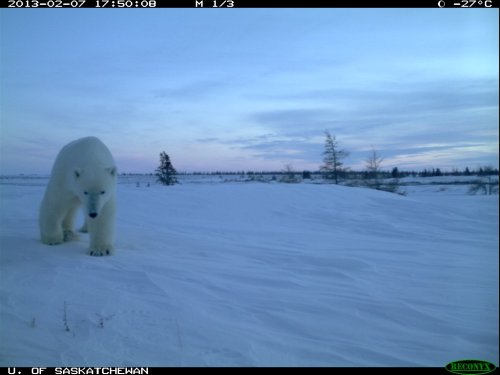
Doug Clark photo polar bears onshore in Feb 2013 Wapusk NP

In winter, all polar bears except females in dens nursing newborn cubs are presumed by biologists to be on the sea ice hunting but it turns out that is not quite true. Although relatively rare over the last twenty years or so, it appears that in some areas, bears are now coming ashore in winter.

The photo above shows a polar bear photographed by a remote camera installed at Broad River Camp, Wapusk National Park, western Hudson Bay on 7 February 2013. It was visible to the camera for 40 minutes but apparently caused no trouble (camera installed and maintained by associate professor Doug Clark from the University of Saskatchewan and colleagues).

Given the fact that there are now many more polar bears than there were in the 1970s as well as more people living in many coastal Arctic communities, problems with bears in winter are likely to increase, as this winter’s events show. More bears out on the ice in winter (January-March) will almost certainly create more competition for the little bit of food that’s available (seals are hard to catch in winter), which means some bears might increasingly be looking for alternate sources of food onshore.

Continue reading

Challenging Alaska polar bear research sound bites and bewildering ESA status

Beaufort Sea male polar bear USGS_2005 Amstrup photo

It’s easy to take polar bear research papers at face value but it’s not very scientific. The snappy sound bites provided for the benefit of the media – whether they’re embedded in press releases or in published abstracts – don’t cut it with trained scientists. Trained scientists read the whole report, critically examine the evidence it contains and assess that evidence within the context of previous knowledge. That’s what they are trained to do.

I challenge the superficial summary on the status of Alaskan polar bear populations provided by FactCheck.org journalist Vanessa Schipani.  Schipani disputed a comment made by Alaska Senator Lisa Murkowski that, according to the latest research Alaskan polar bear population numbers are strong and healthy. I’m not especially interested in the political context of the statement, only Schipani’s bald claim that Murkowski’s declaration is false.

I’ve read all the relevant papers in full and I contend that the evidence supports Murkowski’s statement. Schipani is confusing the issue by regurgitating ‘facts’ that don’t tell the truth of the matter. By the sum of accounts, Alaskan polar bear populations are indeed healthy and strong – whether or not this status will continue is an entirely different question. Continue reading

A new count planned for Southern Beaufort polar bears

I know I was not the only one that thought the last polar bear count conducted by the US Geological Survey (USGS) in the Southern Beaufort generated an untenable result but it appears that some of those challengers are in a position to demand a recount.

polar_bear_usfws_no date_sm

CBC News ran a story late last week announcing a plan is in the works to do an aerial survey of Southern Beaufort Sea polar bears across their entire range over two years starting in 2017 (11 March 2016, “Joint U.S.-Canada Beaufort Sea polar bear survey planned“).

With luck, this period will not include another bout of the same thick spring ice conditions that decimated the population in the mid-2000s (which many reporters concluded was due to reduced summer sea ice because that’s what leading biologists implied). Even if it does, lucky timing will not negate the fact that this population is routinely subjected to devastating population declines caused by natural changes to spring sea ice conditions from which they have recovered on numerous occasions. Continue reading

Worrywart biologists fuel media fearmongering over winter sea ice levels

Have you heard the old adage, “Don’t buy trouble”? I’m thinking we could use a lot more of that attitude from polar bear and Arctic seal biologists these days.

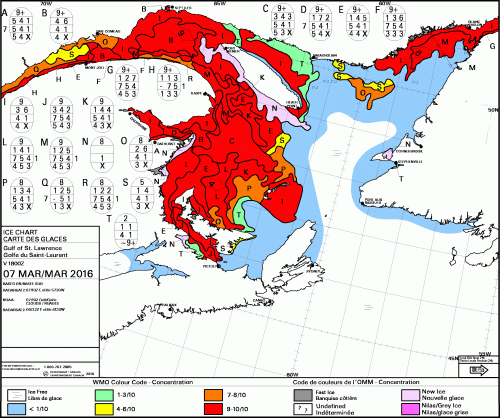
Gulf St Lawrence ice conc 7 March 2016_CIS

In an interview with CBC News yesterday, Department of Fisheries and Oceans Canada (DFO) seal specialist Mike Hammill fed the fear the media wanted to hear while admitting this year’s low ice levels in the Gulf of St. Lawrence will not affect harp seal numbers significantly (7 March 2016, Lack of ice means fewer seal pups off the Magdalen Islands this year: Researcher says impact on overall herd limited, but ice patterns over time could be concern”).

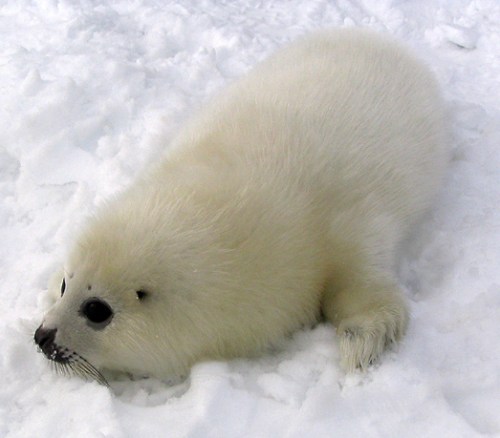
Harp sea newborn_wikipedia

And University of Alberta’s Andrew Derocher has been busy tweeting his heart out that slightly lower than average sea ice levels this winter could mean a “challenging” spring for some polar bears – as if spring isn’t always challenging for some bears (especially young bears that are inexperienced hunters and low in the social hierarchy – meaning bigger, older bears often steal their kills – and old bears that are running out of steam).
Continue reading