Tag Archives: polar bear

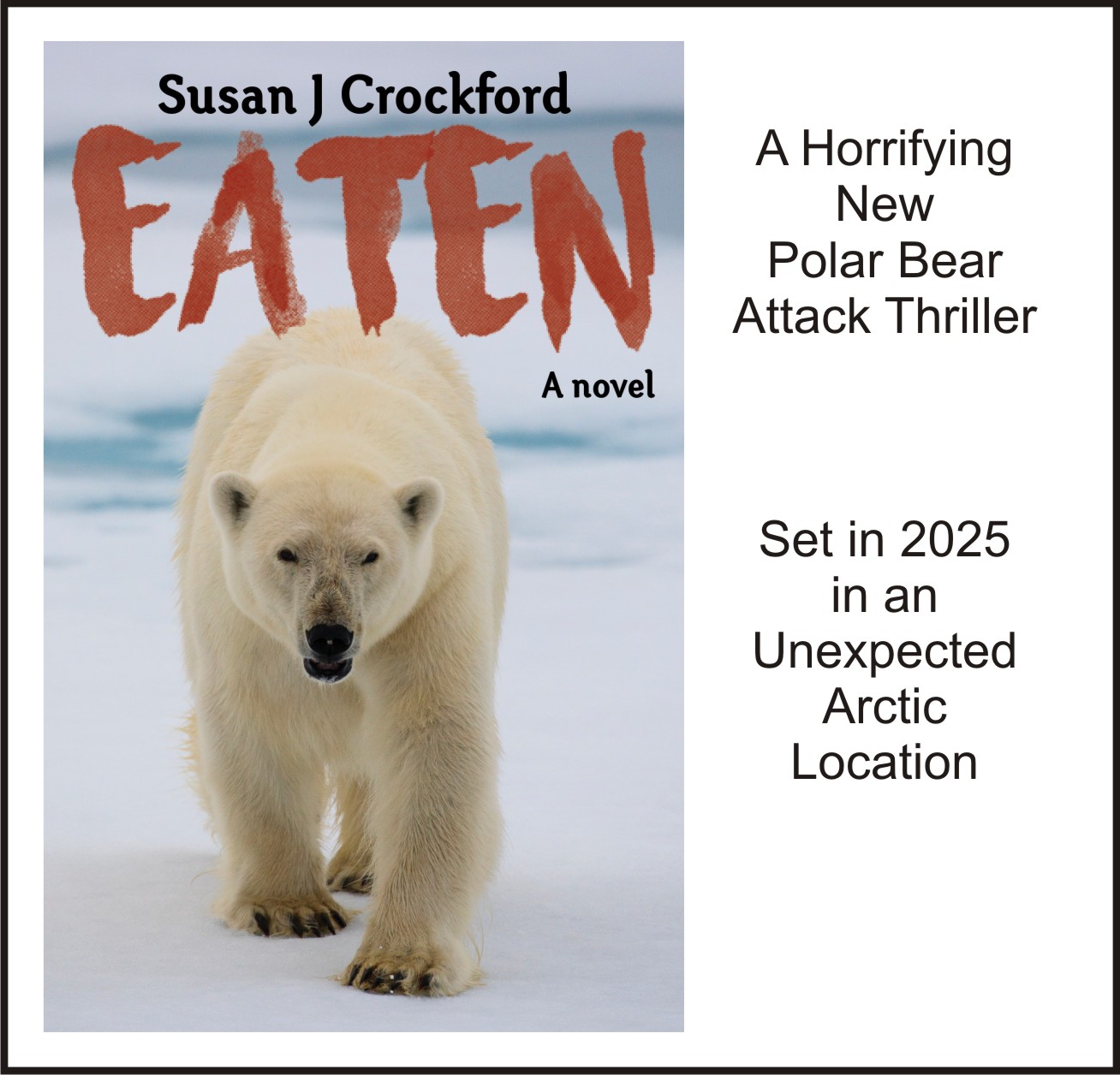
EATEN – My first novel, coming soon!

Watch for it!

EATEN_A new novel_final_lg

For years, polar bear specialists have being playing “what-if.”

They’ve used computer models to predict polar bear responses to computer predicted sea ice conditions 25-90 years into the future and insist their prophecies will become reality unless human behaviour changes. They like to call their “what-if” science.

I decided to play too – except I call my “what-if” a novel. Perfect for people who never read science books and everyone who likes a good story.

Coming soon in Paperback , Kindle, and ePub formats!

Polar bear habitat update – Arctic sea ice today covers same area as it did on June 30

Arctic refreeze is well underway. Less than half way through the Arctic autumn (Oct-Dec), polar bear habitat on 11 November 2015 covered the same total area as it did on the last day of Arctic spring (April-June); it’s just distributed differently.

polar_bear_usfws_no date_sm

Yesterday, courtesy NSIDC Masie

masie_all_zoom_4km_2015 Nov 11

Here is what 30 June 2015 ice extent looked like, with the same amount of ice coverage:

masie_all_zoom_v01_2015181_4km

For the week of 12 November, Hudson Bay sea ice development is well underway, with more ice in the north than there has been in many years; Davis Strait ice is the highest this week since 1999 and Baffin Bay ice coverage is above average. Foxe Basin and the Beaufort Sea are both approaching maximum coverage, which means bears there will be back out on the ice hunting. Chukchi Sea ice has finally surrounded Wrangel Island but the Svalbard Archipelago in the Barents Sea is still ice-free. More ice maps and charts below.
Continue reading

Specialists mum on low Chukchi Sea polar bear habitat this summer and fall

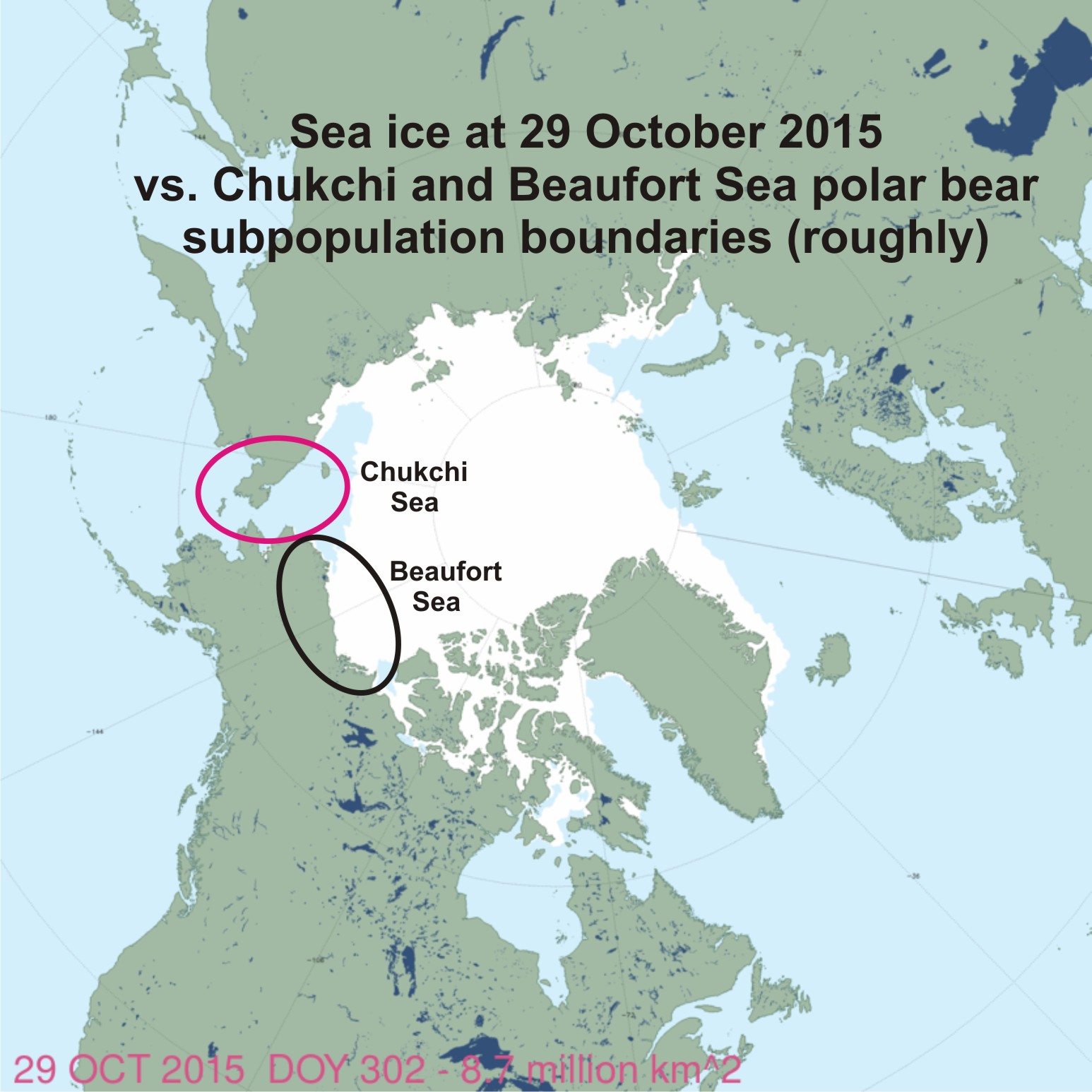
You may or may not have noticed that even though Chukchi Sea ice coverage has been way below average this melt season, there has been no hue-and-cry about poor suffering Chukchi polar bears. That’s because polar bear biologist’s own research has shown that the health and survival of these bears has not been negatively impacted by low summer sea ice. There may be threats from poaching in Russia, but not lack of summer sea ice.

Chukchi vs Beaufort ice at 29 Oct 2015_polarbearscience

As of this date, developing sea ice is only just approaching Wrangel Island, a major polar bear denning region in the Chukchi Sea, see maps below (Ovsyanikov 2006).

Yet, polar bear specialists insist that neighbouring Beaufort Sea bears – who endure a much shorter open-water season – are in peril of extinction because of scarce summer sea ice.
Continue reading

Who tagged the Beaufort Sea polar bear with the tight collar?

I’ve updated my post from last week to reflect that an inquiry to USGS has generated a statement that the Beaufort Sea polar bear reported by CBC last week is NOT one of their bears. Apparently University of Alberta researchers were also tagging polar bears in the region.

polar-bear-radio-collar_CBC Oct 28 2015

See details in the updated post here.

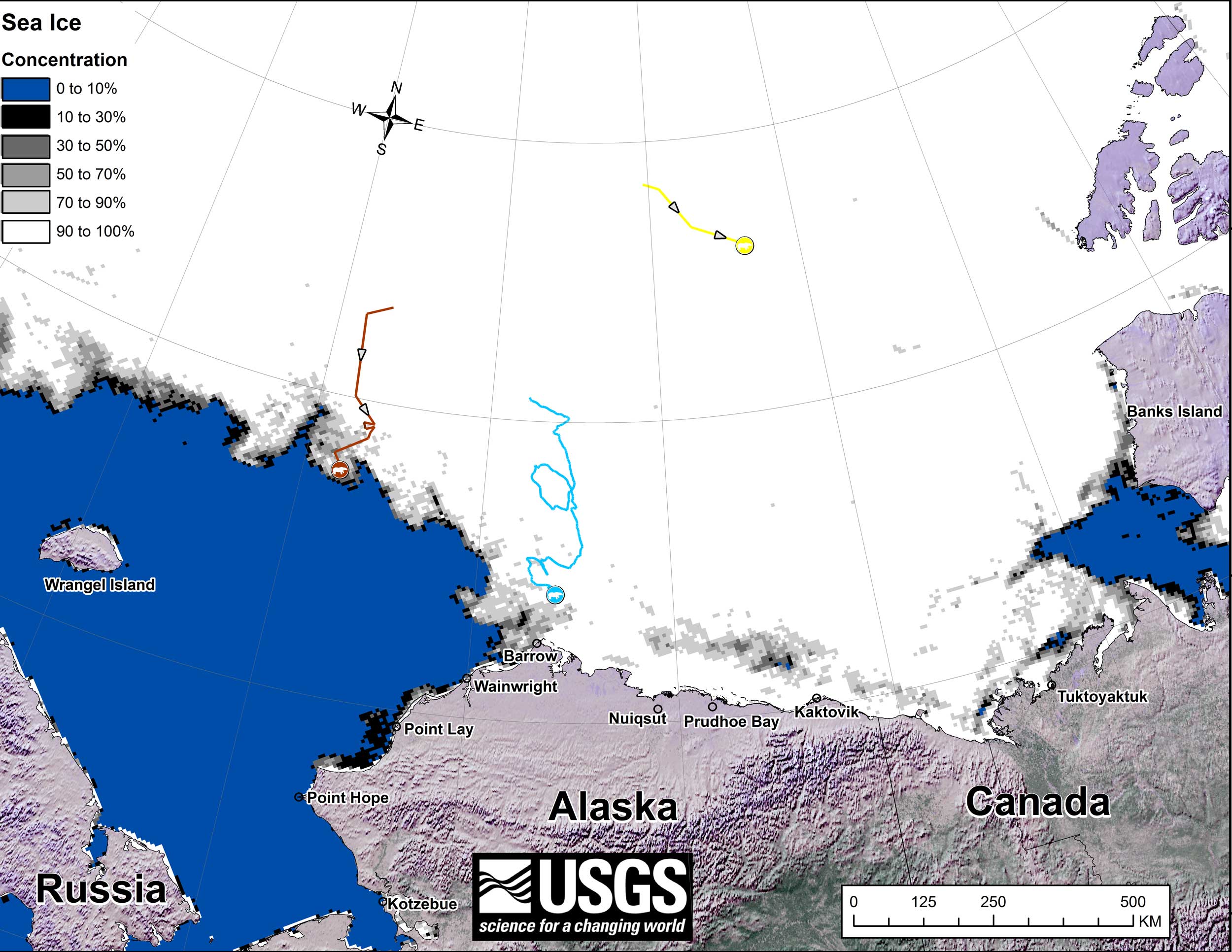
Kaktovik, where the bear was photographed, is not too far from the Canadian border of the Southern Beaufort Sea subpopulation, see USGS tracking map below.

Original caption: "Movements of 3 satellite-tagged polar bears for the month of October, 2015. Polar bears were tagged in 2014 and 2015 on the spring-time sea ice of the southern Beaufort Sea. All 3 of these bears have satellite collar transmitters. Polar bear satellite telemetry data are shown with AMSR2 remotely-sensed ice coverage for 31 October, 2015." Click to enlarge.

Original caption: “Movements of 3 satellite-tagged polar bears for the month of October, 2015. Polar bears were tagged in 2014 and 2015 on the spring-time sea ice of the southern Beaufort Sea. All 3 of these bears have satellite collar transmitters. Polar bear satellite telemetry data are shown with AMSR2 remotely-sensed ice coverage for 31 October, 2015.” Click to enlarge.

How long is it going to take for the people responsible to own up to this situation – and more importantly, remove the tight collar from the bear?

Hudson Bay freeze-up moving faster than recent years, WHB polar bear habitat imminent

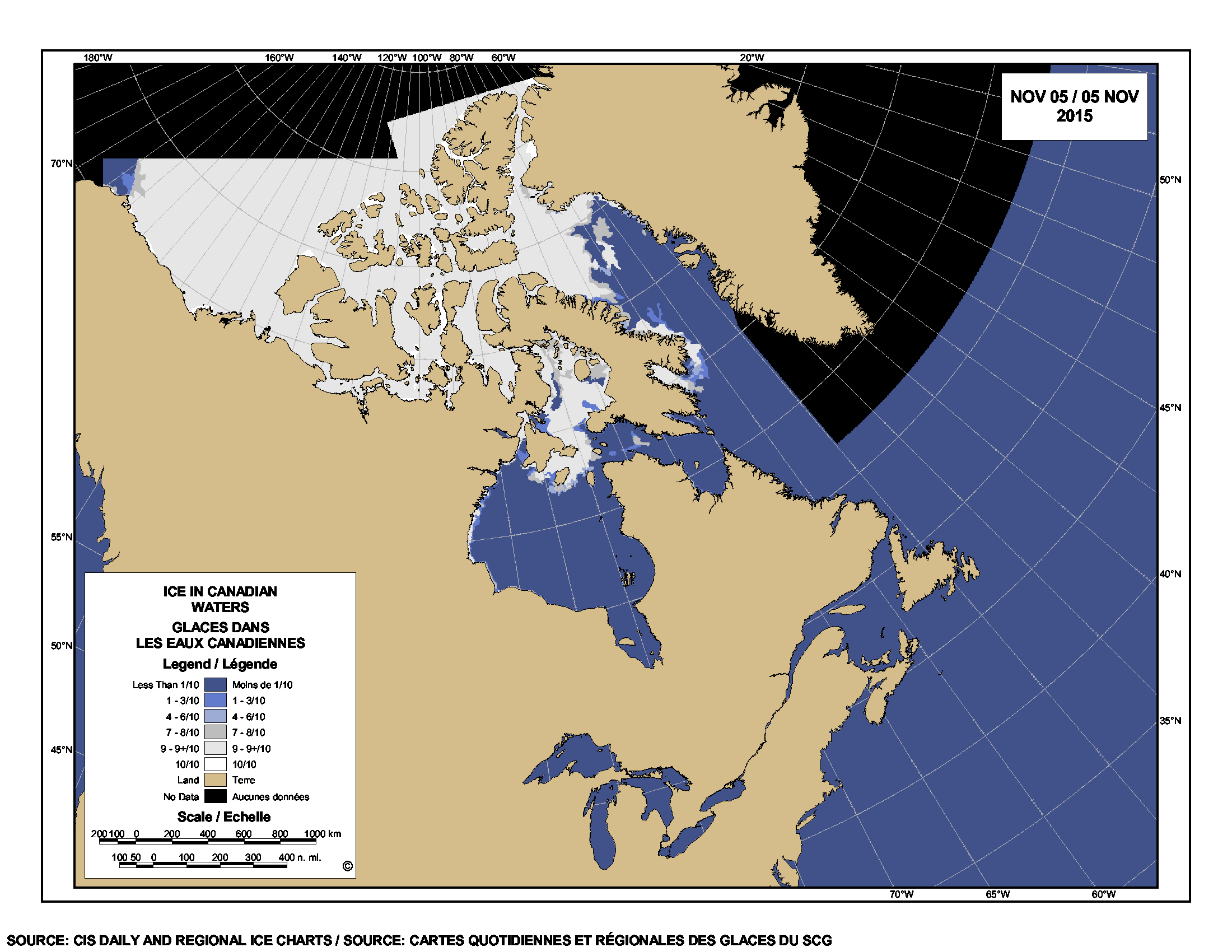
There may not be ice for Western Hudson Bay polar bears to walk on yet but there is still more ice forming along the northwest shore of the bay than last year at this time or even the year before. The Canadian Ice Service (CIS) map for 5 November shows this early formation.

Canadian Arctic Nov 5 2015_CIS

What’s present is mostly grey ice defined by CIS as:

“Young ice 10-15 cm thick, less elastic than nilas [a kind of new ice] and breaks on swell. It usually rafts under pressure.”

Polar bears generally need ice about 30 cm thick to support their weight, which could take a day or two – or a week or two, depending on the weather in northwestern Hudson Bay. For Churchill, along the central coast of western Hudson Bay, ice thick enough for walking will not likely be far behind, given the long-range forecast of freezing weather. In recent years, most Churchill polar bears have left the ice by around 20 November. More maps and graphs for this week below.
Continue reading

2015 may be the earliest in many years that W. Hudson Bay polar bears head for the sea ice

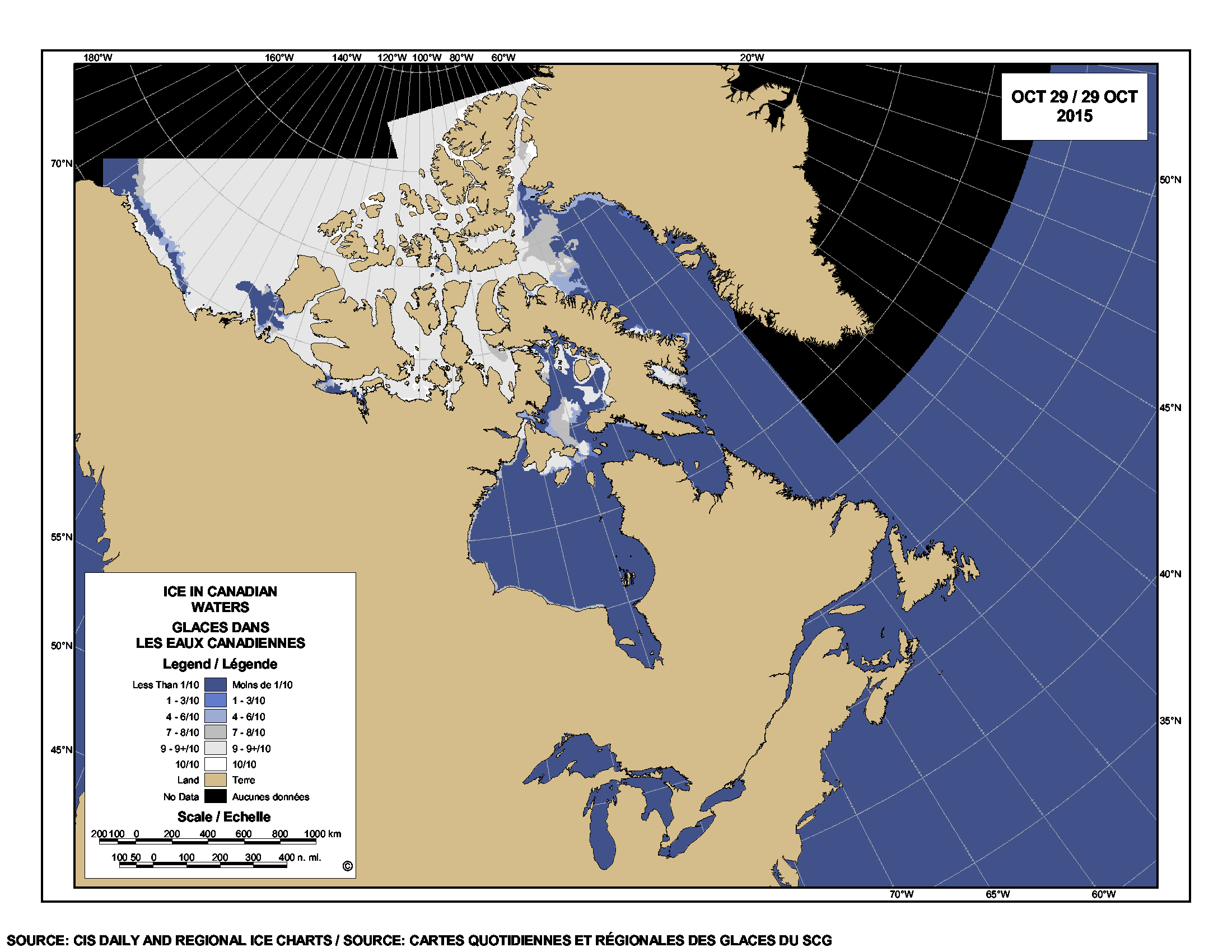
Great news for Western Hudson Bay polar bears! Following up from sea ice conditions last week, CIS maps show ice forming all along western Hudson Bay – not a huge amount, but the beginning of the end of the ice-free season, which recently has not occurred until mid-November (Cherry et al. 2013).

Canadian Arctic Oct 29 2015_CIS

There is above-average sea ice coverage in Foxe Basin and Davis Strait, and only slightly below average coverage in the Beaufort Sea (see graphs below). Polar bear habitat is shaping up very nicely indeed across Canada and the US this year.
Continue reading

Sickening effect of satellite radio collars polar bear researchers don’t want you to see

A report at CBC News (Photo shows polar bear injured by tight radio collar,” Martin Zeilig, 28 October 2015) shows the bloodied neck of a male Southern Beaufort Sea polar bear, taken near Kaktovik, Alaska, whose radio collar is too tight.
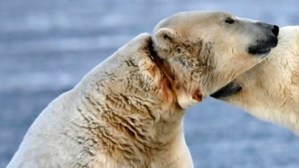
polar-bear-radio-collar_CBC Oct 28 2015

Researchers should not be putting collars on young animals and male bears – they know the problems! Who did the USGS have working for them that did not know this or couldn’t tell a male bear from a female? [see below] The other question is: how many more bears are in the same condition but out of sight on the sea ice – or dead due to their injuries? Don’t forget, this is a population that researchers claim is endangered because of climate change but which really declined recently due to thick spring ice in 2004-2006. [SJC – ambiguity fixed]

UPDATE 28 October 2015: 5:41 pm – in a comment under the CBC story, Churchill polar bear guide Kelsey Eliasson wrote (“4 hours ago”):

“This isn’t a he, it’s a she. Saw this bear during our trip, its a female with one cub.

Male polar bears are not radio collared.”

The statement in the CBC article that the bear with the collar is a male thus seems to be an error.  That makes more sense but does not negate the suffering of the animal.

UPDATE 5 November 2015: 8:30 am – I just received an email from a reader who contacted USGS about this bear and with their permission, I have copied the response below (leaving out the USGS contact person’s details), my bold:

Hello xxxx,

I do not believe USGS banded the bear. I have talked with staff at the USGS Alaska Science Center and found that the polar bear in the news was an adult male. The USGS scientists will band female polar bears, but not male bears. If you have questions, see this site. there is a link to the staff on the left. Click it and you will see a list with the project manager at the top. http://alaska.usgs.gov/science/biology/polar_bears/tracking.html

It may be that USGS is accepting the word of one of the experts quoted in the story [Vince Crichton] that the bear is a male and have denounced their involvement on that basis. Obviously, other polar bear researchers must be working in the area, and Geoff York statements (below) suggest a crew from University of Alberta, led by Andrew Derocher.  But if Kelsey Eliasson is right that this is a female with a cub (see above update), it may indeed be a USGS bear, perhaps one who’s collar has stopped transmitting. The plot thickens.
Continue reading

Beaufort Sea polar bear habitat highest since 2008 at this date

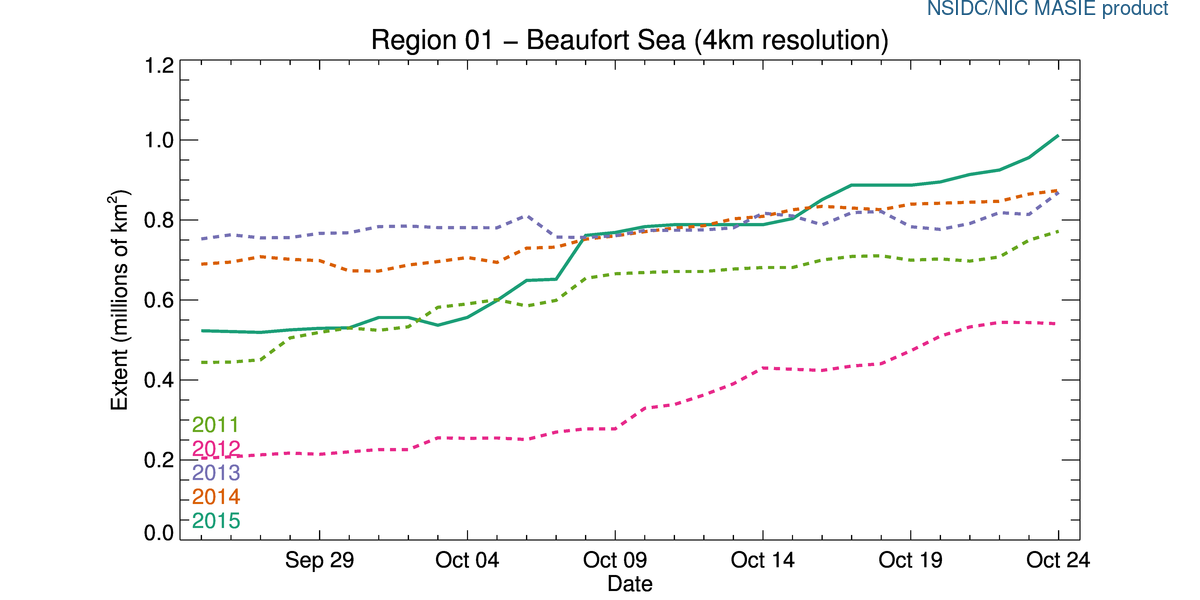
Good news for Southern Beaufort polar bears! Sea ice converging on the north shore of Alaska earlier than any year since 2011 at least, according to NSIDCs regional ice plots (below).

r01_Beaufort_Sea_ts_4km

But wait, their Masie ice maps show it’s actually the earliest since 2008 (although the ice movement onshore was also earlier than 2006 and 2007, see below). And it’s still a full week before the end of October, the first month of Arctic fall (October-December). Lot’s of seal hunting habitat.

This emphasizes the fact that the primary problem faced by Southern Beaufort sea polar bears is not scarce summer ice but by thick sea ice conditions in the spring. Bears photographed near Kaktovik this year were in excellent condition (see here and here, taken by Kelsey Eliasson, Polar Bear Alley). If folks have been seeing starving bears, they haven’t said anything that I’ve been able to find.

Ice maps below.
Continue reading

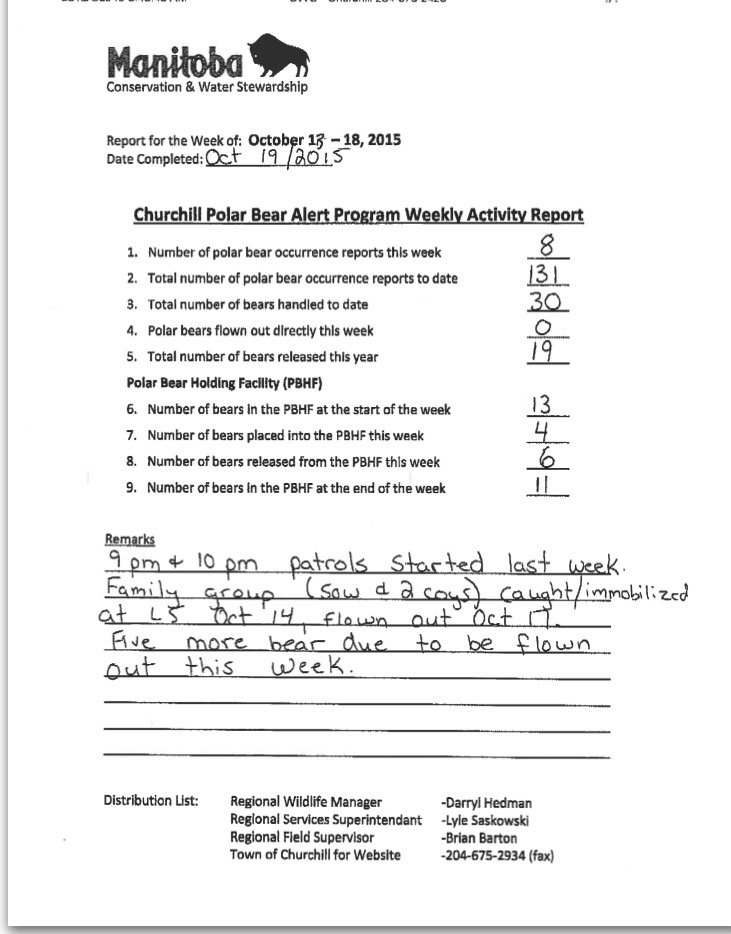
Churchill problem polar bear report for 13-18 October 2015

Latest report on problem bears in Churchill, Manitoba, from the town’s Facebook page.

2015 Oct 13_18_at Oct 19_lg

Polar Bear Alert Program Activity Report as of Oct. 19 (click to enlarge):

30 polar bears handled to date this year; 11 bears in the holding facility this week (6 released, including a sow and two cubs). As mentioned in the new Polar Bear Town reality TV show, Churchill officials have been more vigilant and pro-active since the two polar bear attacks in 2013 than they were previously, capturing any bears than come close to the town.

See previous post here for map and background. Last week’s report here.


Winter returns to the Arctic – freeze-up 2015 at October 20 expands polar bear habitat

Fall is the season when polar bears that have spent the summer fasting can return to the refreezing sea ice to resume successful hunting. For polar bears, fall is the second-most important time of year for hunting, after spring.

masie_all_zoom_4km_2015 Oct 20

The date when freeze-up occurs across the Arctic varies from place to place and year to year, but the process is well underway this year. The US National Snow and Ice Data Center’s MASIE map for 20 October 2015 (above) shows 7.7 mkm2 of sea ice, up from the annual low of 4.41 mkm2 almost 6 weeks ago.

Continue reading