Tag Archives: population size

BBC Arctic Live for viewers outside the UK: watch scientist distort polar bear facts

Viewers outside the UK can now watch polar bear scientist Steve Amstrup live (Episode 2, filmed 2 November 2016), state that there are “20,000-25,000” polar bears in the world, almost a full year after the IUCN Red List put the worldwide polar bear population size at 22,000-31,000.

[even though Amstrup (now chief scientist and spokesperson for Polar Bears International) was a co-author of that 2015 Red List report, Wiig et. al. 2015]
bbc-live-ii-fat-polar-bear-03

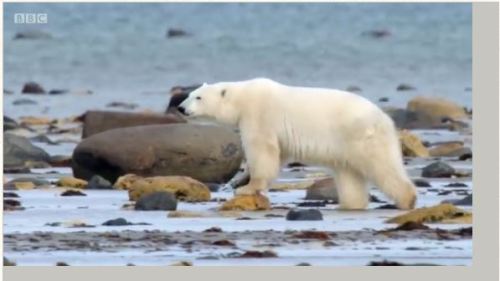
Watch Steve Amstrup, live (Episode 2, filmed 2 November 2016) state that sea ice is only “usually” present in March/April when females with cubs emerge from their dens to feed – as if there has ever not been sea ice present at this critical time of year!

Watch Amstrup , live (Episode 2, filmed 2 November 2016) not point out that the prediction he was responsible for making in 2007 (that got polar bears listed as ‘threatened’ in the USA) has been a total failure: even though the USGS models predicted that polar bear numbers worldwide would decline by 67% and Western Hudson Bay polar bears (as well as nine others) would be wiped out completely when summer sea ice reached the levels they’ve been at since 2007, he pretends that prediction was scientifically valid.

We’ve had sea ice levels not predicted to occur until 2050 for 8 out of the last 10 years and polar bears are still going strong. If Amstrup had been right about the relationship of summer sea ice and polar bear numbers, there would have been no polar bears in Churchill for the BBC to film this year.

Watch all three hour-long episodes below as these two organization team up to promote fear of future global warming with polar bears (or polar bears, as Humble says it). Decide for yourself if polar bear science is being fairly represented.
Continue reading

IUCN Polar Bear Specialist Group website still silent on 2015 Red List assessment

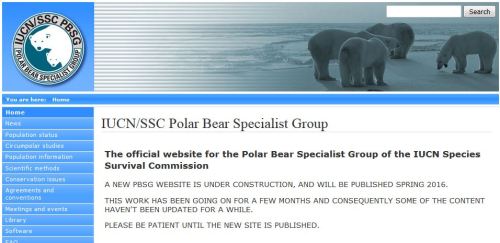
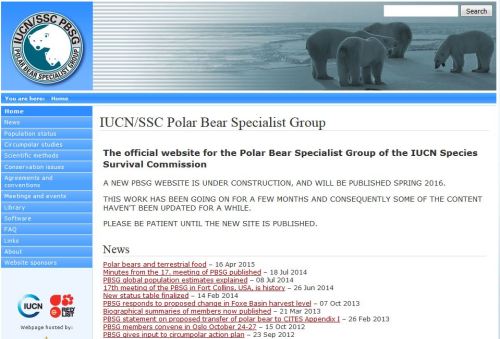
It’s now been 11 months since the IUCN Red List announced the completion of a new conservation assessment for polar bears – but you wouldn’t know that if you visited the website of the IUCN Polar Bear Specialist Group (PBSG).

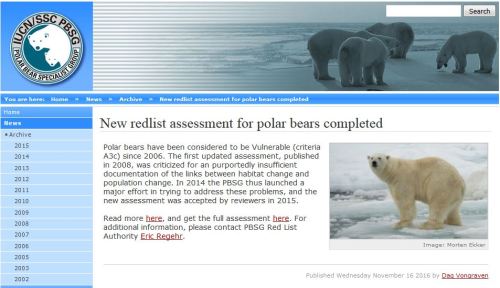
pbsg-website-notice_home-page-2016-oct-18

Back in May 2016, I wrote to the folks at the IUCN Red List asking them why the PBSG had not yet added a link to their website regarding the 19 November 2015 update to the Red List polar bear assessment (submitted by PBSG members in July 2015), a shortcoming I first notice in December 2015. I also inquired why the IUCN Red List folks were not taking the PBSG to task for their failure to keep the public informed of this new development.

After a wait of more than 6 weeks (23 June), I finally received a reply. The Red List official accepted as reasonable the PBSG excuse that since a link to the IUCN Red List was present on their home page as an icon (here), a direct link to the actual Red List polar bear assessment was not necessary. He was informed by the PBSG that the website upgrade had simply taken longer than expected but that it would be completed by the end of July.

And yet, here it is – almost three months later and still no revised website – and more importantly, still no mention of the 2015 Red List assessment update, see screencap above taken 18 October 2016 (which has been up since 14 January 2016).

Note that my complaint is not that the website upgrade has taken longer than expected (doesn’t it always?) – it’s about the continued refusal to provide a simple link to the 2015 Red List assessment at the top of their “News” feature which sits prominently on their home page.

The PBSG is considered the scientific authority on polar bears and in my opinion, the fact that for 11 months their website has lacked a link to the 2015 Red List assessment (which contains many significant changes, including a larger population estimate, a revised population trend, and a prediction of future change with error bars) raises concerns about transparency, potential bias, and lack of accountability of the PBSG organization – and displays a similar kind of contempt for the public that its chairman revealed back in 2014 when he said that population size estimates were “simply a qualified guess given to satisfy public demand.”

Copies of my email exchange with the Red List associate who answered my inquiry are below – decide for yourself if I’m over-reacting.

UPDATE 22 Nov. 2016: A cursory check of the PBSG website today revealed that a few days ago (16 Nov. 2016) the PBSG Chairman finally did what I have been suggesting for almost a year: post a simple notice and link to the 2015 IUCN Red List polar bear assessment.

A simple line in the NEWS section of the home page:

pbsg-website_home-page-2016-nov-16-news-red-list

They even added a short notice with links to the documents (screen cap below).

pbsg-website-redlist-news-notice_2016-nov-16

Yes, pretty much exactly what I suggested in January. I’d hazard a guess I wasn’t the only one complaining.

Continue reading

Arctic sea ice grows & Churchill polar bears into their 4th month of fasting

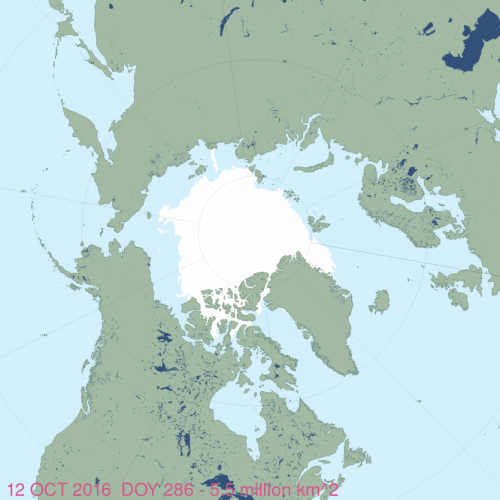
A quiet year for problems in the polar bear capital of the world (Churchill, Manitoba) so far – despite this year tying for the second-lowest minimum since 1979 – and the ice is growing fast. In fact, Arctic ice growth in the second half of September was rapid and there is now more ice than there was at this date in 2007 and 2012 (when polar bears in those regions considered most at risk did not die off in droves).

masie_all_zoom_4km-2016-oct-12

Pessimistic polar bear specialists are wrong  – polar bears are much more resilient to low sea ice levels in summer than they assume: their own data from low summer ice years proves it.  If you’ll recall from my previous post, polar bears seem to have barely survived the extensive sea ice coverage during the Last Glacial Maximum – in other words, too much ice (even over the short term) is their biggest threat. Polar bear numbers, as confirmed by the latest estimates in the 2015 IUCN Red List assessment, are higher now than they have been since the 1960s, despite almost 10 years of summer sea ice minimums below 5.0 mk2.

Churchill Polar Bear Alert reports and Arctic sea ice comparisons at this date, in detail below.

Continue reading

The polar bear problem no one will talk about – the downside to large populations

A large polar bear population with lots of adult males – due to bans on hunting – means more survival pressure on young bears, especially young males. To blame more problems with young male bears on lack of sea ice due to global warming ignores the downside to the reality Norway asked for when it banned hunting more than 40 years ago.

More hungry young males coming ashore looking for food is one of the potential consequences of living with a large, healthy population of polar bears. Biologist Ian Stirling warned of such problems back in 1974.

UPDATE: added below 6 Oct. 2016, statistics of defense of life shootings of polar bears in Svalbard since 1973.

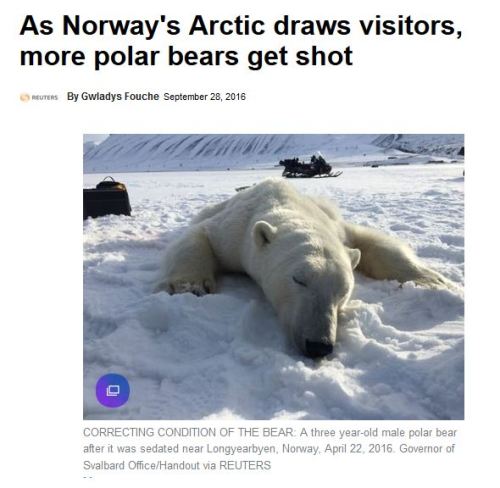
svalbard-more-visitors-more-bears-shot_28-sept-2016-yahoo

Svalbard area polar bear numbers have increased 42% since 2004 and more hungry young polar bears almost certainly mean more polar bear problems, as folks in Svalbard (see map and quotes below) have experienced this year.
Continue reading

Recent studies show Sept ice of 3-5 mkm2 did not kill polar bears off as predicted

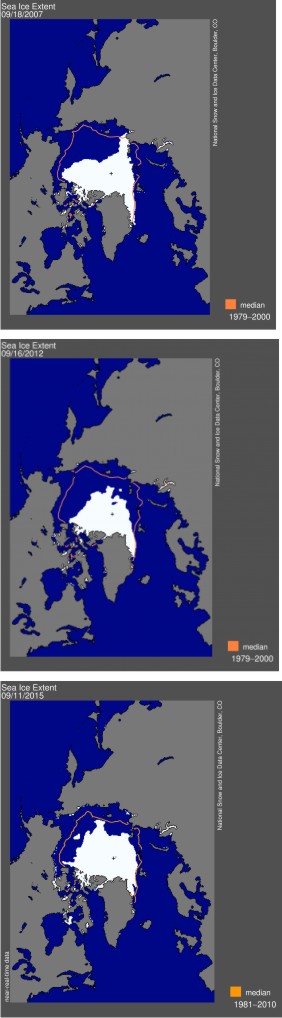
The annual Arctic sea ice minimum for 2016 is imminent and the hand-wringing about polar bear survival has already begun. While this year is shaping up to be another very low sea ice minimum in the Arctic – not as low as 2012 but lower than as low as 2007 (previously the 2nd lowest since 1979) – contrary to predictions, several recent studies show that such low sea ice coverage in summer has had no (or very limited) negative effects on polar bear health and survival. In fact, for polar bears in some areas low summer sea ice has been quite beneficial (although these are not the populations that polar bear specialists predicted would do better).

polar_thin_ice Jessica Robertson_USGS

Since low summer extents of recent magnitude (3.0 – 5.0 mkm2) are clearly not any sort of threat to polar bears, it seems improbable that even an ice-free (≤ 1.0 mkm2) summer (e.g. Wang and Overland 2015) would be devastating to the species [don’t forget Cronin and Cronin 2016: they’ve survived such conditions before] – as long as conditions in spring allow for the necessary concentrated feeding on young seals.

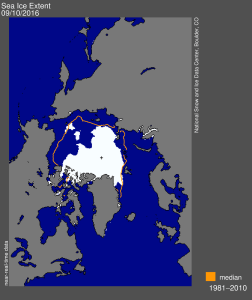
sea-ice-mins_2007_2012_2015_polarbearscienceAbove: Top, minimum at 2012 (16 Sept, 3.41 mkm2, lowest since 1979); Center, 2007 (18 Sept, 4.17 mkm2); Bottom, 2015 (9 Sept, 4.50 mkm2), from NSIDC. Below: sea ice at 10 Sept 2016, 4.137 mkm2 – minimum not yet called).
sea-ice-extent-2016-sept-10_nsidc

Recall that in 2006, the IUCN Polar Bear Specialist Group based their conservation status of ‘vulnerable’ (likely to become threatened within the next 45 years due to reduced habitat) on the predictions of sea ice specialists (see 2008 update here).

Sea ice experts in 2005 predicted such low summer sea ice extents as polar bears have endured since 2007 (3.0 – 5.0 mkm2) would not happen until 2040-2070, at which time PBSG biologists said that >30% of the world’s bears would be gone.

Evidence to the contrary comes from polar bear specialists working in the Chukchi, Beaufort, and Barents Seas – and in Southern Hudson Bay – since 2007. Overall, the latest IUCN Red Book assessment (2015) put the global population size at 22,000-31,000 (or about 26,500).

All of this means that those polar bear experts were wrong: polar bears are more resilient to low summer sea ice conditions than they assumed.

UPDATE 2 January 2017: I’ve added some quotes from the original USGS reports that explicitly state their dire predictions for 2050 that differ from the predictions made by the IUCN Polar Bear Specialist Group.
Continue reading

Columnist admits video on polar bears and global warming contained a serious error

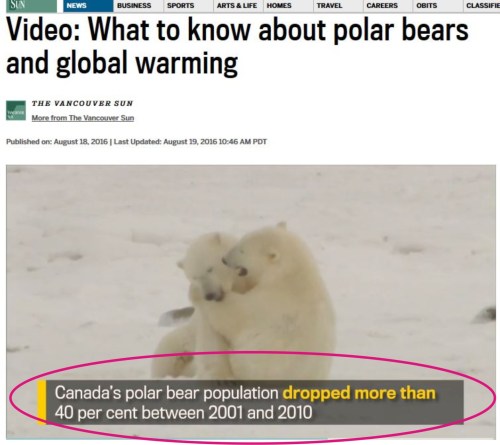
Since mid-August,  Vancouver Sun columnist Daphne Bramham has been filing a series of articles from an expedition cruise through the Northwest Passage for a feature called “Above the Arctic Circle”. One of these appeared on August 18, along with a video called “What to know about polar bears and global warming” and it contained an egregious error that should have stood out to any educated person as being wrong by several orders of magnitude:

What to know about pbs GW_Video_screencap 2_SUN_18 Aug 2016 marked

We are not talking about a difference of opinion or interpretation but a simple fact that was outrageously wrong by a wide margin. You see it, don’t you? Continue reading

USGS report on history of walrus haulouts leaves out correlation with population size

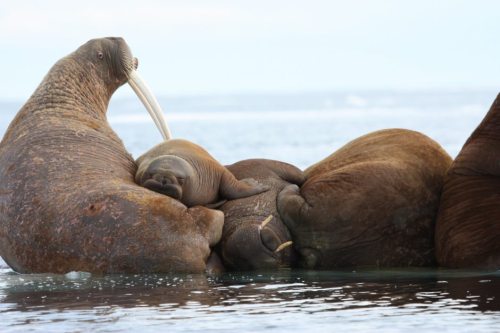
Walrus researchers from the US Geological Survey have a new report on the history of walrus haulouts in the Chukchi and Bering Seas – yet their media efforts (via press release and interviews) fail to mention the relationship between fluctuating size of walrus haulouts and fluctuating walrus population size that is evident in that history. In fact, overall population size is not mentioned at all.

Walrus 2012 July USGS

Two articles came out over the weekend that announced the results of this new joint US-Russian initiative [PBS, Walrus beaching in Alaska might not be as harmful as it looks. Here’s why – 31 July 2016 and ADN, Alaska and Russia join forces to create 160-year database of walrus haulouts – 31 July 2016]

But neither articles nor the new USGS paper they are touting (Fischback et al. 2016) mention the huge summer/fall haulouts of females, calves, and juveniles that were documented in the 1970s that coincided with the huge population size at that time, which crashed in the 1980s.

Only now has the population grown (to at least 200,000) to the point that huge haulouts are again being reported – conservation has done it’s job. But when walrus numbers get too high the animals out-strip their food source and numbers plummet, as they did in the 1980s (Fay et al. 1989; Garlich-Miller et al. 2011). See my fully referenced summary paper, Crockford 2014 (On The Beach: Walrus Haulouts are Nothing New).

Here’s the concern: When (not if) a population crash happens again, will it be blamed on global warming rather than natural causes? According to the PBS article:

“The database is supposed to help federal officials with conservation, especially as more ships start sailing through the newly open waters. The U.S. Fish and Wildlife Service is determining whether walrus should be listed as a threatened species.[my bold]

My GWPF video on the issue (The Walrus Fuss) below:

See excerpts from the USGS database below, with a map:

Continue reading

PBSG failure to acknowledge 2015 IUCN polar bear update drives the public here

It is now past the 15 June 2016 mark and the IUCN Polar Bear Specialist Group (PBSG) has still not acknowledged the 2015 IUCN Red List update on the status of polar bears. See the screencap below, taken this morning.

PBSG at 16 June 2016

This notice has been up since 14 January 2016 and no reference or link to the November 2015 IUCN Red List update has been posted, even though PBSG members authored the report (pdf here)!

What they may not realize is that their silence just drives people who search the internet looking for up-to-date population and conservation status info on polar bears to this site. My posts on population size and conservation status have been the most popular posts since November.

It’s that kind of attention that has made this site so popular: PolarBearScience will reach 750,000 views within the next couple of weeks (see “Blog Stats” lower right) – that’s right, 3/4 million views in less than four years. More than 400,000 readers have come here since the end of July 2012 to find out what’s really going on in the world of polar bears. Continue reading

Polar bears are not bloodthirsty killers, says biologist [just don’t forget your gun]

According to records compiled by James Wilder, a US Forest Service biologist, there were only 20 fatal polar bear attacks (out of 73 total attacks) between 1870 and 2014.

That’s what the 14 June 2016 account in the Anchorage Daily News says (“Sea ice has been keeping polar bears and humans apart — until now”). But I think it’s kind of delusional to suggest that a list of recorded attacks, spanning 145 years throughout the Arctic (including Russia), have captured more than a fraction of all actual polar bear attacks – given that many Arctic communities didn’t have reliable communications in the 1970s (let alone the 1870s). How about all the Inuit and Siberian hunters over the years who failed to return home because they were killed and eaten by a polar bear – unbeknownst to anyone?

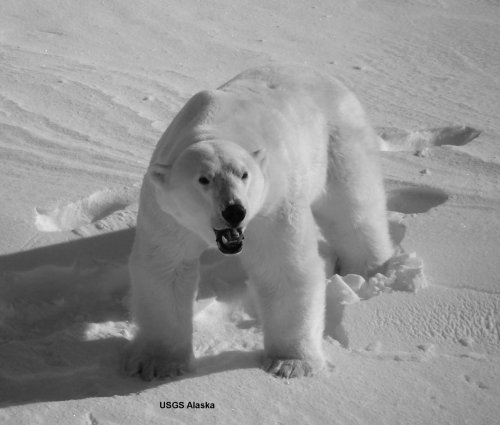
Alaska PB USGS_marked

Wilder presents these numbers as a basis for saying how concerned he is that a longer open-water season in the Arctic could increase the number of attacks by polar bears – and he’s right, that’s a valid concern now that the global population of bears is so high. Many polar bears plus people in a confined area is never a comfortable situation, as the people of Churchill, Manitoba have learned.

But declining sea ice is not the only scenario that could lead to an onslaught of hungry bears and a slew of fatal attacks, as my new science-based novel EATEN highlights. The truth is that if polar bears don’t get enough food in the spring – for any reason – the ice off the beaches of Arctic communities gives polar bears easy access to human prey. If that happens, people had better be prepared – because doors and windows won’t necessarily stop a determined polar bear.

EATEN ebook sale 2016 susancrockford_dot_com

Continue reading

New paper shows no harm from more time on land for S. Beaufort polar bears

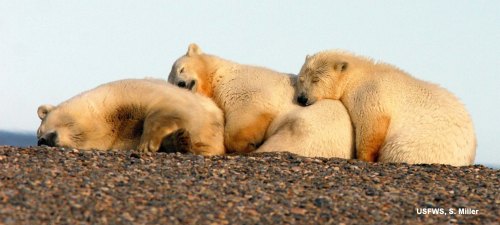
polarbears-arcticnatlwildliferefuge-suzannemiller-usfws_labeled_smTake-home quote from a new polar bear paper by Todd Atwood and colleagues (2016):

“…there is no causal link between the patterns in polar bear vital rates and increased use of terrestrial habitat…”

In other words, there was no information to link the increased time polar bears spent onshore with either an increase or a decrease in body condition, survival or cub production. The authors did find that polar bears were strongly attracted to the bone piles that accumulated in the fall from 2010-2013 after Inuit bowhead whale (Balaena mysticetus) hunting at Barrow, Cross Island, and Kaktovik. Isn’t that a surprise?

The results also appear to confirm previous work that showed terrestrial (land-based) foods are not important to polar bears – a conclusion I totally agree with and which I discussed last year here. No wonder there was no press release issued by USGS about this study. It’s only “news” because someone the Anchorage Daily News interviewed lead-author Atwood yesterday as a way of promoting the International Bear Conference (see previous post here, now updated with a link to the Talk of Alaska radio podcast). Atwood implied there could be advantages to bears from feeding on the bone piles but admitted he had no data to support that assumption.
Continue reading