Posted onSeptember 30, 2015|Comments Off on Activist explorer blames more polar bear encounters since 1985 on reduced sea ice
Activist polar explorer Børge Ousland’s told National Geographic that more polar bear encounters on land are due to reduced sea ice – without any reference to population changes over that time or revealing when or where these observations were made.
More vague anecdotal observations and opinions posing as scientific evidence. Continue reading
Comments Off on Activist explorer blames more polar bear encounters since 1985 on reduced sea ice
Posted onSeptember 25, 2015|Comments Off on Churchill problem polar bear report for 14-20 September 2015
Latest report on problem bears in Churchill, Manitoba, from the town’s Facebookpage. See previous post herefor map and background. Last week’s report here.
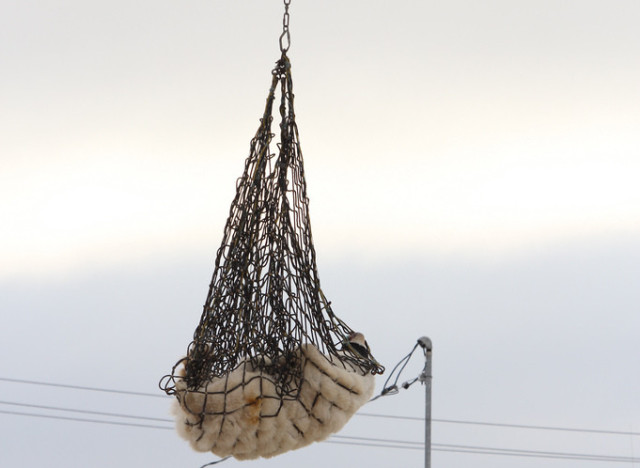
Photo above: A bear is transported to Churchill’s polar bear holding facility (from a 2011 Huffington Post article, “Polar Bear Prison”).
22 polar bears handled to date this year; 15 bears in the holding facility this week. See also last post on Polar Bear Town – a new TV reality show about Churchill polar bears.
Polar Bear Alert Program Activity Report as of Sep 21 (click to enlarge):
Comments Off on Churchill problem polar bear report for 14-20 September 2015
Posted onAugust 13, 2015|Comments Off on Well-fed polar bears onshore at height of summer easily deterred by noise, CBC reports
From the CBC this morning, we have the report of a female polar bear and her cub paying a visit to an Nunavut campsite near Chesterfield Inlet in northwestern Hudson Bay, which is technically within the boundary of the Foxe Basin polar bear subpopulation.
Maggie Putulik photo, 29 July 2015 Chesterfield Inlet, Nunavut.
These are not the desperate bear victims of global warming we have been warned about by polar bear specialists but well-fed curious ursids not averse to an easy meal if there’s one to be had. Such bears are easily deterred by a loud noise. Note this was the second visit by polar bears this Nunavut family had experienced at this location within a three-week period – two other bears had stopped by earlier. Note that ice in this region of Hudson Bay broke up earlier than usual this yearyet these bears seem to be in fine condition and can expect the first fall ice of the season (freeze-up) to appear in their neighbourhood, see maps below. Continue reading
Comments Off on Well-fed polar bears onshore at height of summer easily deterred by noise, CBC reports
Posted onAugust 2, 2015|Comments Off on Keeping track of problem bears in Churchill
The City of Churchill has recently taken to posting its problem bear reports on its Facebook page. This is something to keep an eye on, so let’s catch up so that future reports can be put into context.
Photo above: A bear is transported to Churchill’s polar bear holding facility (from a 2011 Huffington Post article, “Polar Bear Prison”).
Posted onJune 21, 2015|Comments Off on Polar bear news: 1st fat bear ashore in WHB, trouble in S. Greenland, and more hybrid hype
Last week, among other events, the first fat polar bear of the season was photographed on shore in Western Hudson Bay, a fat bear was run out of town in South Greenland, and media outlets spread misinformation – apparently preferring global warming hype to rational facts.
1) First polar bears have been seen onshore in Western Hudson Bay in Wapusk National Park near Cape Churchill (map below) on 18 June this year, apparently fat and well prepared for the summer fast. My informants tell me a few bears usually come ashore in June near Churchill before ice conditions make this necessary; the bulk of the population will probably continue seal hunting for a few more weeks. Those bears will come ashore along the southwest coast (near Polar Bear Provincial Park, in Ontario, see Fig. 2 below). They’ll make their way north to the Churchill area in time for freeze-up in the fall. Watch one fat bear caught on camera on 18 June, below :
2) Fat polar bear spotted in Nanortalik, Southern Greenland 18 June 2015, a bit further south than usual. People from the community drove it away, but not before taking lots of pictures.
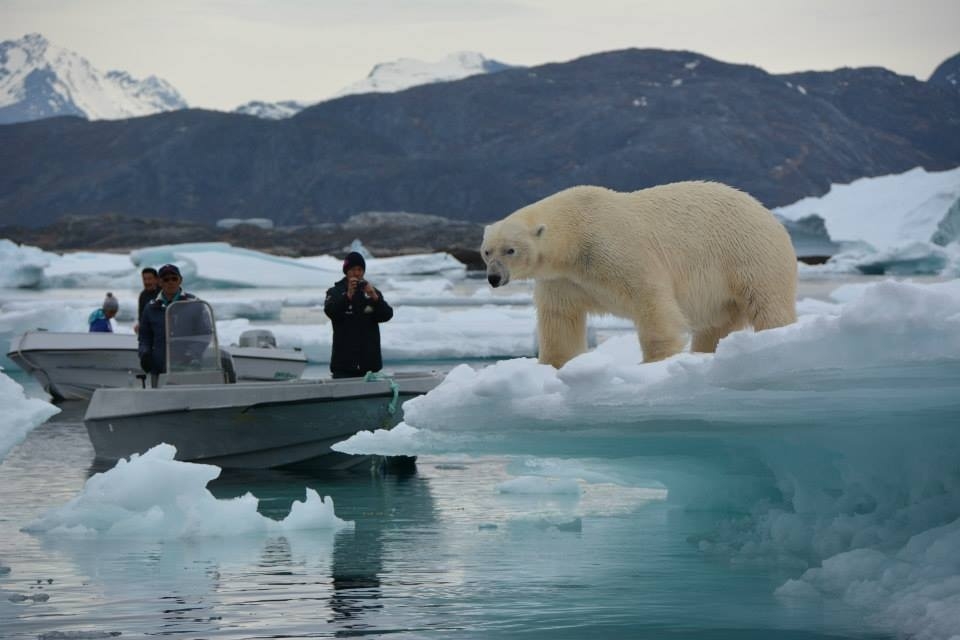
Some very cool photos, including the one above (taken by Henrik Hansen), worth a look. This bear was in excellent condition, well prepared for the summer fast ahead, whether he ends up spending it on shore somewhere (but not near this community!) or on the sea ice further north in SE Greenland (Fig. 1 below). The ice in that areas is probably broken up (~15-30% concentration) but this is enough for the bear to swim from flow to flow to make it’s way up the northeast coast where most East Greenland bears spend the summer. Continue reading
Comments Off on Polar bear news: 1st fat bear ashore in WHB, trouble in S. Greenland, and more hybrid hype
Posted onDecember 11, 2014|Comments Off on Hudson Bay sea ice well above average – excellent early December polar bear habitat
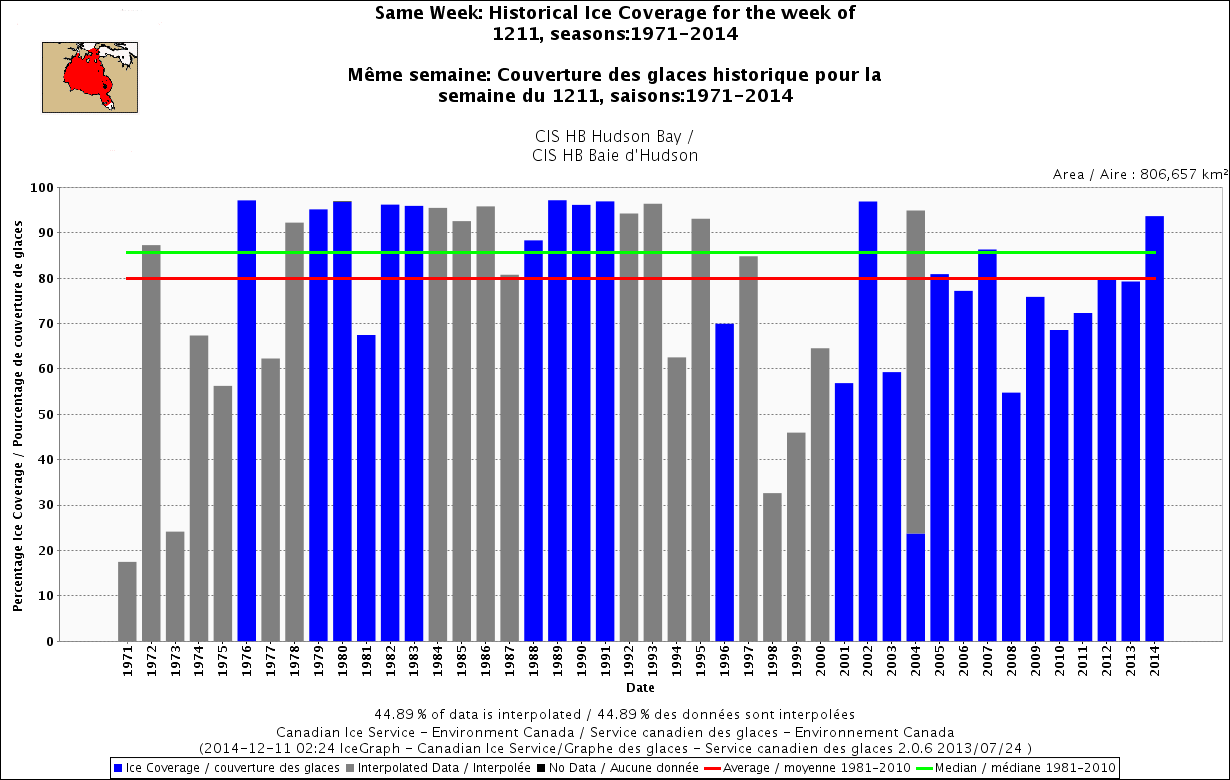
Sea ice development for this date is well above average on Hudson Bay – even more so than last week – making three years in a row of average-to-above average ice habitat available to polar bears in early December (see last week’s ice summary here). Coverage for the week of 11 December from 1971 to 2104 below (from Canadian Ice Service):
More maps below (from CIS and NSIDC), see others here.
Posted onOctober 15, 2014|Comments Off on Churchill problem bears and early breakup dates in WHB: The 1983 & 2004 anomalies
In this part of my critique of Stirling and Parkinson (2006), regarding breakup dates in Western Hudson Bay (see Part I here), I will show that these authors also left out critical data.
Figure 1. A bear is transported to Churchill’s polar bear holding facility, from a 2011 Huffington Post article “Polar Bear Prison.”
Their correlation between number of problem bears in Churchill and breakup dates for WHB worked because some very inconvenient data were simply left out: problem bear data for 1983 and 2004.
Inclusion of that information would have shown 1983 and 2004 were two of the worst years for polar bear problems in recent history despite being late breakup years (1983 also had the last human fatality from a polar bear attack). They could have explained why they did not use the data but they did not — they simply left it out.
Amazingly, this work is being touted as “evidence” that global warming is harming Western Hudson Bay polar bears. Continue reading
Comments Off on Churchill problem bears and early breakup dates in WHB: The 1983 & 2004 anomalies
Watch polar bear habitat reform in the Canadian Arctic: “last 10 days” Canadian Ice Service animation (works anytime) HERE.
See Quote archive for details.










 polarbearscience
You must be logged in to post a comment.