Tag Archives: sea ice

Fake news on polar bear survival predictions is political posturing

I call this fake news because it’s not news – media headlines around the world today (New York Times, Washington Post, DailyMail) are trumpeting the release of a final version of a draft report released with similar fanfare more than a year ago, announced today by the US Fish & Wildlife Service in the official US government publication, Federal Register.

biggest-threat-to-polar-bears-is-global-warming-nyt-headline_9-jan-2017

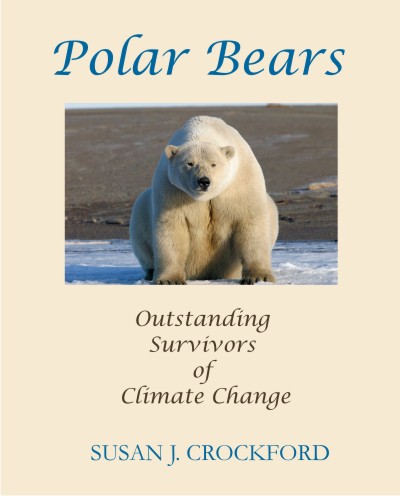
Without action on climate change, say goodbye to polar bears” is exactly the kind of sensationalized nonsense I address in my new detailed science book, Polar Bears: Outstanding Survivors of Climate Change (announced here, discussed here).
Continue reading

Polar bear habitat message for the year end: 2016 Arctic ice extent same as 2010

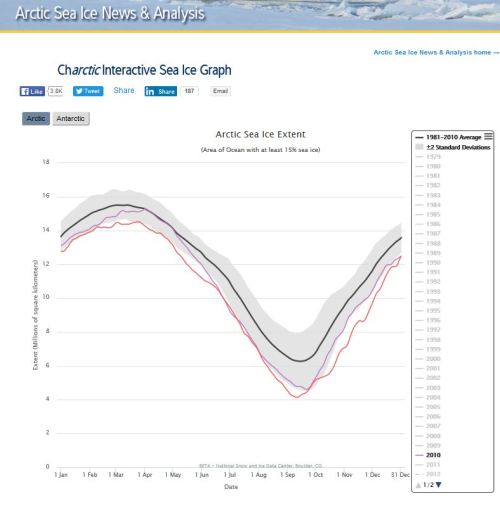
According to NSIDC daily sea ice interactive graph,  there was ever so slightly more ice on 31 Dec 2016 than on that date in 2010. However, the corresponding ice maps show just how differently that ice was distributed.

sea-ice-at-31-dec-2016_vs-2010_nsidc-interactive

Recall that in 2010, there was no huge die-off of polar bears attributed to reduced amounts of sea ice in the fall (or to reduced ice in summer, for that matter) because there was no catastrophic die-off at all.

Continue reading

Polar bear habitat update and attempts to spoil the good news for kids

The trolls are out in force at Amazon, posting negative reviews of my new book, Polar Bear Facts & Myths – they just hate it when credible scientists won’t promote a message of doom. It seems folks of this ilk truly want children to have nightmares about drowning, starving polar bears; they encourage kids to frantically turn out lights in a vain attempt to “Save The Sea Ice” while unbeknownst to them, the polar bears and seals prosper.

I expect those same fear-mongers will really hate my next book, due to be released early next week, because it presents the evidence in a way all readers will understand with the references to back it up. Polar bears and ringed seals are thriving despite recent losses of summer sea ice and there is seemingly a huge body of activists and scientists who don’t want people to know that simple fact.

Coming soon    Polar Bears: Outstanding Survivors of Climate Change

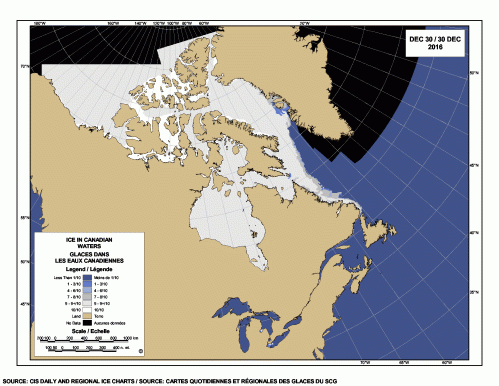
Back to polar bear habitat news, here is the sea ice map for 30 December 2016: Hudson Bay iced-over and lots of ice moving down southern Davis Strait:

Sea ice extent Canada 2016 Dec30_CIS.gif

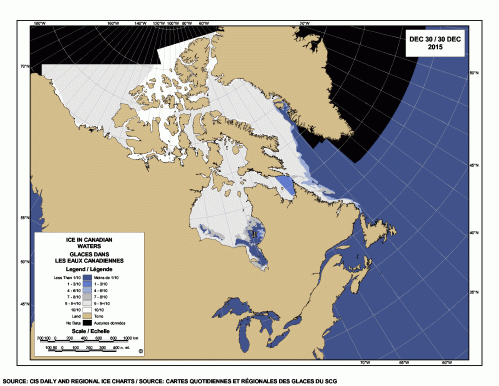
Compare to last year at this time, when polar bears did not die off in droves anywhere in Canada (or we would have heard about it) – remember that 2/3 of the word’s polar bears live in Canada:

canadian-arctic-dec-30-2015_cis

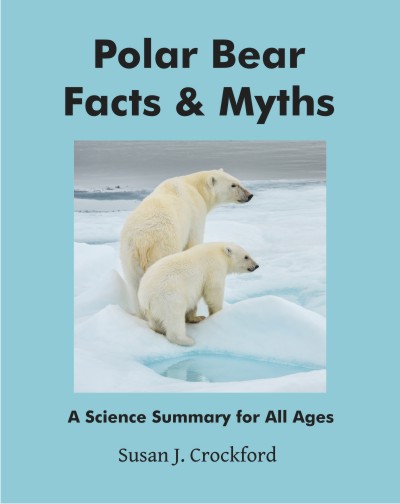
Polar Bear Facts & Myths now available and may arrive in time for Christmas

The first science book suitable for kids that tells the whole truth about polar bears and climate change is now for sale at Amazon.

fm_small

This beautiful, full color summary (44 pages, 8 x 10 inches) explains in simple terms why polar bears are thriving despite the recent loss of Arctic sea ice. It’s written in a question and answer format, in language that readers of all ages can understand (age 7 and up). The book takes a sensible, big-picture approach that many readers will appreciate and is based on the most up-to-date information available.

This is the perfect gift for some of the polar bear lovers on your gift list and if you act quickly (order here), your book may arrive before the 25th. At this time, only the paperback is available but some ebook versions should be out shortly. 

For purchasers for which a pre-Christmas delivery isn’t going to work (publication will be later in Europe; shipping is faster to eastern Canada and the US than to the west), I have provided a gift card you can download to print off and give in lieu of the physical book (kind of a placeholder until it arrives).

UPDATE: 18 Dec. 2016 Now listed at Amazon Canada and Amazon UK

Download gift card PDF HERE for Polar Bear Facts & Myths

Download gift card PDF HERE for Polar Bears: Outstanding Survivors of Climate Change  (coming soon, see below).

[Download Christmas gift cards, one per page, for both books here]

Check my book website for updates.

For adults & high school students (coming soon Now available)

os_small

This color, fully-referenced polar bear science book is aimed at adults and high school students. Polar Bears: Outstanding Survivors of Climate Change is fashioned after the popular lecture with the same title I have given since 2009, which has been enthusiastically received by audiences with diverse backgrounds.

My book website now has full details of these new non-fiction books (along with a revised author biography) and will be updated regularly regarding formats and venues as they become available. Details for EATEN on that site has moved to its own fiction page.

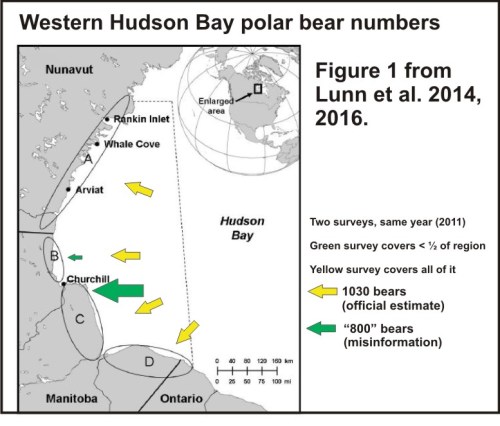
W. Hudson Bay had 1030 polar bears at last count and that is the official number

The IUCN Polar Bear Specialist Group, the IUCN Red List, and Environment Canada (see below) agree that the population size of Western Hudson Bay subpopulation is 1030 or about 1000 bears, based on surveys conducted in 2011.

western-hudson-bay-surveys-2011-compared_polarbearscience-16-dec-2016

For the last few months (most recently, here and here), Andrew Derocher has been telling anyone who will listen that that the number is 800. And no one challenges him – not a single reporter asks where the number comes from, not a single research colleague who knows the truth has publicly stated that Derocher is spreading misinformation.

UPDATE 16 December 2016, half an hour after posting: Add The Atlantic to those accepting Derocher’s misinformation on WHB polar bear numbers without question, and failing to see that because patrols in Churchill were stepped up considerably after a serious mauling occurred in 2013 (because several bears got through their Halloween dragnet), more “problem” bears in Churchill since then only mean the Polar Bear Alert folks are doing their jobs.

But what does The Atlantic conclude, after talking to Derocher?

The Churchill bears…are probably doomed.

Never was a rational book on the science and conservation status of polar bears more desperately needed – it will be available soon.
Continue reading

Coming soon: the polar bear science books you’ve been requesting

It’s just past the first anniversary of the publication of my science-based novel, EATEN, so satisfied readers may be pleased to learn that I have a pair of polar bear science books set to be released.

Finally – books for adults and children that present the facts about polar bears without spin and fear-mongering about model-predicted futures: reference books that include the most up-to-date information that show polar bears have the innate ability to adapt quickly to changes in sea ice.

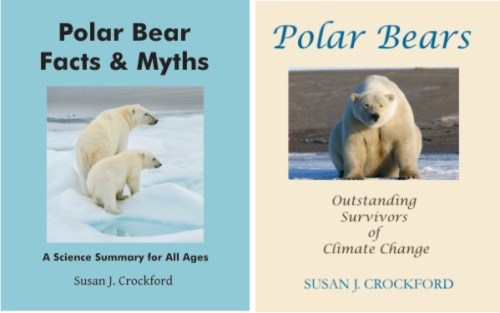
Barring major revisions, the covers will look like this:

os-and-fm-cover-drafts-14-dec-2016

One is a fully-referenced book for adults and high school kids called Polar Bears: Outstanding Survivors of Climate Change.

The other is a fabulous companion or stand-alone summary volume (ages 7 and up), called Polar Bear Facts and Myths: A Science Summary for all Ages..

Both books are full-color and relatively short. With luck, they should be available next week, so stay tuned for details. Each will sell for well under US$20 (exact prices unknown).

Continue reading

Polar bears that didn’t die from recent sea ice loss will die in 35 yrs, say ‘sperts

Yesterday, the DailyMail (among others) was suckered into running virtually the same story The Guardian (among others) hyped last year about this time.

Using a science journal version of the 2015 IUCN Red List assessment report, polar bear data collectors and their fortune-teller colleagues have managed to get polar bears back in the news.

crystalball_468x317_predictions_sq

I wrote about this last year – it’s actually good news, although you wouldn’t know it from the headlines.

Let me paraphrase the ‘sperts:

“After 10 years of ice conditions we didn’t expect would happen until mid-century (a worst-case scenario we said would cause more than 30% of the world’s polar bears to die – except they didn’t), we have now determined (using a new model and a brand new definition of sea ice specific to polar bears) that by mid-century, there is only a 70% chance that 30% of polar bears will die.”

This is how they explain away all the bears that didn’t die as they should have when summer sea ice declined to about 5 mkm2 and below after 2006.

Continue reading

History of anxiety over sea ice gets a video

A brief historical perspective on the failed predictions that have plagued scientific understanding of Arctic sea ice changes – predictions embraced wholeheartedly by polar bear specialists and conservation experts. It’s worth a watch.

Transcript here from the Global Warming Policy Foundation.

No correlation between freeze-up dates for WHB sea ice & Churchill temperatures

This is a follow-up to my last post and this time, I’ll address the implied correlation between freeze-up dates for Hudson Bay and Churchill temperatures in November that is being made by folks who should know better .
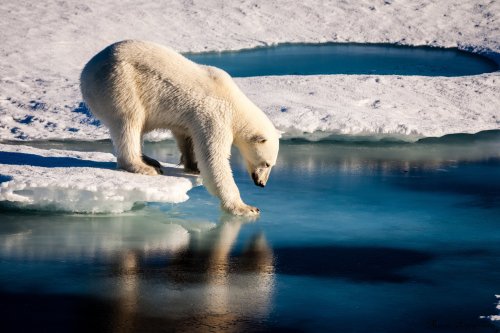
polar-bear-tests-thin-ice_mario-hoppmann_noaa-funded-imaggeo-egu-eu

Monday, 14 November 2016 a.m, over at Polar Bears International [my bold]:

“As a new week starts in Churchill, the weather is the warmest we’ve ever seen at this time of year. The tundra is muddy, with remnant patches of snow, and the bay is ice-free.” PBI Blog (no author designated)

Well, that may be true for the last few years – the high on 14 November 2016 (-1.20C) was the highest since 2012.

Andrew Derocher made a similar statement on the 4th (my bold):

There’s no sea ice anywhere in Hudson Bay yet—not even in the northern part of the Bay where ice should be forming. It’s above freezing today and if the forecast holds, it will be a record high for this date. It was 10 degrees colder last year at this time.”

Derocher is being unscientifically vague here and also misleadingly cites highs and lows as if they were the same. In fact, according to weather records kept by Environment Canada, for 4 November 2016 at Churchill, the daily high was +1.50C (compared to –1.50C in 2015). The daily low in 2015 was -15.30C, a 10 degree difference. The next-highest temp. for that date since 2012 was +0.70C in 2014 – hardly an earth-shattering difference.

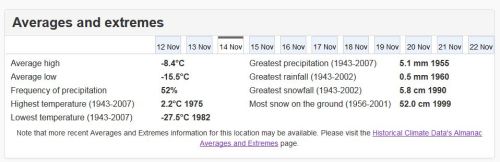
However, if you are trying to draw conclusions about climate, you should go back at least 60 years (two climate periods of 30 years each). Temperature records for Churchill go back to 1943, which can be used to assess the claim for the 14th of November made by PBI.

According to weather records kept by Environment Canada, for 14 November at Churchill, the year with the highest temperature was 1975 (+2.20C):
churchill-weather-averages-and-extremes-2016-ec-14-nov

That was Monday. But as of yesterday, the weather recorded – and the forecast for the following week (17-23 November) was quite different, as the screencap below shows:
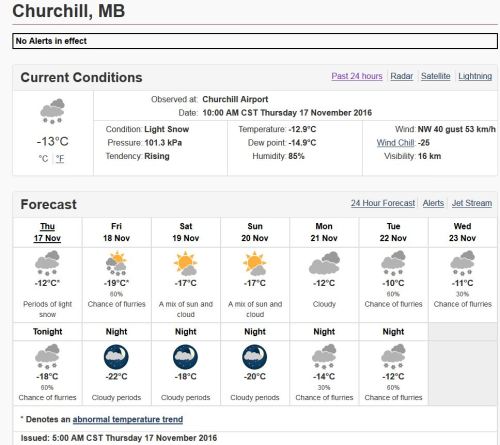
churchill-weather-2016-abnormal-cold-17-23-nov

The final recorded max. for yesterday (Thurs. 17 Nov) was -9.70C vs. a min. of -17.70C. So, a bit warmer during the day than predicted but as cold as expected overnight.

And for today, the current temperature in Churchill, as I write this is, is -190C (-310C with the wind chill) and the year with the highest temperature recorded for 18 November was 1944 (0.00C) – which was also the highest temperature for the 19th, recorded in 1943.

Ice maps and historical background below. See last post for recent multi-year comparison.
Continue reading

No correlation between freeze-up dates for Hudson Bay & total Arctic ice cover

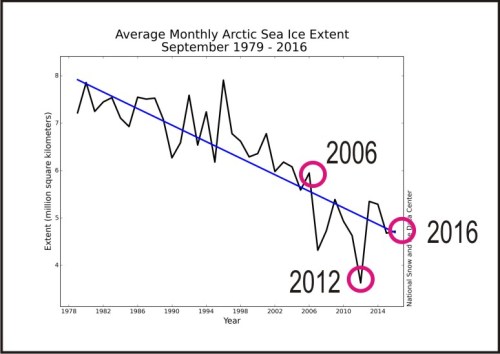
Guess which year between 2006 and 2016 had the latest start to freeze-up on Hudson Bay, given that 2012 had the lowest September average and 2007 and 2016 tied for second-lowest (see graph below, from NSIDC), and that sea ice in the Arctic right now is the lowest it’s been for this date since 1979?

sea-ice-sept-averages-graph-only-marked-for-2006-up

If you guessed anything other than 2010, you guessed wrong – in addition, 2006 (not 2016) was second latest.

There is no correlation between Arctic sea ice coverage and freeze-up dates for Western Hudson Bay.

Yet, Polar Bears International (“Save Our Sea Ice”) –  who were surely in and around Churchill in 2010 and 2006 watching polar bears – just posted an alarming statement about local conditions, implying that slow freeze-up of Hudson Bay this year is a reflection of the fact that “sea ice is at a record low across the Arctic.”

They also claim that “…the weather is the warmest we’ve ever seen at this time of year.” That may be true, but if so, it is also meaningless with respect to the progress of freeze-up.

Does no one at PBI remember the very late freeze-up of 2010 or 2006? Odd, that.

Continue reading