Tag Archives: sea ice

Paris climate change deal will not stop polar bears dying due to thick ice in spring

Thick spring ice due to natural causes is currently the single biggest threat to polar bears. Not declining summer sea ice – thick spring ice. That could change in the future but right now, the evidence supports that statement.

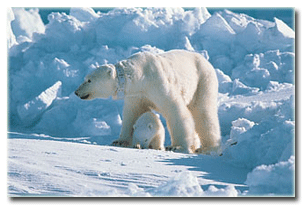
polar_bear with collar_USGS

Polar bear deaths due to cyclical changes in Arctic sea ice thickness in the spring have continued despite rising CO2 emissions and declining summer sea ice extent (last major incident, 2004-2006): there is no reason to expect this will not continue. Unwarranted attention on summer ice extent has deflected attention from this major cause of local polar bear population decline.

Sea ice models do not address past or future changes in spring ice thickness and predictive models of polar bear survival blame all population declines on summer sea ice declines despite strong evidence to the contrary (Crockford 2015: The Arctic Fallacy). Continue reading

Polar bear habit update – day 333 Arctic sea ice hits 11.1 mkm2

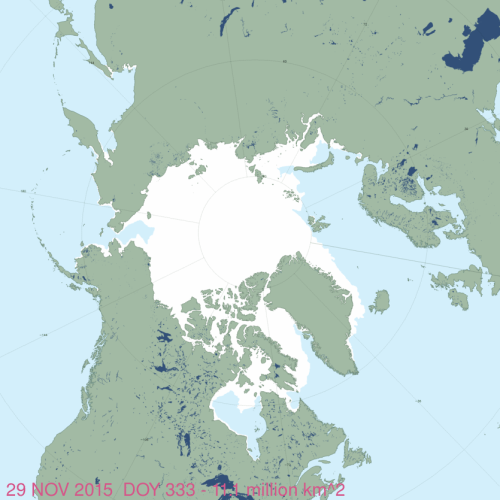
It’s just past the height of fall in the Arctic (Oct-Dec) and polar bear habitat is expanding day by day: according to NSIDC Masie ice charts, the ice has now surpassed 11 mkm2 in extent. Fall is the second most important feeding period for polar bears after spring.

masie_all_zoom_4km 2015 day 333_Nov 29

Only the Barents and Kara Seas (north of Norway and western Russia) are short of ice right now, similar to conditions seen in the fall of 2013. Last fall (2014), conditions were much better and as a consequence, researchers saw a lot of females with healthy cubs in the spring of 2015.

Continue reading

W Hudson Bay polar bears now on the ice hunting but killer whales could be trapped

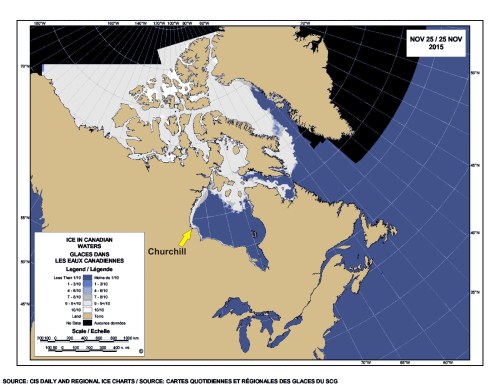
According to reports from folks on the ground in Western Hudson Bay, most polar bears were out on the ice resuming seal hunting by the 20th or 21st November at the latest (some got started quite a bit earlier). That’s less than 2 weeks later than the average date in the 1980s (which was November 8).

Sea ice Canada 25 Nov 2015_with Churchill

However, the rather odd pattern of freeze-up this year may not be good news for any killer whales still remaining in Hudson Bay – their access to the open ocean is already virtually blocked by ice.

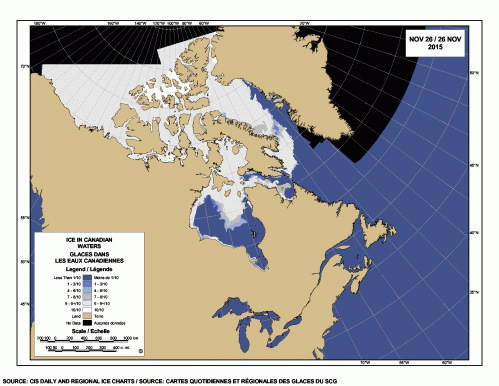
UPDATE 26 November 2015: What a difference a day makes! Look at the spectacular ice development overnight along the west coast of Hudson Bay and in the central portion of the bay since yesterday (below).

Canadian Arctic Nov 26 2015_CIS

Continue reading

IUCN Red Book officials forced scientific standards on polar bear predictive models

As I reported Thursday, the IUCN announcement of a new Red List assessment for polar bear got the usual overwrought attention from international media outlets. However, not one of these contained a quote from a polar bear biologist.

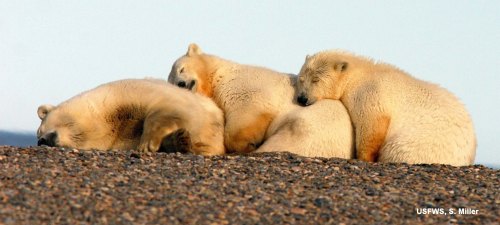
polarbears-arcticnatlwildliferefuge-suzannemiller-usfws_labeled_sm

Steven Amstrup, science spokesperson for activist conservation organization Polar Bears International, has so far had nothing to say to the media. Yet, Amstrup was a co-author of the IUCN Red List report. Not until late in the day following the release of the report did his his organization’s website post a short, bland news report (“Climate Change Still Primary Threat to Polar Bears”).

Similarly, Ian Stirling, Andrew Derocher, Nicholas Lunn (also a co-author of the IUCN Red List report), and former WWF employee Geoff York – who are usual go-to guys for polar-bears-are-all-going-to-die media frenzies – have so far been silent and invisible on this issue.

In addition, while the IUCN press release [backup here: 2015 IUCN Red List press release_Nov 19 2015] included a quote from IUCN Polar Bear Specialist Group (PBSG) chairman Dag Vongraven, as of this morning (21 November, PST), the website of the PBSG contains no mention of this decision – no item in the “News” category  and, more importantly, no update of the status table  or global estimates to reflect the changes contained in the report  (even though they obviously knew it was coming months ago: the report was submitted to the IUCN Red List 27 August 2015).

In my opinion, this silence says it all: polar bear specialists know this assessment is a severe de facto critique of their 2008 assessment (as well as Amstrup’s predictive models) and it’s a big step backwards for their conservation activism. I expect they are silent because they are royally pissed off.

However, this assessment is good news because finally, some standards of scientific rigor have been applied to polar bear predictive models – even though the PBSG were still been allowed to pretend that summer sea ice coverage is critical to polar bear health and survival (Crockford 2015).  Continue reading

Only a 70% chance that polar bear numbers will decline by 30% by 2050

Despite the stupendously unwarranted hype being generated out of the recent release of the 2015 update to the IUCN Red List status assessment for polar bears, in fact the prognosis is better than it has been for years.

That’s because polar bear experts have been forced by the IUCN standards committee to acknowledge the great deal of uncertainty in their predictive models. They now admit there is only a 70% chance that number will decline by 30% over the next 35 years: only slightly higher than a 50:50 chance.

That means there is a 30% chance that the numbers WILL NOT decline by 30% over the next 35 years. See my detailed analysis, where you will find copies of the report and links to the online IUCN Red List assessment.

That has not stopped all major news outlets from treating this report as a new pronouncement of gloom:

CBC, Canada: (“Polar bear numbers to fall as Arctic ice shrinks: study
Population will decline by more than 30% over next 35 to 40 years, experts say”). Except the first sentence admits this is merely “likely”, not “will”:

“Polar bear populations are likely to fall by more than 30 per cent by around mid-century as global warming thaws Arctic sea ice, experts said on Thursday in the most detailed review of the predators to date.”

Mirror UK: “Polar bears facing extinction as numbers ‘to fall by a third over next 40 years’: There is now a high probability numbers of the species will decline by more than 30%, experts claim”

Express UK: “Nearly 8,000 polar bears to ‘DIE OUT’ as vulnerable giants hurtle towards ‘obliteration’: POLAR bears face a “decimation” in the next couple of decades with more than 30 per cent in population set for complete wipe-out in the most terrifying warning yet.”

The Guardian UK: ” Climate change is ‘single biggest threat’ to polar bear survival: ‘High probability’ of a 30% decline in polar bear numbers by 2050 due to retreating sea ice, IUCN study finds”

[Except, as I noted in my previous post, the IUCN report did not evaluate extinction risk].

 

IUCN Red List says global polar bear population is 22,000 – 31,000 (26,000)

The long-awaited 2015 IUCN Red List assessment for polar bears was released today (Wiig et al. 2015) and it includes some rather astonishing details − including the fact that the population trend is unknown.

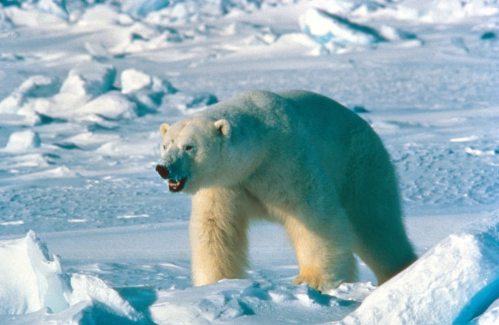
polar_bear_usfws_no date_sm

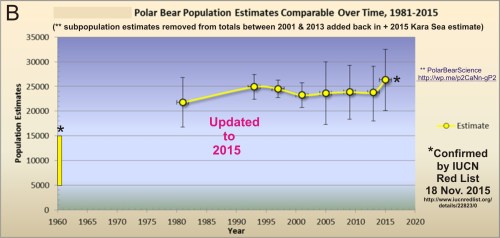
1) It confirms the global population size I published in May 2015 (20,129-32,558; average 26,344). See the graph below, now amended to reflect this point. If global numbers do decline over the next 35 years, it will be from a high point not previously acknowledged by the IUCN Polar Bear Specialist Group (PBSG).

Crockford OFFICIAL polar bear numbers to 2015_IUCN concurrs Nov 18

2) The current population trend is listed as: ? Unknown. [NOT declining – if anyone claims it is, send them here: IUCN Red List U. maritimus]

3) It puts the generation time for polar bears at 11.5 years (range 9.8-13.6), a huge drop from the 15 years used in previous predictive models. This change makes a big difference to the model results: three generations (the minimum period needed to show a trend) are now 35 years rather than 45 years.

4) It states there is a 70% chance of a 30% decline in polar bear numbers by 2050 and a 7% probability of a reduction > 50% if sea ice declines as predicted, but noted the large amount of uncertainty in these projections. That means there is a greater chance that numbers will not decline by 30% in the next 35 years (a 30% chance) than that the numbers will decline by 50% or more by 2050. That sounds like good news to me.

5) It will continue to list polar bears as Vulnerable. PBSG biologists managed to prevent polar bears from being listed as Least Concern or perhaps Near Threatened. But they had to give up a lot to get it.

6) The report supplement (Wiig et al. 2015 supppl.) explained why they did not calculate extinction probabilities and extinction is not mentioned at all on the IUCN Red List polar bear assessment page. This assessment only considers the probabilities of a decline in population size by 2050.

Yet, a spokesperson for the IUCN apparently stated (The Guardian, Climate change is ‘single biggest threat’ to polar bear survival; 19 November 2015 ) that:

“There is a high risk of extinction and the threat is serious,” said Dena Cator of the IUCN’s species survival commission. “You could consider polar bears to be a canary in the coal mine. They are an iconic and beautiful species that is extremely important to indigenous communities. But changes to their sea ice habitat are already being seen as a result of climate change.”

Apparently Dena Cator does not expect that people will read the report or find the assessment page on the IUCN Red List website – or she’s giving her personal opinion rather than explaining the report results. More on the points above and links to the report supplement pdf below, with quotes.
Continue reading

Eaten: A novel, now available

My new novel has been published! The paperback is ready to order and will ship immediately; the ebooks are available for pre-order and will download November 30, 2015.

More detail and links here: www.susancrockford.com

Paperback book or Kindle ebook can be ordered on Amazon.com (US and Canada), click here: http://www.amazon.com/Eaten-novel-Susan-Crockford/dp/151930255X [temporary Kindle link here, until Amazon gets it linked to the paperback: http://www.amazon.com/dp/B0182FUIV0 ]

In the UK, find the paperback here and the Kindle version here.

ePub version (via Smashwords, which ships to Apple, Barnes & Noble, and Kobo), see https://www.smashwords.com/books/view/592875

LIMITED TIME OFFER for the ePub version: November 30, 2015 until December 3, 2015 only

     FREE with promotion code GW98Q (not case-sensitive)

This will make a great Christmas/holiday present for friends and family who don’t read science books – give them an alternative with this great story with a bit of science lite.

Polar bear habitat update – Arctic sea ice today covers same area as it did on June 30

Arctic refreeze is well underway. Less than half way through the Arctic autumn (Oct-Dec), polar bear habitat on 11 November 2015 covered the same total area as it did on the last day of Arctic spring (April-June); it’s just distributed differently.

polar_bear_usfws_no date_sm

Yesterday, courtesy NSIDC Masie

masie_all_zoom_4km_2015 Nov 11

Here is what 30 June 2015 ice extent looked like, with the same amount of ice coverage:

masie_all_zoom_v01_2015181_4km

For the week of 12 November, Hudson Bay sea ice development is well underway, with more ice in the north than there has been in many years; Davis Strait ice is the highest this week since 1999 and Baffin Bay ice coverage is above average. Foxe Basin and the Beaufort Sea are both approaching maximum coverage, which means bears there will be back out on the ice hunting. Chukchi Sea ice has finally surrounded Wrangel Island but the Svalbard Archipelago in the Barents Sea is still ice-free. More ice maps and charts below.
Continue reading

Specialists mum on low Chukchi Sea polar bear habitat this summer and fall

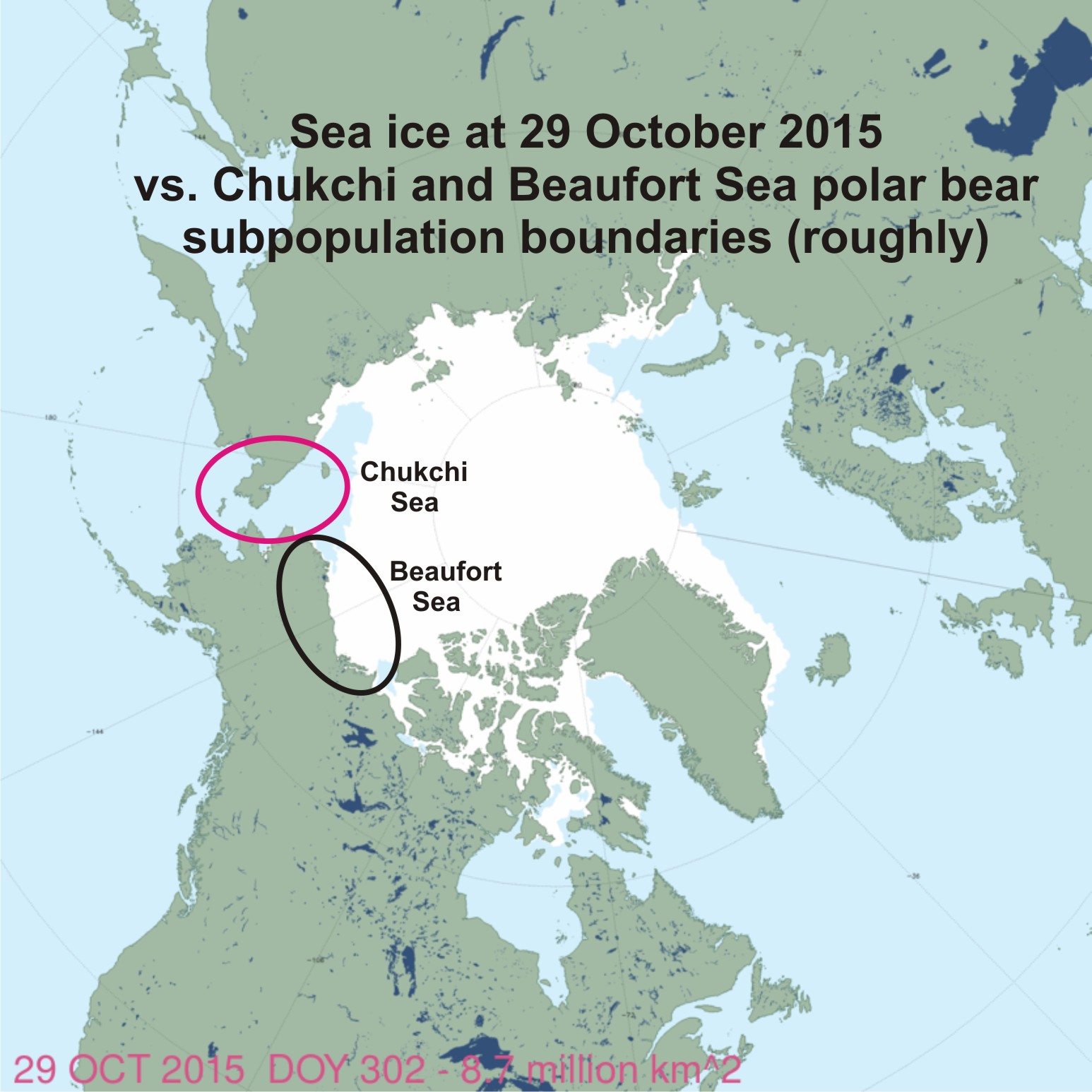
You may or may not have noticed that even though Chukchi Sea ice coverage has been way below average this melt season, there has been no hue-and-cry about poor suffering Chukchi polar bears. That’s because polar bear biologist’s own research has shown that the health and survival of these bears has not been negatively impacted by low summer sea ice. There may be threats from poaching in Russia, but not lack of summer sea ice.

Chukchi vs Beaufort ice at 29 Oct 2015_polarbearscience

As of this date, developing sea ice is only just approaching Wrangel Island, a major polar bear denning region in the Chukchi Sea, see maps below (Ovsyanikov 2006).

Yet, polar bear specialists insist that neighbouring Beaufort Sea bears – who endure a much shorter open-water season – are in peril of extinction because of scarce summer sea ice.
Continue reading

Hudson Bay freeze-up moving faster than recent years, WHB polar bear habitat imminent

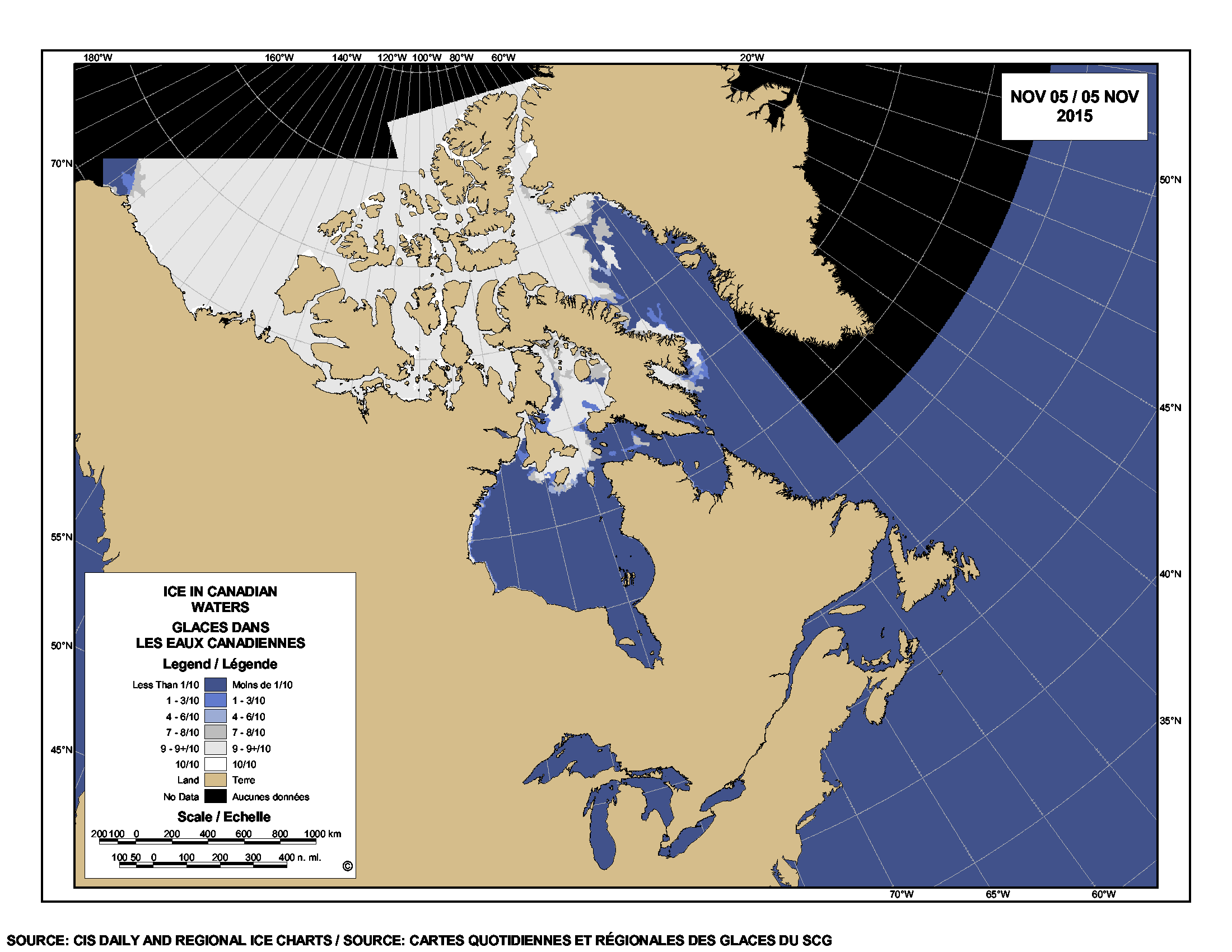
There may not be ice for Western Hudson Bay polar bears to walk on yet but there is still more ice forming along the northwest shore of the bay than last year at this time or even the year before. The Canadian Ice Service (CIS) map for 5 November shows this early formation.

Canadian Arctic Nov 5 2015_CIS

What’s present is mostly grey ice defined by CIS as:

“Young ice 10-15 cm thick, less elastic than nilas [a kind of new ice] and breaks on swell. It usually rafts under pressure.”

Polar bears generally need ice about 30 cm thick to support their weight, which could take a day or two – or a week or two, depending on the weather in northwestern Hudson Bay. For Churchill, along the central coast of western Hudson Bay, ice thick enough for walking will not likely be far behind, given the long-range forecast of freezing weather. In recent years, most Churchill polar bears have left the ice by around 20 November. More maps and graphs for this week below.
Continue reading