Tag Archives: status

Polar bear status changes in 2013 deconstructed, with a map to the good news

You can’t figure out what’s going on with status updates from the IUCN Polar Bear Specialist Group (PBSG) without deconstructing the spin and the 2013 update is no exception. Here’s my travel guide, with a map, to the good news.

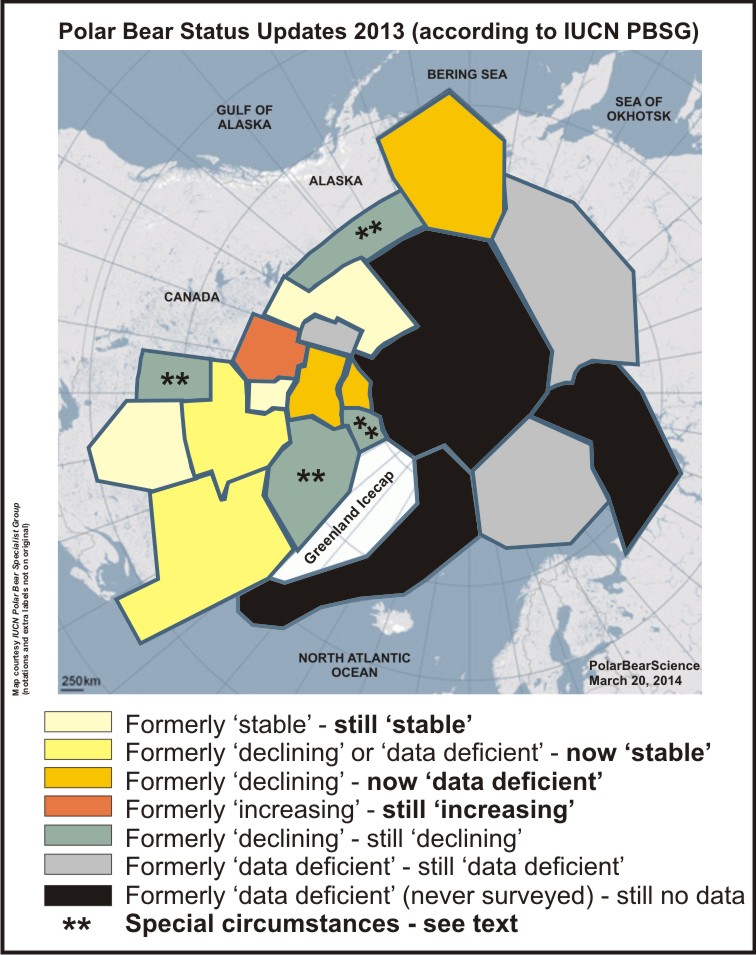
Polar Bear Subpopulations 19_2013 updates_March 20 2014_sm

I’ve finally had a chance to go through all of the details provided with the 2013 PBSG status table (pdf here). It’s just about all good news, once you wade through the spin. Numbers aside, out of the 13 populations for which some kind of data exist, five populations are now classified by the PBSG as ‘stable’ (two more than 2009), one is still increasing, and three have been upgraded from ‘declining’ to ‘data deficient’ (I explain below why this is a promotion).

That leaves four that are still considered ‘declining’- two of those judgments are based primarily on concerns of overhunting, and one is based on a statistically insignificant decline that may not be valid and is being re-assessed (and really should have been upgraded to ‘data deficient’). That leaves only one population – Western Hudson Bay – where PBSG biologists tenaciously blame global warming for all changes to polar bear biology, and even then, the data supporting that conclusion is still not available.

Continue reading

Great polar bear red herring in the Southern Beaufort

Red herring iconWe know that thick-ice springs occurred in 1974, 1975, 1986, 1992, 2004, and 2005 in the former ‘Eastern Beaufort’ – now the southern portion of the ‘Northern Beaufort’ and the eastern portion of the ‘Southern Beaufort.’ We know that these severe spring ice conditions negatively impacted both polar bears and ringed seals in this region every decade since the 1960s because the effects have been documented by numerous studies conducted in April through May for polar bears (Amstrup et al. 2006; Cherry et al. 2009; Pilfold et al. 2012; Stirling 2002; Stirling and Lunn 1997; Stirling et al. 1980; Stirling et al. 1993; Stirling et al. 2008) and in June and July for ringed seals (Harwood et al. 2012; Smith 1987), see previous posts here, here, and here.

For example, even though Ian Stirling and colleagues argued in their 2008 paper that the thick spring ice conditions in 2004, 2005 and 2006 (but not those in previous decades) were caused by storms initiated or intensified by greater amounts of open water in previous summers, they did not deny that the thick-ice springs occurred. They stated quite clearly that:

The 1960s, 1970s, and 1980s each experienced a two- to three-year decline in seal productivity in the eastern Beaufort Sea and Amundsen Gulf, associated with heavy ice conditions, around mid-decade. Each was followed by a decline in polar bear reproduction and condition, after which both seal and bear populations recovered (Smith, 1987; Harwood et al., 2000; Stirling, 2002). The beginning of each of those three periods was associated with heavy ice conditions through the winter before the reproductive decline of the seals, followed by a late spring breakup.” [my bold]

So, I have to say, I was shocked but not surprised to find that in the more recent scientific literature, the phenomenon of thick-ice springs every decade in Southern and Northern Beaufort has been deliberately ‘disappeared.’ 

Not surprised because I suspected it had happened — this issue was a feature of the Stirling and Derocher (2012) paper from late last year which was the topic of my very first blog post, “Cooling the polar bear spin.

However, I think it is important to document how the transmogrification of sea ice effects on polar bears was managed in the scientific literature so that everyone can see exactly what has been done. In a truly astonishing move for what is supposed to be a field of science, thick-ice springs have been effectively replaced by an open-water red herring as the scourge of Southern Beaufort polar bears.

Continue reading

Misleading “State of the Polar Bear” graphic still not fixed

UPDATE FEBRUARY 19, 2014The misleading “State of the Polar Bear” graphic is now GONE (as of January 31, 2014). A new 2013 status table is offered by the PBSG here. It has detailed text explanations and harvest information, with references, hyperlinked to each subpopulation entry (“Press the subpopulation hyperlink and more information will appear“) and may have replaced the “State of the Polar Bear” graphic that the PBSG commissioned for upwards of US$50,000, although the PBSG website says it is being “updated [A pdf copy of the 2013 colour table is here, and my commentary on it is here.] I have left the original post as is, below.

This is an update regarding the IUCN Polar Bear Specialist Group (PBSG)’s fancy, multilevel State of the Polar Bear web graphic that I discussed previously here, here, and here.

To refresh your memory, two points about this graphic stand out, both regarding polar bear population estimates:

1) The population estimates listed on the Nations map (copied below) add up to 22,600-32,000 – far higher than the official estimate of 20,000-25,000 polar bears worldwide.

2) The population estimates listed on the upper layer of the Subpopulation map add up to just 13,036 – not even close to the official estimate of 20,000-25,000 polar bears worldwide.
Continue reading

Matt Ridley’s foreword to my “10 good reasons not to worry” list – “We should be listening to Susan Crockford”

Benny Peiser over at the Global Warming Policy Foundation has just posted an essay by well-known author Matt Ridley (including “The Rational Optimist”), entitled “We should be listening to Susan Crockford” which is included as a foreword to a pdf of my earlier post, “Ten good reasons not to worry about polar bears.”

This stand-alone pdf is especially suitable for sharing with friends and policy makers.

I encourage you to have a look.

Ten good reasons not to worry about polar bears

IMPORTANT UPDATE March 13, 2013 Benny Peiser over at the Global Warming Policy Foundation has just posted an essay by well-known author Matt Ridley, entitled “We should be listening to Susan Crockford” which is included as a foreword to a pdf of this very post (“Ten good reasons not to worry about polar bears”), suitable for sharing. I encourage you to have a look.

[Update September 28, 2013: See also this follow-up post “Polar bears have not been harmed by sea ice declines in summer — the evidence.”]

Polar Bear-Cubs-Canada_Wallpaper

PB  logo colouredThis year marks the 40th anniversary of the signing of an international agreement to protect polar bears from commercial and unregulated sport hunting. The devastating decades of uncontrolled slaughter across the Arctic, including the Bering Sea, finally came to an end. And so in honor of International Polar Bear Day (Wed. February 27) – and because some activists are calling 2013 The Year of the Polar Bear – I’ve made a summary of reasons not to worry about polar bears, with links to supporting data. I hope you find it a useful resource for tuning out the cries of doom and gloom about the future of polar bears and celebrating their current success.

Continue reading

Bearded and ringed seals join the polar bear as “threatened” by a computer-modeled future

As I pointed out in Featured Quote #22 (posted on Dec. 23, 2012), bearded and ringed seals have recently joined the polar bear on the American ESA’s list of animals that are “threatened” by computer-modeled predictions of Arctic sea ice declines projected 50-100 years into the future (USFWS 2008, 2012a, 2012b).

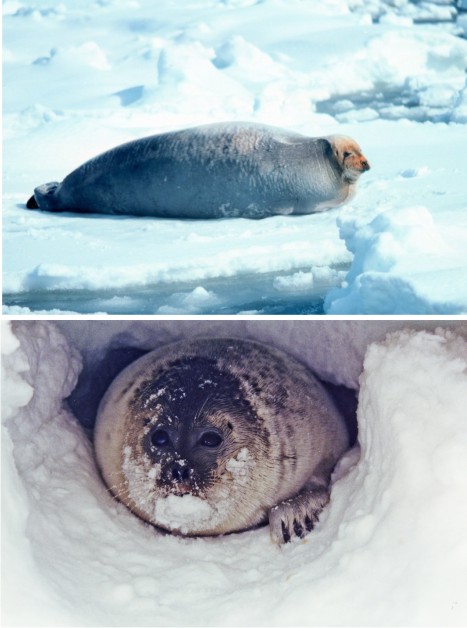
NOAA photos of bearded seal (top) and ringed seal (bottom)

NOAA photos of bearded seal (top) and ringed seal (bottom). The bearded seal is one of the largest Arctic ice seal while the ringed seal is the smallest. Both are eaten by polar bears, although ringed seals are consumed most often.

The decision by NOAA (National Oceanographic and Atmospheric Administration) affects the Arctic subspecies of ringed seal (Phoca hispida hispida) as well as the Okhotsk subspecies (Phoca hispida ochotensis) (in addition to several others) and thus includes all ringed seals off Alaska’s coast in the Beaufort, Chukchi and Bering Seas. The decision also affects two particular subpopulations of bearded seal (Erignatha barbatus): the “Beringia” [Bering Sea/Chukchi] subpopulation (about half of which reside in Alaskan waters), and the subpopulation that lives in the Sea of Okhotsk. (Alaska Fisheries (NOAA) Final Decision). Continue reading

PBSG polar bear population assessment made simple

[Update: Feb. 10 2013. I have corrected an oversight in the summary tables – the originals neglected to indicate that the Barents Sea subpopulation is shared between Norway and Russia (not controlled by Norway alone). Here is revised Table 1 and revised Table 2. ]

[Update 2: Sept. 26, 2013. See Global population of polar bears has increased by 2,650-5,700 since 2001″ for further insight. I have also made slight corrections to the tables below, now marked Version 3.]

A couple of weeks ago, a news report appeared highlighting an interview with Russian biologist Nikita Ovsyannikov, deputy director of Russia’s polar bear reserve on Wrangel Island in the Chukchi Sea. This is what the news report said:

He [Ovsyannikov] guessed the number of bears around the Chukchi Sea, which also sometimes migrate in small numbers to western Alaska, had dropped over the past three decades from “about 4,000 to no more than 1,700 at best.

See Kelsey’s comments over at Polar Bear Alley and the comment I left there, here and my related previous post here

This media focus on Chukchi Sea polar bear numbers caught my attention because I had recently spent some time going through the 15 Polar Bear Specialist Group (PBSG) meeting reports in an effort to summarize the population estimates they provided. This international group first met in Fairbanks, Alaska in 1965 to advance and coordinate polar bear research and conservation under the auspices of the International Union for Conservation of Nature (IUCN) and the Species Survival Commission (SSC). I knew that according to the PBSG, the population of the Chukchi Sea is zero – that is, no Chukchi bears are included in the official total of 20,000-25,000 bears because no reliable survey had ever been done. Ovsyannikov’s statement to the press encouraged me to finish my summary of the population estimates in the PBSG meeting report tables.

This was not an easy task, in part due to the virtually constant changes in presentation style and format in the tables used to present the data (which appeared first in the 1981 report). For example, even between the 14th (2005) and 15th (2009) meeting reports, the population data table presents the subpopulations in different order and swaps the position of two critical columns (“status” and “observed or predicted trend”), making it extremely difficult for readers to do a quick comparison between years.

So I simplified the 2009 table (the most recent available), leaving out the future predictions as irrelevant to questions about current status. I included some population estimates and status assessments from previous reports to show the changes over time (where available). The full summary table, designated Table 1,  is provided here as a pdf. [update 2013 – this is Version 3]. However, in this format, it still spans two pages, so I composed another  table that contains the 2009 status information only (2009 is the most recent available), see Table 2, version 3 below. Viewing the data this way may surprise you.

continue reading