Category Archives: Conservation Status

Tracking polar bears in the Beaufort Sea – May 2014 map and USGS video footage

Here is the May 2014 follow-up to my post on the July 2013 track map for female polar bears being followed by satellite in the Beaufort Sea by the US Geological Survey (USGS) – “Ten out of ten polar bears being tracked this summer in the Beaufort Sea are on the ice.”

See that post for methods and other background on this topic, and some track maps from 2012 (also available at the USGS website here).

The USGS track map May 2014 is copied below (Fig. 1).

Compare this to April’s map (Fig. 2) – the 24 bears from April are down to 20 and the bears are spreading out a bit from the area on the central Alaskan coast where they were originally tagged. Fifteen of these bears have satellite collar transmitters [and therefore are females] and 5 of these bears have glue-on satellite transmitters [either males or subadult animals].

Some comments on the polar bear video cam footage released June 6 by USGS and stories on it run by the media follow.

Continue reading

Activists pressure tactics to force Canada to list polar bears as ‘threatened’ have failed

The Center for Biological Diversity has failed in its bid to use NAFTA (North American Free Trade Agreement) to pressure Canada to list polar bears as a species ‘threatened’ with extinction — wrapping up a story I wrote about twice last year (here and here).

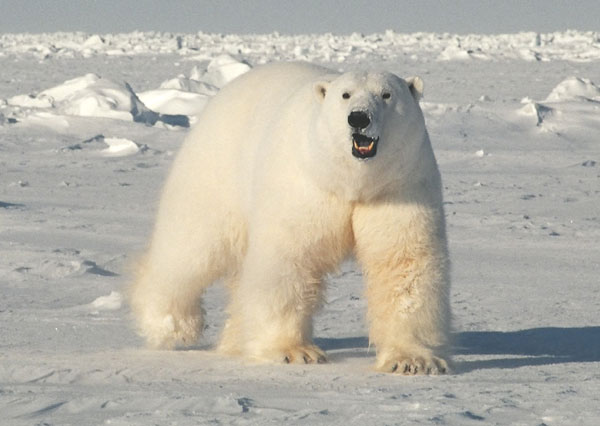
Chukchi male 1240 lbs labeled Durner 2008

Continue reading

Earth to Newsweek: polar bear populations have not been on the decline since 2008

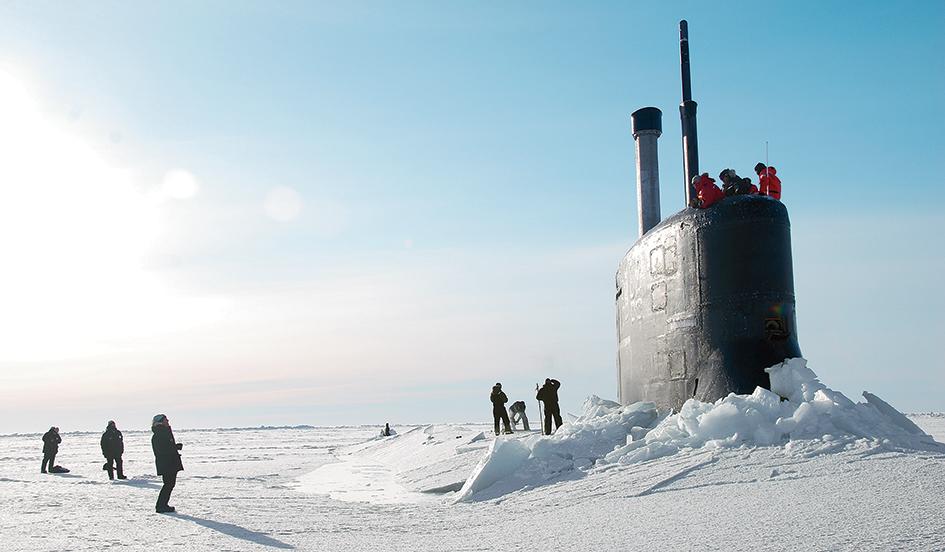
A recent Newsweek story about the US Navy having no “rules of engagement” to deal with polar bear encounters leads with alarmist misinformation.

Photo credit Cmdr. Christy Hagen/U.S. Navy

Photo credit Cmdr. Christy Hagen/U.S. Navy

Author Max Strasser (April 30, 2013), in his recent article in Newsweek (As the World Warms, Navy Strategists Plan for an Arctic Rush”) [h/t D. V]

Approximately 25,000 polar bears live in and around the Arctic Circle. Climate change has put the majestic ursines, a longtime favorite of children’s books and Christmas cards, in peril. In 2008, the United States listed them as a “threatened species” under the Endangered Species Act, and populations have been on the decline since then.”

Sigh. Not so Max, totally not so.

Global polar bear numbers have been stable for the last 30 years, as the graphs below show. The proposed ‘threat’ to polar bears is a future decline in sea ice predicted by computer models. The future, Max, is not now.

Polar bear populations are currently doing very well (see my post on the most recent status update report here). On top of that, note that the bears are well distributed throughout available Arctic habitat — one of the accepted hallmarks of a healthy species.

Figure 1. Upper graph uses totals reported in PBSG status tables, with min/max; Lower graph uses the same figures, but adds back in the so-called "inaccurate" estimates dropped 2005-2013. The 1960 figure * is a ballpark estimate. See previous post here.

Figure 1. Upper graph uses totals reported in PBSG status tables, with min/max; Lower graph uses the same figures, but adds back in the so-called “inaccurate” estimates dropped 2005-2013. The 1960 figure * is a ballpark estimate.
See previous post here.

OK, with that error corrected, back to the point of the Newsweek story…

Continue reading

My interview with CNS News: “Alaskan Polar Bears Threatened…By Too Much Spring Ice”

Not bad, as these things go, but the reporter made one error that needs correcting – so I’m doing it here to set the record straight, just in case it does not get taken care of in the original story.

CNS News reporter Barbara Hollingsworth had seen my post last week, “Current ice conditions don’t bode well for Beaufort Sea polar bears” and wanted to talk to me about it. It was a little rushed, but I agreed.

This is how it turned out, with the error corrected and an updated ice thickness map.
Continue reading

New polar bear exhibit at Winnipeg zoo will help make it “self-sustaining”

Here’s a development I’m sure you’ll find surprising: the July opening of the new polar bear exhibit at the Assiniboine Zoo in Winnipeg, Manitoba, expected to draw huge crowds this summer, will coincide with a substantial hike in entrance fees.

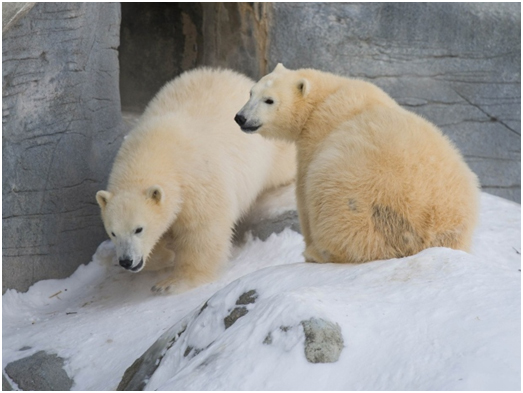
Kaska and Aurora, courtesy Assiniboine Park Zoo.

Kaska and Aurora, courtesy Assiniboine Park Zoo, Winnipeg.
Aurora is the cub orphaned in Churchill last year when her mother was shot.

Starting July 3, the fee for adults will increase from $10.24 to $18.50, not including GST. Said a CBC News report earlier today:

“Officials said the admission prices are being adjusted to “reflect the industry standard across zoos in North America” and bring the Winnipeg zoo closer to being a self-sustaining facility.

“Our job was to build a world-class and increasingly self-sustaining facility that allowed the [Assiniboine] Park and Zoo to be dramatically less dependent on tax dollars,” Redmond said.”

So, that’s why having polar bears in zoos are a good thing. Didn’t I say that last year? See the whole story here, more comments below.

Continue reading

Polar bears move around as sea ice habitat changes – this is what resilience looks like

Oddly, it seems some people expect polar bears to sit around and suffer (or die) when local conditions deteriorate, rather than move elsewhere.

PolarBear_2008_USGS

While there are perhaps a few places where moving is not really an option over the short term, over the long term (more than one season) polar bears are free to shift to another locale if ice conditions change (either too much ice or too little).

An announcement by the WWF last week (10 April) caught my eye, as it talked about bears moving from one area to another because of changing ice conditions — as if this was surprising, extraordinary and newsworthy. That said, at least they weren’t suggesting the bears are all going to die because of declining ice, which is a huge improvement.

See what you think of this part of the press release (below), in the context of what we know about the movement of bears between regions:

Continue reading

Southern Beaufort polar bear ‘decline’ & reduced cub survival touted in 2008 was invalid, PBSG now admits

It is now clear that the phenomenon of bears moving across Southern Beaufort Seapbsg logo subpopulation boundaries compromised the US decision to list polar bears as ‘threatened’ and the IUCN Polar Bear Specialist Group (PBSG) knows that was the case.

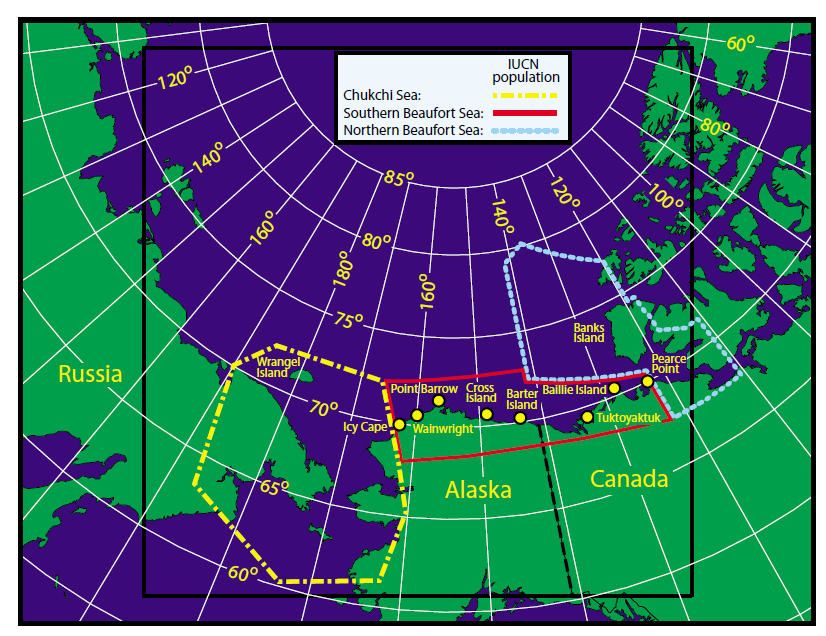
As I pointed out last week, the PBSG has admitted in their 2013 status table update (pdf here) that bears move around so much between the Chukchi Sea (CS), the Southern Beaufort (SB), and the Northern Beaufort (NB) subpopulations that major changes in the boundaries of the SB subpopulation are necessary (see Fig. 1 below).

Figure 1. From the paper by Amstrup and colleagues (2005) describing the effect that movement of bears across subpopulation boundaries has on setting harvest quotas – and population estimates. Southern Beaufort boundary is solid red, Chukchi Sea is dashed yellow and Northern Beaufort is dotted light blue. “Point Barrow” is Barrow, AK (well inside the SB boundary). Click to enlarge.

Figure 1. From the paper by Amstrup and colleagues (2005) describing the effect that movement of bears across subpopulation boundaries has on setting harvest quotas and population estimates. Southern Beaufort (SB) boundary is solid red, Chukchi Sea (CS) is dashed yellow and Northern Beaufort (NB) is dotted light blue. “Point Barrow” is Barrow, AK (well inside the SB boundary). Click to enlarge.

Well, that’s not really news — changes to the SB boundaries were promised by the PBSG back in 2009 (Obbard et al. 2010), based on research by Steven Amstrup and colleagues published in 2001 and 2005. But now, in an astonishing admission, the PBSG have acknowledged that the last population survey for the SB (Regehr, Amstrup and Stirling, 2006), which appeared to register a decline in population size and reduced cub survival over time, did not take known movements of bears into account as it should have done.

In other words, that 2006 study almost certainly did not indicate bears dying due to reduced summer sea ice in the SB, as biologists said at the time — and which they presented as evidence that polar bears should be listed by the ESA as ‘threatened’ — but reflected capture of bears that were never part of the SB subpopulation and so moved out of the region.

As the PBSG said about the 2006 estimate:

“…it is important to note that there is the potential for un-modeled spatial heterogeneity in mark-recapture sampling that could bias survival and abundance estimates.” [my emphasis]

Spatial heterogeneity” means that the sampled bears could have come from more than one population, a possibility which violates a critical requirement of the statistics used to generate the population and survival estimates. “Un-modeled” means that the ‘movement of bears’ problem was not factored into the mathematical models that generated the 2006 population size and survival estimates as it should have been.

Ecologist Jim Steele pointed some of this out in his book and his guest post last year, so it’s not news that this was done.

What’s shocking is that the PBSG have now admitted that the ‘movement of bears’ issue essentially invalidates the 2006 population estimate and the much-touted ‘reduced survival of cubs.’ The reduced survival of cubs data from that SB study was a critical component of the argument that US bears were already being negatively impacted by global warming and thus, should be listed as ‘threatened’ under the ESA (US Fish & Wildlife Service 2008).

Since the population decline and reduced survival is now acknowledged to be unfounded — and perhaps deliberately so — I ask you this: will a new SB survey — soon to be released by the same lead author (Eric Regehr) — undo the broken trust in US and PBSG polar bear biologists? Continue reading

Polar bear status changes in 2013 deconstructed, with a map to the good news

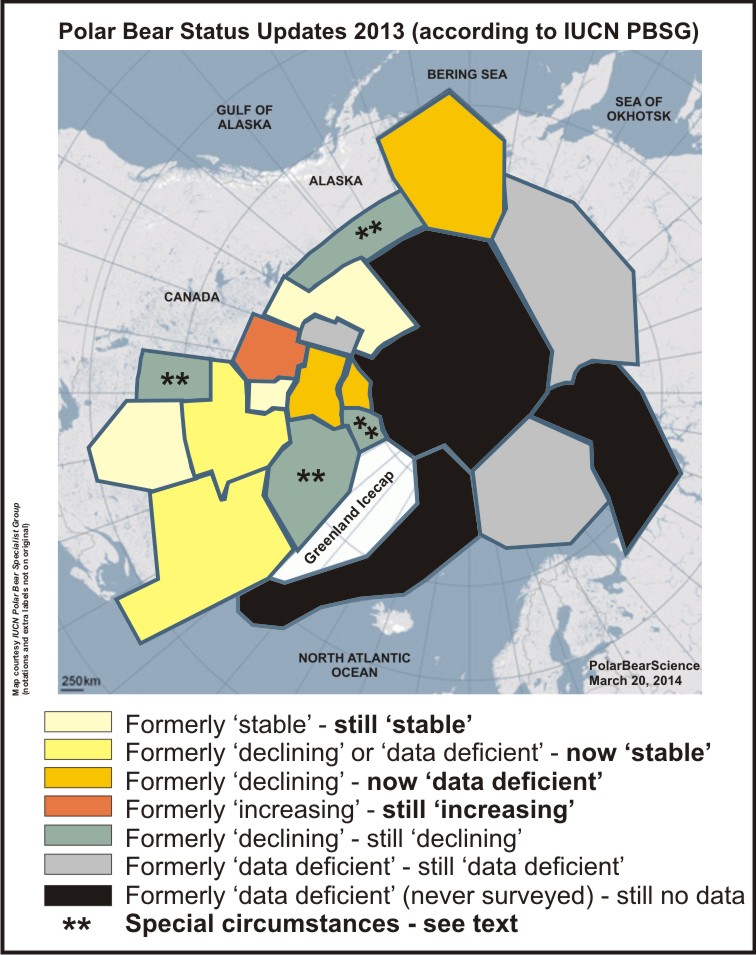
You can’t figure out what’s going on with status updates from the IUCN Polar Bear Specialist Group (PBSG) without deconstructing the spin and the 2013 update is no exception. Here’s my travel guide, with a map, to the good news.

Polar Bear Subpopulations 19_2013 updates_March 20 2014_sm

I’ve finally had a chance to go through all of the details provided with the 2013 PBSG status table (pdf here). It’s just about all good news, once you wade through the spin. Numbers aside, out of the 13 populations for which some kind of data exist, five populations are now classified by the PBSG as ‘stable’ (two more than 2009), one is still increasing, and three have been upgraded from ‘declining’ to ‘data deficient’ (I explain below why this is a promotion).

That leaves four that are still considered ‘declining’- two of those judgments are based primarily on concerns of overhunting, and one is based on a statistically insignificant decline that may not be valid and is being re-assessed (and really should have been upgraded to ‘data deficient’). That leaves only one population – Western Hudson Bay – where PBSG biologists tenaciously blame global warming for all changes to polar bear biology, and even then, the data supporting that conclusion is still not available.

Continue reading

Davis Strait polar bear habitat higher now than in 1979 and early 1980s

The Davis Strait polar bear subpopulation is said to be ‘vulnerable’ to the supposed effects of global warming because, like Hudson Bay, Davis Strait sea ice retreats every summer, leaving polar bears on land for several months.

However, Davis Strait bears have been upgraded to ‘stable’ status, according to the latest table (2013) issued by the IUCN Polar Bear Specialist Group (see their boundary map for Davis Strait bears below). Recent development of sea ice in the region can only improve that rating.

[More background here and heremap-DavisStrait

It seems that sea ice in Davis Strait is well above normal for this time of year – a recent announcement by the Canadian Ice Service (CIS) says it’s 10% above average, higher than it’s been in 25 years (h/t S. Goddard).

The Canadian Ice Service, an arm of Environment Canada, said there is 10 per cent more ice this year compared to the 30-year average.

We probably haven’t seen a winter this bad as far as ice for the past 25 years,” said Voight, referring to both the amount and thickness of the ice.

He said the Gulf of St. Lawrence is covered and some areas are “quite severe.” [my bold]

Full story here.

Latest ice map (March 12) below from the US National Snow and Ice Data Service (NSIDC).

As I pointed out recently here, Barents Sea ice is below average this year, largely due to natural variation in the Atlantic Multidecal Oscillation (AMO), but is higher over the western Atlantic (Sea of Okhotsk ice is below average too but there are no polar bears there).

There is lots of ice around Labrador and Newfoundland, however.

Sea ice extent 2014 March 12 NSIDC

I thought I let you see exactly what CIS are talking about: what did the ice look like 25 years ago, in 1989? What about 35 years ago, in 1979, the start of the satellite record for sea ice? It might surprise you. Continue reading

Barents Sea polar bear condition varies with AMO and spring sea ice conditions

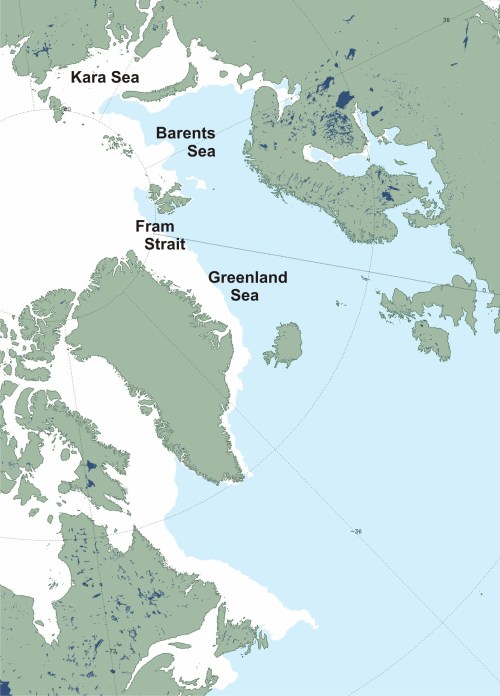
Fig. 1. NSIDC sea ice extent at March 8, 2014 (a "MASIE" product), with labels added. Click to enlarge.

Figure 1. NSIDC sea ice extent at March 8, 2014 (a “MASIE” product), with labels added. Click to enlarge.

In its end of February report, the US National Snow and Ice Data Center (NSIDC) noted that Barents Sea ice was below average for this time of year (see Fig. 1 above, and Fig. 5 below) but suggested this was primarily due to natural variation driven by the Atlantic Multidecadal Oscillation (AMO):

“The Barents Sea has experienced consistently low extents, particularly in winter, and this year has been no different. While the Barents and Kara seas normally have close to 2 million square kilometers (772,000 square miles) of ice in February, recent years have seen 500,000 square kilometers (193,000 square miles) of ice extent or lower. This year, the Kara Sea is near average, but the Barents Sea remains low (Figure 4a). Unlike other regions in the Arctic, longer records of Barents Sea ice extent exist from records of fishing, whaling, and other activities. A recent paper (Miles et al., 2013 [2014, now in print]) examined these records, along with paleoproxy data, to examine extent over the past four hundred years. They found a 60- to 90-year cycle in Barents and Greenland seas ice extent related to the Atlantic Multidecadal Oscillation (AMO); the AMO is a basin-wide cycle of sea surface temperature variability similar to the El Niño and La Niña cycles in the Pacific, but varying over much longer periods. This research shows that in addition to the warming trend in the Arctic, some sea ice regions are likely also responding to natural climate variability.” [my bold]

The paper they cite (Miles et al. 2014, discussed elsewhere in December 2013 here) described the AMO this way:

“The AMO is a coherent pattern of basin-wide sea surface temperature (SST) variations with a period of roughly 60–90 years. ..Paleoenvironmental studies suggest that the AMO has persisted through previous centuries [Gray et al., 2004] and even millennia [Knudsen et al., 2011].”

Note that Miles and colleagues were looking at ice records on or around the sea ice maximum in winter/spring.

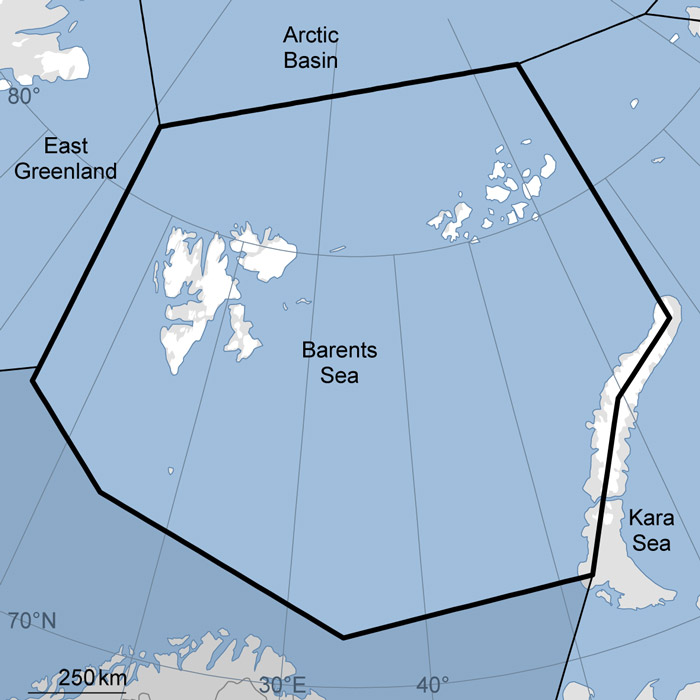
The Polar Bear Twist: Norwegian biologists Jon Aars and Magnus Andersen, who I’ve discussed before, have pointed out that the condition of polar bear males and females around Svalbard (Fig. 2) they examined over the last 20 years varied with the AMO and sea ice levels in spring and early summer. [research results posted at the website for Environmental Monitoring of Svalbard and Jan Mayen (MOSJ), Norwegian Polar Institute].
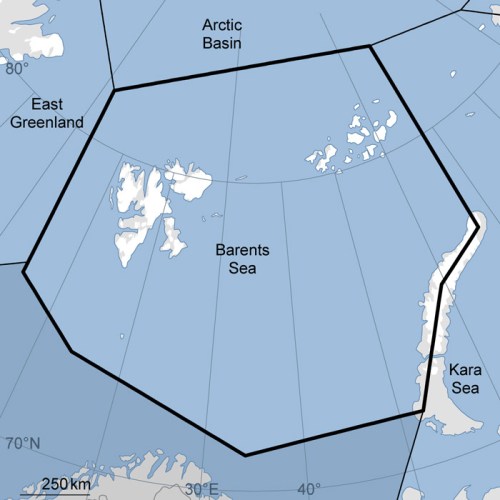
Figure 1. The Barents Sea polar bear subpopulation, courtesy the IUCN Polar Bear Specialist Group. "Svalbard" is the largest archipelago, in the eastern portion.

Figure 2. The Barents Sea polar bear subpopulation boundaries, courtesy the IUCN Polar Bear Specialist Group. Svalbard is the largest archipelago, closest to the East Greenland Sea.

That makes a lot of sense to me, given that spring/early summer is the most critical feeding season for polar bears because it’s when fat young seals are most easily available.

It also makes sense to me that you may need a record hundreds of years long to understand the natural variability of Arctic Sea ice in its various regions. Recall that natural variation, not global warming, is now being used to explain the large variation in annual sea ice cover in the Bering Sea (home to Chukchi Sea polar bears). Continue reading