Category Archives: Population

S Beaufort polar bears largely recovered from known 2004-2006 decline, says new study

A bit more good news about polar bear populations, this time from an abundance study in the Southern Beaufort Sea. A paper released yesterday showed a 25-50% decline in population size took place between 2004 and 2006 (larger than previously calculated). However, by 2010 the population had rebounded substantially (although not to previous levels).

All the media headlines (e.g. The Guardian) have followed the press release lead and focused on the extent of the decline. However, it’s the recovery portion of the study that’s the real news, as it’s based on new data. Such a recovery is similar to one documented in the late 1970s after a significant decline occurred in 1974-1976 that was caused by thick spring ice conditions.

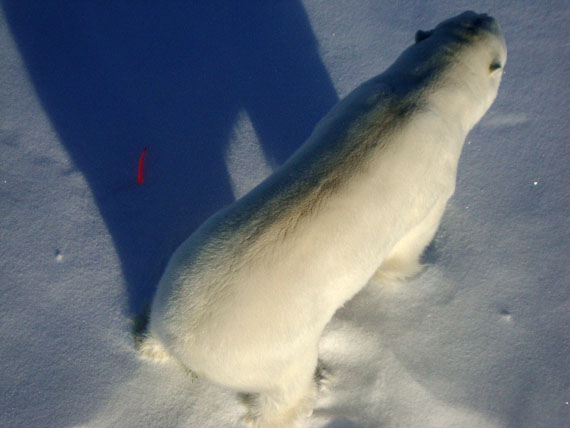
Polar bear with collar and tag_USGS_labeled

The title of the new paper by Jeffery Bromaghin and a string of polar bear biologists and modeling specialists (including all the big guns: Stirling, Derocher, Regehr, and Amstrup) is “Polar bear population dynamics in the southern Beaufort Sea during a period of sea ice decline.” However, the study did not find any correlation of population decline with ice conditions. They did not find any correlation with ice conditions because they did not include spring ice thickness in their models – they only considered summer ice conditions.

I find this very odd, since previous instances of this phenomenon, which have occurred every 10 years or so since the 1960s, have all been associated with thick spring ice conditions (the 1974-76 and 2004-2006 events were the worst). [Another incident may have occurred this spring (April 2014) but has not been confirmed].

Whoever wrote the press release for this paper tried hard to suggest the cause of the 2004-2006 event might have been “thin” winter ice caused by global warming that was later deformed into thick spring ice, an absurd excuse that has been tried before (discussed here). If so, what caused the 1974-1976 event?

It seems rather unscientific as well as implausible to even try to blame this recent phenomenon on global warming. However, neither the authors of the paper or the press release writers seemed to want to admit that 2-3 years of thick ice development in the Southern Beaufort could have been the cause of the population decline in 2004 (as for all of the previous events). No, that wouldn’t do, not in the age of global warming.

So, we are left with this equally absurd conclusion from the author:

The low survival may have been caused by a combination of factors that could be difficult to unravel,” said Bromaghin, “and why survival improved at the end of the study is unknown.

I’ve summarized the paper to the best of my understanding (there was a lot of model-speak to wade through), leaving out the prophesies of extinction, which in my opinion don’t add anything.

UPDATE November 19, 2014: Don’t miss my follow-up post, with some startling new information, Polar bear researchers knew S. Beaufort population continued to increase up to 2012
Continue reading

BBC provides a forum for desperate biologists: “Will polar bears become extinct?”

Yesterday, the BBC published a story that gave the two most alarmist polar bear researchers on the planet a forum to market their ‘polar bears are doomed’ message. This time the desperation shows: watch how these biologists move the goal-posts, make claims so misleading they border on lies, and pretend they don’t have big, big trouble with their predictive models.

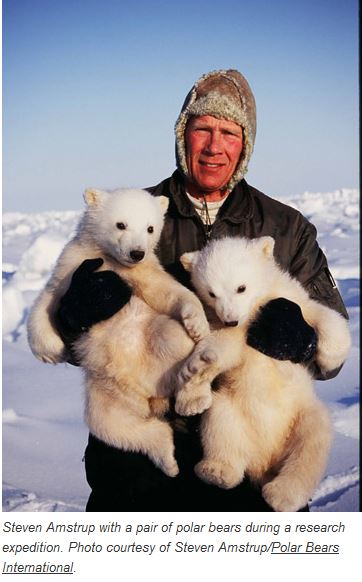
Amstrup_only solution_with 2 cubs_Oct 8 2014

Amstrup photo that accompanied an interview last month.

Continue reading

Polar bear specialist says there are 800 polar bears in W Hudson Bay, gov’t says ~1,000-1,500

Activist polar bear biologist Andrew Derocher (University of Alberta) may have gone too far this time. In an interview with Yahoo News, Derocher is quoted as saying:

“When I first started here about 30 years ago the population was about 1,200 bears and now we’re down to about 800,” team member Andrew Derocher, a biology professor at the University of Alberta, said in a phone interview from the tundra outside Churchill.”  [my bold]

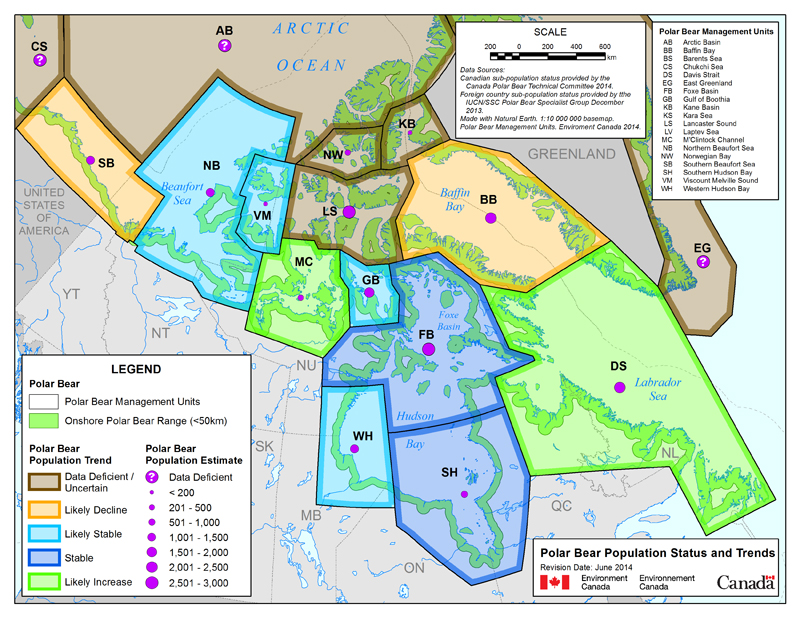
Figure 4. Environment Canada's "Map 3: 2014 Canadian Polar Bear Subpopulation and Status Map," original here.

Environment Canada’s “Map 3: 2014 Canadian Polar Bear Subpopulation and Status Map,” original here. Click to enlarge.

However, the Polar Bear Technical Committee of Environment Canada says differently: it estimates there are ~1000-1,500 bears in Western Hudson Bay (WH) and that the population is probably stable, as their new status map (dated June 2014, copied above) shows. A recent (2014) peer-reviewed paper by Stapleton and colleagues (discussed here) provides the data for that estimate.
Continue reading

Polar bear biologists doing mark-recapture work in Hudson Bay may have misled the world

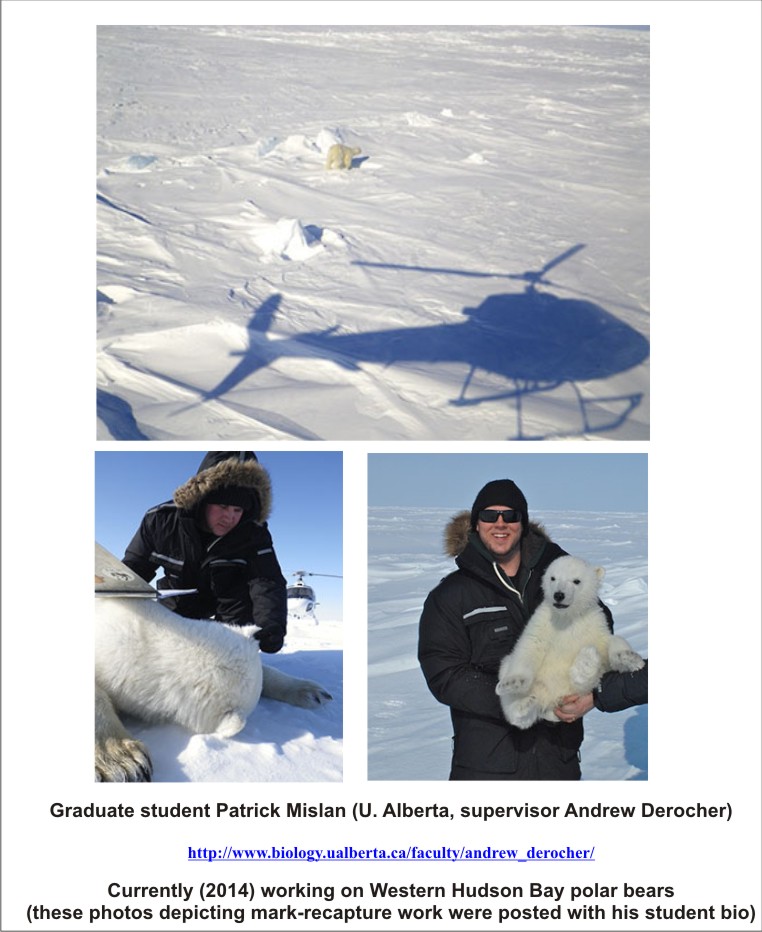
What exactly are Western Hudson Bay (WHB) polar bear researchers hiding? Since 2004, research on the body condition and cub production of Western Hudson Bay (WHB) polar bears has been carried out but none of the results of these mark-recapture studies have been made public.

U Alberta student Mislan bio photos_PolarBearScience

The researchers all claim that WHB polar bears are struggling to survive because of recent sea ice changes but won’t release the 10 years worth of updated information they possess on the bears or the sea ice.

Continue reading

Status of Canadian polar bear populations has been changed – more good news

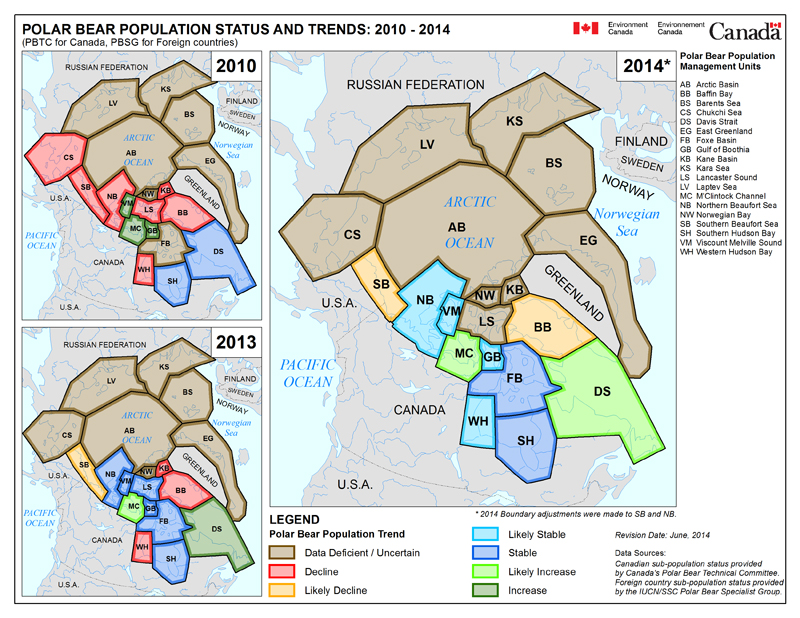
According to maps dated June 2014, Environment Canada (EC) has changed the trend status of several Canadian subpopulations — without any announcement or publicly-available documents explaining the basis of the changes.

Figure 3. "Series of Circumpolar Polar Bear Subpopulation and Status Trend Maps 2010, 2013 & 2014" Note the asterisk below the 2014 map, which is dated "June 2014" and is different in its status assessment from the one released in February 2013 by the PBSG. Original here.

Figure 1. Environment Canada’s “Map 4: Series of Circumpolar Polar Bear Subpopulation and Status Trend Maps 2010, 2013 & 2014.” Original here.

And would it surprise you to learn that virtually all of these status changes reveal more good news about polar bears?
Continue reading

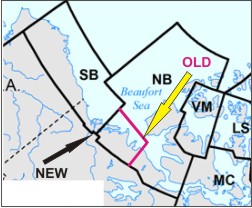
Beaufort Sea polar bear subpopulation boundary has been changed

Environment Canada recently posted a set of maps on its website that show it has moved the boundary between the polar bear subpopulation it shares with the USA — without a word to the media or a note anywhere.

EC S_N Beaufort boundary change Sept 8 2014_cropped PolarBearScience

Continue reading

Inuit resist government requests to tag and collar polar bears in MClintock Channel

Inuit residents of Cambridge Bay in the Central Canadian Arctic are resisting requests by the Nunavut Government to tranquilize, collar and tag polar bears to assist in their population survey.

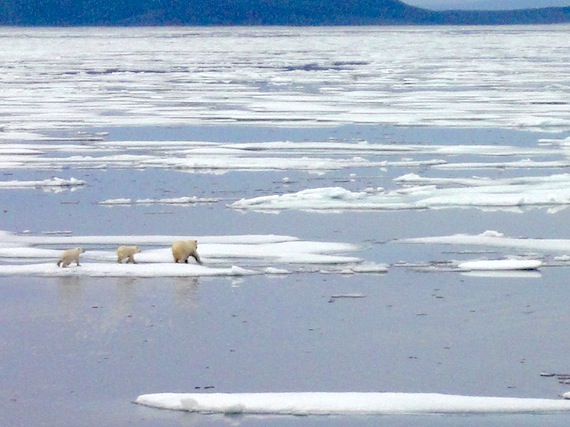
“A female polar bear and her two cubs dash across the ice near Gjoa Haven, where the polar bear hunt has been limited for nearly 15 years. (PHOTO BY JANE GEORGE)” Story here, also by Jane George.

“A female polar bear and her two cubs dash across the ice near Gjoa Haven, where the polar bear hunt has been limited for nearly 15 years. (PHOTO BY JANE GEORGE)” Story here, also by Jane George.

Continue reading

Tracking polar bears in the Beaufort Sea – September 2014 map

Here is the September 2014 follow-up to my post on the July 2013 track map for female polar bears being followed by satellite in the Beaufort Sea by the US Geological Survey (USGS) – “Ten out of ten polar bears being tracked this summer in the Beaufort Sea are on the ice.”

See that post for methods and other background on this topic, and some track maps from 2012 (also available at the USGS website here).

The USGS track map for September 2014 is copied below (Fig. 1).

At the end of September, with sea ice starting to rebuild, it appears there were 8 bears on the ice and three on land.

The situation for September was not very much different from August, except that two of the 11 bears (up from one) were on the ice in the Chukchi Sea in September, a phenomenon that was recently acknowledged to have affected the last population estimate for the Southern Beaufort subpopulation.

Continue reading

Natural selection helps polar bears adapt to sea ice variability – which means some bears die

Evolution is not just for the long-term – natural selection also goes on over short time periods. In the case of polar bears, this adaptation is almost certainly critical for its long-term survival.

Hudson Bay female with cub_Wapusk_Thorsten Milse_Gov CA

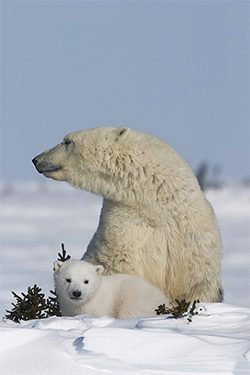
Hudson Bay female with cub Wapusk National Park, Thorsten Milse, Government of Canada

Not all polar bears are identical — that is the reality that allows natural selection to operate.

I will argue that early breakup years in Western Hudson Bay weed out individual polar bears that do not have the physiological or behavioral characteristics necessary to be useful members of the population – and that this is a good thing for the entire population.

Continue reading

M’Clintock polar bear survey’s first year plagued by fog in an area thick with heavy ice

“Blizzards, we had fog — we had to sleep in the helicopter, on the sea ice one night, because we couldn’t fly anywhere,” Markus Dyck, senior polar bear biologist with the GN, told Nunatsiaq News Sept. 5.”

Polar bear with dart_bear_570_2012 Kane Basin_M Dyck photo

Fog was the theme of polar bear research this summer in Queen Maud Gulf, otherwise known as the M’Clintock Channel polar bear subpopulation region.

The ice has been heavy in that region as well, according to a the National Snow and Ice Data Center (NSIDC) and reported yesterday in another story (Heavy pack ice in NW Passage ice creates tough conditions this year: Pack ice clogs Queen Maud Gulf).

For maps showing where M’Clintock Channel and Queen Maud Gulf actually are, see the maps — and more quotes — below.
Continue reading