Category Archives: Sea ice habitat

Harp seal: most abundant Arctic seal is an undervalued polar bear prey species

The harp seal is the most abundant seal species in the northern hemisphere (estimated to number more than 9 million animals – that’s more harps than ringed seals) but are found only in the North Atlantic. Partly because they give birth on mobile pack ice, harps have their pups earlier in the season than all other Arctic seals, which means that in some regions, they are a critical food source for polar bears that have eaten little over the winter months.
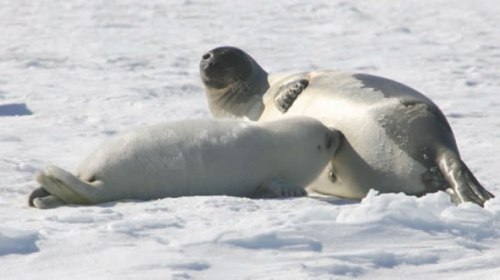
Harp seal pup_DFO Newfoundland

Although young ringed seals are considered the primary prey of polar bears throughout the Arctic, young harp seals undoubtedly represent an increasingly important resource for populations of Davis Strait, East Greenland and Kara Sea bears.

Most of the harp seals in the NW Atlantic/Atlantic Canada (about 80% of them) have their pups off Newfoundland and Labrador, an area known as the “Front” (the location of my polar bear attack novel, EATEN: special deals all this week). Harps seals at the Front now provide a huge prey base for polar bears of the large (and possibly still growing) Davis Strait subpopulation (photo below courtesy DFO Canada).

There are an estimated 7.4 million harps in Atlantic Canada today (range 6.5-8.3m), an exponential increase over the early 1980s, when perhaps only half a million so remained.  Pagophilus groenlandicus was assigned a conservation status of ‘Least Concern’ by the IUCN Red List in June last year (Kovacs 2015), when it was estimated that the global population size of the harp seal was greater than 9 million animals and probably growing1, 2 due to reduced human hunting:

“…harp seals have been harvested for thousands of years but currently the population is large and the number of animals harvested is declining.” [my bold]

Photographers and animial rights activists love cute, fluffy harp seal pups and rarely mention the carnage that goes on in spring as polar bears devour the naive youngsters. See the video below (from 2008), for an example of the cuteness factor.
Continue reading

Spring sea ice prediction by CIS for Atlantic Canada 2016 vs. observations

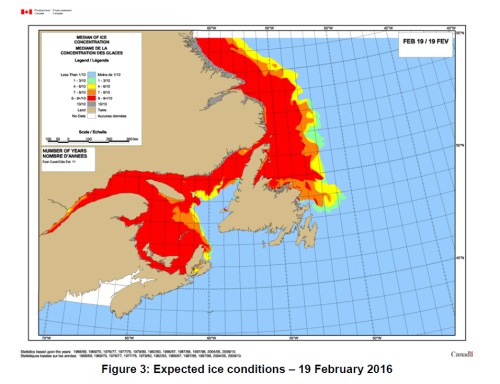
The Canadian Ice Service prediction for spring ice coverage for Atlantic Canada in 2016, released 1 December 2015, would be as extensive as 2014 and 2015 or greater.

Their expected ice coverage for 19 February 2016 is copied below (CIS fig. 3):

2016 Newfoundland Ice outlook for 19 Feb 2016_at Dec 1 2015

In my December 2015 post that reported this prediction, I compared it to past ice coverage at 19 February. But that date is now past: how does the predicted ice coverage compare to reality (i.e., observations)? Have a look below.
Continue reading

Polar bear habitat mid-winter update

Sea ice extent in the Arctic is a bit below average this year at mid-winter but there are no data to suggest this situation will have a negative impact on polar bears.

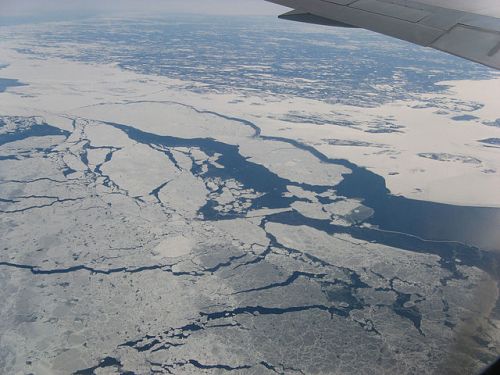
Sea_ice_near_coast_of_Labrador_-b_wikimedia_sm_26 March 2007

[Photo above is sea ice off the coast of Labrador, Canada on 26 March 2007 (from Wikimedia): polar bears in the southern portion of the Davis Strait subpopulation have been particularly successful in recent years because in late March through May/June they hunt abundant numbers of young harp and hooded seals in this habitat]

Polar bear researchers presume that most animals eat little to nothing over the winter, because it explains why even non-pregnant bears are at their lowest weight at the beginning of spring.

Sea ice charts and maps below. Continue reading

Polar bear myths perpetuate from the mouth of stuck-in-the-past Ian Stirling

In my last post, I complained about “vague and misleading statements” made by polar bear specialists and conservation advocates. Here’s a recent example of that phenomena, from veteran polar bear biologist Ian Stirling.


stirling_UA faculty page photo accessed July 22 2012

The magazine of Canada’s North, UpHere, published an interview with Ian Stirling this month. The piece begins:

“No fear-mongering. No exaggeration. For Ian Stirling, it’s purely about the science.”

Yeah, well – judge for yourself. Here’s a sample:

“We have lost on average about half the sea ice that we had in 1979, which is the first year that satellite coverage of the Arctic was taken [he’s talking about September ice here]. Places like Hudson Bay are breaking up three weeks earlier than they used to and freezing up a couple weeks later. We’re going to have even more significant effects over a much wider area in the Arctic. We’re likely to lose another 30 or 40 percent, or even half of the bears that we have today in the middle of the century, and unchecked, we will likely have very few bears left at the turn of the next century. In 2100, we’ll probably just have a few small remaining pockets in the northern Canadian Arctic islands and northern Greenland.”

Read the rest here.

Stirling’s opinion about polar bears and climate change hasn’t changed since at least 2004 despite the following scientific developments: Continue reading

Many otherwise intelligent people believe only a few hundred polar bears remain

The other day, I got a call from an international journalist who admitted he’d done no research into the polar bear issue but believed, based on media reports he’d heard, that there must only be about 100-200 bears remaining in the Arctic. I know he’s not alone.

polar-bears-3-large_USGS

This journalist was utterly astonished to learn that the IUCN Red List assessment in 2015 put the polar bear population total at 22,000-31,000 bears and demanded proof that this was true.

Here is a summary of the Red List report, with references and links to the report:

The 2015 IUCN Red List assessment update for polar bears (published 18 November 2015) states that the global polar bear population is 22,000 – 31,000 (26,000), that the current trend is ‘unknown’ and that there is only a 70% chance that polar bear numbers will decline by 30% in 35 years (with virtually zero chance that the numbers will decline by 80% or more by 2050) – in other words, zero chance of extinction. [Detailed in a document called 22823 Ursus maritimus]. It classifies the polar bear as ‘vulnerable’ to extinction based on predictions of future sea ice decline due to global warming [similar to ‘threatened’ by other organizations] Pdf here.

Below is a list of what truly worrying species declines look like: that is, animals whose numbers have actually declined, no prophesies involved (Adler 2008).
Continue reading

Polar bears rarely come ashore in January but one did on Tuesday

Polar Bear stock image gg66298544_sm

In a life-mimics-fiction moment, this report appeared Tuesday morning (26 January) in The Telegram newspaper in Newfoundland:

“The RCMP is warning the public after reports were received of a polar bear in Tilting. Fresh bear tracks were seen in the Fogo Island community Tuesday.”

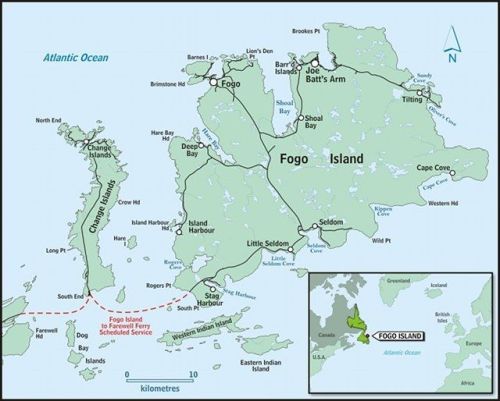
Tilting is a small town on the eastern shore of Fogo Island (see map below): Fogo Island sits off the northeast shore of Newfoundland (and is featured prominently in my new polar bear attack novel). Fogo Island lays at about the same latitude as London, England. The CBC, Canada’s national news outlet, also ran the story.

Fogo_on Fogo Island Newfoundland details

A government public advisory issued yesterday stated:

“Residents are cautioned following reported sightings of polar bears tracks near the community of Titling, on the eastern end of Fogo Island. Conservation officers confirmed the tracks to be within one kilometre of the community and believe the polar bear has since returned to saltwater. [my bold]

Polar bears are not usually seen onshore in Newfoundland until late March or April (previous stories here and here), after the ice has been close to shore for week and bears have feed extensively on newborn harp and hooded seal pups. Bears that come ashore in January – well before seal pups are born in spring (late February/mid-March) – can potentially be very dangerous because they are likely very hungry. None of the reports of this sighting gave any indication of the probable age of this bear. However, it must be kept in mind that young bears (3-5 years old) are more apt to be in a desperate state at this time of year.

Or, perhaps the bear caught interesting smells coming from shore and decided to take a short swim to check it out. The sea ice was still offshore at the time (see maps in yesterday’s post) but clearly, not too far off for the bear to swim. There may have been icebergs frozen into the pack ice that broke away (too small to show up on ice maps), that brought the bear further south than it would have ventured on its own.

It is a rare event for a polar bear to come ashore at Newfoundland in January, but it has happened before. Apparently, another bear came ashore, also on Fogo Island – in 1935 – and attacked someone. See the story below.
Continue reading

Polar bear habitat at 26 January 2016

There is still below average ice extent in the Barents Sea but there is no data whatsoever to indicate that this situation poses a problem for polar bears, given that as far as researchers know, polar bears eat little or nothing during the winter. That’s why the bears are at their leanest at the end of winter and why seal pups born in early spring are such a critical food source.

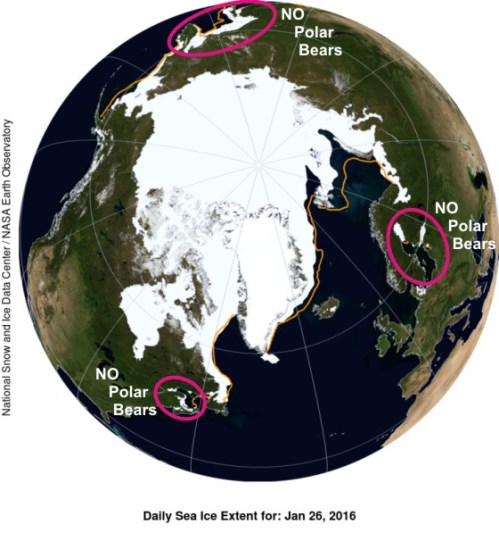
Note on map below (from WUWT Sea Ice Page, marked; original here) that polar bears are not found in three areas that are included in the total Arctic ice extent figures: below-average or above-average ice in the Sea of Okhotsk, Baltic Sea, and Gulf of St. Lawrence have no impact on polar bear health and survival.


Polar bear habitat at 26 Jan 2016_no bears marked_PolarBearScience_sm

Additional ice maps below. Continue reading

Polar bear survival: habitat 2013 vs. 2016 for 22 January

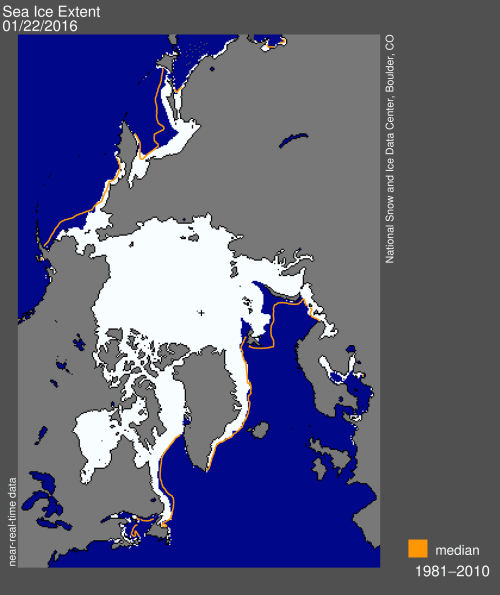
Using sea ice maps issued by the National Sea Ice Data Center (NSIDC), it’s interesting to compare these two years with respect to polar bear health and survival (keeping in mind that no polar bears live in what I like to call the armpits of the Arctic – the Sea of Okhotsk, the Baltic Sea or in the Gulf of St. Lawrence)1:

22 January 2016

Sea ice extent 2016 Jan 22 NSIDC

Continue reading

Genetic similarity of polar bears does not make them vulnerable to global warming

A new genetics paper suggests that global warming will “fragment” polar bear habitat to such an extent that it will further reduce the already-low genetic variability documented in the bears, with disastrous effects on survival.

Beaufort Sea male polar bear USGS_2005 Amstrup photo

However, that argument only works if you disregard a rather large body of literature on other mammals as well as the history of polar bears themselves. I’ve addressed this issue before (“Low genetic diversity will not make polar bears more vulnerable to extinction”) and what I said then needs to be repeated now:

“…there is lots of evidence to support my contention that polar bears are not more vulnerable to extinction just because they have low genetic diversity.

I continued:

Many populations that were reduced to very low numbers (i.e., gone through a ‘bottleneck’ ), ending up with low genetic variation, have subsequently recovered dramatically without adverse affects.

In other words, they not only recouped their population size after a population bottleneck but did so while dealing with subsequent environmental fluctuations and other natural threats to their survival (Lehman 1998:R723-724).

In some cases, genetic diversity increased after a population bottleneck, via mechanisms biologists are only just beginning to understand.

In fact, there is good evidence to suggest that ice age cooling is what previously fragmented polar bear populations: past warm interglacial periods brought bears closer together, confined more or less to the area within the Arctic Circle – even in winter.

Go back and read the entire genetic diversity post. I concluded it by recounting several examples of abundant and successful mammal populations with low genetic diversity (with references), including Northern elephant seals, Guadalupe fur seal, Sand Nicolas Island fox, Mouflon sheep, and North Atlantic right whale. The details are worth reviewing. If you can’t access a paper you want to read, contact me via the contact page above and I’ll send it along.

Regarding this new paper (Kutschera et al. 2016), what I said before needs repeating:

“To suggest that polar bears cannot endure a bit of Arctic warming in the future (whether natural or due to human influences on climate, or a bit of both) is absurd: climatic extremes have defined the evolutionary history of polar bears, which means that climatic extremes have fine-tuned their biological adaptability.”

In fact, the paleoclimate/genetics paper by Cronin and Cronin (2015) which I summarized a few days ago, documents those climatic extremes. See below for details on the polar bear genetic diversity paper.
Continue reading

Paleoclimate + genetic study confirms: Arctic species adapted to sea ice changes

A new paper that combines paleoclimatology data for the last 56 million years with molecular genetic evidence concludes there were no biological extinctions [of Arctic marine animals] over the last 1.5M years despite profound Arctic sea ice changes that included ice-free summers: polar bears, seals, walrus and other species successfully adapted to habitat changes that exceeded those predicted by USGS and US Fish and Wildlife polar bear biologists over the next 100 years.

Healy Aug  24 2015 Polar-Bear V Tim Kenna

Cronin, T. M. and Cronin, M.A. 2015. Biological response to climate change in the Arctic Ocean: the view from the past. Arktos 1:1-18 [Open access] http://link.springer.com/article/10.1007/s41063-015-0019-3

Thomas Cronin is a USGS paleoclimatologist at the Eastern Geology and Paleoclimate Science Center, and Matthew Cronin is a molecular geneticist at the University of Alaska Fairbanks (see previous posts here and here about Matt’s work on the genetics of polar bear evolution).

From the Abstract:

Arctic climatic extremes include 25°C hyperthermal periods during the Paleocene-Eocene (56–46 million years ago, Ma), Quaternary glacial periods when thick ice shelves and sea ice cover rendered the Arctic Ocean nearly uninhabitable, seasonally sea-ice-free interglacials and abrupt climate reversals.

The final discussion and two summary graphics from this paper (copied below) are especially useful:

Continue reading