Category Archives: Sea ice habitat

Tracking polar bears in the Beaufort Sea – more bears added to the April 2014 map

Polar bears were tagged in 2013 and 2014 on the spring-time sea ice of the southern Beaufort Sea. Seventeen of these bears have satellite collar transmitters and 7 of these bears have glue-on satellite transmitters” say the folks at the USGS Alaska Science Center.

I guess that’s why the April map was late getting posted.

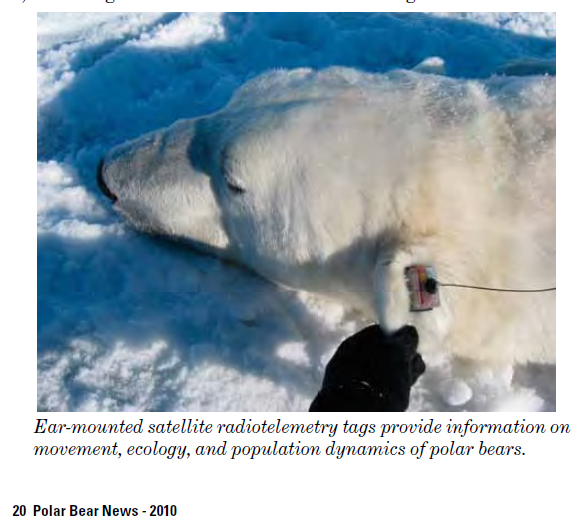
Polar bear ear tag_USFWS_PolarBearNews2010

Continue reading

Tracking polar bears in the Beaufort Sea – April map not yet available

Cannot do my April follow-up to my post on the July 2013 track map for female polar bears being followed by satellite in the Beaufort Sea by the US Geological Survey (USGS) – Ten out of ten polar bears being tracked this summer in the Beaufort Sea are on the ice.

“Tracking Polar Bears by Satellite” has not yet been updated with the April map, which is unusual for this late in the month (it is usually updated within the first few working days of every month). Perhaps the sea ice data they use was late being processed?

Here is the map for March, discussed previously here.

Figure 1. Movements of 5 satellite-tagged polar bears for the month of March, 2014. Polar bears were tagged in 2013 on the spring-time sea ice of the southern Beaufort Sea. All 5 of these bears have satellite collar transmitters. Note that the dots with the polar bear icons are the end points (end March), while the other end of the string is their position in early March. These are the same 5 females that were present in January. Click to enlarge.

Figure 1. Movements of 5 satellite-tagged polar bears for the month of March, 2014. Polar bears were tagged in 2013 on the spring-time sea ice of the southern Beaufort Sea. All 5 of these bears have satellite collar transmitters. Note that the dots with the polar bear icons are the end points (end March), while the other end of the string is their position in early March. These are the same 5 females that were present in January. Click to enlarge.

Previous dates for tracking available here.

Polar bear habitat update – ice coverage at the beginning of this year’s critical feeding period

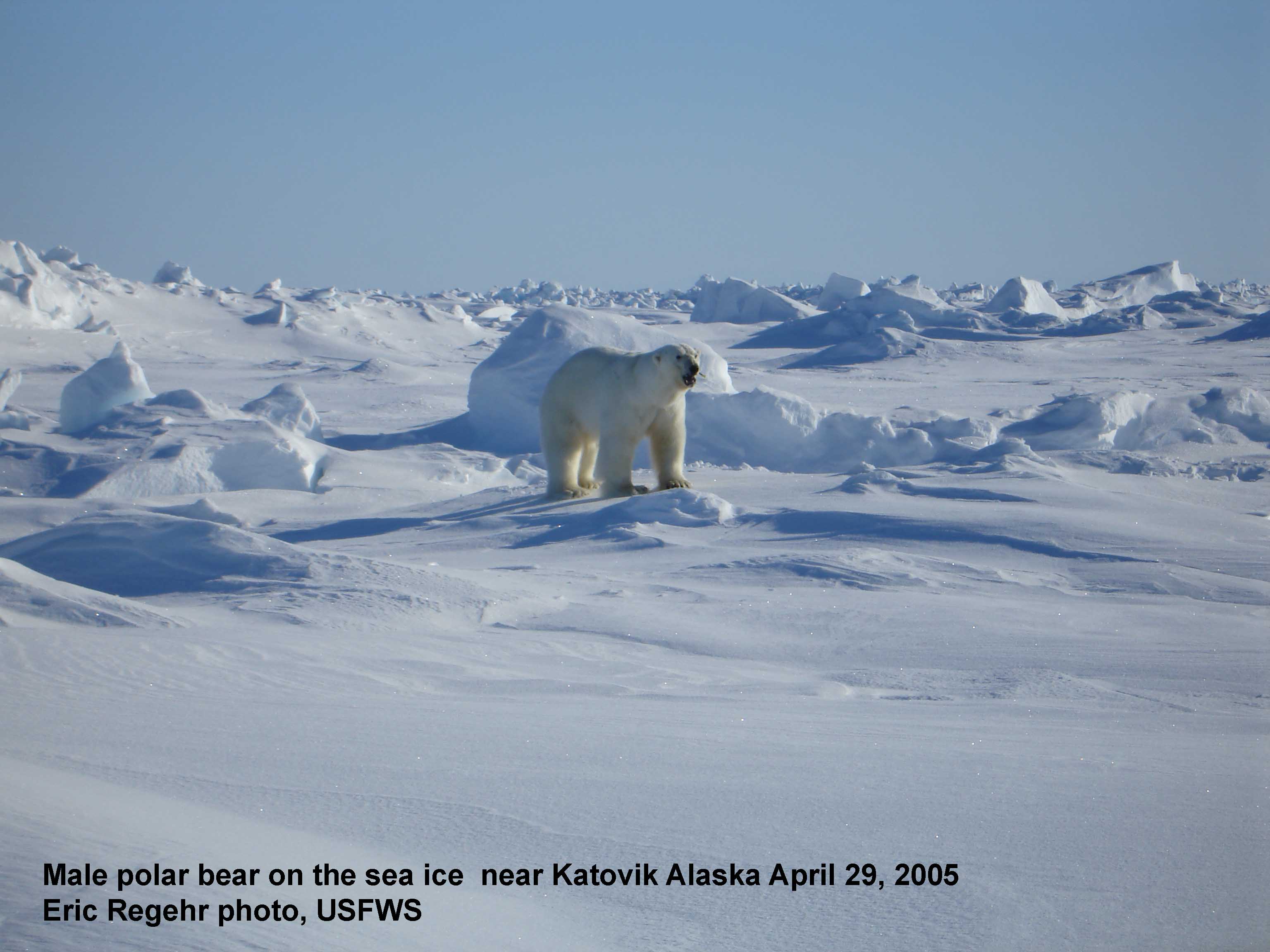
Polar bears are all out on the sea ice at this time of year, feeding on new-born seal pups. Here’s a look at what the ice conditions are like at this critical time.

Polar_Bear_male on sea ice_Alaska Katovik Regehr photo_April 29, 2005_sm labeled

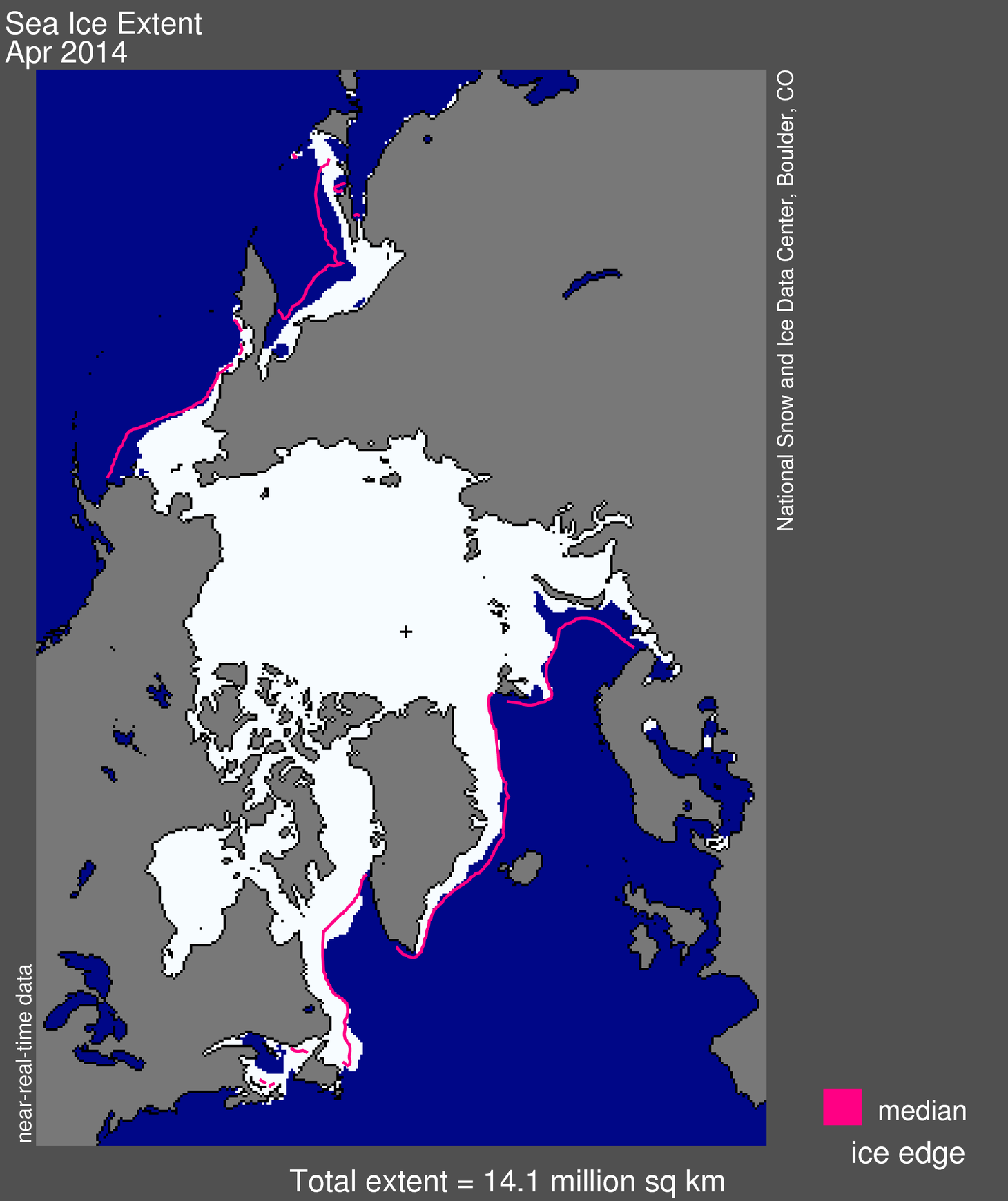
end April extent NSIDC May 4

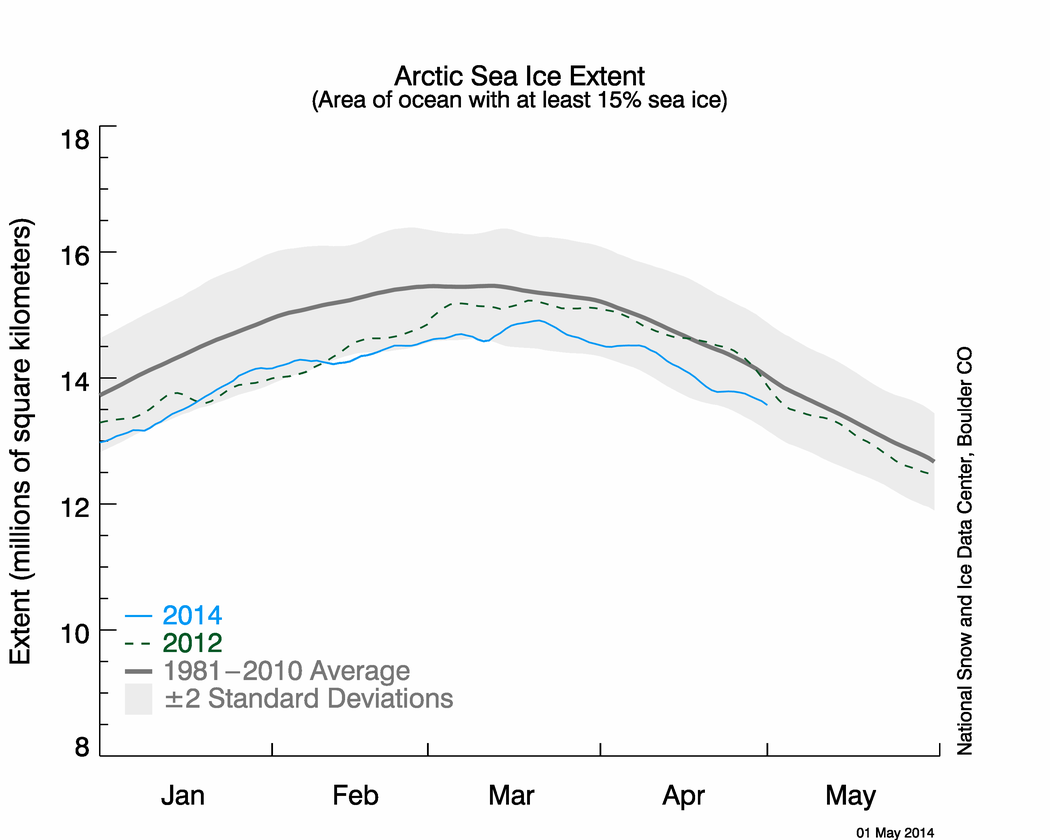
The ice extent is still well within two standard deviations from the 1981-2010 average, which indicates no deviation from natural variation, as the graph (below) for May 1, 2014 from the US National Snow and Ice Data Center (NSIDC) shows.

Sea ice extent 2014 May 1_NSIDC_graph

Between the official spring maximum (according to the NSIDC ) on March 21, with a total extent of 14.8 million km2, the ice slowly retreated in some regions and increased in others, while most regions remained pretty much the same. This is an important reminder that the Arctic as a whole is not a homogeneous region but one with marked regional variation.

As has been noted elsewhere (Sunshine Hours), ice in the Greenland Sea (habitat of ‘East Greenland’ bears) and the Barents Sea both increased in extent over this period. Bering Sea ice (habitat of southern ‘Chukchi Sea’ bears) declined markedly but Baffin Bay/Gulf of St. Lawrence ice (habitat of ‘Davis Strait’ bears) declined much less, as NOAA’s MASIE maps copied below show very well.

Continue reading

PBI Facebook posts on Stirling’s polar bear that “died of climate change” have disappeared

It seems the two PBI Facebook posts about polar bear expert Ian Stirling’s bear that supposedly “died of climate change” last summer, which included some scathing comments and links to this blog, were removed sometime between late August 2013 and yesterday, when I happened to look for them.

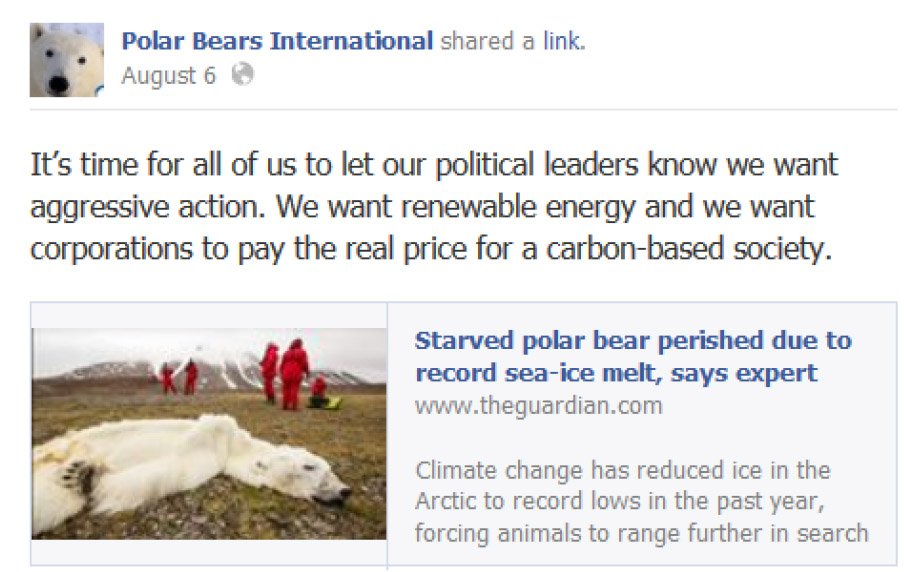
See the screen-caps below. The first one, posted August 6, linked to the original Guardian article on the Svalbard bear and added some activist spin for good measure!

Polar Bears International Facebook_Aug 6

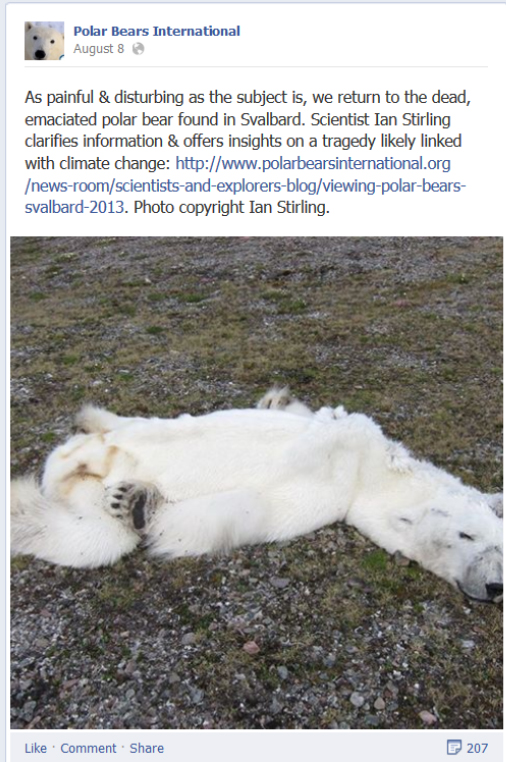
The second one, posted August 8, linked to an PBI news item that introduced a PBI blog post written by Stirling, in which he attempted some damage control.1

PBI link to Stirlings blog post on the bear that died of climate change_with activist spin_Aug 8 2013

[Reprise: Stirling speculated that a 16 year old bear found emaciated and dead in Svalbard, three months after it had been captured by researchers in good condition, had died of starvation due to lack of sea ice caused by global warming. Guardian writers transformed this into a bear that “died of climate change.” No mention from in the original story that 16 years is near the maximum life expectancy for male bears in the wild, that death by starvation is the usual cause of death for very old bears, or that other bears in the area were doing just fine (based on the fact that the Norwegian team working that area had just posted their data online). See my original post here, followup here, Featured Quote #44, here and footnote below]

Stirling himself (a “scientific advisor” to Polar Bears International, PBI), and the-polar-bears-are-dying message generally, took a big hit over that incident. But attempting to rewrite history? See the screen-cap below, taken yesterday (pdf here):

PBI_Fan Photo Day Aug 6 to Aug 13 gap_Svalbard bear story gone_April 29 2014

The deletion of these two entire entries suggests that PBI and Ian Stirling would rather their faithful Facebook followers and donors not have a chance to revisit the scathing comments and links to this blog. I assume it is the comments and links that were the offending parts, since Stirling’s blog post at PBI is still there, and of course, the news stories carried elsewhere are still out there. So instead of deleting comments, they removed the entire posts.

Good thing I saved screen caps of many of the more critical comments, from at least two PBI Facebook followers I’ve never heard of — have a look. [August 6th post was also captured by the cache machine]
Continue reading

My interview with CNS News: “Alaskan Polar Bears Threatened…By Too Much Spring Ice”

Not bad, as these things go, but the reporter made one error that needs correcting – so I’m doing it here to set the record straight, just in case it does not get taken care of in the original story.

CNS News reporter Barbara Hollingsworth had seen my post last week, “Current ice conditions don’t bode well for Beaufort Sea polar bears” and wanted to talk to me about it. It was a little rushed, but I agreed.

This is how it turned out, with the error corrected and an updated ice thickness map.
Continue reading

Current ice conditions don’t bode well for Beaufort Sea polar bears

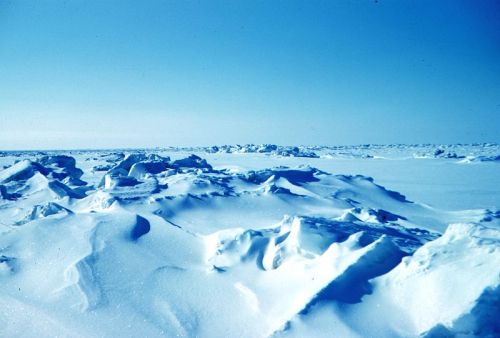
Thick spring ice along the shore of the Eastern and Southern Beaufort is bad news for polar bears, especially females emerging from their dens with new cubs. Are those conditions developing now?
Beaufort Sea pressure ridges_Spring 1949 wikipedia sm

Every 10 years or so, since at least the 1960s, nearshore ice gets too thick for ringed seals to maintain their breathing holes and many breeding seals depart the area. This leaves a lot of polar bears without the baby seals they need to consume to get them through the rest of the year (that’s if they don’t (or can’t) leave themselves).

I’ve discussed various aspects of this phenomenon before, with references – see the list at the end of this post.

Sadly, we are on schedule for such conditions to recur – could be this year, could be next. The last time of heavy spring ice was 2004 and previous heavy ice conditions occurred the springs of 1964, 1974 (the worst), 1984, 1992 and 2004. The 2004-2006 event was reportedly almost as bad as the 1974-1976 event.

So, prompted by reports of the heaviest sea ice conditions on the East Coast “in decades” and news that ice on the Great Lakes is, for mid-April, the worst it’s been since records began, I took a close look at ice thickness charts for the Arctic. I’m not suggesting these conditions are necessarily related to Beaufort ice, just that they got me thinking.

Here’s a screencap of the US Navy ice thickness animation chart for yesterday [from WUWT Sea Ice Page]
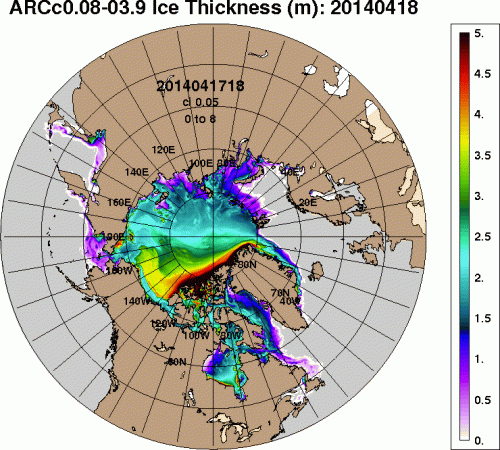
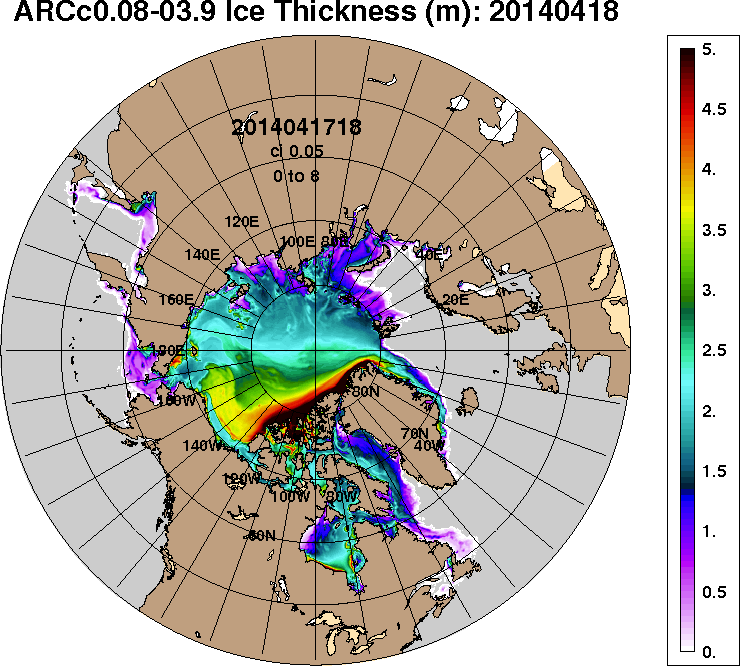
Figure 1. Arctic Sea Ice Thickness (NRL), for April 18, 2014. Look at thick ice (yellow, 3.5-4.0 meters thick) spreading along the north coast of Alaska. See the 30 day animation here.

Figure 1. Arctic Sea Ice Thickness (NRL), for April 18, 2014. Look at thick ice (yellow, 3.5-4.0 meters thick) spreading along the north coast of Alaska. See the 30 day animation here.

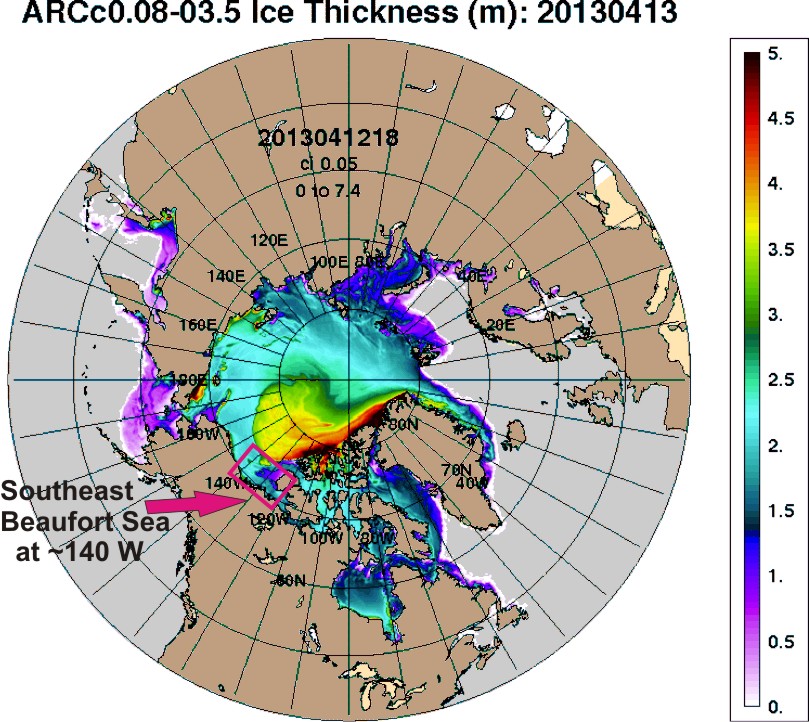
Below is a similar image from about the same time last year, with the Southeast Beaufort Sea marked.
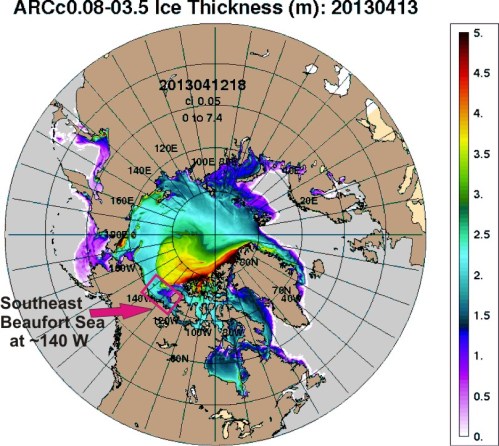
Figure 2. Arctic Sea Ice Thickness (NRL), for April 13, 2013. Southeastern Beaufort marked.

Figure 2. Arctic Sea Ice Thickness (NRL), for April 13, 2013. Southeastern Beaufort marked.

I don’t think this bodes well for Beaufort bears but we’ll have to wait and see if there are any reports of starving bears bit later this spring and summer. Sea ice charts aren’t a guarantee that this heavy spring ice phenomenon is developing in the Beaufort, but they could be a warning.

Below are archived ice age charts from the US National Snow and Ice Data Center (NSIDC) for some previous years when Beaufort bears had trouble, especially 2004-2006, with which I compare this year’s conditions. [h/t Steve Goddard for alerting me to this resource]

Continue reading

Polar bears move around as sea ice habitat changes – this is what resilience looks like

Oddly, it seems some people expect polar bears to sit around and suffer (or die) when local conditions deteriorate, rather than move elsewhere.

PolarBear_2008_USGS

While there are perhaps a few places where moving is not really an option over the short term, over the long term (more than one season) polar bears are free to shift to another locale if ice conditions change (either too much ice or too little).

An announcement by the WWF last week (10 April) caught my eye, as it talked about bears moving from one area to another because of changing ice conditions — as if this was surprising, extraordinary and newsworthy. That said, at least they weren’t suggesting the bears are all going to die because of declining ice, which is a huge improvement.

See what you think of this part of the press release (below), in the context of what we know about the movement of bears between regions:

Continue reading

Tracking polar bears in the Beaufort Sea: March map

Here is the March 2014 follow-up to my post on the July 2013 track map for female polar bears being followed by satellite in the Beaufort Sea by the US Geological Survey (USGS) – “Ten out of ten polar bears being tracked this summer in the Beaufort Sea are on the ice.”

See that post for methods and other background on this topic, and some track maps from 2012 (also available at the USGS website here).

The USGS track map March 2014 is copied below (Fig. 1).

Compare this to February’s map (Fig. 2) – you’ll be surprised at how little has changed!

Figure 1. Movements of 5 satellite-tagged polar bears for the month of March, 2014. Polar bears were tagged in 2013 on the spring-time sea ice of the southern Beaufort Sea. All 5 of these bears have satellite collar transmitters. Note that the dots with the polar bear icons are the end points (end March), while the other end of the string is their position in early March. These are the same 5 females that were present in January. Click to enlarge.

Figure 1. From original caption: “Movements of 5 satellite-tagged polar bears for the month of March, 2014. Polar bears were tagged in 2013 on the spring-time sea ice of the southern Beaufort Sea. All 5 of these bears have satellite collar transmitters.” Note that the dots with the polar bear icons are the end points (end March), while the other end of the string is their position in early March. These are the same 5 females that were present in January. Click to enlarge.

Continue reading

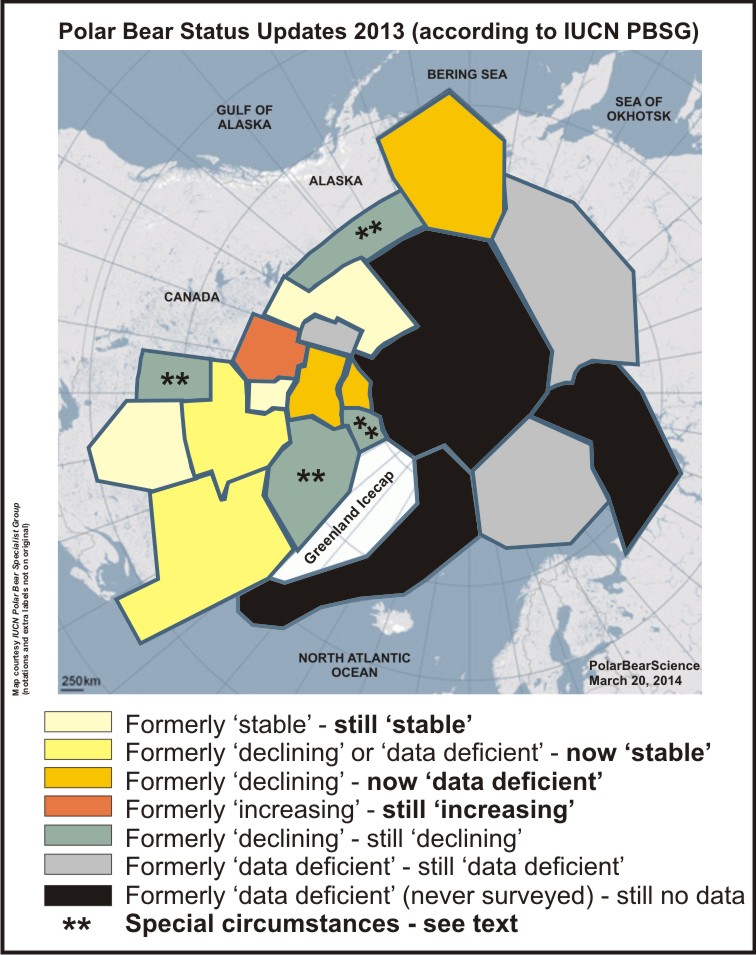
Polar bear status changes in 2013 deconstructed, with a map to the good news

You can’t figure out what’s going on with status updates from the IUCN Polar Bear Specialist Group (PBSG) without deconstructing the spin and the 2013 update is no exception. Here’s my travel guide, with a map, to the good news.

Polar Bear Subpopulations 19_2013 updates_March 20 2014_sm

I’ve finally had a chance to go through all of the details provided with the 2013 PBSG status table (pdf here). It’s just about all good news, once you wade through the spin. Numbers aside, out of the 13 populations for which some kind of data exist, five populations are now classified by the PBSG as ‘stable’ (two more than 2009), one is still increasing, and three have been upgraded from ‘declining’ to ‘data deficient’ (I explain below why this is a promotion).

That leaves four that are still considered ‘declining’- two of those judgments are based primarily on concerns of overhunting, and one is based on a statistically insignificant decline that may not be valid and is being re-assessed (and really should have been upgraded to ‘data deficient’). That leaves only one population – Western Hudson Bay – where PBSG biologists tenaciously blame global warming for all changes to polar bear biology, and even then, the data supporting that conclusion is still not available.

Continue reading

New genetic study confirms polar bears survived several warm Interglacials

There is a new polar bear genetics paper out in the Journal of Heredity, by University of Alaska Fairbanks genetics professor Matt Cronin and colleagues. Matt Cronin, in case you didn’t know, was the first to pick up the close genetic relationship between polar bears and grizzlies, as a result of research he and colleagues did back in the early 1990s (Cronin et al. 1991).

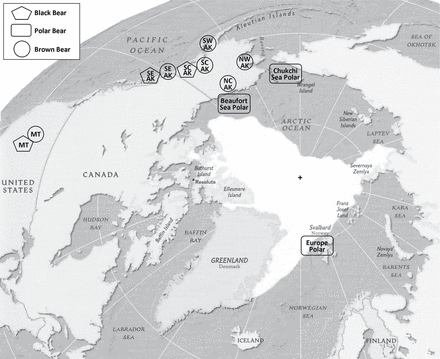
Figure1 from Cronin et al. 2014 (in press) showing the locations of bear samples used in their genetic study. MT, Montana; AK, Alaska; Polar bear samples were from the Chukchi, Beaufort and Barents Sea populations.

Figure 1 from Cronin et al. 2014 (in press) showing the locations of bear samples used in their genetic study. MT, Montana; AK, Alaska; Polar bear samples were taken from the Chukchi, Beaufort and Barents Sea populations.

While no earth-shattering new information was revealed in this new study, reported over the weekend by the Alaska paper SitNews (March 15), it used a more detailed method to confirm the results of previous work – that polar bears have been around long enough to have survived several past Interglacial periods that were warmer than today (with less ice in the Arctic) and are genetically distinct from grizzlies.

A feature that really set this work apart was how it was promoted.
Continue reading