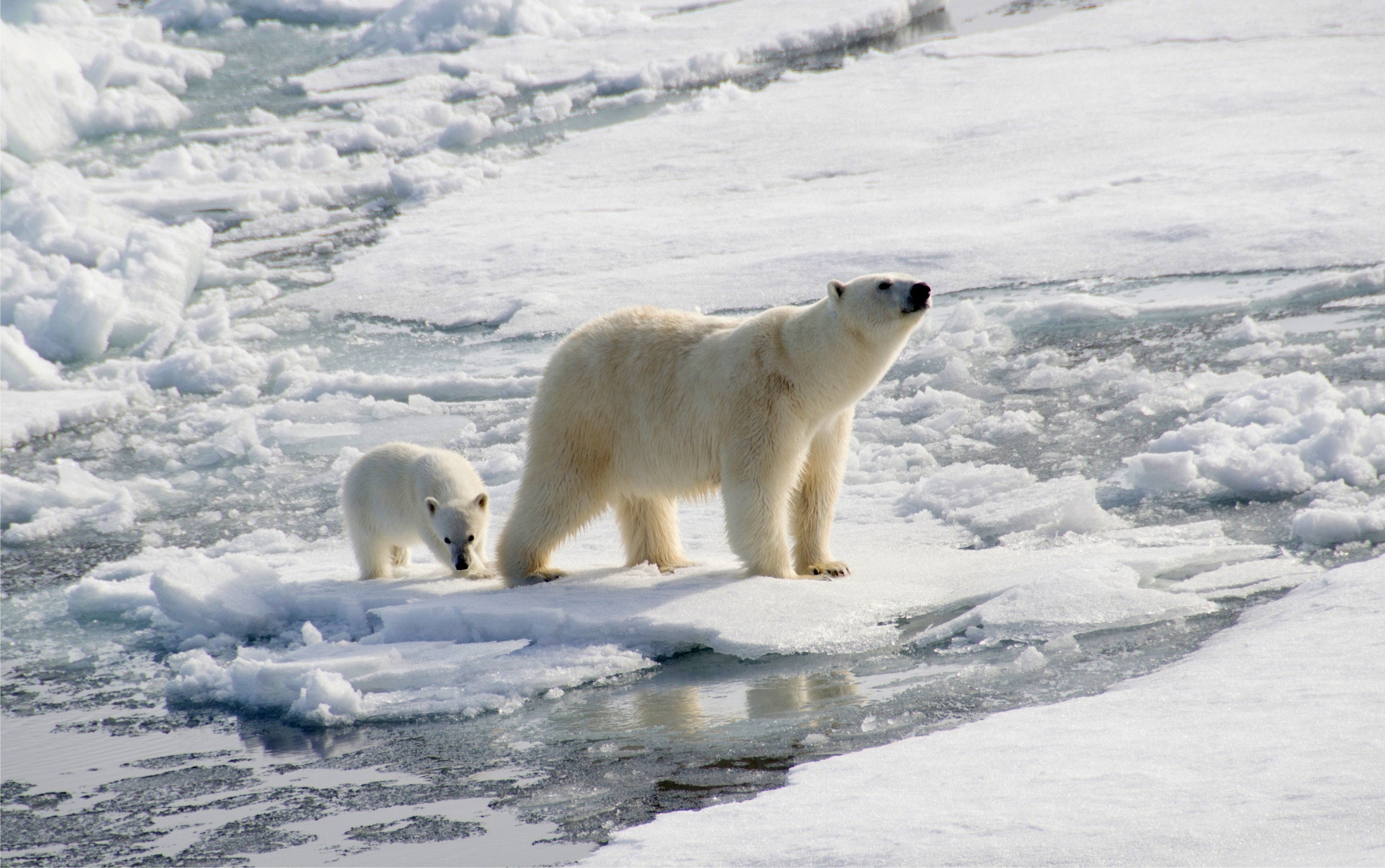
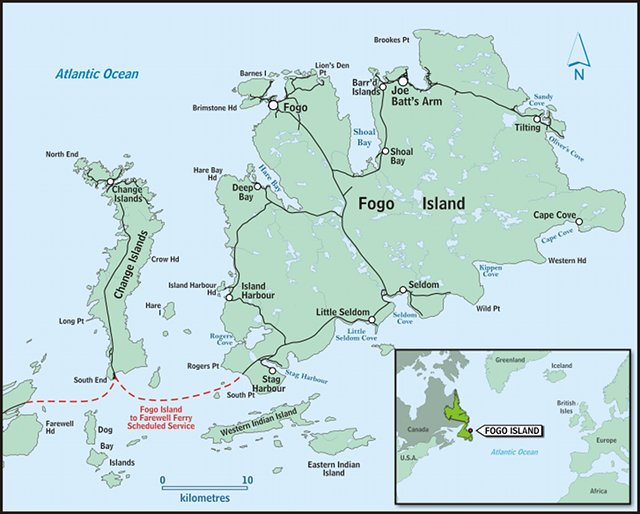
Another polar bear on Fogo, this time on the south shore as sea ice surrounds the island

On Friday, 8 April, a polar bear was photographed on the south coast of Fogo Island, Newfoundland at a time when sea ice surrounded the offshore island. The bear, spotted near North Side Road near Stag Harbour, was non-threatening to the point of being totally chilled out, but attracted enough human attention to cause traffic congestion. Another sighting a little more than a week ago near Tilting on the east side of the island could possibly have involved the same bear.

Continue reading

Sea ice average for March is the metric used to compare to previous winters

The average sea ice cover at the end of March is the metric used to compare ‘winter’ ice to previous years or decades, not the single-day date of ‘most’ ice. This year, March ended with 14.6 mkm2 of sea ice, most of which (but not all) is critical polar bear habitat. Ice charts showing this are below.

But note that ice over Hudson Bay, which is an almost-enclosed sea used by thousands of polar bears at this time of year, tends to continue to thicken from March into May: these two charts for 2020 show medium green becoming dark green, indicating ice >1.2 m thick, even as some areas of open water appear.

Continue reading

Polar bear attempted to break down front door of house in Newfoundland with people inside

A frightening incident just after midnight on Sunday left a woman and her daughter on the Northern Peninsula of Newfoundland shaken when a polar bear tried to break down their front door. Luckily for them, the bear was not starving and therefore not persistent: it soon stopped without doing much damage and neighbours were able to drive it away from the house. Again, the premise of my polar bear attack thriller, EATEN, is that the bear could have gotten into the house if it had really been motivated by hunger to do so. And what if that had happened and there were no neighbours to call for help?

There is still abundant ice around the northern Peninsula (see below), and gov’t officials are warning residents to be wary of other bears reported in the region. A CBC story on the incident quotes local wildlife officials as saying they “generally receive between 30 and 60 calls about polar bears annually. There have been 10 this year so far.” However, as I’ve pointed out previously, it appears this has only been true since 2012 or so: lots of bears visiting Newfoundland and Labrador in the spring is a relatively new phenomenon.

Continue reading

Newfoundland polar bear sighting two days ago: why my novel was set on Fogo Island in March

On 29 March, there was a sighting of a polar bear on Fogo Island near the community of Tilting that prompted an official warning to residents. Although this bear caused no problems so far, that hasn’t always been the case and it’s a useful reminder that this is why I set my polar bear attack thriller EATEN in this location, at this time of year. If you haven’t read it, or given it as a gift, now might be the perfect time! In Canada here and the UK here.

From a review of EATEN by polar bear-human interaction specialist Doug Clark (June 2016):

Susan Crockford has not only written a fun novel that gets readers thinking, she has probably done polar bear conservation a real service. Because of how politicized polar bears have become as symbols of climate change, fiction is the only arena where one can really present this kind of scenario right now.

Sea ice conditions off Newfoundland on 28 March:

Unpacking the claim that photos from 1950 are Soviet soldiers feeding ‘starving’ polar bears

You may have seen this one before: a photo from 1950 of Soviet soldiers feeding polar bears sweetened condensed milk from a tank. There are others, taken about the same time.

Let’s look at the claims being promoted regarding these photos a little more critically.

Continue reading

Arctic sea ice maximum extent was present for at least two weeks at about 14.9 million km2

US National Snow and Ice Data Center says the Arctic maximum extent for this winter peaked at 14.88 mkm2 on 25 February, but in fact this amount of ice coverage lasted for at least two weeks (22 February – 8 March), with very slight variation. Just a little something they all left out of their announcements, for some reason.

Continue reading

Good news for polar bears and seals: new study finds multiyear Arctic sea ice is getting thinner

The fact that multiyear sea ice got thinner between 2018 and 2021 as documented by a new study, is ultimately good news for polar bears: less multiyear ice compared to first year ice is better for all marine mammals in the Arctic. Polar bears and seals, for example, are dependent on the seasonal ice that forms every winter (Atwood et al. 2016; Durner et al. 2009). Multiyear ice is simply too thick for any purpose except as a summer refuge for polar bears (for which land will do just as well) and a platform for maternity dens over the winter, for which thick first year ice will often do just as well (Anderson et al. 2012; Rode et al. 2018).

Continue reading

Polar bear encounter with dog in Black Tickle Labrador has a happy ending for both

In the first such report I’ve seen this season, last Sunday a family husky living on the south coast of Labrador met a curious young polar bear in very good condition; the bear left without incident but the family captured video of the encounter. Abundant ice offshore has almost certainly brought a number of Davis Strait bears south ready to feed on newborn harp seal pups, which won’t be available for a few more weeks.

From April 2019, also at Black Tickle.

We are approaching the season described in my polar bear attack thriller, EATEN. A timely read if you haven’t seen it yet, available in paperback and ebook formats.

Continue reading

State of the Polar Bear 2021: polar bears continued to thrive

The current health and abundance of polar bears continues to be at odds with predictions that the species is suffering serious negative impacts from reduced summer sea ice blamed on human-caused climate change.

Continue reading

Accepted sea otter population estimate at 1911 as inaccurate as rejected polar bear estimate for 1960s

Sea otter specialists, without shame or apology, routinely use a benchmark figure of ‘about 2,000’ for the pre-protection population size of the species at 1911 based on extremely limited evidence yet polar bear specialists refuse to accept a benchmark figure for the 1960s despite the existence of eight published estimates made by experts at the time. Sea otters came much closer to extinction than polar bears did and are not out of the woods yet, for reasons that are not entirely understood (Doroff et al. 2021).

Andrew Derocher, 22 February 2022: ‘There never was a population estimate of global abundance in the 1960s.’

Derocher’s statement and those of his colleagues, discussed at length in The Polar Bear Catastrophe That Never Happened, makes them look biased and unprofessional. There is absolutely no rational scientific justification for holding this stance.

Continue reading