Tag Archives: attack

Polar bears do not outnumber people in Svalbard and the backlash against ecotourism over a justified defensive kill

It is often said that there are more polar bears than people in Svalbard, Norway (see BBC, “Polar bear shot dead after attacking cruise ship guard29 July 2018). But that isn’t true now and probably hasn’t been for a very long time. This pseudo-fact (a misunderstanding made by tourism promoters) continues to be quoted as the story about the Svalbard polar bear shot by a cruise ship bear guard last week evolves in the online and print media. The media continue to focus on social media backlash against ecotourism, which is nothing like the pushback about the starving polar video from last year.

Svalbard dead bear_Gustav Busch Arntsen_Governor of Svalbard_NTB Scanpix via AP 28 July 2018

Continue reading

Cruise ship bear guard survives being mauled by polar bear in Svalbard

Less than a month after a fatal polar bear attack near Arviat, Western Hudson Bay, European media reported this morning that one of two German polar bear guards escorting a group of tourists on a shore visit in northern Svalbard was mauled on 28 July by a polar bear before the second guard could kill it.

Svalbard dead bear_Gustav Busch Arntsen_Governor of Svalbard_NTB Scanpix via AP 28 July 2018

The man was air-lifted to hospital in Longyearbyen with non-life-threatening head injuries. Whether the bear was fat or thin was not mentioned but a necropsy will be performed.

More details are likely to be available within the next few days. The guards and tourists were from the German cruise ship MS Bremen, which apparently is operating a live web cam. The group landed on the Sjuøyane Islands, the northernmost group of islands in the Svalbard archipelago (see the top of the black box on the map below).

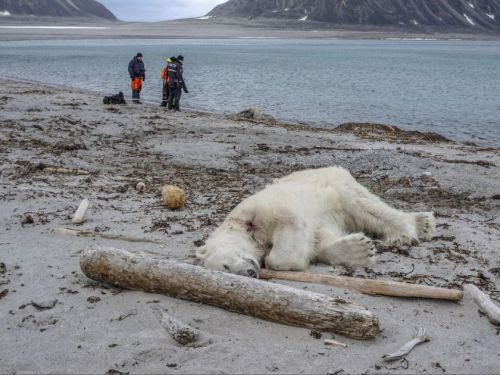
UPDATE 28 July 2018 11:00 pm PT: The photo of the dead bear (above, provided by the Governor of Svalbard), shows the animal was in poor condition. See my comments below regarding sea ice coverage for the area: the bear had likely been on the islands since early May and if he was not in good condition when he left the ice, he would have been desperate by now. However, we still do not know if he was sick or injured, young or old. That information will come with time.

UPDATE 29 July 2018: The cruise ship line has released a statement on Facebook that includes further details about the attack, see below.

Continue reading

New information on the fatal polar bear attack at Arviat, Western Hudson Bay

Additional information is available regarding the fatal mauling of a young Arviat father two weeks ago that may answer the question of why the bear left the Hudson Bay sea ice well before it was necessary. Was it lack of sea ice (blamed on global warming), as biologist Ian Stirling recently insisted — or did natural food attractants lure the bear ashore prematurely?

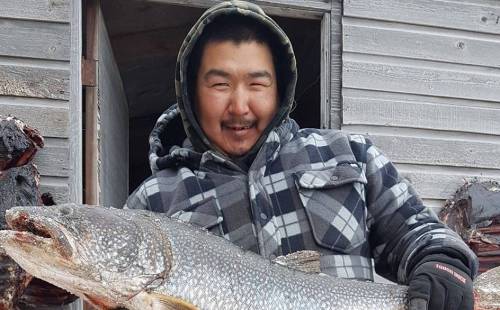
Aaron Gibbons_fishing_Gibbons family photo

I would also like to appeal to readers to consider a donation to the Go Fund Me campaign set up to support the widow and children of Aaron Gibbons, who was only 31 years old. So far, there has not been an overwhelming response (less than 1/2 of the modest goal of $5,000 met after two weeks) and that saddens me deeply.

I have contributed myself but each individual can only do so much. Imagine losing your spouse in this most vicious manner (the children witnessed the attack and were the ones that called for help) and think of the challenges of healing your family and keeping it afloat financially. Please see the GO FUND ME page and contribute if you can.

What I’ve learned over the last week is that the polar bear that killed Aaron Gibbons was a big male in poor condition but he was not the only bear onshore at the time. In addition, the Arctic tern nesting colony on Sentry Island was undoubtedly an enticing natural attractant that seems to have encouraged these bears to leave the ice far north of where they might otherwise have come ashore.

UPDATE 20 July 2018: I’ve added the most recent (19 July) map of collared WH polar bear locations on Hudson Bay to the “Condition of the Sea Ice” discussion below. Also, I am pleased to see that the GO FUND ME campaign has now gone above the half-way mark (~$2800.00 as of 2:00 PM Pacific time). My personal thanks to every one who was able to contribute. I hope to see the goal reached within the next few days.

UPDATE 6 September 2018: A news announcement today revealed that the necropsy done on the bear that attacked Aaron Gibbons was an adult male in “fair” condition (thin but not skinny). See my report here and the news story here. And I’m pleased to report that the GoFundMe goal of $5000 for Aaron’s family has been reached: thanks to all PolarBearScience readers for their support.
Continue reading

First fatal polar bear attack in W. Hudson Bay since 1999 occurred yesterday in Arviat [corrected]

A brave young father from Arviat on the northwest coast of Hudson Bay was killed yesterday evening by a polar bear while trying to protect his children.

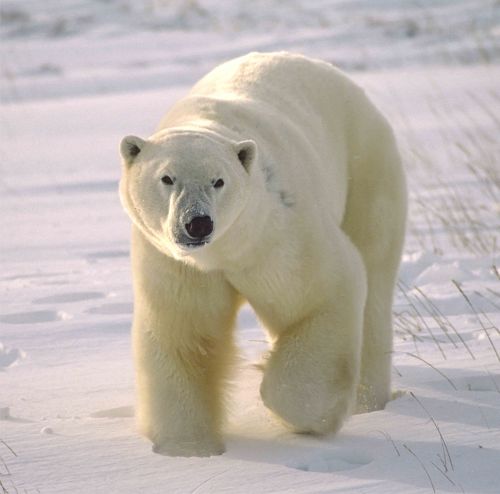
Walking bear_129029633_web size

Aaron Gibbons, 31, was the nephew of Gordy Kidlapik, who follows this blog and my twitter account. Gordy has often sent me useful local information and perspectives from Arviat, which is in Nunavut (north of Churchill, Manitoba).

It was heartbreaking to hear this news firsthand from Gordy:

https://twitter.com/Irngutaq/status/1014336102461726720

Arviat with Churchill_Google maps

More below and to follow as further details emerge. My sincere condolences to Gordy and his family – what a horrific loss.

UPDATE: 4 July 2018 9:00 pm PT. See correction below regarding the last fatal WHB attack, which was in 1999 (Rankin Inlet), not 1983 as my original title read. My apologies but as you’ll see, the newspaper didn’t get it right either.

Continue reading

Consensus polar bear experts dealt with criticism differently in 2007

Frustration with criticism over the fate of polar bears decades into the future has plagued consensus experts since they first brought their concerns to the attention of conservation organizations in the mid-2000s. But now that catastrophe has not materialized, these researchers have shifted their defensive style from logical reasoning to relentless insult.

Dealing with criticism 2007 vs 2017

A decade ago, doubts about the veracity of the proposed ESA conservation status of “threatened” with extinction due to predicted effect of global warming came primarily through the media, who were seen to give critics a platform.

In a revealing article published 10 years ago in the fall of 2007 (before the ESA decision had been made) by polar bear biologists Ian Stirling and Andrew Derocher (“Melting Under Pressure: The real scoop on climate warming and polar bears”) in The Wildlife Professional, some of the same concerns were being raised as in 2017 by Harvey and colleagues (that including Stirling and fellow polar bear biologist Steven Amstrup) in BioScience (“Internet blogs, polar bears, and climate-change denial by proxy”), but the approach and the language is startlingly different.
Continue reading

Did Harvey et al. authors aim to help Google censor polar bear information?

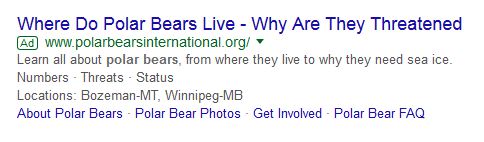
A recent New Time Times article about Google’s practice of generating ad revenue via ‘promoted’ search results (“How Climate Change Deniers Rise to the Top in Google Searches” 29 December 2017) had a surprising and disquieting ending about the prospect of internet censorship.

PBI Google ad_7 Jan 2018 why are they threatened

It was a quote from Jeff Harvey of “Internet Blogs, Polar Bears, and Climate-Change Denial by Proxy” (Bioscience, 29 November 2017) fame:
Continue reading

Failed Amstrup polar bear predictions have climate change community in a panic

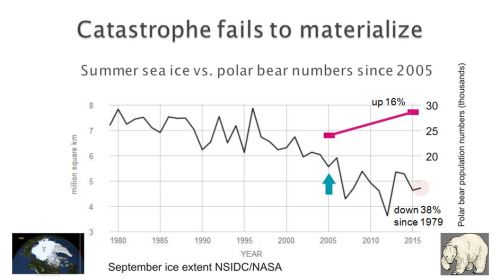
Polar bear experts who falsely predicted that roughly 16,400 polar bears would be dead by now1 (given sea ice conditions since 2007) have realized their failure has not only kicked their own credibility to the curb, it has taken with it the reputations of their climate change colleagues. This has left many folks unhappy about the toppling of this important global warming icon but ironically, consensus polar bear experts and climate scientists (and their supporters) were the ones who set up the polar bear as a proxy for AGW in the first place.
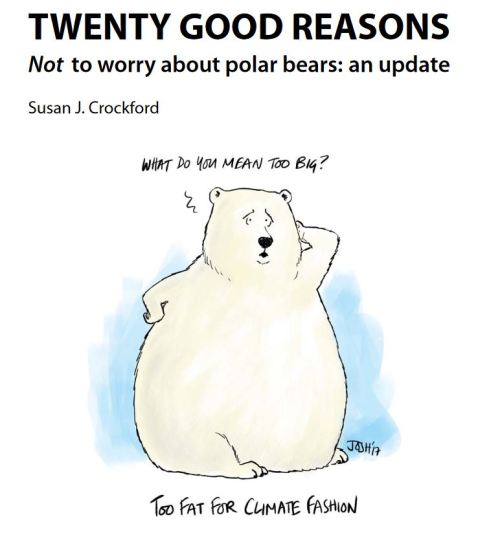
Cover image_Twenty Reasons_polarbearscience

I published my professional criticisms on the failed predictions of the polar bear conservation community in a professional online scientific preprint journal, which has now been downloaded almost 2,000 times (Crockford 2017; Crockford and Geist 2017).
Crockford 2017_Slide 12 screencap

My paper demonstrates that the polar bear/seaice decline hypothesis, particularly the one developed by Steven Amstrup, is a failure. I’m not the only one who thinks so, as emails obtained from the US Fish and Wildlife Service show. The argument the paper lays out and the facts it presents have not been challenged by any one of the consensus polar bear experts who object to it so strenuously. Instead, they have chosen to misrepresent my work, and publicly belittle my credentials and scientific integrity in the published literature (Harvey et al. 2017) and online.

Harvey and colleagues suggest in their paper that I and others use polar bears as a proxy for AGW as part of a deliberate plan to undermine the public’s confidence in global warming.

Harvey et al. state:

“…the main strategy of denier blogs is therefore to focus on topics that are showy and in which it is therefore easy to generate public interest. These topics are used as “proxies” for AGW in general; in other words, they represent keystone dominoes that are  strategically placed in front of many hundreds of others, each representing a separate line of evidence for AGW. By appearing to knock over the keystone domino, audiences targeted by the communication may assume all other dominoes are toppled in a form of “dismissal by association.” [my bold]

I do not recall ever stating or implying that if polar bear predictions of doom were wrong, then general climate change models must also be wrong. But if any other bloggers have done so, they can hardly be blamed.

A bit of reflection shows it was the climate science community itself — in collaboration with Arctic researchers and the media — who by the year 2000 (below left) set the polar bear up as an icon for catastrophic global warming. They made the polar bear a proxy for AGW.

Al Gore used the polar bears on an ice flow image (above right) to seal global warming icon status for the polar bear in his 2007 movie, An Inconvenient Truth (see National Post March 2007 article here).

As Harvey et al. co-author Michael Mann said only a few years ago (24 March 2014):

“We are now the polar bear.”

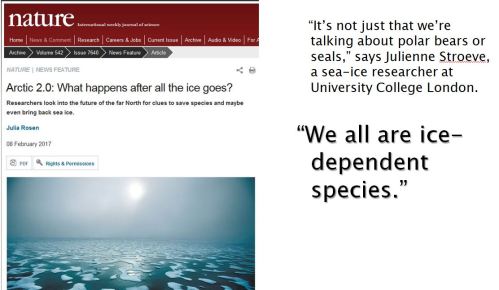
A clear association was made between polar bear survival and AGW, time and time again, as recently as last February (2017):
Stroeve 2017 we are all ice dependent species

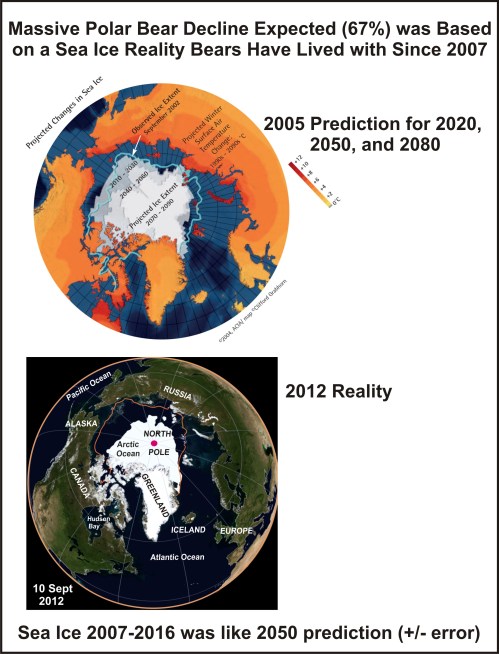
So, when the polar bears failed to die by the thousands as polar bear models predicted, after years of lower summer ice than any sea ice models predicted (see graphic below), some people may have logically stated or implied that perhaps general climate models are similarly flawed.

In essence, Mann’s “we are now the polar bear” statement came back to bite him and his colleagues in the ass, Amstrup and Ian Stirling included.  Predictably, they would like to blame someone else for their failure and embarrassment, so they wrote a sloppy tantrum paper that pretends my polar bear/sea ice decline document doesn’t exist.

I guess we all should have seen it coming.

UPDATE 8 January 2018: Forgot to add that Mann’s upcoming children’s book depends on the polar bear being an appealing icon for global warming: he uses the bears as a hook to grab the interest and sympathy of naive youngsters so that he can sell them his scary modeled prophesy of the future. In contrast, my children’s book Polar Bear Facts & Myths deals with the current status and science of polar bears, sea ice and Arctic ecology and draws no parallels between global warming predictions and polar bear survival.

Mann_tantrum that saved the world Dec 2017 cropped

Fig 3 Sea ice prediction vs reality 2012

Predicted sea ice changes (based on 2004 data) at 2020, 2050, and 2080 that were used in 2007 to predict a 67% decline in global polar bear numbers vs. an example of the sea ice extent reality experienced since 2007 (shown is 2012). See Crockford 2017 for details.

Footnote (added 30 March 2018):

Just to clarify, this represents the predicted decline of 67% of the population (i.e. 24,500 bears) estimated to exist in 2005 by the US Geological Survey.

References

Crockford, S.J. and Geist, V. 2018. Conservation Fiasco. Range Magazine, Winter 2017/2018, pg. 26-27. Pdf here.

Crockford, S.J. 2017. Testing the hypothesis that routine sea ice coverage of 3-5 mkm2 results in a greater than 30% decline in population size of polar bears (Ursus maritimus). PeerJ Preprints 2 March 2017. Doi: 10.7287/peerj.preprints.2737v3 Open access. https://doi.org/10.7287/peerj.preprints.2737v3

Harvey, J.A., van den Berg, D., Ellers, J., Kampen, R., Crowther, T.W., Roessingh, P., Verheggen, B., Nuijten, R. J. M., Post, E., Lewandowsky, S., Stirling, I., Balgopal, M., Amstrup, S.C., and Mann, M.E. 2017. Internet blogs, polar bears, and climate-change denial by proxy. Bioscience. DOI: 10.1093/biosci/bix133

Recent incident in Foxe Basin shows the danger of hungry polar bears in winter

A late-night encounter with a thin and hungry polar bear in the northern Quebec community of Ivujivik in early March was a nightmare-inspiring event.

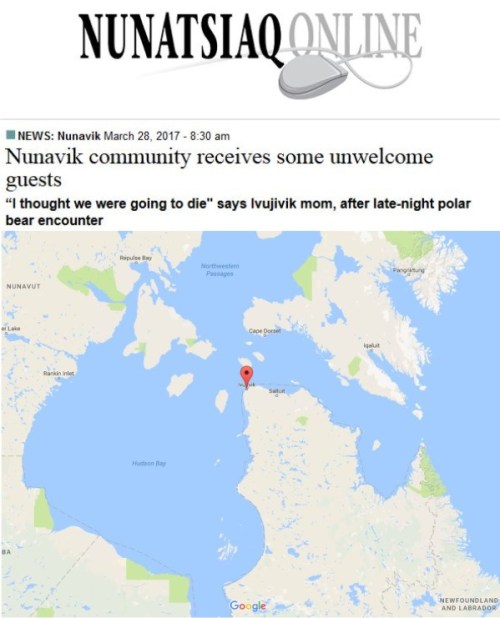
Ivujivik polar bear encounter plus headline_NunatsiaqOnline 28 March 2017

Reported this morning by NunatsiaqOnline (Nunavik community receives some unwelcome guests, 28 March 2017), the thwarted polar bear attack at the edge of Hudson Bay was the fourth defense kill this year (and the second this month) after a large number of bear sightings by residents this winter.

In contrast to reports of other encounters this winter that involved unusually fat bears for this time of year, this bear was thin and obviously dangerous.

Continue reading

Polar bears onshore in Svalbard update: bears again run out of Longyearbyen

Update to 18 Jan 2017 post: For at least 10 days, officials in Longyearbyen, Svalbard have been trying to keep a particularly persistent female polar bear and her two cubs away from the community. After being chased away last week, Sunday night (22 Jan) the trio appeared again at dog kennels at the edge of town but this time, but this time officials drove them even further south.

svalbard-female-2-cubs-23-jan-2017_icepeople-news

Continue reading

No correlation between freeze-up dates for Hudson Bay & total Arctic ice cover

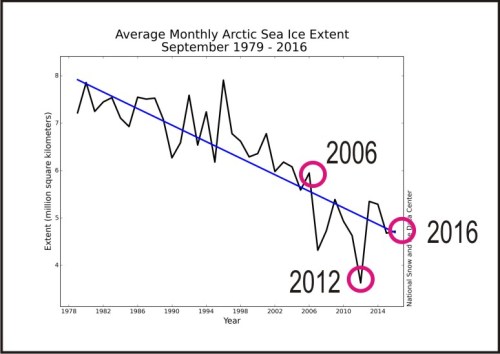
Guess which year between 2006 and 2016 had the latest start to freeze-up on Hudson Bay, given that 2012 had the lowest September average and 2007 and 2016 tied for second-lowest (see graph below, from NSIDC), and that sea ice in the Arctic right now is the lowest it’s been for this date since 1979?

sea-ice-sept-averages-graph-only-marked-for-2006-up

If you guessed anything other than 2010, you guessed wrong – in addition, 2006 (not 2016) was second latest.

There is no correlation between Arctic sea ice coverage and freeze-up dates for Western Hudson Bay.

Yet, Polar Bears International (“Save Our Sea Ice”) –  who were surely in and around Churchill in 2010 and 2006 watching polar bears – just posted an alarming statement about local conditions, implying that slow freeze-up of Hudson Bay this year is a reflection of the fact that “sea ice is at a record low across the Arctic.”

They also claim that “…the weather is the warmest we’ve ever seen at this time of year.” That may be true, but if so, it is also meaningless with respect to the progress of freeze-up.

Does no one at PBI remember the very late freeze-up of 2010 or 2006? Odd, that.

Continue reading