Tag Archives: Beaufort Sea

Longest-swimming polar bear lost less weight than if she had stayed onshore

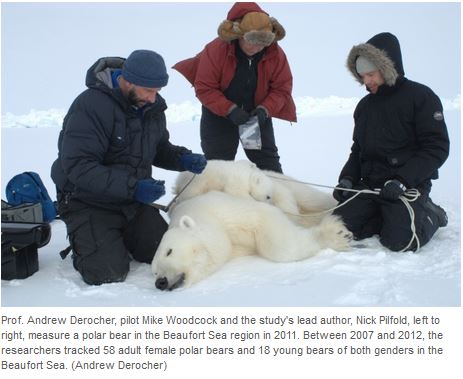
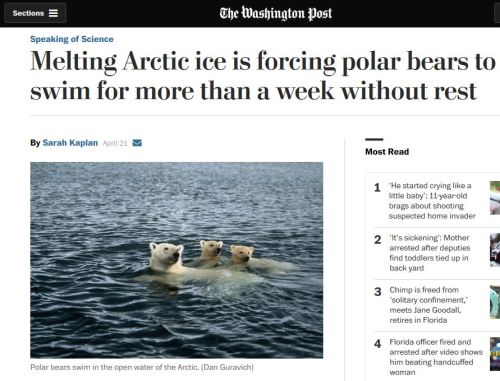
Recent media hype over swimming polar bears in the Southern Beaufort has been quite spectacular (still going strong today at the Washington Post here) but a close look at relevant data shows the message is bogus. Researchers admit (in their methods section) they couldn’t tell if bears said to have swum “non-stop” actually hauled out for half a day or more to rest on small ice flows invisible to satellites and astonishingly, the bear getting all the media attention – who swam the longest of any bear – lost less weight than a bear would have done simply sitting on shore for the same length of time.

Washington Post_swimming polar bears_snapshot 21 April 2016

Continue reading

No evidence that long-distance swimming contributed to Beaufort Sea polar bear population crash of 2004-2006

The air is thick with desperation on the polar bear front:

“[Andrew] Derocher said the polar bear population in the Beaufort Sea has fallen more than 50 per cent in the past 10 years.

“So it is a concern that this is probably one of the factors associated with the population decline,” he said.

Derocher_CBC news 19 April 2016

As the CBC report in which this quote appears states immediately afterwards, there is no evidence for such a thing in the paper under discussion:

“The study found no direct evidence of that – all polar bears appeared to survive the swims recorded in the study.”

There is no truth to Derocher’s first statement either. Desperation – you don’t have to be a scientist to sense it. And the media wonder why people don’t trust them…

Continue reading

Tracking polar bears in the Beaufort Sea – new crop of tagged bears for 2016

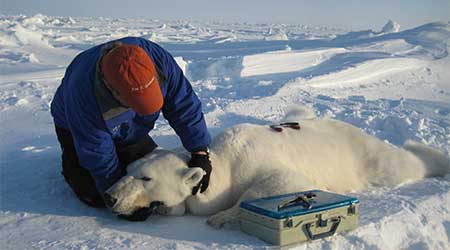
Five more bears were tagged near the Southern Beaufort Sea coast last month, all in the western portion of the coast where Chukchi Sea bears are often encountered. They join the one female who seems to have made a den way out over the continental shelf, where she’s been all winter.

putting_collar_on_polar_bear_slider_USGS

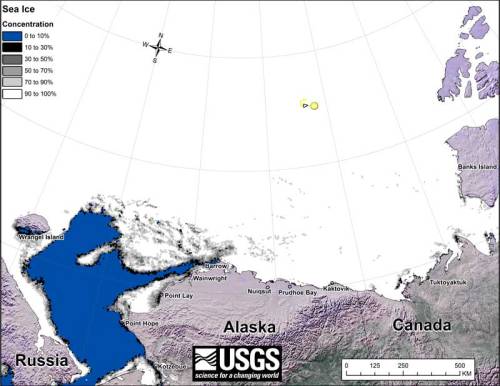
This is the March 2016 follow-up to my post on the July 2013 track map for female polar bears being followed by satellite in the Beaufort Sea by the US Geological Survey (USGS) – “Ten out of ten polar bears being tracked this summer in the Beaufort Sea are on the ice.”

Five tagged bears are relatively few compared to eight last spring, and thirteen in 2013 [added to 7 from the previous year for a total of twenty, which were down to 13 by June]  but the same as five tagged in 2014.  This spring, three of the USGS tagged bears have glue-on transmitters, which means they are either males or juvenile bears rather than females (which are fitted with collars):

“In collaboration with the U.S. Fish and Wildlife Service we are also experimenting with glue-on and ear tag satellite transmitters, which can be deployed on adult male bears and younger, still-growing bears.”

Continue reading

A new count planned for Southern Beaufort polar bears

I know I was not the only one that thought the last polar bear count conducted by the US Geological Survey (USGS) in the Southern Beaufort generated an untenable result but it appears that some of those challengers are in a position to demand a recount.

polar_bear_usfws_no date_sm

CBC News ran a story late last week announcing a plan is in the works to do an aerial survey of Southern Beaufort Sea polar bears across their entire range over two years starting in 2017 (11 March 2016, “Joint U.S.-Canada Beaufort Sea polar bear survey planned“).

With luck, this period will not include another bout of the same thick spring ice conditions that decimated the population in the mid-2000s (which many reporters concluded was due to reduced summer sea ice because that’s what leading biologists implied). Even if it does, lucky timing will not negate the fact that this population is routinely subjected to devastating population declines caused by natural changes to spring sea ice conditions from which they have recovered on numerous occasions. Continue reading

Polar bear myths perpetuate from the mouth of stuck-in-the-past Ian Stirling

In my last post, I complained about “vague and misleading statements” made by polar bear specialists and conservation advocates. Here’s a recent example of that phenomena, from veteran polar bear biologist Ian Stirling.
 

stirling_UA faculty page photo accessed July 22 2012

The magazine of Canada’s North, UpHere, published an interview with Ian Stirling this month. The piece begins:

“No fear-mongering. No exaggeration. For Ian Stirling, it’s purely about the science.”

Yeah, well – judge for yourself. Here’s a sample:

“We have lost on average about half the sea ice that we had in 1979, which is the first year that satellite coverage of the Arctic was taken [he’s talking about September ice here]. Places like Hudson Bay are breaking up three weeks earlier than they used to and freezing up a couple weeks later. We’re going to have even more significant effects over a much wider area in the Arctic. We’re likely to lose another 30 or 40 percent, or even half of the bears that we have today in the middle of the century, and unchecked, we will likely have very few bears left at the turn of the next century. In 2100, we’ll probably just have a few small remaining pockets in the northern Canadian Arctic islands and northern Greenland.”

Read the rest here.

Stirling’s opinion about polar bears and climate change hasn’t changed since at least 2004 despite the following scientific developments: Continue reading

Tracking polar bears in the Beaufort Sea – one tagged bear left at year end 2015

I’ve combined the months of November and December for this post on USGS polar bear tracking in the Beaufort Sea because there’s not much to tell: there’s one tagged bear left and she’s going almost nowhere. Where’s the news in that?

Beaufort tracking USGS bear-movements-November 2015 sm

Movements of 1 satellite-tagged polar bear female for the month of November, 2015; shown with sea ice coverage at 30 November 2015. This bear was tagged in the spring of 2015 in the Southern Beaufort Sea. See original image here and December movements below.

Actually, it does tell us something: this female is probably in a sea ice den, a relative common phenomenon in the Beaufort Sea. And she’s on ice that’s out over very deep water. Continue reading

Polar bear habitat update – Arctic sea ice today covers same area as it did on June 30

Arctic refreeze is well underway. Less than half way through the Arctic autumn (Oct-Dec), polar bear habitat on 11 November 2015 covered the same total area as it did on the last day of Arctic spring (April-June); it’s just distributed differently.

polar_bear_usfws_no date_sm

Yesterday, courtesy NSIDC Masie

masie_all_zoom_4km_2015 Nov 11

Here is what 30 June 2015 ice extent looked like, with the same amount of ice coverage:

masie_all_zoom_v01_2015181_4km

For the week of 12 November, Hudson Bay sea ice development is well underway, with more ice in the north than there has been in many years; Davis Strait ice is the highest this week since 1999 and Baffin Bay ice coverage is above average. Foxe Basin and the Beaufort Sea are both approaching maximum coverage, which means bears there will be back out on the ice hunting. Chukchi Sea ice has finally surrounded Wrangel Island but the Svalbard Archipelago in the Barents Sea is still ice-free. More ice maps and charts below.
Continue reading

Specialists mum on low Chukchi Sea polar bear habitat this summer and fall

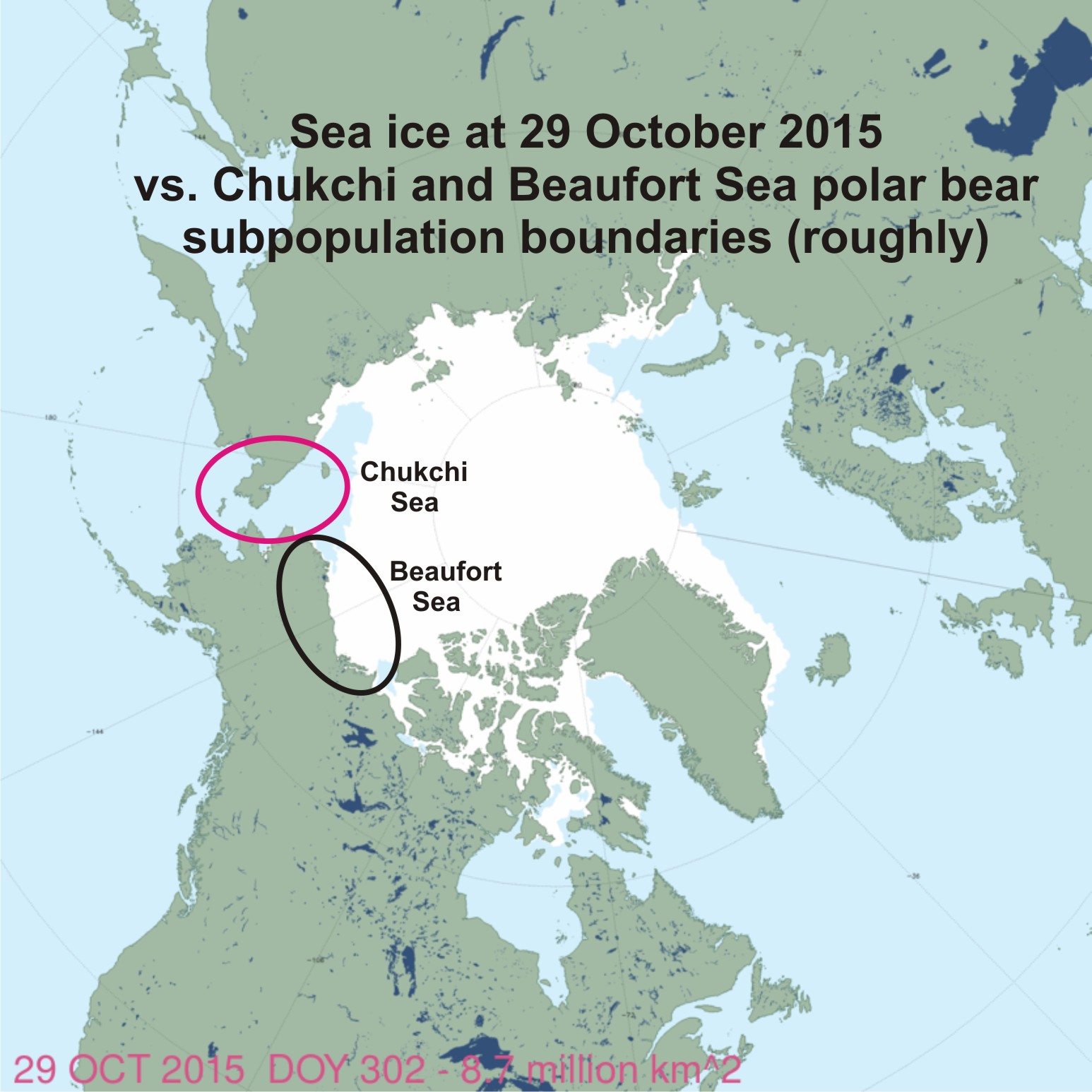
You may or may not have noticed that even though Chukchi Sea ice coverage has been way below average this melt season, there has been no hue-and-cry about poor suffering Chukchi polar bears. That’s because polar bear biologist’s own research has shown that the health and survival of these bears has not been negatively impacted by low summer sea ice. There may be threats from poaching in Russia, but not lack of summer sea ice.

Chukchi vs Beaufort ice at 29 Oct 2015_polarbearscience

As of this date, developing sea ice is only just approaching Wrangel Island, a major polar bear denning region in the Chukchi Sea, see maps below (Ovsyanikov 2006).

Yet, polar bear specialists insist that neighbouring Beaufort Sea bears – who endure a much shorter open-water season – are in peril of extinction because of scarce summer sea ice.
Continue reading

Who tagged the Beaufort Sea polar bear with the tight collar?

I’ve updated my post from last week to reflect that an inquiry to USGS has generated a statement that the Beaufort Sea polar bear reported by CBC last week is NOT one of their bears. Apparently University of Alberta researchers were also tagging polar bears in the region.

polar-bear-radio-collar_CBC Oct 28 2015

See details in the updated post here.

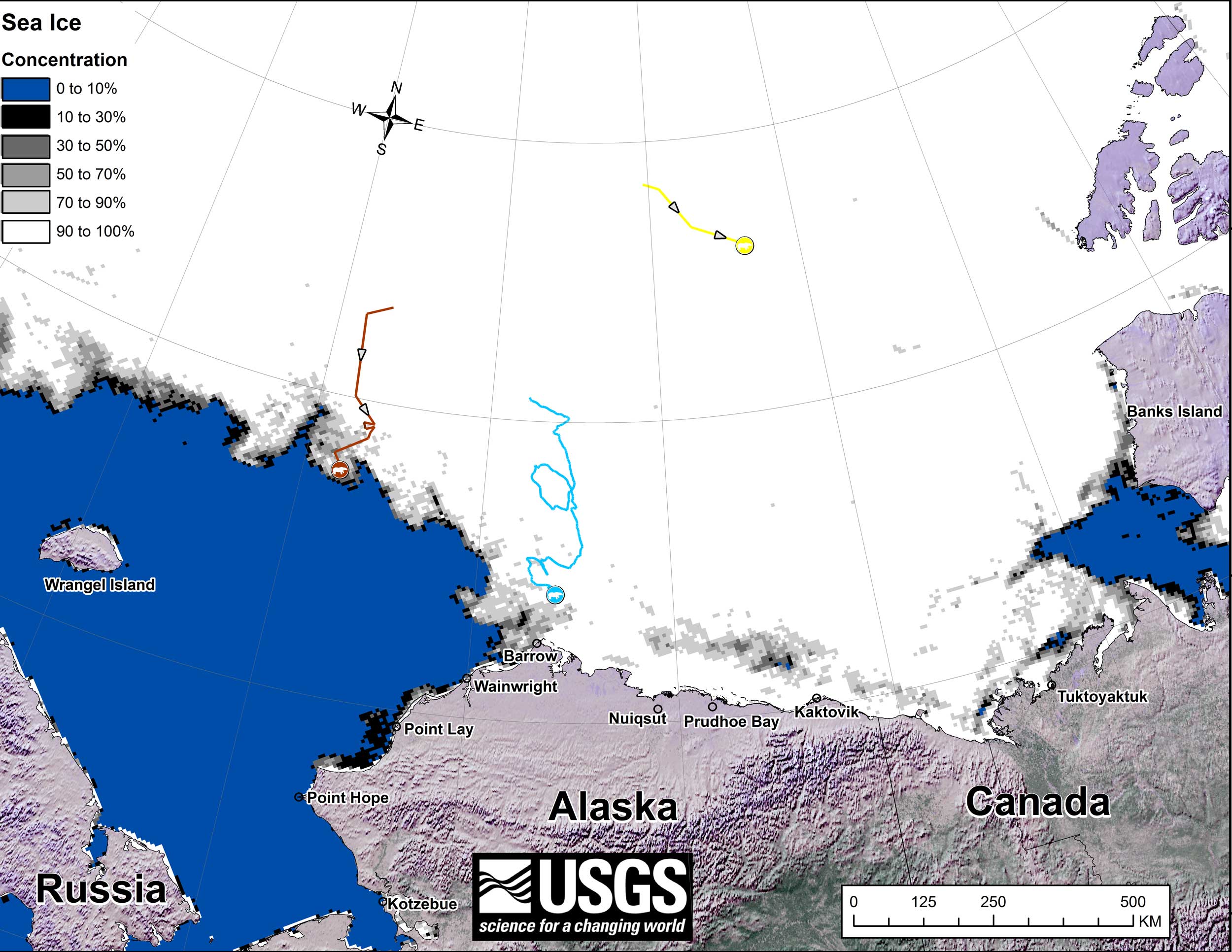
Kaktovik, where the bear was photographed, is not too far from the Canadian border of the Southern Beaufort Sea subpopulation, see USGS tracking map below.

Original caption: "Movements of 3 satellite-tagged polar bears for the month of October, 2015. Polar bears were tagged in 2014 and 2015 on the spring-time sea ice of the southern Beaufort Sea. All 3 of these bears have satellite collar transmitters. Polar bear satellite telemetry data are shown with AMSR2 remotely-sensed ice coverage for 31 October, 2015." Click to enlarge.

Original caption: “Movements of 3 satellite-tagged polar bears for the month of October, 2015. Polar bears were tagged in 2014 and 2015 on the spring-time sea ice of the southern Beaufort Sea. All 3 of these bears have satellite collar transmitters. Polar bear satellite telemetry data are shown with AMSR2 remotely-sensed ice coverage for 31 October, 2015.” Click to enlarge.

How long is it going to take for the people responsible to own up to this situation – and more importantly, remove the tight collar from the bear?

Tracking polar bears in the Beaufort Sea – all three bears on the ice during October 2015

All three of the females with radio collars installed by USGS last spring (see footnote below) spent October out on the sea ice – which suggests the Kaktovik female with the tight collar that made the news last week was either wearing a failed collar, USGS removed her icon from the map, or she was not wearing a USGS collar.

polar-bear-radio-collar_CBC Oct 28 2015

It is possible that the poor bear was the one represented by the purple icon from last month (see map below), the only USGS collared bear that was on shore during September and still sending signals. The bear in the above photo was photographed in Kaktovik, easy walking distance for a bear, near the end of October.  The purple icon on shore in the September USGS map is no longer present this month.

As far as I know, there has been no follow-up information on the fate of this bear: we still don’t know whether the collar has yet been successfully removed.
Continue reading