Tag Archives: Churchill

Churchill problem polar bear report for 7-13 September 2015

Latest report on problem bears in Churchill, Manitoba, from the town’s Facebook page. See previous post here for map and background.

19 polar bears handled to date this year; 12 bears in the holding facility.

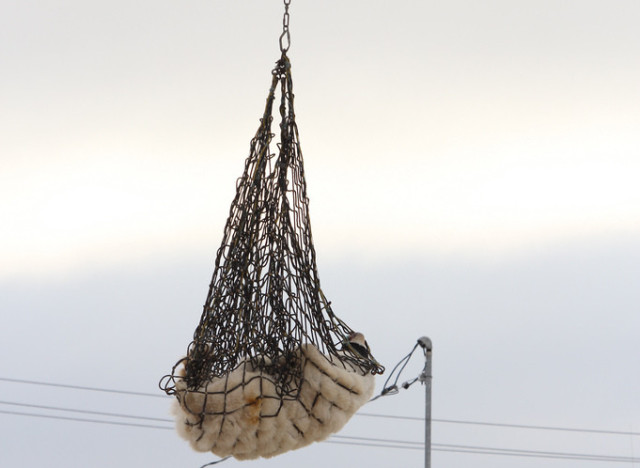
Polar bear-TRANSPORTED-TO-POLAR-PRISON_w Huff Post 2011

Photo above: A bear is transported to Churchill’s polar bear holding facility (from a 2011 Huffington Post article, “Polar Bear Prison”).

Activity report for 7-14 September 2015 copied below (click to enlarge):

2015 Sept 7-13_at Sept 14

In 1999, climate change apparently threatened Western Hudson Bay polar bears

Now, not so much. Here is a 16- year old CBC TV special on Churchill polar bears – listen to Ian Stirling and reporter Eve Savory use the early breakup of sea ice on Hudson Bay in 1999 to hype the alarm about Western Hudson Bay polar bears. Watch Stirling in action darting and measuring bears and bemoaning the good old days of the 1980s, claiming the “bears are sending a signal from the ecosystem.

Watch this archived copy of “The Shrinking Bears of Hudson Bay and compare his claims to what has actually happened in the 16 years since then. It runs just over 15 minutes.

Climate change threatens polar bears 2_CBC 1999

“Just as the ice is shrinking in Hudson Bay, so are its polar bears. Climate change has shortened the season for winter ice, a crucial period for the bears to feast on seals and build up their fat reserves. And so, over the 18 years that wildlife biologist Ian Stirling has been studying them, the polar bears have become skinnier and their offspring fewer. In this 1999 report for CBC-TV’s The National, Stirling says once their habitat is gone, there’s nowhere else the Hudson Bay polar bears can go.” [my bold – see notes below]

Program: The National [Canadian Broadcasting Company, CBC]
Broadcast Date: Sept. 23, 1999
Duration: 16:39

Stirling has continue to make these claims since 1999, yet no updated evidence has been provided. There is no plausible evidence that the decline of polar bear numbers in Western Hudson Bay was due to sea ice changes caused by human-caused global warming (Crockford 2015) or that continued declines in condition of bears or litter size have  occurred. Note that the latest survey of Western Hudson Bay polar bears found no trend in either breakup or freeze-up dates since 2001 (Lunn et al. 2013) and that the population is now stable.

Ice coverage charts and breakup dates graph below, for context.
UPDATE ADDED – see below
Continue reading

Hudson Bay ice update – researchers awfully quiet about what polar bears are doing

This year 225 thousand km2 of sea ice remained on Hudson Bay at 10 August compared to 96 thousand km2 in 2009, the last late breakup year for which there are detailed ice maps and polar bear data.

Hudson Bay breakup Aug 10 2015_CIS

In 2009, most Western Hudson Bay polar bears were onshore by 22 August, just after the very last remnants of ice disappeared (see map below). This year? The remaining ice is further east, in Southern Hudson Bay territory.  Last report from a few weeks ago showed some Southern Hudson Bay bears came ashore early but past behavior suggests some bears will wait until the bitter end before they come ashore – until the very last remnants of ice disappear (Cherry et al. 2013).
Continue reading

Keeping track of problem bears in Churchill

The City of Churchill has recently taken to posting its problem bear reports on its Facebook page. This is something to keep an eye on, so let’s catch up so that future reports can be put into context.

Figure 1. A bear is transported to Churchill’s polar bear holding facility, from a 2011 Huffington Post article “Polar Bear Prison.”

Photo above:  A bear is transported to Churchill’s polar bear holding facility (from a 2011 Huffington Post article, “Polar Bear Prison”).

Continue reading

Polar bear news: 1st fat bear ashore in WHB, trouble in S. Greenland, and more hybrid hype

Last week, among other events, the first fat polar bear of the season was photographed on shore in Western Hudson Bay, a fat bear was run out of town in South Greenland, and media outlets spread misinformation – apparently preferring global warming hype to rational facts.

1) First polar bears have been seen onshore in Western Hudson Bay in Wapusk National Park near Cape Churchill (map below) on 18 June this year, apparently fat and well prepared for the summer fast. My informants tell me a few bears usually come ashore in June near Churchill before ice conditions make this necessary; the bulk of the population will probably continue seal hunting for a few more weeks. Those bears will come ashore along the southwest coast (near Polar Bear Provincial Park, in Ontario, see Fig. 2 below). They’ll make their way north to the Churchill area in time for freeze-up in the fall. Watch one fat bear caught on camera on 18 June, below :

2) Fat polar bear spotted in Nanortalik, Southern Greenland 18 June 2015, a bit further south than usual. People from the community drove it away, but not before taking lots of pictures.

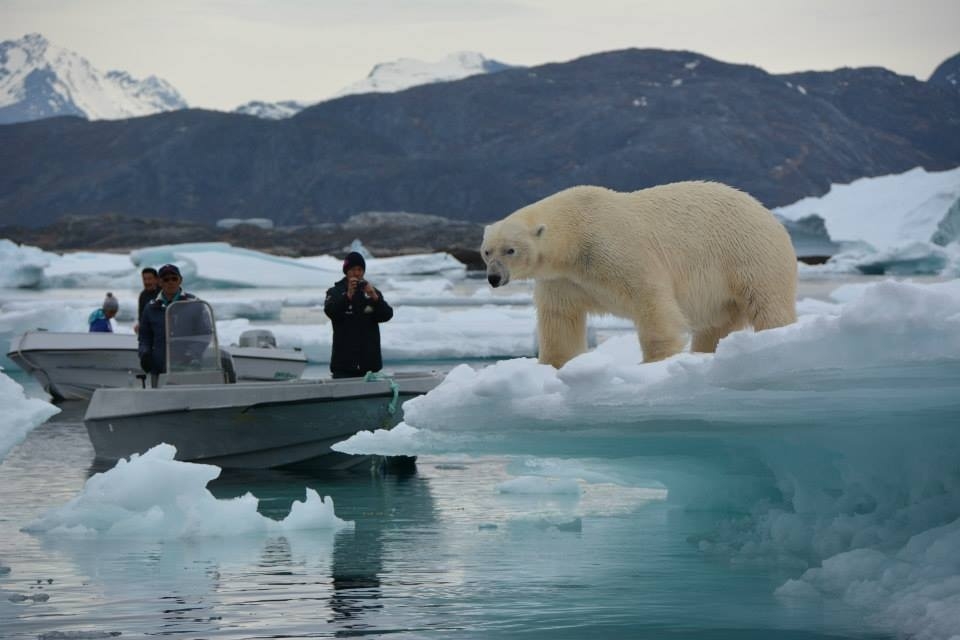
Greenland South_polar-bear-nanortalik-08_henrik-hansen_June_18_2015

Some very cool photos, including the one above (taken by Henrik Hansen), worth a look. This bear was in excellent condition, well prepared for the summer fast ahead, whether he ends up spending it on shore somewhere (but not near this community!) or on the sea ice further north in SE Greenland (Fig. 1 below). The ice in that areas is probably broken up (~15-30% concentration) but this is enough for the bear to swim from flow to flow to make it’s way up the northeast coast where most East Greenland bears spend the summer.
Continue reading

Hudson Bay breakup date for 2015 will really depend on which definition you use

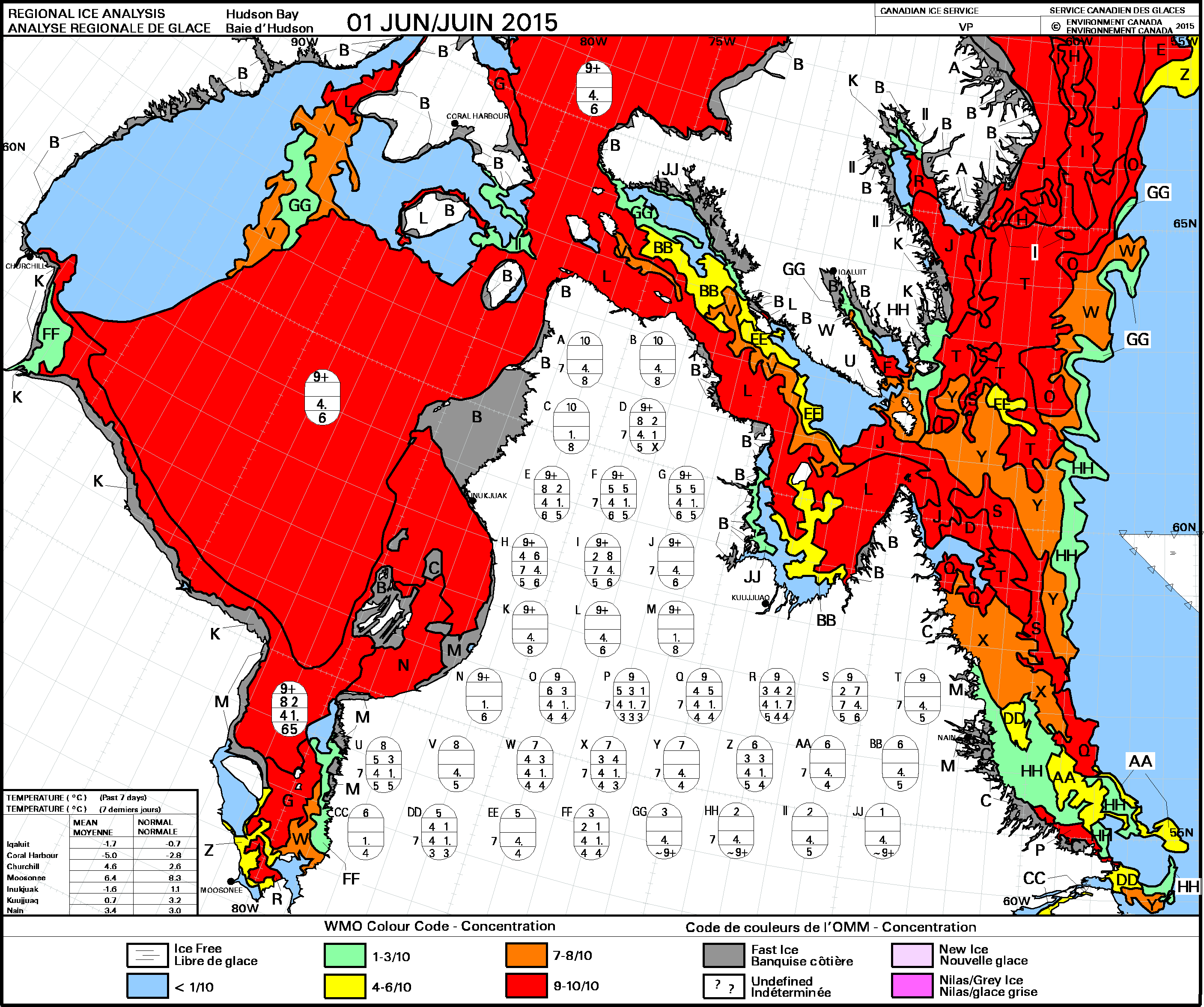
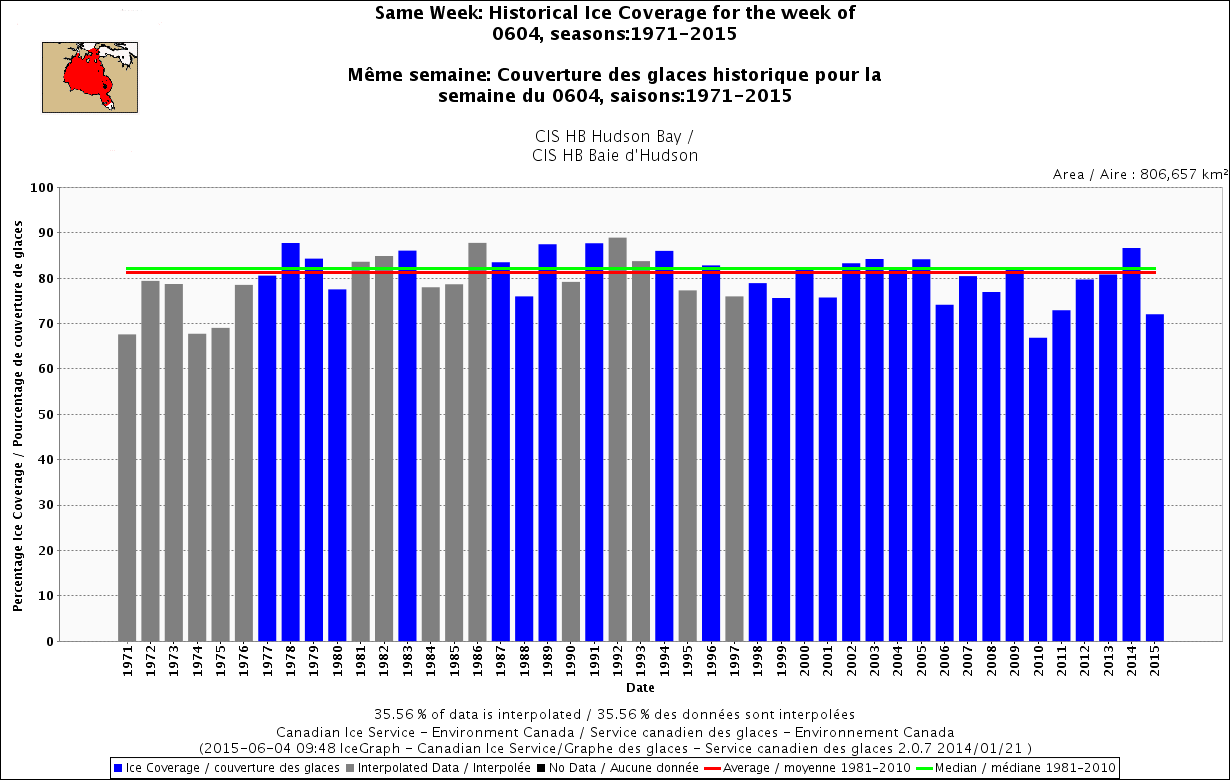
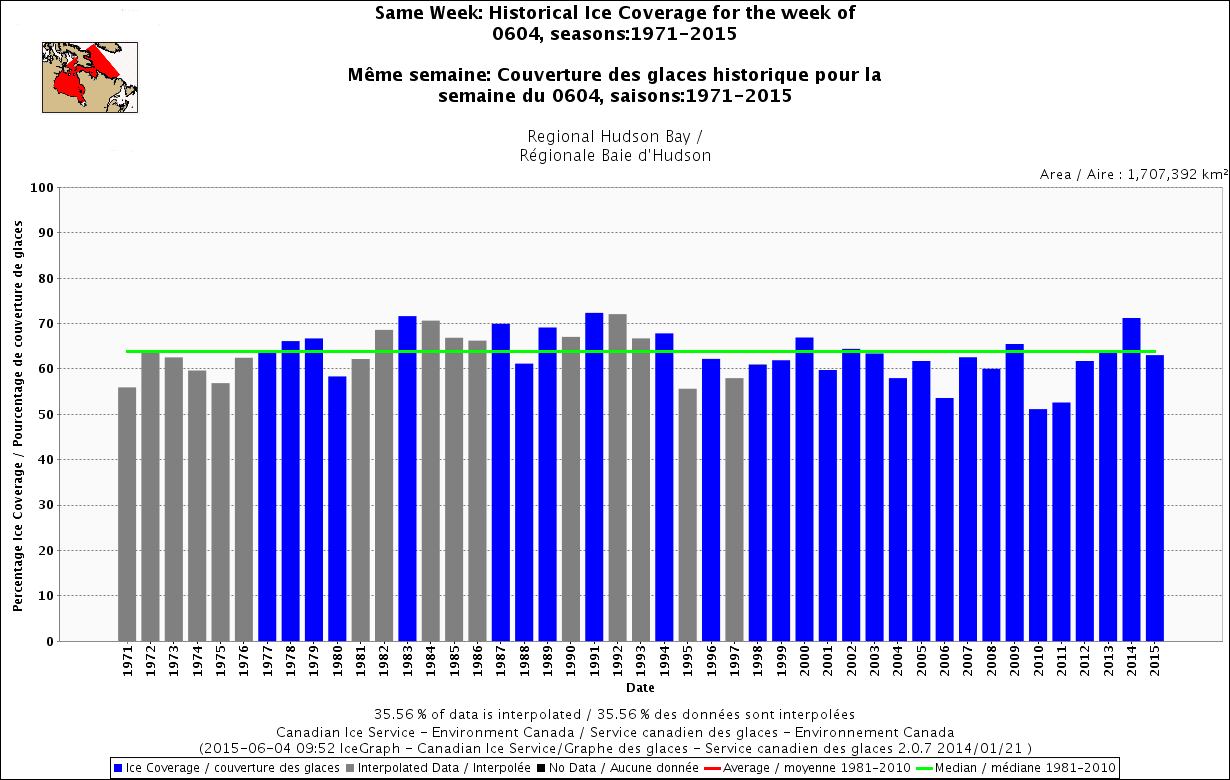
Is breakup imminent for Hudson Bay sea ice? Probably not, but this year more than ever, it will depend on how you define it. Hudson Bay concentratation_2015 June 1_CIS Despite a large patch of open water in western Hudson Bay (CIS chart above, for 1 June), there is still more than 70% sea ice coverage over the entire bay as of this week, when you use the standard breakup definition of 50% ice coverage (Fig. 1).  Ice remaining over the bay is mostly 90% or greater, as the chart above shows – which means there is still a lot of polar bear hunting habitat remaining.
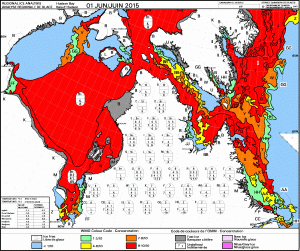
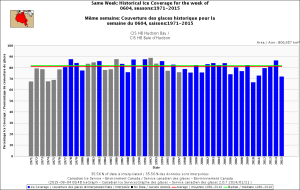
Figure 1.

Figure 1. Sea ice coverage over Hudson Bay, as a percentage, for the week of 4 June, 1971-2015. Click to enlarge.

The interconnected region of Hudson Bay, Hudson Strait, and southern Davis Strait (Fig. 2), what the Canadian Ice Service calls “Regional Hudson Bay,” is only slightly below average for the week of 4 June.
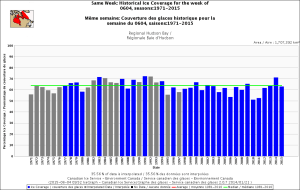
Regional Hudson Bay, week of 4 June.

Figure 2. Regional Hudson Bay, week of 4 June. Click to enlarge.

Since ice concentration is factored into breakup date calculation, a record-early breakup is simply not possible, since the previous record date (2 June, for 1990) has already passed. It might be an earlier than average breakup year but not very early, based on the 50% coverage definition (Fig. 3, below). This year, because of the unusual pattern of breakup of Hudson Bay ice, it will be critical for polar bears which definition of breakup is used – the old, 50% method (adopted because it’s what sea ice professionals used) or the newest one, which was determined to be most relevant to WHB polar bears (Cherry et al. 2013).

UPDATE 6 June 2015: I’ve added the forecast for ice conditions over the summer for North America (which for these folks includes June because it’s aimed at temperate NA, polar bear folks call June the end of spring), provided by the Canadian Ice Service: “Seasonal outlook for North American Arctic Waters issued by the North American Ice Service on 2 June 2015” [points of potential interest marked] The sea ice forecast (Table 1) for southwestern Hudson Bay (where most western and southern Hudson Bay polar bears come ashore) is for complete ice melt by 1 Aug, eight days later than the earliest date over the period 1968-2013. Time will tell if that’s what happens.
Continue reading

Polar bear habitat update – more spring sea ice around Svalbard than 2014 & 2012

Polar bear habitat for the last week of March is well above average in eastern Canada for the second year in a row. The very low extent of ice in the Sea of Okhotsk – which has contributed strongly to the low maximum extent this year – is irrelevant to our discussion, since no polar bears live there.

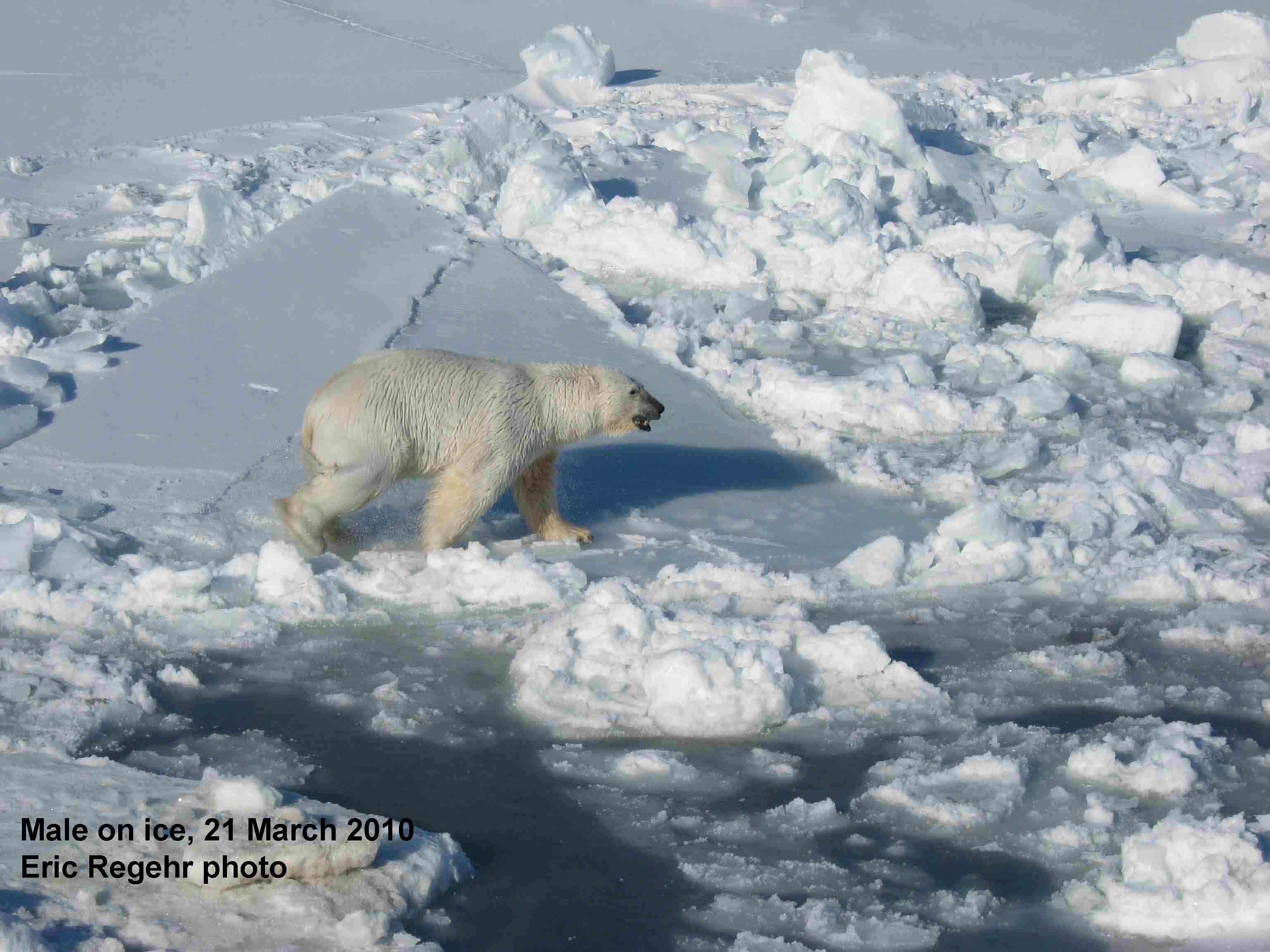
Polar_Bear_male_Regehr photo_March 21 2010_labeled

There is a bit more concentrated ice around Svalbard than last year (or in 2012), although ice in the Barents Sea in general is still below average due to the state of the Atlantic Multidecadal Oscillation (AMO). The state of the AMO and its effects on Barents Sea polar bear sea ice habitat has nothing to do with global warming: it’s a cycle that has been documented for centuries (Miles et al. 2014).

Still, there is plenty enough sea ice for polar bear hunting: this is the beginning of the critical feeding time for all polar bears (see here and here), but especially for the survival of new cubs-of-the-year, so I have a few words about Western Hudson Bay cubs below.

Have a look for yourself.
Update: Added 20 March 2015, comparison maps from Cryosphere Today for 2006 vs. 2015.
Continue reading

Western Hudson Bay polar bears will still be around in 20 years

This is not a bet or prophesy based on models, it’s my conviction as an experienced zoologist, based on history demonstrating the resilience of the species.

Send_Nico_to_Churchill_PolarBearScience

I’m so sure about Western Hudson Bay polar bears that I’ve started a spare-change jar marked “Send Nico to Churchill.” Nico is my new grandson, just two months old now. This will be our first Christmas with a baby in a long time.

Nico_sm

Nico’s special savings account will assure that in 20 years (given wise investments), he’ll be able to see Churchill polar bears in their own element.

Warmest wishes to all my readers and thanks for your support, it is much appreciated.

Susan

Hudson Bay sea ice well above average – excellent early December polar bear habitat

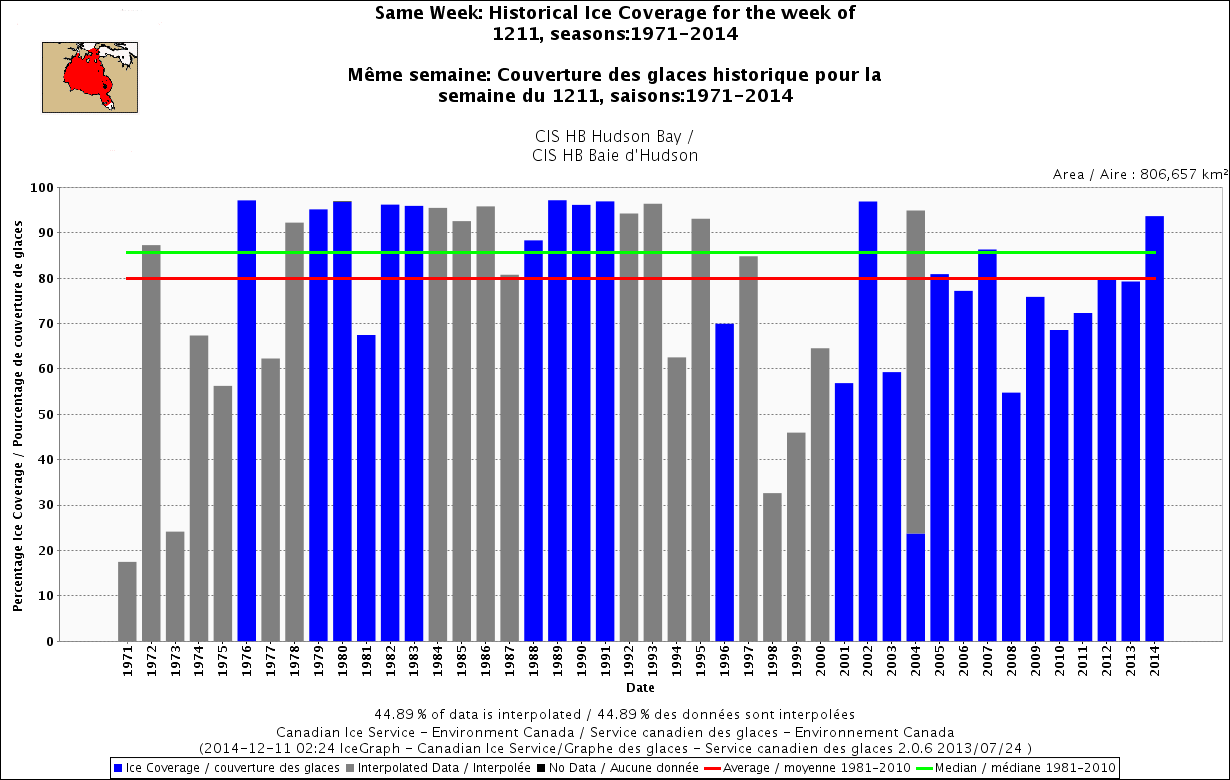
Sea ice development for this date is well above average on Hudson Bay – even more so than last week – making three years in a row of average-to-above average ice habitat available to polar bears in early December (see last week’s ice summary here). Coverage for the week of 11 December from 1971 to 2104 below (from Canadian Ice Service):

Hudson Bay freeze-up same week_Dec 11 1971_2014 w average

More maps below (from CIS and NSIDC), see others here.

Continue reading

Hudson Bay freeze-up: way more ice for this day than in 2013

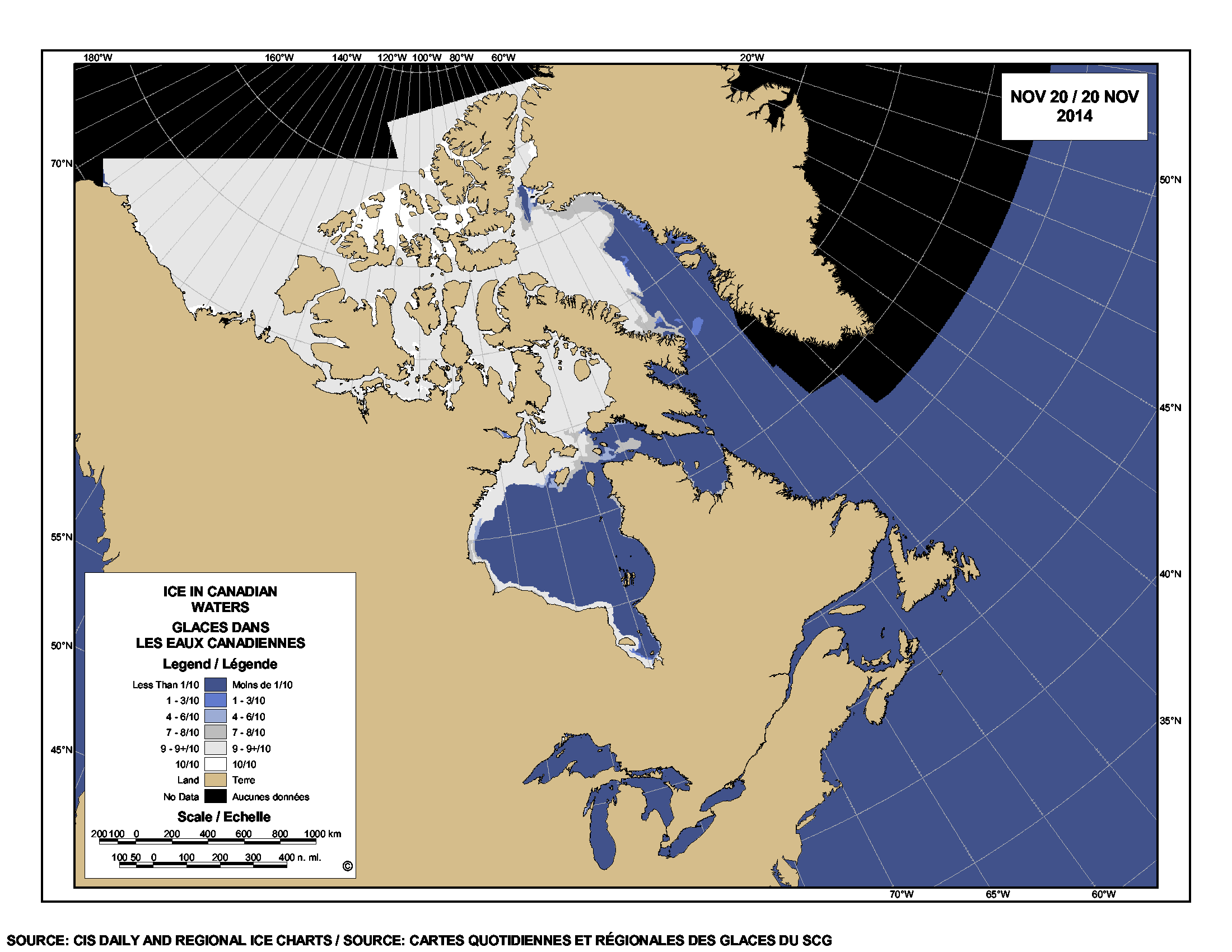
On this day (20 November 2014), there is way more sea ice over Hudson Bay and Foxe Basin than 2013, with ice starting to form in Hudson Strait.

The polar bears of Hudson Bay are on the ice (except pregnant females, who will be in their dens); Churchill polar bear season is over (see previous discussions here and here).

Ice maps and graph courtesy Canadian Ice Service.

Sea ice extent Canada 2014 Nov 20 CIS
Continue reading