Tag Archives: Churchill

As polar bear populations fail to decline with sea ice, message of doom intensifies

If 10 years of summer sea ice levels expected to kill 2/3 of the world’s polar bears by 2050 hasn’t had an impact, why would anyone expect a bit less summer ice will do the job?
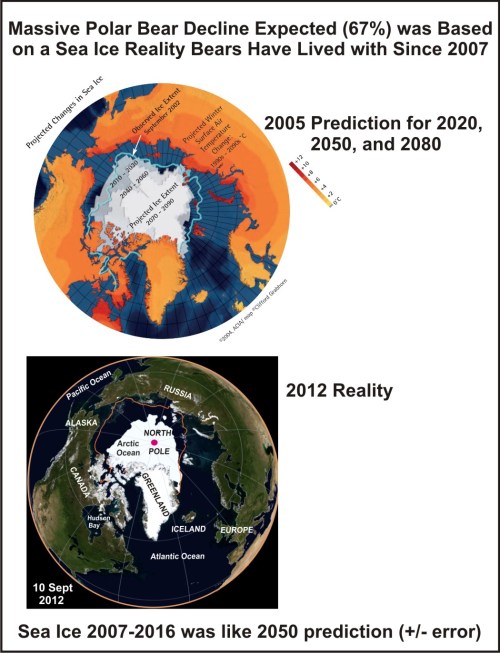
sea-ice-prediction-vs-reality-2012_polarbearscience

The more the polar bears fail to die in droves, the shriller the message from activist polar bear researchers – via willing media megaphones – that the great death of the bears will soon be upon us, just you wait and see!

Some big media guns were out this past week spreading the prophesy of doom fed to them by the polar bear researchers most committed to the “threatened with extinction” narrative: The New York Times, The Atlantic, The Guardian. The desperation is becoming palpable as the public catches on to their epic failure.

In 2007, the sea ice dropped to a level the experts said wouldn’t be reached until mid-century, and since then, it has remained at that low level (about 3-5mkm2, give or take some measuring error). And in 2007, US Geological Survey (USGS) biologists said with absolute confidence that when sea ice levels reached that point, 2/3 of the world’s polar bears would be gone.

No bears at all would remain, they said, in Western Hudson Bay (the Churchill bears), Southern Hudson Bay, Foxe Basin, Davis Strait, Baffin Bay, Southern Beaufort, Chukchi Sea, Barents Sea, Kara Sea, and the Laptev Sea:  ten out of 19 subpopulations would be extirpated if sea ice levels in most years dropped to the summer lows in the 3-5 mkm2 range.

On the basis of that prediction, polar bears were declared ‘threatened’ with extinction by the US Fish & Wildlife Service (USFWS) under the Endangered Species Act (ESA).

But nothing of the kind happened. There are still lots of polar bears – and not even struggling-to-survive bears but lots of fat healthy bears everywhere across the Arctic, in what were considered by USGS biologists to be the most vulnerable regions of all: Western Hudson Bay (i.e., Churchill), Chukchi Sea and Southern Beaufort (Alaska) and the Barents Sea (Norway).

This is the truth the world needs to hear: the experts were wrong. Polar bears have not been driven to the brink of extinction by climate change, they are thriving. This is the message of each of my two new books (one of which is appropriate for kids of all ages, see the sidebar).

In turns out that polar bears are much more resilient to changing levels of sea ice than data collectors assume and the proof is in the current healthy populations everywhere. Continue reading
An El Niño year late start to freeze-up on Hudson Bay: bears gearing up to hunt

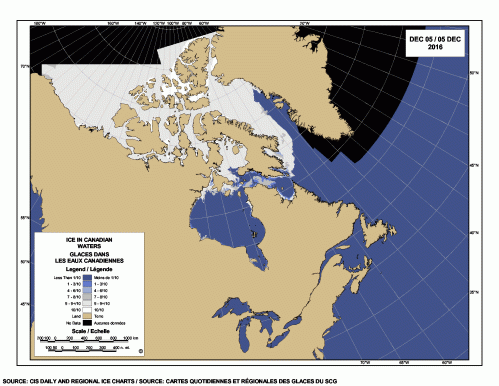
There is no serious ice on the west shore of Hudson Bay yet (as the map below shows) but the winds have just shifted – instead of coming from the south, they are now blowing in from the north.

Freeze-up and a resumption of seal hunting for Western and Southern Hudson Bay polar bears looks imminent. The bears get out on the ice as soon as they are physically able, when the ice is about 3-4 inches thick (about 10 cm).

sea-ice-extent-canada-2016-dec-5_cis

I’m going to let Kelsey Eliasson from PolarBearAlley, on shore at Churchill, convey the gist of the freeze-up situation on the Bay.

Recall that freeze-up was late in both 1998 and 1999 – during the height of that strong El Niño warmth as well as the year following. Continue reading

No correlation between freeze-up dates for WHB sea ice & Churchill temperatures

This is a follow-up to my last post and this time, I’ll address the implied correlation between freeze-up dates for Hudson Bay and Churchill temperatures in November that is being made by folks who should know better .

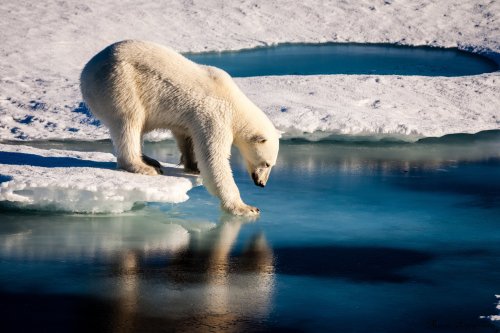
polar-bear-tests-thin-ice_mario-hoppmann_noaa-funded-imaggeo-egu-eu

Monday, 14 November 2016 a.m, over at Polar Bears International [my bold]:

“As a new week starts in Churchill, the weather is the warmest we’ve ever seen at this time of year. The tundra is muddy, with remnant patches of snow, and the bay is ice-free.” PBI Blog (no author designated)

Well, that may be true for the last few years – the high on 14 November 2016 (-1.20C) was the highest since 2012.

Andrew Derocher made a similar statement on the 4th (my bold):

There’s no sea ice anywhere in Hudson Bay yet—not even in the northern part of the Bay where ice should be forming. It’s above freezing today and if the forecast holds, it will be a record high for this date. It was 10 degrees colder last year at this time.”

Derocher is being unscientifically vague here and also misleadingly cites highs and lows as if they were the same. In fact, according to weather records kept by Environment Canada, for 4 November 2016 at Churchill, the daily high was +1.50C (compared to –1.50C in 2015). The daily low in 2015 was -15.30C, a 10 degree difference. The next-highest temp. for that date since 2012 was +0.70C in 2014 – hardly an earth-shattering difference.

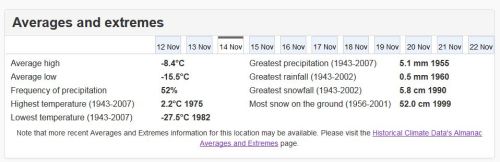
However, if you are trying to draw conclusions about climate, you should go back at least 60 years (two climate periods of 30 years each). Temperature records for Churchill go back to 1943, which can be used to assess the claim for the 14th of November made by PBI.

According to weather records kept by Environment Canada, for 14 November at Churchill, the year with the highest temperature was 1975 (+2.20C):

churchill-weather-averages-and-extremes-2016-ec-14-nov

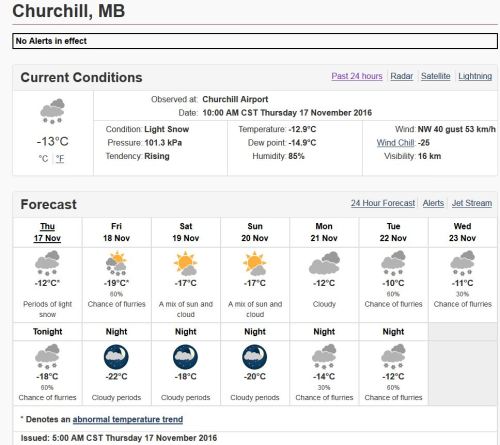
That was Monday. But as of yesterday, the weather recorded – and the forecast for the following week (17-23 November) was quite different, as the screencap below shows:

churchill-weather-2016-abnormal-cold-17-23-nov

The final recorded max. for yesterday (Thurs. 17 Nov) was -9.70C vs. a min. of -17.70C. So, a bit warmer during the day than predicted but as cold as expected overnight.

And for today, the current temperature in Churchill, as I write this is, is -190C (-310C with the wind chill) and the year with the highest temperature recorded for 18 November was 1944 (0.00C) – which was also the highest temperature for the 19th, recorded in 1943.

Ice maps and historical background below. See last post for recent multi-year comparison.
Continue reading

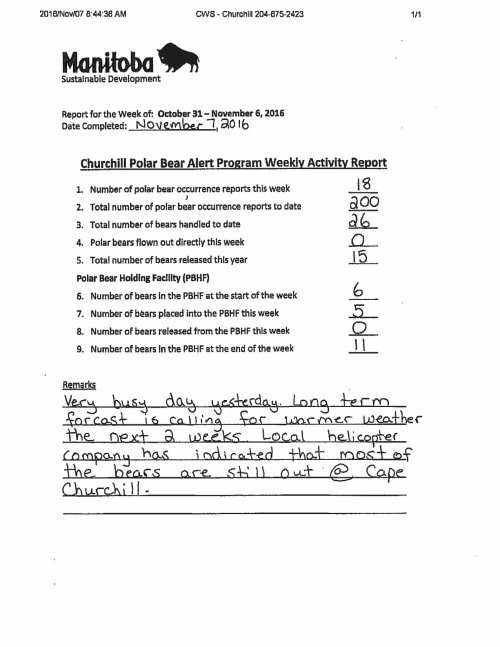
Polar Bear Alert report for 1st week of November 2016, Churchill Manitoba

Week 17 (I’ve been counting) for 31 October – 6 November (Week 1 was 11-17 July):

“Most bears are still out at Cape Churchill.” [see map below]

2016-oct-31-nov-6_week-17_week-11-missing

See previous reports here, and here. Ten-day sea ice animation, CIS.
Continue reading

Ice formation in W Hudson Bay slower than 2015 but not likely as slow as 1983

After a great start this year for Churchill-area polar bears of Western Hudson Bay – who came off the ice in better than usual condition after what must have been a good spring hunting season – ice maps suggest that freeze-up will be later than last year, an impression confirmed by on-the-ground observers.

Ice coverage this year at 7 November (2016):

sea-ice-extent-canada-2016-nov-7_cis

Ice coverage last year at this date (7 November 2015), see this post for details:

UPDATED 23 November 2021: see below.
Continue reading

If experts had been right about sea ice, there would be no polar bears in Churchill

The simple fact is that if polar bear experts had been right about the threat to polar bears from the loss of summer sea ice in the Arctic, there would be no polar bears in Churchill this fall. No bears for tourists to photograph, none for biologists to study, and certainly none for the BBC to film for an upcoming three-part TV special called “Arctic Live.

polar-bear-stock-image-gg66298544_sm

The low-ice future that biologists said would doom polar bears to extinction by 2050 has already happened in 8 out of the last 10 years. The sea ice future has been realized.

Polar bears have experienced those supposedly deadly low-ice summers for almost a decade but the global population did not drop by 2/3 as predicted and not a single one of the ten subpopulations predicted to be extirpated under those conditions has been wiped out.

How much more wrong can you be than that? Will the BBC mention this conundrum in their show? Will the polar bear experts they consult share this fact with viewers? We’ll all have to watch and see [show times and summaries of each program here, 1-3 November] but here are some background facts that might enhance your viewing experience.

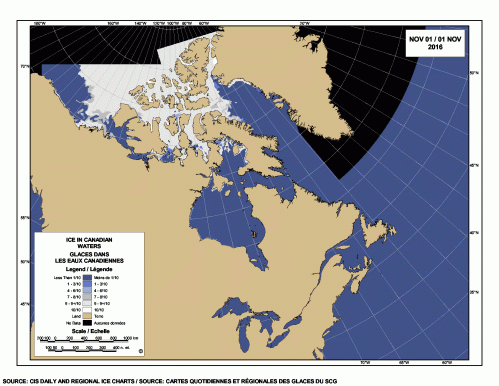
UPDATE: Sea ice condition of Hudson Bay at 1 November 2016 below from the Canadian Ice Service (some slushy ice looks to be forming along the coast north of Churchill – this is how freeze-up starts). See the animation for the last 10 days here:

sea-ice-extent-canada-2016-nov-1_cis

Continue reading

Arctic sea ice grows & Churchill polar bears into their 4th month of fasting

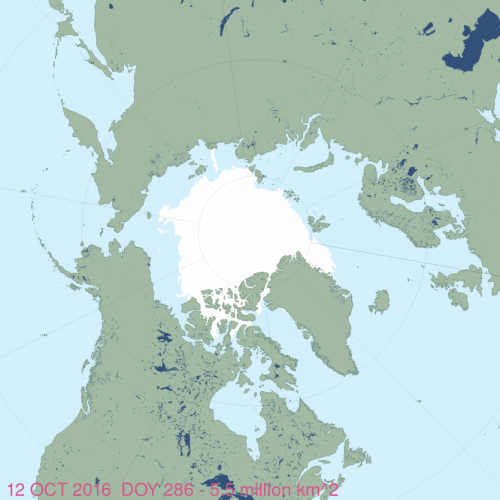
A quiet year for problems in the polar bear capital of the world (Churchill, Manitoba) so far – despite this year tying for the second-lowest minimum since 1979 – and the ice is growing fast. In fact, Arctic ice growth in the second half of September was rapid and there is now more ice than there was at this date in 2007 and 2012 (when polar bears in those regions considered most at risk did not die off in droves).

masie_all_zoom_4km-2016-oct-12

Pessimistic polar bear specialists are wrong  – polar bears are much more resilient to low sea ice levels in summer than they assume: their own data from low summer ice years proves it.  If you’ll recall from my previous post, polar bears seem to have barely survived the extensive sea ice coverage during the Last Glacial Maximum – in other words, too much ice (even over the short term) is their biggest threat. Polar bear numbers, as confirmed by the latest estimates in the 2015 IUCN Red List assessment, are higher now than they have been since the 1960s, despite almost 10 years of summer sea ice minimums below 5.0 mk2.

Churchill Polar Bear Alert reports and Arctic sea ice comparisons at this date, in detail below.

Continue reading

Add human graves to the list of things that attract polar bears to communities

A report last week that a polar bear dug a human cadaver out of a coffin buried in the cemetery on the west coast of Hudson Bay did not get the media attention it perhaps deserved: it takes the term ‘grisly’ to a new level.

Early arrival of polar bears at Nunavut hamlet prompts early monitoring: One bear digs into burial plot at Arviat cemetery (NunatsiaqOnline, 29 August 2016).

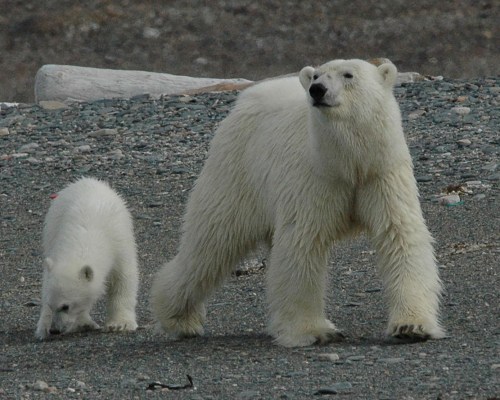
mother-and-cub-on-beach_Stirling

Quotes from the story, a map, and comments on problem bears below.
Continue reading

Polar bears off the ice in W. Hudson Bay are “well fed and in great shape” this year

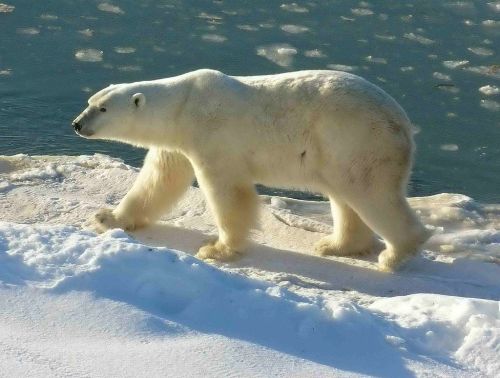
Churchill_Polar_Bear_2004-11-15 Wikipedia

Reports from Seal River, just north of Churchill at Churchillwild, at July 26 were crowing about seeing lots of bears onshore, with a veritable beehive of activity the weekend of 16/17 July:

“This has without a doubt been Churchill Wild’s most spectacular start to the summer polar bear watching season. …Bear numbers are up spectacularly this year and all are looking very fat and healthy, perhaps much to the chagrin of climate change “experts.” Our best day for the seductive white carnivores over the past week featured 21 polar bears sighted between the Lodge and our whale swim spot!

The ice pack, which was still visible a week ago [i.e, 17 July or so], has finally dissipated and pushed a large number of bears on to our coastline here at Seal River, with the end result being many very happy cameras!” [my bold]

And in Churchill proper, the Polar Bear Alert program has issued three reports so far this season (courtesy the Town of Churchill), which confirm that bears in the Polar Bear Capital of the World are also in great shape.

For the week of July 11-17, 2016:

“Bears are off the sea ice and on land. They are looking well fed and in great shape.”

See all three PBA reports below, compared to one from last year at this time (as well as a map and some ice charts).

More fat, healthy bears than last year, enough to keep the Polar Bear Alert folks hopping and tourists in the north happy. Sure doesn’t sound like a suffering population to me. Continue reading

Four years of PolarBearScience and polar bear habitat for ‘Christmas in July’

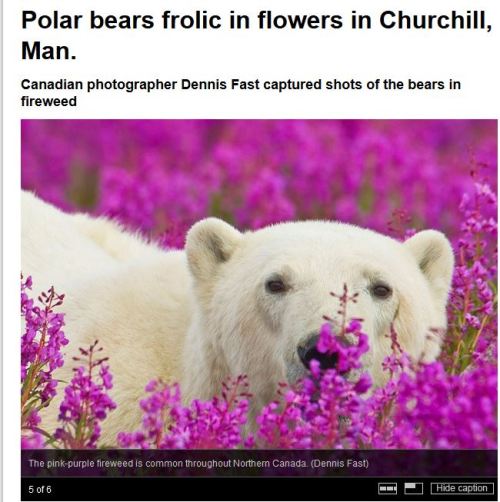
The traditional gift for a 4th anniversary is flowers, so to celebrate 4 years of blogging at PolarBearScience, I’m highlighting a CBC article from last year that featured the work of photographer Dennis Fast, who captured some fantastic images of polar bears cavorting in a field of fireweed near Churchill (see screencap below from the 2015 CBC feature, more at the DailyMail for 21 August 2015). Great photography – it deserves another look.

Churchill pbs in wildflowers_CBC feature_August 2015

Hard to imagine that four years have passed! Cheers to Hilary Ostrov (who blogs at The view from here) for getting me over my initial frustrations with WordPress – without which I’d never have made it this far – and for her much-appreciated typo alerts [Hilary is still dealing with on-going health issues but we talk on the phone from time to time.]

And thanks of course to my readers, who’ve made it all worthwhile. I truly appreciate all your tips and feedback. The word is getting out, via tweets and retweets, reblogging, personal blog and Facebook discussions, as well as links back to particular posts in the comments of news articles and other internet content, and straight up media mentions. The sum of it all has brought us to this point: 495 posts, over 764,000 views, and more than 411,000 visitors. Not too shabby for a single issue science blog, eh?

I thought of adding a Tip Jar button for next year, but decided against it – instead, if you’d like to support my efforts here, you can buy my polar bear attack novel (give it as a gift if you’re not keen on this type of fiction). I’d be just as grateful. See the sidebar for the link.

But back to business – below find sea ice maps of polar bear habitat at 25 July (‘Christmas in July’), this year as well as some previous years.
Continue reading