Tag Archives: population decline

USGS ‘treadmill’ paper repeats bogus claim that ice loss harmed polar bears

The newest polar bear science paper making the rounds courtesy the US Geological Survey, is a perfect example of a statistically-significant result with no biological significance. While the results are rather lame, the paper is dangerous because it repeats the disingenuous claim (see Crockford 2017) that Southern Beaufort Sea polar bear numbers declined in recent years due to summer sea ice loss.
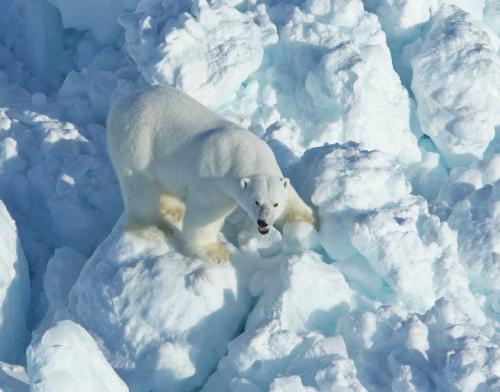
polar_bear_rubble_ice_Mike Lockhart USGS_8 April 2011

The USGS authors (Durner et al. 2017) know this harm-from-summer-ice-loss assertion is not true for the Southern Beaufort subpopulation but the more papers they can get into print that say so, the more likely it will be believed — and the less likely readers will check older literature that documents the recent decline in polar bear numbers was due to a three year period (2004-2006) when thick ice conditions in spring made seal hunting a challenge, a repeat of a well-known phenomenon (e.g. Stirling et al. 1980; Stirling 2002) unique to this region that has been documented since the 1960s.

The Durner paper (USGS press releaseIncreased Sea Ice Drift Puts Polar Bears on Faster Moving Treadmill” published online 6 June ahead of print) spins the research results as potentially significant bad news but in so doing reveals how desperate they have become to make the public and their biology colleagues believe that Southern Beaufort polar bears, among others, are being negatively affected by summer sea ice loss (as per Stirling and Derocher 2012).

Durner, G.M., Douglas, D.C., Albeke, S.E., Whiteman, J.P., Amstrup, S.C., Richardson, E., Wilson, R.R. and Ben-David, M. 2017. Increased Arctic sea ice drift alters adult female polar bear movements and energetics. Global Change Biology. DOI: 10.1111/gcb.13746 http://onlinelibrary.wiley.com/doi/10.1111/gcb.13746/abstract [paywalled]

In fact, the Durner et al. paper does not document any harm to polar bears from the proposed ‘treadmill’ effect of more rapidly moving ice for the period 1999-2013 compared to 1987-1998, but instead uses models to suggest bears might have to eat one to three more seals per year to compensate for the extra energy needed to walk against the moving ice. That’s right: perhaps only 1 more seal per year out of the 50 or so they would usually consume (see Stirling and Øritsland 1995). In my opinion, that’s a pretty lame result for what one of the co-authors described as an immense amount of work.

News outlets have essentially used the USGS press release as a click-bait lede for another round of Trump-bashing with respect to the Paris climate change agreement, see here and here: the stories are hardly about polar bears at all. And predictably, polar bear activist and co-author Steven Amstrup (paid spokesperson for Polar Bears International, famous for their “Save Our Sea Ice” campaign) appears to be using the same approach: an up-coming call-in talk radio program at NPR’s Anchorage affiliate KSKA for Tuesday 13 June at 10:00 (Alaska time, see “Talk of Alaska”) is being billed as a discussion of “polar bears, climate change, and the Paris Accord” (h/t AK geologist). Continue reading
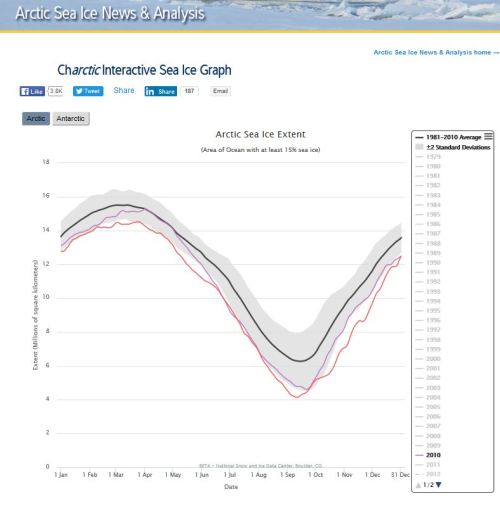

Polar bear habitat message for the year end: 2016 Arctic ice extent same as 2010

According to NSIDC daily sea ice interactive graph,  there was ever so slightly more ice on 31 Dec 2016 than on that date in 2010. However, the corresponding ice maps show just how differently that ice was distributed.

sea-ice-at-31-dec-2016_vs-2010_nsidc-interactive

Recall that in 2010, there was no huge die-off of polar bears attributed to reduced amounts of sea ice in the fall (or to reduced ice in summer, for that matter) because there was no catastrophic die-off at all.

Continue reading

Hudson Bay could be ice-free in winter within 5-10 years, says seal researcher

Ringed seal biologist Steven Ferguson, in a statement to a reporter from the Winnipeg Free Press, made one of the boldest predictions I’ve ever heard:

crystalball_468x317_predictions_sq


“Hudson Bay could experience its first ice-free winter within 5-10 years.”

You heard it here, folks. It appears Ferguson thinks Hudson Bay was never ice-free in winter even during the Eemian Interglacial, when the Bering Sea was ice-free in winter – something that has not come close happening in recent years (Polyak et al. 2010:1769).

Sounds like a bit of ill-advised grandstanding to me.

Continue reading

Columnist admits video on polar bears and global warming contained a serious error

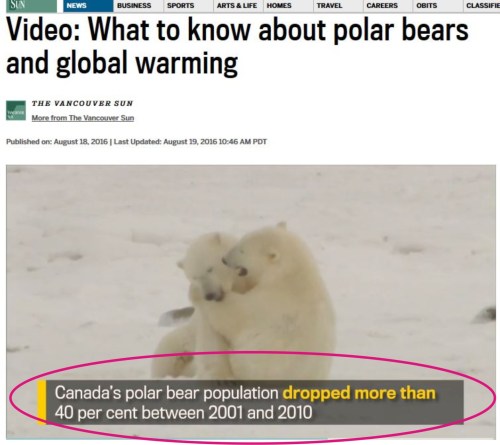
Since mid-August,  Vancouver Sun columnist Daphne Bramham has been filing a series of articles from an expedition cruise through the Northwest Passage for a feature called “Above the Arctic Circle”. One of these appeared on August 18, along with a video called “What to know about polar bears and global warming” and it contained an egregious error that should have stood out to any educated person as being wrong by several orders of magnitude:

What to know about pbs GW_Video_screencap 2_SUN_18 Aug 2016 marked

We are not talking about a difference of opinion or interpretation but a simple fact that was outrageously wrong by a wide margin. You see it, don’t you? Continue reading

Polar bears barely survived the sea ice habitat changes of the last Ice Age, evidence suggests

While the polar bear is an Ice Age species, genetic and fossil evidence suggests it barely survived the profound sea ice changes associated with the Last Glacial Maximum, one of the most severe glacial periods of the Pleistocene.

polar_bear_usfws_no date_sm

A map of sea ice extent at the climax of the Last Glacial Maximum (both perennial and seasonal ice), prepared with the help of a colleague, makes it possible to discuss what genetic and fossil evidence can tell us about the probable effects of glacial conditions on polar bears and ringed seals.

Continue reading

Graphing polar bear population estimates over time

I’ve already commented on the 2013 update of polar bear population status released by the IUCN Polar Bear Specialist Group (PBSG).

However, I thought it might be interesting to graph the changes in global population estimates over time (from 1981-2013) — not just the actual estimates from PBSG status tables (with their min/max error ranges) but those totals plus the so-called “inaccurate” estimates that the PBSG have dropped from their accounts in recent (2005-2013) assessments: Chukchi Sea, East Greenland, Queen Elizabeth Islands (now known as the “Arctic Basin”), and Laptev Sea.

In 2001, those “inaccurate” estimates contributed 5,000-5,400 bears to the global total, but now they’re gone — no bears from those regions contribute to the official totals listed on recent PBSG status tables.

Adding those dropped estimates back into the global totals makes it possible to generate a graph in which the global estimates are truly comparable over time.

To see how the dropped estimates influenced the perception of population change over time, I’ve also graphed the estimates given by the PBSG in their status tables. I’ve combined the two into one image (Fig. 1, click to enlarge) to make comparison easy.

UPDATE 5 December 2014: Links to more recent posts relevant to this issue added below. The most recent numbers, added 31 May 2015, are here.

UPDATE 26 March 2019: See “Latest global polar bear abundance ‘best guess’ estimate is 39,000 (26,000-58,000)
Continue reading

Polar bears at Kaktovik, Alaska not stranded due to retreating ice

“I’ve lived here all my life and there are more bears every year. I read stories about polar bears being on the brink of extinction because of global warming, look out of my window and start to laugh.” Tori Sims, Kaktovik (Mail on Sunday, Sept. 28, 2013).

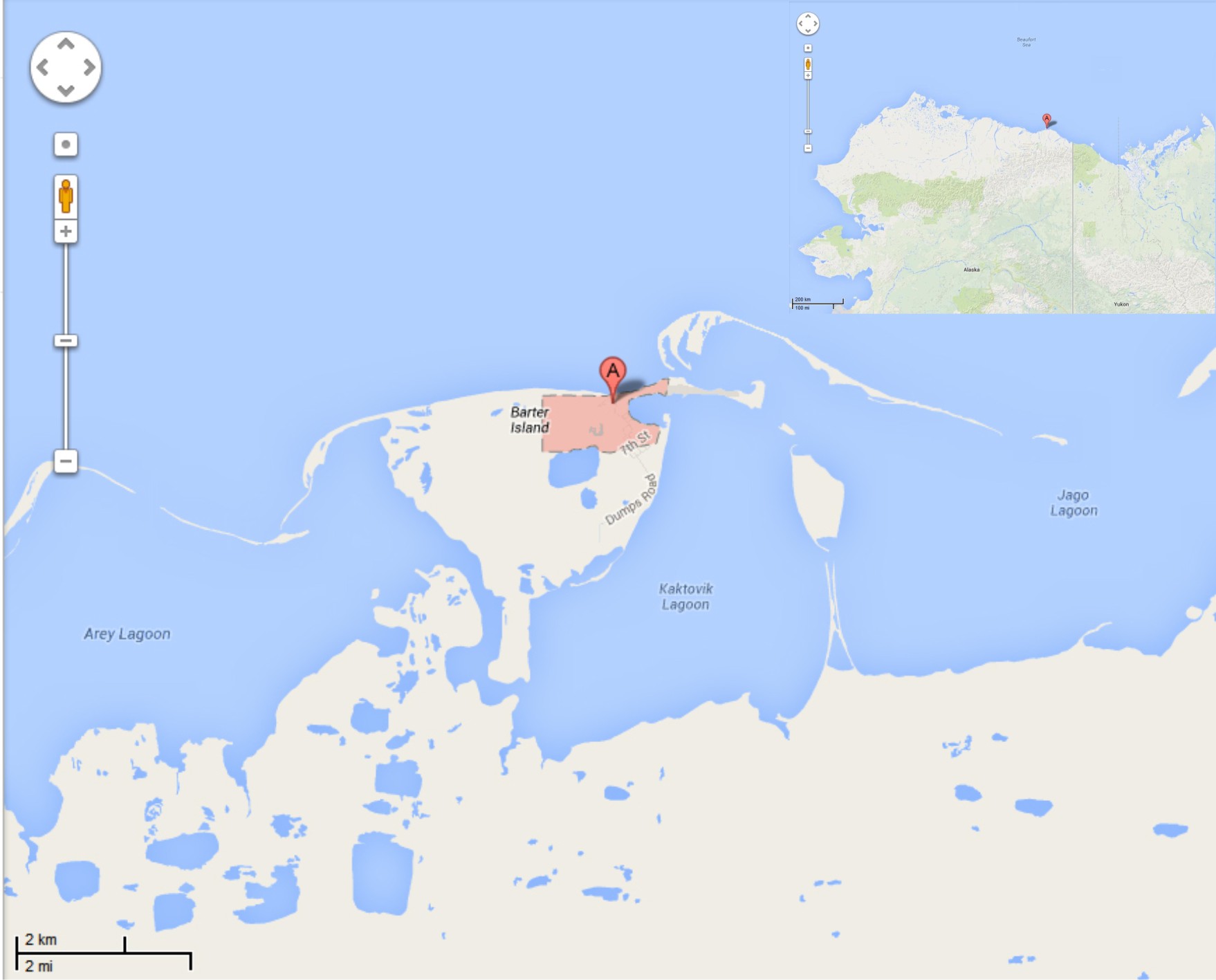
As you can see, Kaktovik is in the news again. This tiny community sits on the edge of the Beaufort Sea, on Barter Island on the North Slope of Alaska (Fig. 1). It lies within the Southern Beaufort polar bear subpopulation, which has been classified as “declining” by the IUCN Polar Bear Specialist Group (Obbard et al. 2010).

The determination of “declining” was based on a small dip in population numbers between 2001 and 2006 (not statistically significant), plus a decline in body size and condition, and smaller litter sizes documented between 1986 and 2006 (Rode et al. 2010). A new population survey is underway.

Figure 1. Kaktovik, Alaska, from Google maps.

Figure 1. Kaktovik, Alaska, from Google maps. Click to enlarge.

There have been suggestions that bears become “stranded” along the Alaska coast near Kaktovik because of retreating sea ice, and that more bears present in this area in recent years are an indication that they are in trouble due to global warming.

I’ve compiled some quotes, maps, and links to stories, photos and videos about Kaktovik polar bears to show that this claim is false.

Continue reading

The two faces of polar bear biologists – Zac Unger interviews Amstrup and Stirling

Former firefighter Zac Unger has been in the news quite a lot over the last few months, promoting his new book, “Never Look a Polar Bear in the Eye” (see Zac’s website here, where you’ll find a list of some of the articles he’s written; the Canadian Geographic one is very good (“The truth about polar bears”) and was the one that originally caught my attention in early December 2012. One article that I’ve read is missing from that list, “Are Polar Bears Really Disappearing?” (Wall Street Journal, Feb. 8, 2013). There is a book review in the Winnipeg Free Press here (Feb. 2, 2013) and on climate scientist Judith Curry’s blog (Dec. 21, 2012), and an interview with Globe and Mail columnist Margaret Wente here from Feb. 23, 2013).

I’ve mentioned bits from some of these articles previously: Featured Quote #32 (Feb. 23, 2013) and in my Dec. 16, 2012 post, ‘Species-threatening’ population declines vs. polar bear declines.

In my last post, I promised a follow-up discussion on cannibalism in polar bears, as it has been promoted by polar bear biologists. I recalled a discussion of this by Unger, which I think makes a nice lead-in for my own essay, which I should have up in a few days.

Here is the money quote from Unger (with a link to the NBC interview with Amstrup and Stirling he is talking about). A lengthy excerpt from the article is below, for the context – it’s well worth a read:

[In 2008, after watching polar bear biologist Dr. Steve Amstrup give an interview on NBC News explaining “the evidence behind the decision to list the polar bear as threatened. Evidence like cannibalism.”] “Wait a second. Hadn’t Amstrup just finished telling me that the cannibalism thing was getting too much play by a bloodthirsty media?” Zac Unger, PS Magazine, Dec. 17, 2012 [2:40 min. NBC News video here]

Continue reading