Author Archives: susanjcrockford

Tracking polar bears in the Beaufort Sea: August map

Here is the follow-up I promised to my post on the July track map for polar bears being followed by satellite in the Beaufort Sea by the US Geological Survey (USGS) – Ten out of ten polar bears being tracked this summer in the Beaufort Sea are on the ice. See that post for methods and other background on this topic, and some track maps from 2012.

The track map for August was posted on the USGS website on September 4th and is copied here below (Figure 1). The ice moved a bit further offshore during August but not nearly as far as it did in 2012. The ten bears from July were down to eight – their collars might have stopped working or fallen off (most likely), they might have left the area entirely (also possible) or they might have died (the researchers don’t say which).

 Figure 1. “Movements of 8 satellite-tagged polar bears for the month of August, 2013. Polar bears were tagged in 2013 on the spring-time sea ice of the southern Beaufort Sea. All 8 of these bears have satellite collar transmitters [i.e., all are females]. Polar bear satellite telemetry data are shown with Ice Analysis charts from 26 August, 2013. Ice Analysis charts are made available by the National Ice Center. The land cover is made available by Natural Earth. Click on the above image to enlarge.”[Note that the dots with the polar bear icons are the end points (end August), while the other end of the string is their position in early August. The yellow dot is behind the purple dot, on shore; two of the bears present in July (see Fig. 2 below) are no longer being tracked - their collars might have stopped working or fallen off (most likely), they might have left the area entirely (also possible) or they might have died. The researchers don’t say.]


Figure 1. “Movements of 8 satellite-tagged polar bears for the month of August, 2013. Polar bears were tagged in 2013 on the spring-time sea ice of the southern Beaufort Sea. All 8 of these bears have satellite collar transmitters [i.e., all are females]. Polar bear satellite telemetry data are shown with Ice Analysis charts from 26 August, 2013. Ice Analysis charts are made available by the National Ice Center. The land cover is made available by Natural Earth. Click on the above image to enlarge.” [Note that the dots with the polar bear icons are the end points (end August), while the other end of the string is their position in early August. The yellow dot is behind the purple dot, on shore; two of the bears present in July (see Fig. 2 below) are no longer being tracked – their collars might have stopped working or fallen off (most likely), they might have left the area entirely (also possible) or they might have died. The researchers don’t say.]

So, of the eight polar bears still being followed by USGS researchers in August, three were on shore and five were on the ice. Only time will tell if the three females on shore are pregnant and preparing maternity dens for the winter, but this seems the likely reason they are not on the ice with the others.

I’ll post the track map for September when it is available in early October at the USGS website.

The map for July 2013 is below, for comparison: Continue reading

Ten out of ten polar bears being tracked this summer in the Beaufort Sea are on the ice

PB_male on ice_Regehr USFWS_March 2010_labeledTracking Beaufort Sea polar bears over the summer — what can it tell us about how important the position of summer sea ice relative to the shoreline in this region is to these bears? Do Beaufort Sea bears get stranded on shore like the polar bears in Davis Strait and Hudson Bay?

Polar bear biologist Eric Regehr (with the US Fish & Wildlife Service, or FWS) has a team working with US Geological Survey researchers (USGS) in the southern Beaufort tracking where adult female polar bears go throughout the year. This is part of on-going research in the Beaufort and Chukchi Sea (see previous post here; see also Fish & Wildlife 2009; Polar Bear News 2010 and 2013; Rode and Regehr 2010, pdfs below; and just out, the “accepted” version of the Rode et al. paper discussed here, and announced in my last post here).

The researchers have been posting a summary map at the end of each month on the USGS website showing the tracks of the females they fitted with radio collars the previous spring — for 2013, and back to 2010. They can’t put collars on male bears because their necks are larger around than their heads, so a collar would just slip off.

I’ve posted the July 2013 track map below, which shows all ten bears out on the ice, and the previous month (June 2013) to compare it to (the August map should be out shortly). I’ve included a few maps from 2012 to allow you to compare this year’s results to the situation last summer.

The August tracks should be available after the Labour Day weekend – check back next week to see where the bears have been this month. I’ll post the map here or you can go to the USGS website directly. [UPDATE Sept 4, 2013: The August map is up, posted here.]

Continue reading

Good news about Chukchi Sea polar bears whispered by US Fish & Wildlife Service

Just out: the “accepted” version of the Rode et al. paper discussed here last month — detailing just how well polar bears in the Chukchi Sea subpopulation are doing, despite recent declines in sea ice.

However, what was decidedly odd was how I found out about it.

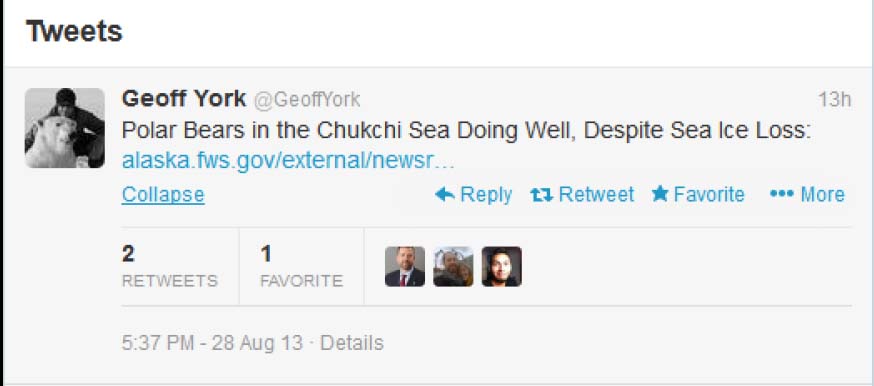
Yesterday (Aug 28), while looking for something else, I found a “press release” tweeted by World Wildlife Fund (WWF) employee Geoff York, who is now also a full voting member of the Polar Bear Specialist Group (PBSG).

Chukchi bears press release tweet_Geoff York Aug 28 2013

The announcement that York tweeted is listed as “alaska.fws.gov/external/newsroom/pdf/cs_polar_bear_article.pdf” and I found a stand-alone copy of the pdf with that title on Google.

However, FWS has so far (Aug. 29, 7:00 am PT) not mentioned this item on their [central] website, their twitter account, or their Facebook page (pdf here, with its original title). The “press release” has no date and is not on FWS letterhead but is authored by “Eric V. Regehr, U.S. Fish & Wildlife Service.” [I guess FWS employees can issue their own press releases?] UPDATE: Found it finally in the “FWS Alaska region” (Alaska FWS, posted Aug. 22, 2013, which included the Eric Regehr summary tweeted by York), via a news report at SitNews dated Aug. 27. Mystery solved]

Also odd that so far, no one except Geoff York himself seems to have picked it up (nothing so far on WWF website or Facebook page, Polar Bears International pages, or at ScienceDaily. [Update: see news report at SitNews dated Aug. 27. Still odd that the FWS report has been sitting there quietly since the 22nd (Thursday of last week)]

Not exactly how I’d choose to spread good news, but perhaps that’s the point.

Nevertheless, not too much new in the paper itself [contact me if you’d like a copy] – no population size estimate, for example – other than what I included in the summary provided last month (based on a March presentation by lead author Karyn Rode), except this: spring litter sizes [1.90 in 2007 and 2.17 in 2009 on Wrangel Island] were “are among the highest reported for 18 of 19 polar bear populations” and were similar to litter sizes 20 years earlier.

I guess the picture of the Chukchi female with a litter of triplet yearling cubs included without mention in the 2010 Rode and Regehr report (pdf here, copied below, discussed previously here) was significant after all.

Rode and Regehr 2010_Chukchi_report2010_Fig1_triplets_labelled

Continue reading

Polar bears have not been harmed by sea ice declines in summer – the evidence

PB  logo colouredThe polar bear biologists and professional activists of the IUCN Polar Bear Specialist Group (PBSG) continue to insist that since 1979 increasingly smaller amounts of Arctic sea ice left at the end of summer (the September ice minimum) have already caused harm to polar bears. They contend that global warming due to CO2 from fossil fuels (“climate warming” in their lexicon) is the cause of this decline in summer ice.

In a recent (2012) paper published in the journal Global Change Biology (“Effects of climate warming on polar bears: a review of the evidence”), long-time Canadian PBSG  members Ian Stirling and Andrew Derocher (both of University of Alberta) summarized their position this way:

“Climate warming is causing unidirectional changes to annual patterns of sea ice distribution, structure, and freeze-up. We summarize evidence that documents how loss of sea ice, the primary habitat of polar bears (Ursus maritimus), negatively affects their long-term survival”

I’ve spent the last year examining their evidence of on-going harm, but in addition, I’ve looked at the evidence (much of it not mentioned in the Stirling and Derocher paper1) that polar bears have either not been harmed by less sea ice in summer or have thrived in spite of it.

This is a summary of my findings. I’ve provided links to my original essays on individual topics, which are fully referenced and illustrated. You are encouraged to consult them for complete details. This synopsis (pdf with links preserved, updated; pdf with links as footnotes, updated) complements and updates a previous summary, “Ten good reasons not to worry about polar bears” (pdf with links preserved; pdf with a foreword by Dr. Matt Ridley, with links as footnotes).

Update 8 September 2013: to include links to my post on the recently published Chukchi population report; updated pdfs have been added above.

Update 22 January 2014: added figure comparing March vs. September sea ice extent using the same scale, from NOAA’s “2014 Arctic Report Card,” discussed here.
Continue reading

Ian Stirling’s howler update: contradicted by scientific data

Following up on my last post (Ian Stirling’s latest howler: “the polar bear who died of climate change”), I tracked down some details contained in the original Norwegian news report but which were left out of the articles that spread the story around the world. I also found some pertinent research posted online that appears to be the work of the researchers who captured this bear in April.

Figure 1. The Norwegian newpaper, The Local (Aug. 7, 2013), identifies the location that the bear was found as “a small island near Texas Bar” (marked by the square on the above map) in the very north of Spitsbergen and states it was found on July 7 – details other reports did not bother to include. To have been 250km south of that position in April (when he was tagged), he must have left the ice near the southern tip of Spitsbergen when there was still lots of ice further north.

Figure 1. The Norwegian newspaper, The Local (Aug. 7, 2013), says the bear was found on “a small island near Texas Bar” (marked by the square on the above map) in the very north of Spitsbergen, and states it was found on July 7 – details other reports did not bother to include. [“Texas Bar” is a hut built by a Norwegian hunter in 1927]. To have been 250km south of that position in April (when he was tagged), he must have left the ice near the southern tip of Spitsbergen when there was still lots of ice further north.


Continue reading

Ian Stirling’s latest howler: “the polar bear who died of climate change”

Will wildlife biologist and Polar Bear Specialist Group member Ian Stirling now say anything – no matter how unscientific – to garner more sympathy and media attention for polar bears? It appears so.  [see followup post published Aug. 11, here]

A tabloid-style picture-is-worth-a-thousand-words article appeared in the environment section of the UK newspaper The Guardian yesterday (August 6, 2013) with a picture of a dead polar bear meant to wring your heart. The picture is a vehicle for statements from Ian Stirling and others that this polar bear died from climate change. A longer article was alongside.

The caption below the photo of a dead polar bear (animal tragedy porn) is this:

This 16-year-old male polar bear died of starvation resulting from the lack of ice on which to hunt seals, according to Dr Ian Stirling.”

Many folks have been asking questions about this and so have I.

I suggest this is what really happened: the polar bear biologists working in Svalbard earlier this year knew this bear was going to die back in April when they captured him – they simply waited, with a photographer on hand, until he died. It was an orchestrated photo-op.

[Update, Aug. 8, 2013: I suggest it was not necessary for anything more to happen to “orchestrate” this photo than for the researchers who captured the bear in April to tell colleagues and local tour boat operators (who always have avid photographers on board) to “keep an eye out for a dead bear, we don’t think this guy is going to make it.” However, very little real information is provided. Who knows when (or from whom) we’ll get the whole story — if ever? That’s why anecdotal accounts like these aren’t “evidence” of anything, in the scientific sense. That’s the real take-home message here.  If this dead bear was being presented as scientific evidence, we’d have been given all the details, including necropsy results, local ice conditions, precise dates, locations, and photos of any other bears that were seen that were in poor condition. In other words, a proper scientific report. ]

Continue reading

Biologists spreading misinformation: hybridization with grizzlies not due to polar bears moving inland

A paper published last week in the journal Science, written by a team of biologists and atmospheric scientists, expounds on a possible dire future for a range of Arctic animals. It’s called, “Ecological consequences of sea-ice decline” and surprisingly, polar bears are discussed only briefly.

However, with the inclusion of one short sentence, the paper manages to perpetuate misinformation on grizzly/polar bear hybridization that first appeared in a commentary essay three years ago in Nature  (Kelly et al. 2010)1. The Post et al. 2013 missive contains this astonishing statement (repeated by a Canadian Press news report):

Hybridization between polar bears and grizzly bears may be the result of increasing inland presence of polar bears as a result of a prolonged ice-free season.

Lead author of the paper, Professor of Biology Eric Post, is quoted extensively in the press release issued by his employer (Penn State University, pdf here). In it, Post re-states the above sentence in simpler terms, removing any doubt of its intended interpretation:

“… polar and grizzly bears already have been observed to have hybridized because polar bears now are spending more time on land, where they have contact with grizzlies.

Both statements are patently false. All recent hybridization events documented (2006-2013) occurred because a few male grizzlies traveled over the sea ice into polar bear territory and found themselves a polar bear female to impregnate (see news items here and here, Fig. 1 below). These events did not occur on land during the ice-free season (which is late summer/early fall), but on the sea ice in spring (March-May).

Grizzlies have been documented wandering over the sea ice of the western Arctic since at least 1885 (Doupe et al. 2007; Fig. 2, below) and the presence in this region of hybrid grizzly/polar bear offspring is not an indicator of declining summer sea ice, whether due to global warming or natural causes, or some combination thereof.

Continue reading

Baffin Bay polar bear status – waiting for the count

Here’s a quick summary of the status of Baffin Bay polar bears, a subpopulation I’ve not previously discussed in detail. Nothing especially earth-shattering here, except perhaps to wonder about the involvement of the World Wildlife Fund (WWF) in a new helicopter survey of the region.

Baffin Bay (Fig. 1) is north of Davis Strait. It lies between western Greenland and Baffin Island in the eastern Arctic.

Unlike the other north/south neighbour-pair of Western/Southern Hudson Bay   (which I discussed previously), the sea ice history for Baffin Bay/Davis Strait is not as similar: Davis Strait bears have a much longer on-shore fast than Baffin Bay bears (see last post here). However, all four of these subpopulations have ‘seasonal sea ice’ – that is, the ice melts completely in late mid-to-late summer, forcing bears onshore for varying lengths of time until fall freeze-up.

Figure 1. The Baffin Bay subpopulation region lies north of Davis Strait (map on the left from Vongraven and Peacock 2011: Fig. 3) and management is shared between Canada (Nunavut) and Greenland. In total area, it covers 1.08 million km2 and its “suitable ice habitat in spring” (according to Taylor and Lee 1995) is 413,500 km,2 somewhat less than Davis Strait. The map on the right shows the sea ice extent at the end of March 2010 (NSIDC), the winter maximum.

Figure 1. The Baffin Bay subpopulation region lies north of Davis Strait (map on the left from Vongraven and Peacock 2011: Fig. 3) and management is shared between Canada (Nunavut) and Greenland. In total area, it covers 1.08 million km2 and its “suitable ice habitat in spring” (according to Taylor and Lee 1995) is 413,500 km2, somewhat less than Davis Strait. The map on the right shows the sea ice extent at the end of March 2010 (NSIDC), the winter maximum.

A peer-reviewed paper published last year (Rode et al. 2012) compared body condition vs. sea ice changes in Davis Strait and Baffin Bay (discussed here). But while that research contributed to an updated population estimate for Davis Strait (Peacock et al. 2013, discussed here), it did not do the same for Baffin Bay. This is likely because the body condition work in Baffin Bay was split between spring and fall, and it has already been determined that many Baffin Bay bears are offshore in the spring and not available for counting using shore-based methods.

That’s a shame, because the last population estimate was completed back in 1997 (Taylor et al. 2005) and it is now seriously out of date.

However, it appears the Government of Nunavut is currently in the process of surveying this region by helicopter, so a new population estimate should be available soon.

But this aspect of the survey might surprise you — a press release issued February 11, 2013 by WWF contained the following statement:

Results from the above-noted surveys will be completed and shared beginning in April 2013.

WWF made contributions of $82,000 to the Government of the Northwest Territories and $111,000 to the Government of Nunavut via Environment Canada, towards the total costs of these surveys. These funds were raised through the Arctic Home campaign from engaged Canadians and matched by The Coca-Cola Company.”  [my bold]

So, of the hundreds of millions the WWF pulls in from donations, they passed along less than $100,000 [$96,500 plus an equal contribution by Coca-Cola) to offset “the total costs of the survey.

We are not told what those total costs are, but I expect they run well over a million dollars for a multiyear/multi-region project like this, perhaps over two million. Which makes $96,500 rather a drop in the bucket. That might have paid for some of the jet fuel for the helicopters used for the survey, but probably not all of it.

Status details below.
Continue reading

Baffin Bay-Davis Strait ice concentration comparison – why use the “summer mean”?

I’ve been in the process of looking at the status of polar bears in the Baffin Bay region, which lies to the north of Davis Strait (Fig. 1), but a related issue caught my attention that I think deserves discussion.

Figure 1. Polar bear subpopulations defined by the Polar Bear Specialist Group (PBSG). Note that Baffin Bay, Davis Strait, Western Hudson Bay and Southern Hudson Bay are all similar in that they become ice-free by early fall (the September minimum) or before.

Figure 1. Polar bear subpopulations defined by the Polar Bear Specialist Group (PBSG). Note that Baffin Bay, Davis Strait, Western Hudson Bay and Southern Hudson Bay are all similar in that they become ice-free by early fall (the September minimum) or even before.

Recall that in a recent post on the Beaufort Sea ice extent comparison offered by the National Snow and Ice Data Center (NSIDC) here, I commented:

What puzzled me was why they featured only the last 7 years when satellite data go back to at least 1979. Is there something in that data they don’t want us to see?”

Something similar struck me about the analysis of sea ice in Baffin Bay and Davis Strait conducted by polar bear researchers Karyn Rode and colleagues (Rode et al. 2012). In their comparison of body condition (relative fatness) of bears in Davis Strait and Baffin Bay (see previous post here), they introduced an entirely new sea ice metric – “mean daily summer sea ice concentration,” defined as the mean of values between May 15 and October 15 each year based on ice charts provided by the Canadian Ice Service.

Why invent a metric that has never been used (as far as I know) for analysis of polar bear health, survival or success?

Why not use breakup dates, as has been done for decades for subpopulations in Hudson Bay (e.g. Cherry et al. 2013), where the ice also disappears in late summer?

Is there something in the ice data for Baffin Bay and Davis Strait that Rode and colleagues don’t want us to see?

Since I had already made a composite of Cryosphere Today ice maps at July 12 for my discussion of the Chukchi/Beaufort NSIDC analysis mentioned above, it was relatively easy to look at what was going on in Baffin Bay and Davis Strait on that date in mid-summer. Keep in mind that ice extent and concentration at July 12 records the state of polar bear habitat prior to the late summer decline in sea ice that occurs every year.

Continue reading

Southern Hudson Bay subpopulation status, farthest south of all polar bears

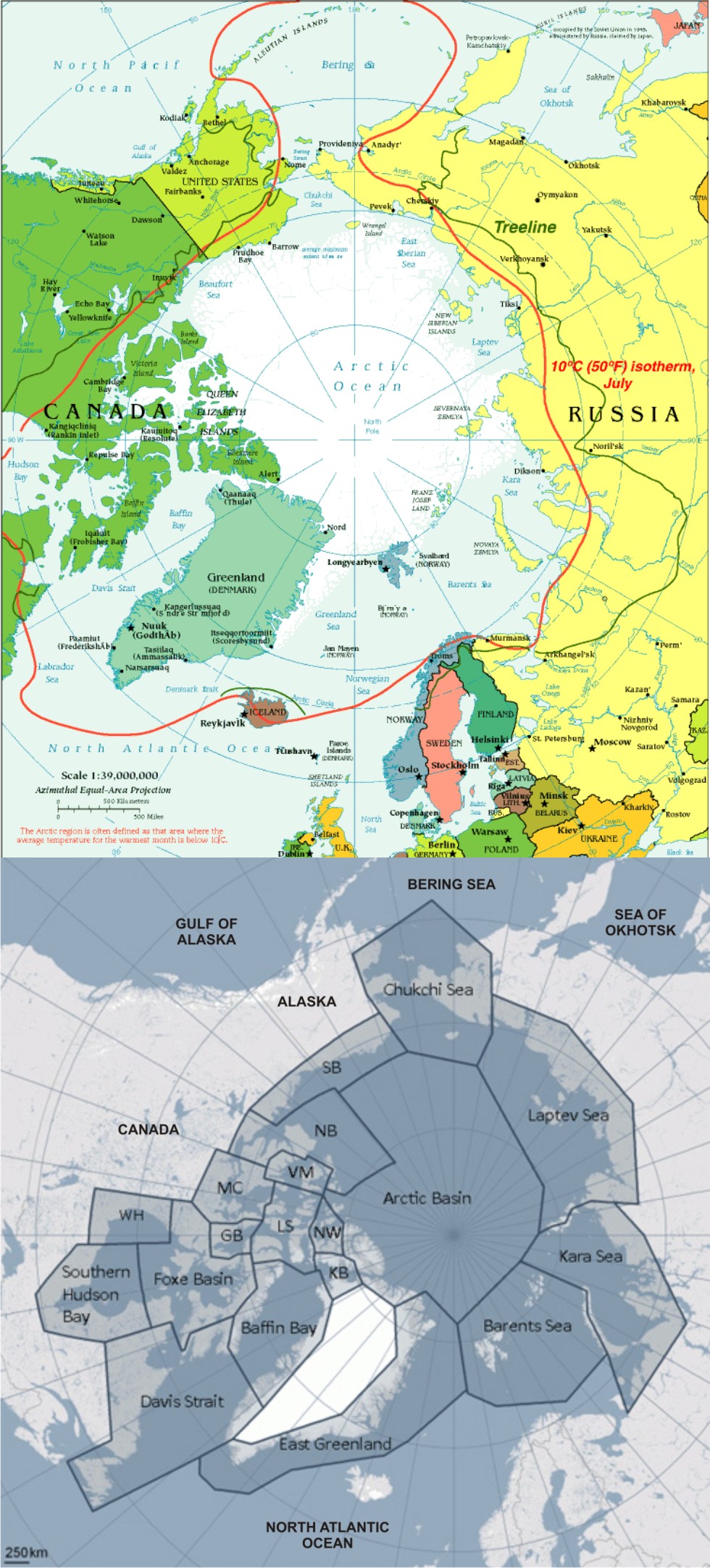
“The Arctic” is a bit hard to define. While the Arctic Circle works as a good boundary for some purposes and the 100C isotherm for July for others, neither work for polar bears because several subpopulations live well south of these limits (Fig. 1).

In the east, Western Hudson Bay, Southern Hudson Bay and Davis Strait are all located well south of the Arctic Circle and the first two (and half of Davis Strait) are beyond the 100C July isotherm as well. In the western Arctic, the Chukchi Sea subpopulation is within the 100C July isotherm but at least half of its bears reside south of the Arctic Circle (Fig. 1) in the Bering Sea (see previous post here).

Unique amongst all of these is Southern Hudson Bay – all of its polar bears make maternity dens and/or spend the summer south of 600N.

Southern Hudson Bay (SH) bears live in the Canadian provinces of Ontario, while Western Hudson Bay (WH) bears reside in Manitoba and Nunavut. The two groups mix over the winter but appear to spend the summer/fall in their respective regions (Stirling et al. 2004). [See previous posts on Western Hudson Bay bears here, here, and here]

“Further south” in the Arctic usually means warmer, with open water present more weeks every summer, sea ice for fewer weeks over the winter. So, shouldn’t the bears of Southern Hudson Bay be already suffering more harm from global warming than virtually all other subpopulations, including those in Western Hudson Bay?

After all, Western Hudson Bay bears appear to have experienced a statistically significant decline in numbers, among other effects (Regehr et al. 2007; Stirling and Derocher 2012) — surely Southern Hudson Bay bears are doing worse?

You’d think so, but they aren’t.

Figure 1. Boundary limits for “the Arctic” (top map) such as the Arctic Circle (dashed line) or the 100C isotherm for July (solid red line) would not include several polar bear subpopulations that live south of these.

Figure 1. Boundary limits for “the Arctic” (top map) such as the Arctic Circle (dashed line) or the 100C isotherm for July (solid red line) would not include several polar bear subpopulations that live south of these.

UPDATED October 28, 2014: Reference added, Obbard et al. 2013 (aerial survey results).
Continue reading