Category Archives: Life History

Western Hudson Bay freeze-up earlier than average for 1980s for the third year in a row

This is the third year in a row that freeze-up of Western Hudson Bay (WH) ice has come earlier than the average of 16 November documented in the 1980s. Reports by folks on the ground near Churchill confirm polar bears are starting to move onto the sea ice that’s developing along the shore after almost 5 months on land. After five good sea ice seasons in a row for WH polar bears, this repeat of an early freeze-up means a sixth good ice season is now possible for 2019-2020.

Sadly for the tourists, however, it means the polar bear viewing season in Churchill will be ending early this year, just like it did last year and the year before.
Churchill pbs checking the ice 10 Nov 2019 Amanda Atarling photo

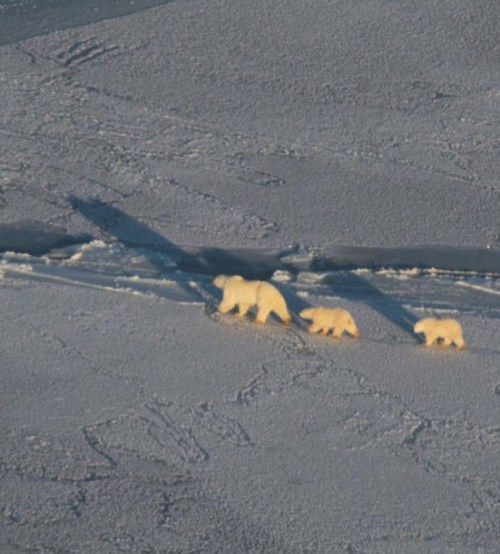
Polar bear family on the ice off Churchill Manitoba (taken from a helicopter), courtesy Explore.org

When mothers with cubs are out on the ice (see photo above), it’s pretty certain the mass movement from land to sea ice is well underway because these family units are usually the last to leave.

UPDATE 19 November 2019: Polar Bear Alert report for 11-17 Nov (week 20) confirms that freeze-up is underway, bears are heading out on the ice and problem bears held in the ‘jail’ were released 13 November. See below.
Continue reading
My London lecture according to Josh

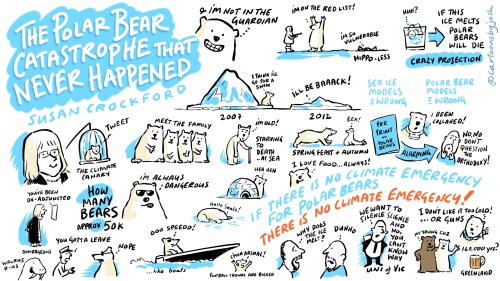
London lecture at the GWPF offices was splendid from my point of view and the audience seemed to enjoy themselves fully. Josh was there and sent his cartoonist’s perspective of the evening*:
Susan-Crockford-PolarBear-GWPF London 21 October 2019 Josh

*PS Thanks Josh and such a pleasure to finally meet you.

Polar bear activity picks up in Churchill as W Hudson Bay freeze-up time approaches

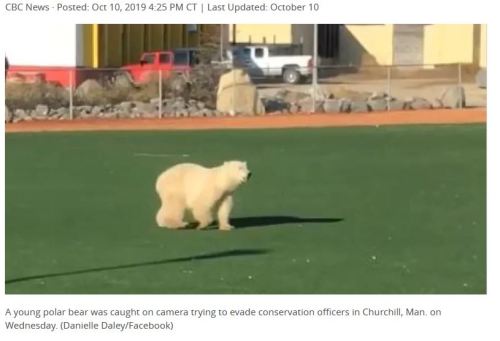
This is week 15 for most polar bears onshore near Churchill in Western Hudson Bay, which means they have been onshore for almost 4 months. Still, photos being circulated are still showing bears in excellent condition and we are just waiting to see if freeze-up this year is as early as it has been for the last two years.

polar bear churchill 9 Oct 2019 Danielle Daley photo

Continue reading

Activist biologist filled with eco-anxiety shares unfounded fear of polar bear catastrophe

Misplaced eco-anxiety that kids have about polar bears starts with activist biologists like Steven Amstrup, spokesperson for an organization devoted to raising climate change alarm – and media outlets like The Guardian who help them spread fears unsupported by scientific evidence.

Kaktovik AK fat adult male polar bear mid September 2019_Ed Boudreau photo permission to use

Fat healthy polar bear male at Kaktovik, Alaska in the Southern Beaufort Sea, September 2019, Ed Boudreau photo, with permission.

You can’t get much more over the top than these statements from Amstrup today but read carefully: it’s either opinion or factual aspects of polar bear life (“we know that the bears aren’t feeding”) made to sound like new, terrifying developments that can be blamed on climate change. Continue reading

Polar bear books for kids and young adults are the perfect antidote for climate anxiety

In this short interview clip with Friends of Science director Michelle Stirling, I talk about Polar Bear Facts & Myths (for kids 7 and up) and EATEN, my science-based polar bear attack thriller that’s appropriate for older teens and young adults. Both are available in paperback and ebook formats, while the paperback version of Polar Bear Facts & Myths is also available in French, German, Dutch, and Norwegian.

Polar Bears: Outstanding Survivors of Climate Change is also suitable for teens and young adults and is fully referenced.

Churchill polar bear activity report for week 7 shows oddly few problems so far

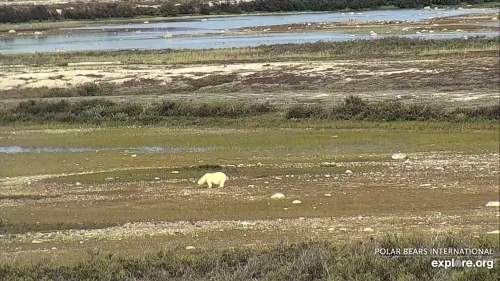
It’s week 7 of the Churchill polar bear season that began in early July and it’s been remarkably quiet: compared to 208 and 2016, there were half as many problem bear incidents in 2019. A few bears have come off the ice near the community and they’ve been in good shape, as are the bears to the east at Cape Churchill (see one captured on live cam 23 August shown below) and the north at Seal River.

churchill-fat-bear-cape-east-23-aug-2019_explore-dot-org-cam.jpg

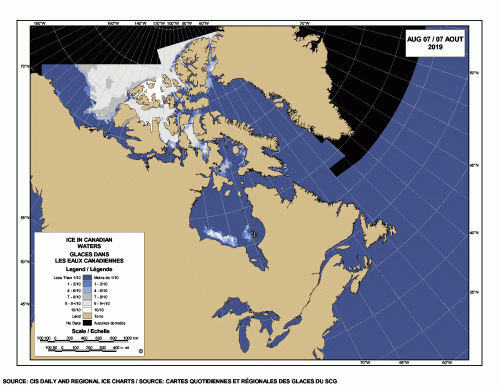
But it looks like many more bears than usual may have decided to ride out the slow-melting ice that lingered well past the first week of August and came ashore further south, towards the Manitoba/Ontario border.

Sea ice Canada 2019 Aug 7

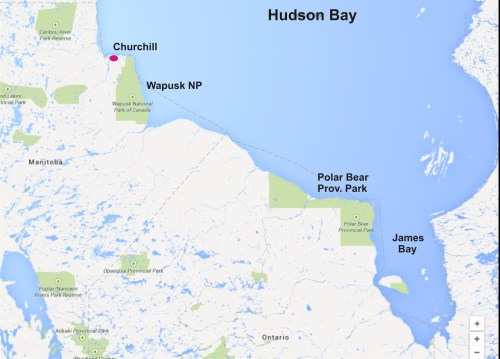
If so, these bears will have to make their way north over the summer so they can intercept the first ice forming along the northwest coast off Wapusk National Park near Churchill. That’s why Western Hudson Bay bears are said to undergo a migration: no matter where they leave the ice in summer, most bears head to areas around Churchill so that they can resume seal hunting on the early fall ice.

Wapusk Nat Park_Hudson Bay_Google maps_w Churchill

A paucity of bears around Churchill in late summer/early fall is not unprecedented, however. Stirling and colleagues pointed out that in 1972 and 1973, for reasons they could not explain, there had been fewer bears than usual around Churchill well before freeze-up and therefore, fewer problem bears (Stirling et al. 1977:17).

Below is a comparison of the Polar Bear Alert Program report for last week (Week 7, Aug 19-25) to previous years.

Continue reading

Media and USGS biologist sensationalize recent report of a polar bear encounter in Alaska

It’s been a slow summer for polar bear news to hype, so we shouldn’t be surprised that a local report that polar bears this summer have descended on the town of Kaktovik, Alaska one week earlier than 2017 has morphed into an international story that makes a 2016 research report sound like this year’s news, with headlines trumpeting: “polar bear encounters are increasing” due to a longer open water period. Nevertheless, it was reported just two weeks ago that Alaska has not had a polar bear attack since 1993.

polar_bear-US FWS_young bear Alaska maybe Kaktovik no date

This is a particularly blatant example of how the media skew polar bear ‘news’ for public consumption, aided by scientists with a particular message to sell. Not surprisingly, a number of essential facts have been left out of this sensationized account, in part because the polar bear specialist the media consulted left those facts out of his statement.  This is the sort of bias displayed by polar bear specialists that I discuss in my new book, The Polar Bear Catastrophe That Never Happened.

Continue reading

Polar bear spotted on Bear Island (Barents Sea) this winter for the first time in 8 years

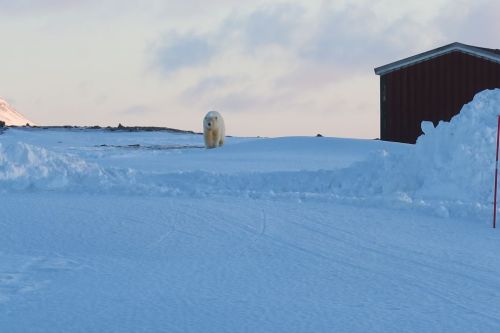
A polar bear was spotted this year on Bear Island (Bjørnøya) in the southern Barents Sea on 8 March by the crew at the Meteorological Station. The last time these workers had seen a polar bear was 2011 but this year extensive Barents Sea ice literally brought a bear to their doorstep, similar to the way that sea ice brings bears to southern Labrador and Newfoundland in late winter and spring.

Bear island 8 March 2019_first bear seen by Meteorological Institute station crews since 2011_Bjørnøya Meteorological Station photo

After below-average ice cover around Svalbard for most of the winter months of January and February, by early March the ice had expanded so far to the south it reached Bjørnøya. It was the kind of ice that hadn’t been seen in decades and almost immediately, a polar bear was spotted on shore. Given the length of time that the ice surrounding the island persisted, it is likely more bears came ashore but were not seen: the Meteorological Station at the north end of the island is the only place that people live over the winter (see maps below).

Continue reading

RCMP on manhunt spot a fat polar bear far from the coast of Western Hudson Bay

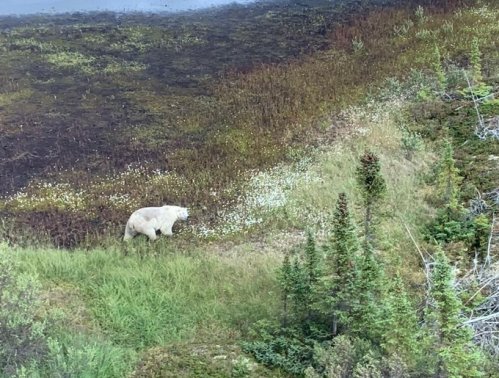
In the course of a manhunt for two murder suspects wanted in British Columbia, Royal Canadian Mounted Police posted a photo of a fat polar bear they spotted about 200 km north of Gillam, Manitoba.

Fat pb spotted by RCMP outside Gillam during manhunt 27 July 2019

This fat bear – as would any others that might be spotted in the area – is a pregnant female from the Western Hudson Bay subpopulation intent on finding a secure place to dig a den in the permafrost where she can stay cool over the summer and give birth this winter.

However, true to form, The Guardian (28 July 2019) ludicrously suggests those on the hunt for the murder suspects are now at risk of a polar bear attack:

The threat of a polar bear attack has become a reality for the huge Canadian police and military contingent searching for the teenage duo suspected of shooting dead Australian tourist Lucas Fowler, his US girlfriend and a university botanist.

Continue reading

First Churchill problem polar bear report of the season: its only incident caught on film

We are constantly told things are getting worse for polar bears, especially those in Western Hudson Bay, because the ice-free season there was predicted to decline earlier than other regions. It hasn’t turned out that way but that does not stop the public rhetoric of doom or NGOs pleading for funds.

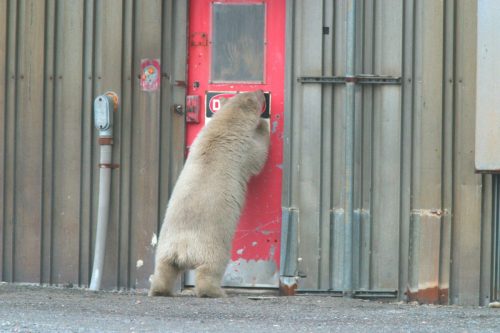
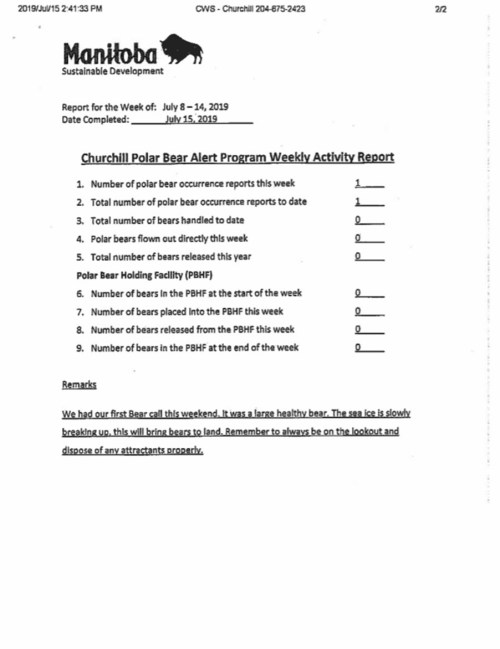
Last week, the Town of Churchill made public its first problem polar bear report of the year but oddly, it has only one entry.  This is the first time I’ve seen such a sparse first report:  since 2015, the first few incidents of the season have been subsumed into a first week report (issued no earlier than the first week of July) that announces the arrival of many bears on land.

Churchill problem bears_week 1_2019 July 8-14

Is this report of an isolated incident an attempt by Polar Bear Alert officials to make sure the first report of the season was not issued weeks later than usual? Or was it posted in isolation because the official response to the incident was caught on video and shared on social media (see below)?

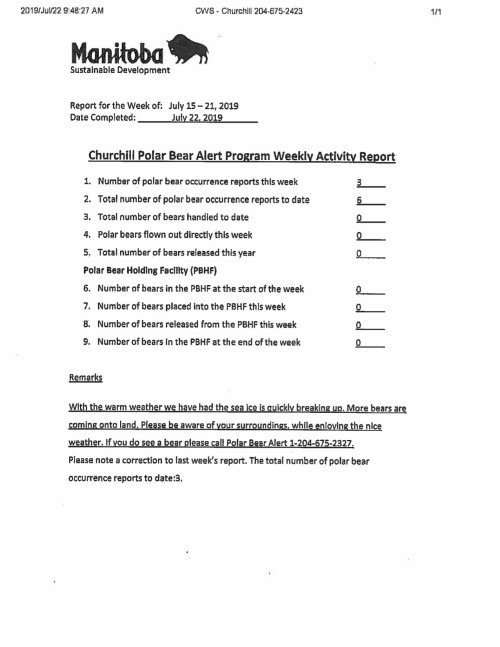
UPDATE 22 July 2019: Published early this afternoon by the Town of Churchill, the problem polar bear report for the 2nd week of the season claims an error in last week’s report that they only just noticed when preparing this week’s report (but a full 24 hours after this blog post was published – but that’s probably a coincidence). Below is the report for week 2 (15-21 July 2019), showing that three incidents occurred last week.

Churchill problem bears_week 2_2019 July 15-21

Continue reading