Category Archives: Life History

Low Bering Sea ice mostly due to south winds, no data on an impact for polar bears

Sea ice in the Bering Sea this winter was said to be the lowest since the 1850s, largely driven by persistent winds from the south rather than the usual north winds although warm Pacific water was a factor early in the season (AIRC 2018). But what, if any, impact is this surprisingly low winter and spring ice cover likely to have on Chukchi Sea polar bear health and survival?

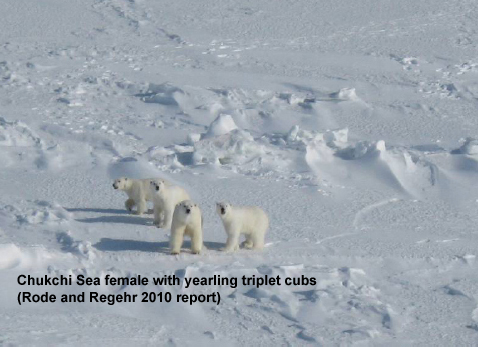
Rode and Regehr 2010_Chukchi_report2010_Fig1_triplets_labelled

In fact, research on Chukchi Sea polar bears has included so few examples of individuals utilizing the Bering Sea in winter (Jan-March) and early spring (April-May) that any conclusions regarding an impact from this year’s sea ice conditions are likely to be invalid. In short, we don’t know what will happen since it has not happened before within living memory; the opinions of polar bear specialists must be taken with a grain of salt because so many of their previous assumptions have turned out to be wrong (Crockford 2017a,b, 2018), see here, here, and here. Seals, walrus and polar bears are much more flexible and resilent to changes in habitat conditions than most modern biologists give them credit for and consequently, it will be fascinating to see how the ice will change over the coming months and how the animals will respond.

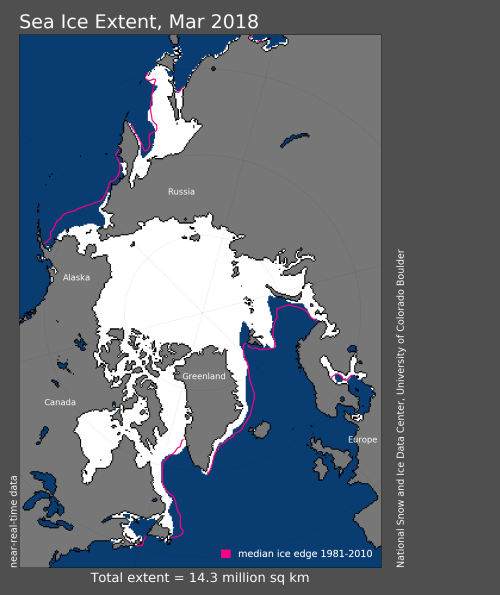
Sea ice extent 2018 March average NSIDC

Continue reading

Polar bear habitat update early spring 2018

Spring in the Arctic is April-June (Pilfold et al. 2015). As late April is the peak of this critical spring feeding period for most polar bear populations, this is when sea ice conditions are also critical. This year, as has been true since 1979, that sea ice coverage is abundant across the Arctic for seals that are giving birth and mating at this time as well as for polar bears busy feeding on young seals and mating.

Polar_Bear_male on sea ice_Alaska Katovik Regehr photo_April 29, 2005_sm labeled

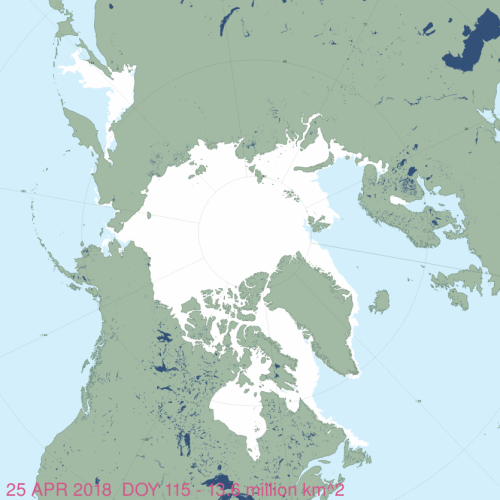
Below is a chart of sea ice at 25 April 2018, showing sea ice in all PBSG polar bear subpopulation regions:

masie_all_zoom_4km 2018 April 25

Some Arctic subregions below, in detail. Continue reading

Winter polar bear sea ice habitat by early March 2018 varied little from 2006 or 2017

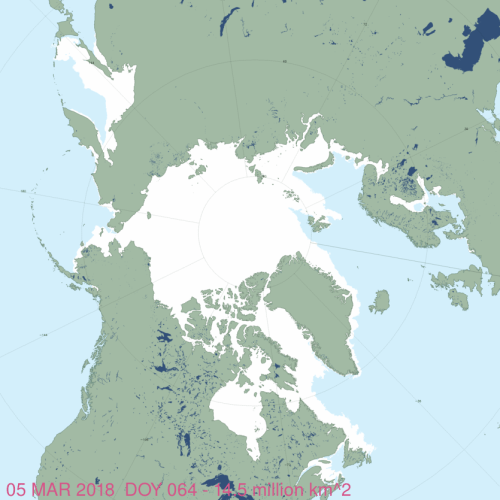
Here’s a polar bear habitat update for early March: some folks are wringing their hands over the relatively extent of ice this season but ice maps show that as far as polar bear habitat is concerned, conditions are not materially different this year from what they were in 2006 or 2017. There is still plenty of late winter sea ice for polar bears needing a platform from which to hunt Arctic seals, which in some areas will have already begun giving birth to their fat furry pups (harp seals first, other species later).

The MASIE map for 5 March 2018 (Day 64) shows ice extent at 14.5 mkm2:

masie_all_zoom_4km 2018 March 5

Continue reading

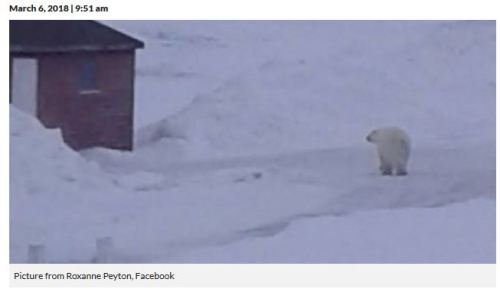
Polar bear sighted onshore in northern Newfoundland at St. Lunaire-Griquet

The first report I’ve seen this season of a polar bear onshore has come in and ironically, it comes from northern Newfoundland, the setting of my polar bear attack thriller, EATEN. Only time will tell if this year will be as active as 2017’s record-breaker for polar bears ashore in Newfoundland.

Saint Lunaire Griquet Newfoundland polar bear_VOCM news_6 March 2018

Update: 6 March 2018. A couple of hours after posting this, CBC News Newfoundland published a story on this incident, providing a bit more detail and video footage of the bear wandering around local houses.

Continue reading

State of the Polar Bear Report 2017 to be released Feb 2017 at press lunch Toronto

My “State of the Polar Bear Report 2017” will be unveiled at a Global Warming Policy Foundation press conference and luncheon in Toronto on Tuesday, 27 February, in celebration of International Polar Bear Day. There will be a video presentation as well.

State of Polar Bear Report cover_12 Feb 2018 image

The report summarizes clear, reliable and concise information on the current state of polar bears relative to historical records. It highlights up-to-date data and research findings in a balanced and factual format that avoids hype and exaggeration, all in one place. It is intended for a wide audience, including scientists, teachers, students, decision-makers and the general public interested in polar bears and Arctic ecology.

The launch will be held on Tuesday 27 February at 11:00am at the Toronto Public Library, Founders’ Room, 789 Yonge St, Toronto, ON M4W 2G8.

Programme

* Welcome (Dr Benny Peiser, Director of the GWPF)
* Introduction: Prof Chris Essex (Chairman of the GWPF’s Academic Advisory Council)
* Short video screening
* Presentation: Dr Susan Crockford (author of the report)

For further information and to schedule interviews, please contact Harry Wilkinson (harry.wilkinson@thegwpf.org)

A copy of the report will be posted on Polar Bear Science Tuesday.

Franz Josef Land is a sea ice refugium for most pregnant Barents Sea polar bears

Consensus polar bear expert Andrew Derocher has been busy over the last few weeks, expounding a story of doom regarding Svalbard area polar bears (e.g. here and here), ridiculing the suggestion that Franz Josef Land is viable alternate habitat for Barents Sea bears, especially pregnant females looking for a place to den and give birth. But the facts say otherwise.

Svalbard polar bear_Aars August 2015-NP058930_press release

Below are the long answers, with references and ice maps, to the questions Derocher asked in his 21 December 2017 tweet (above), a refreshing change from the ‘take my word for it, I’m the official expert’ answer one gets from him, along with derogatory slurs directed at those who don’t share his pessimism.

UPDATED 1 February 2019. Two references added.

Continue reading

Harvey et al. attack article mum on real selection process for polar bear papers used in their analysis

The Harvey et al. Bioscience article that attacks this blog and others that link to it — a veritable tantrum paper that took 14 people to write — included a sciency-looking analysis of peer-reviewed articles said to have been retrieved by the database “Web of Science” using the search terms “polar bear” and “sea ice.”

Temper-Tantrum graphic

“Consensus science pounds the floor and chews the carpet in angry frustration.” [mpainter, 25 December 2017]

Other critics have pointed out that the Harvey paper used 92 such references:

“Of the 92 papers included in the study, 6 are labeled ‘controversial.’ Of the remaining 86, 60 are authored or co-authored by Stirling or Amstrup, or Derocher. That is, close to 70% (69.76%) of the so-called ‘majority-view’ papers are from just three people, 2 of whom wrote the attack paper themselves.” [Shub Niggurath, crossposted at Climate Scepticism, 14 December 2017]

The bias of co-author papers used to represent the “expert consensus” on polar bear biology is only one problem with this particular attempt at making the Harvey paper look like science: in fact, the short list of papers used for analysis is a far cry from the original number returned by Web of Science for the search terms the authors say they used in the supplementary information.

How that large original number (almost 500) was whittled down to less than 100 is not explained by the authors. As a consequence, I can only conclude that the “methodology” for paper selection was likely defined after the fact. While the method of paper selection sounds simple and reasonable, apparently not one of the Harvey et al. paper’s co-authors checked to see if it was plausible (or didn’t care if it was not).

Continue reading

Bioscience paper and starving polar bear follow-up

Between the two stories (the attack by my colleagues and the starving polar bear hype), views at my blog have gone through the roof and one Arctic biologist speaks out on what SeaLegacy folks should have done when they saw a starving polar bear on Baffin Island this summer.
polar_bear_sow_two_cubs_feeding_with_gulls_Kaktovik_USGS

For the two weeks prior to the release of the Harvey paper (rounding to the nearest 100) the number of page views was 11,400 while for the two weeks since the Harvey et al. paper was released views were at 72,300 (with 14,900 views yesterday, 23,300 views the day before, and 12,500 the day before that). Prior to the Harvey et al. incident, my highest-ever one day blog view tally was 10,400 (a walrus haulout post!).

Several blogs were discussing the Harvey et al. paper and its implications from the first day (29 November) and a few have contacted me to say their blog views are way up as well. Terry Corcoran at the National Post wrote a supportive column, here.

So much for shutting down non-conforming opinion and criticism, especially mine. Now folks know exactly where to go for an unbiased take on polar bear issues.

One reader contacted me via my ‘contact me’ page and insisted he wanted to make a cash donation to support my blogging efforts:

“First, I apologize for adding to your (probably) overflowing inbox, but wanted to let you know that I have followed recent developments and applaud your response to these ignorant accusers.

I would be happy to assist you with monetary support in order to help defray any expenses you have incurred recently, or anticipate soon. If there is a method to do that, please let me know.

The stress and time away from your regular work is precisely what prompted me to contact you. To me this attack on your work is similar to a person that has had a fire in their home. Everything is put on hold while they tend to all of the mitigation, insurance response, etc. It takes time, energy and money.”

I wish I could have said “it’s not necessary” but he’s absolutely right. I’ve had to take time off work to deal with the issue, and it’s not over yet. Christmas is fast approaching. I don’t have a donate button here at PolarBearScience but we figured out a way to make it happen. His generous contribution is much appreciated. I’ve had dozens of emails of support, from known colleagues to people I’ve never heard from before.

Comments on the starving polar bear below.

UPDATE 11 December 2017: shortly after posting, I came across James Delingpole’s just-published column on the starving polar bear issue, read it here.

UPDATE 11 December 2017: I forgot to say that I have yet to hear back from the editors of Bioscience regarding my retraction request, except they did respond to my second email on Friday asking for confirmation that they received the letter sent three days earlier. I shouldn’t have had to prompt them: confirming receipt of such document is common courtesy and good business practice.  (h/t Anthony Watts)

UPDATE 11 December 2017 7:00 PM PST: Finally, after the damage has been done, polar bear specialists have spoken out (sort of) on the SeaLegacy “starving polar bear as victim of climate change story.” An article in the National Post was published in the early evening and features an interview with Andrew Derocher, with comments from Ian Stirling and Inuit representative Terry Audla (“What everybody got wrong about that video of a starving polar bear“). CBC covered a similar change of tune here. Too little, too late, I say. And over at the Globe and Mail, Margaret Wente has a hard-hitting piece today on why this kind of exaggeration is bad for everyone.
Continue reading

One starving bear is not evidence of climate change, despite gruesome photos

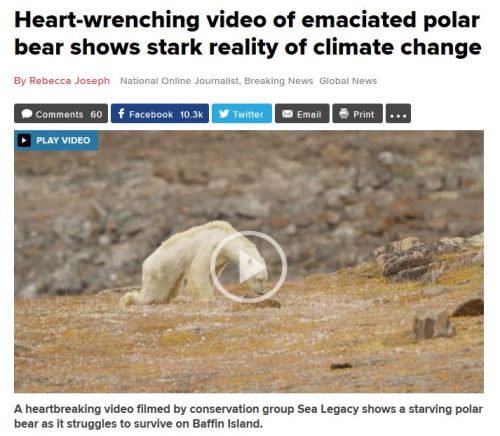
We finally have this year’s example of the new fad of claiming every polar bear that died of starvation (or on its way to starving to death) — and caught on film — is a victim of climate change: a young bear on Somerset Island near Baffin Island, Nunavut filmed in August during its last agonizing hours by members of an activist conservation organization called SeaLegacy.

‘I filmed with tears rolling down my cheeks’: Heart-breaking footage shows a starving polar bear on its deathbed struggling to walk on iceless land.” [actual title of article in the DailyMail Online, 8 December 2017]. CBC Radio (8 December 2017) jumped on it as well, as have others. National Geographic ran a similar story, like others, that compliantly emphasized the future man-made global warming threat the photographers were touting.

Baffin Island starving pb headline_GlobalNews_8 Dec 2017

This is no different from Ian Stirling’s “bear that died of climate change” back in 2013, or several others since then: here, here, and here (one of these incidents also involved the same photographer as this incident, Paul Nicklen). I’ve called this practice of filming dead or dying bears and splashing the photos across the pages of newspapers and the internet “tragedy porn” — a kind of voyeurism that leaves people open to emotional manipulation. The internet laps it up.

UPDATE 9 December 2017: a quote from another source shows photographer Paul Nicklen’s “expertise” in polar bear biology, see below.

UPDATE 11 December 2017: an Arctic seal specialist, Jeff Higdon, has weighed in via twitter about the possible cause of death of this bear and also what the SeaLegacy team should have done when they found the bear in this condition. See below

UPDATE 12 December 2017: See my update to this post here.

Continue reading

W Hudson Bay polar bear season wrap-up: problem bear stats & sea ice vs. 2016

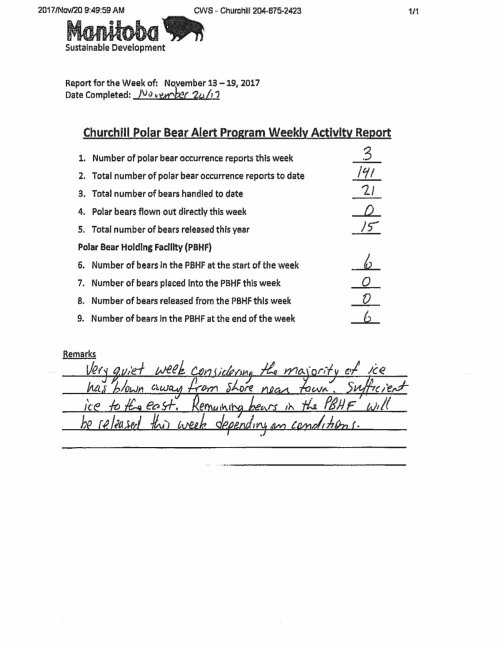
This year, due to an early freeze-up of the sea ice, many polar bears left the Western Hudson Bay area (including Churchill) the week of November 6-12. However, the folks who produce Churchill’s problem polar bear statistics did not generate a report for that week, so we are left with assessing the final freeze-up situation based on the previous report (see it here) and the one they have just released for the week of 13-19 November (below), the 18th week of the season (which began July 10):

Churchill Polar bear alert report Nov 13-19_Nov 20 released

The “quiet” week was almost certainly due to the fact that very few bears were still around, having left the previous week.

While it is apparently true that a south wind briefly blew ice away from the area around the town of Churchill, most bears had left by that point and there was plenty of ice to the north and southeast for bears that had congregated outside the town to wait for the ice to form.

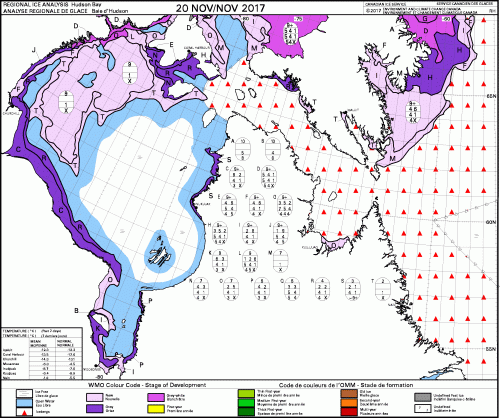
Churchill sits on a point of land (see map below) that makes new ice vulnerable to winds from the south but this year impact was small: the north winds returned within a few days and so did the ice.

Hudson Bay weekly ice stage of development 2017 Nov 20

By this week there were still a few stragglers that hadn’t left shore but most of these were mothers with cubs, as well as young bears living on their own, who often hold back to avoid dangerous encounters with adult males at the ice edge.

A few adult males that were still in excellent condition after 4 months ashore without food seemed in no particular hurry to resume hunting. In part, this may have been due to the rather foul weather prevalent since the first week of November (with howling winds, low temperatures and blowing snow much of the time).

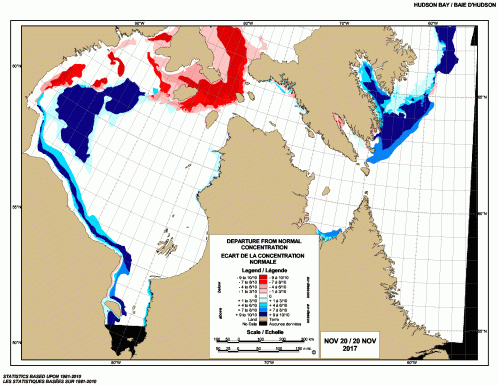
You can see in the chart below just how much more ice there was for the week of 20 November compared to average — all those dark and light blue areas along the west coast of Hudson Bay (and east of Baffin Bay) indicate more ice than usual. Even Southern Hudson Bay has enough shore ice for bears to resume hunting. Foxe Basin (to the north of Hudson Bay) has less ice than usual (red and pink) but there is still enough ice for polar bears there to begin their fall hunting, as the chart above makes very clear.

Hudson Bay weekly departure from normal 2017 Nov 20

Freeze-up and bear movement offshore were about three weeks earlier this year in Western Hudson Bay compared to 2016, which made a huge difference to the number of problem bears in Churchill, see below.

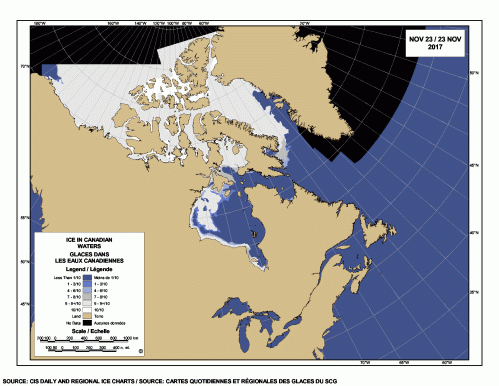
UPDATE 23 November 2017: CIS ice chart for today showing the ice forming in the northwest sector of Hudson Bay

Sea ice Canada 2017 Nov 23

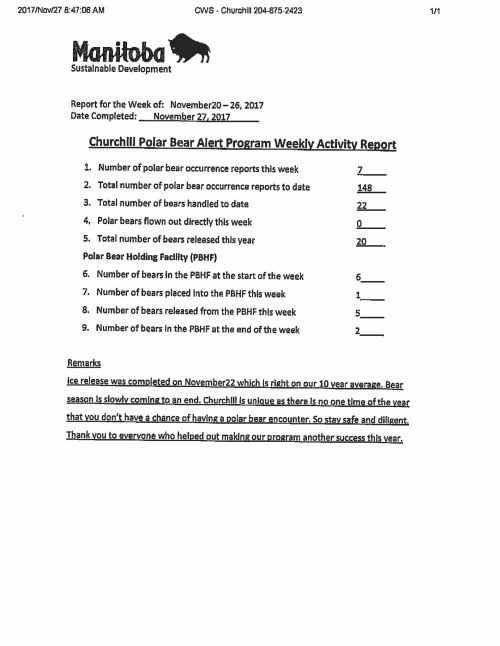
UPDATE 27 November 2017: Final problem polar bear report copied below, issued by the town of Churchill. As noted above, the fact that some bears remained onshore into last week was a very local anomaly not experienced over the rest of the region.

churchill-pb-reports_week-19_20-26-nov-2017_last-of-the-season.jpg

Continue reading