Category Archives: Life History

Polar bear mating season winds down with lots of sea ice habitat available

Habitat for polar bears is abundant worldwide as the prime feeding season passes its peak and mating season for sexually mature bears winds down.
JR1_1266.tif

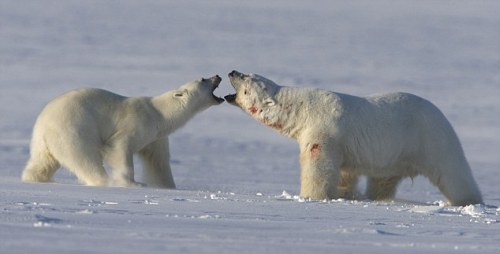
Battle among polar bear males for the right to mate, from this 2011 DailyMail story here.

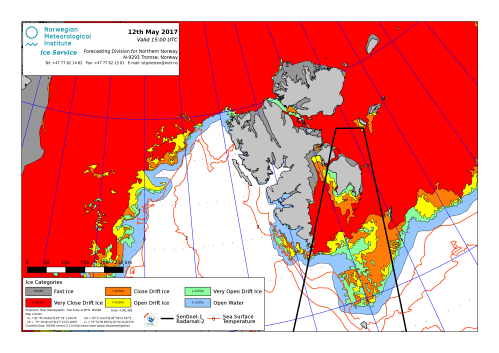
There is much more ice than usual around Svalbard in the Barents Sea and off Newfoundland and southern Labrador, home to ‘Davis Strait’ bears. There have been no media reports of polar bears onshore anywhere (since the third week of April in Newfoundland and late January in Svalbard).

Sea ice map below for 12 May 2017:
Svalbard ice extent 2017 May 12_NIS

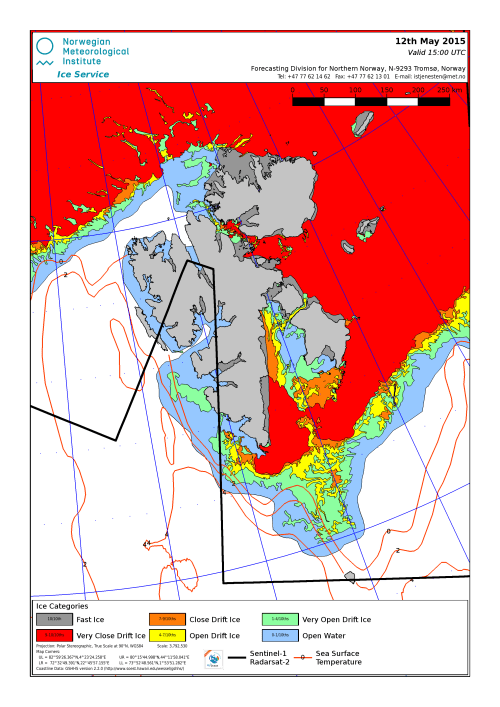
Compare the extent and concentration of ice around Svalbard above (at 12 May 2017) to conditions that prevailed on the same date in 2015 (below), considered a “good ice” year for local polar bears (and the year of the last population size count which registered an increase over the 2004 count):
Svalbard ice extent 2015 May 12_NIS

There hasn’t been this much ice in the area at this point in the season for many years, especially to the north of Svalbard, and levels since late April have been above even the long-term average (disregard the huge downward blip, which is clearly a sensor malfunction of some kind):
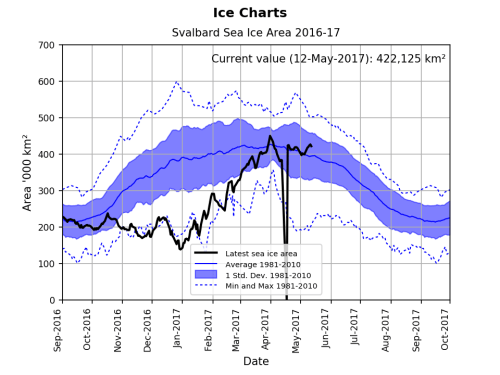
Svalbard ice extent 2017 May 12 graph_NIS

In fact, ice is pretty solid throughout the Barents Sea and East Greenland at this time:
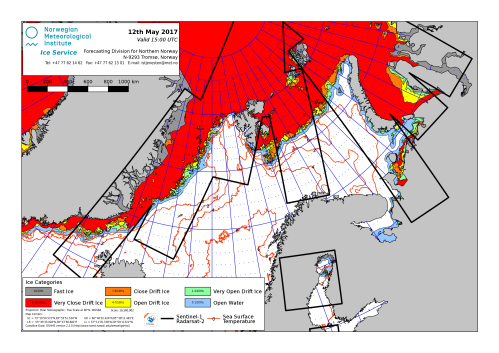
Barents Sea ice extent 2017 May 12_NIS

Across the Atlantic, the situation is similar, with unseasonably heavy sea ice off eastern North America and the Southern Beaufort Sea.
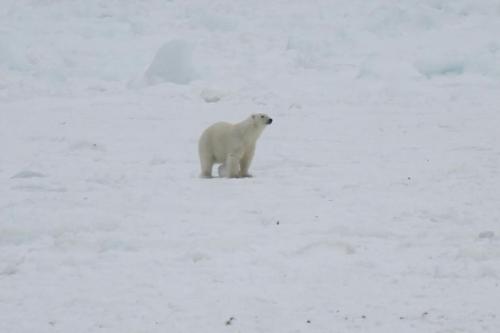
Continue reading

East Coast crawling with polar bears since early March thanks to the pack ice

The  hot polar bear news right now is the large number of sightings of bears onshore in Newfoundland and Labrador – even the CBC is impressed.

Melrose nfld Polar Bear 02_2017 April 3_Brandon Collins shared photo The Packet

Photo taken by Brandon Collins in Melrose (on the Trinity Bay side of the peninsula) Monday 3 April 2017

All the bears have been brought to land by the abundant pack ice that’s been present off Labrador and northern Newfoundland (the territory of Davis Strait polar bears), which also killed a humpback whale that got trapped against the north shore (a not unusual event, apparently).

Mapping the reports of polar bear sightings since early March helped me get a handle on the total number of encounters: more than a dozen, it turns out.  There have been a few bear sightings in this region every year recently but such high numbers are remarkable, especially so early in the season. When will it end?

Increased numbers of bears in the population is one explanation for increased numbers of encounters onshore at this time of year, although recent storms may have encouraged more bears than usual to come ashore in Newfoundland.

My picture annotated map and a list of sighting reports, with links, is below but stay tuned: this story may not be over yet.

UPDATE 4 April: more photos and sea ice maps added below.

UPDATE 5 April: another sighting, in St. Brendan’s (west of Bonavista), added to the map below and quotes from one witness. The map is now Version 2. A sea ice map for 5 April has also been added at the end of the post.

UPDATE 9 April: another sighting and a bear casualty, see below. Map revised again.

UPDATE 14 April: CBC Newfoundland article (12 April: Highway of ice: Easy route for polar bears chasing food, prof says) based on my radio interview that aired 11 April.

UPDATE 22 April: Another sighting west of St. Anthony on Wednesday, 19 April has been added to the map (now Version 4) and an alert that I’ve added a new post (21 April) about the claim by one vocal polar bear specialist that all of these sightings are the result of “failed” sea ice conditions off Newfoundland and Labrador this year (seriously, I’m not making this up). I’ve added the most recent ice map at the end of this post.
Continue reading

Another fat bear onshore in late winter, along Gulf of St. Lawrence north coast

Another fat bear onshore in late winter, this time along the Quebec shore of the Gulf of St. Lawrence (22 March 2017) – and this time, one of the witnesses to the sighting took some great photos. Courtesy CBC News (Polar bear makes rare appearance on Quebec’s Lower North Shore 24 March 2017).

Gulf St Lawrence North shore PB visit 22 March 2017_CBC headline

Quotes, location map, and sea ice charts below.

Continue reading

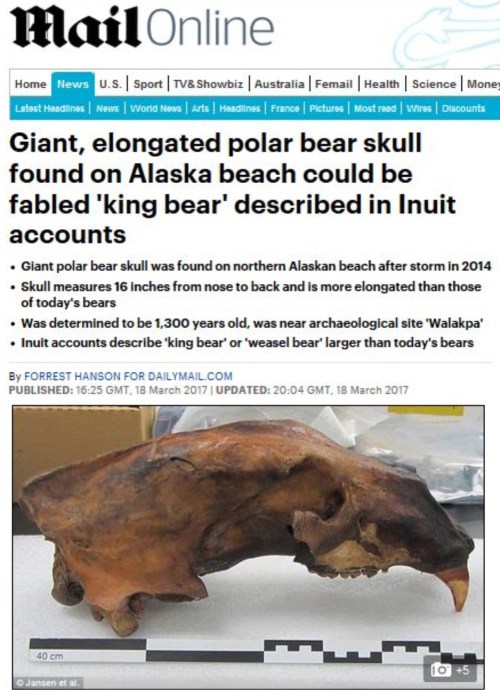
Prehistoric polar bear find has elongated body type Inuit know as a ‘weasel bear’

A story that broke in Alaska newspapers a month ago made the UK press this weekend about the archaeological discovery of 1,300 year old polar bear skull that may be associated with an unusual body type known to Inuit hunters. See the Mail Online cropped headline below, full story here – and some quotes and critical background below.

Weasel bear headline with skull graphic 18 March 2017

Continue reading

Several fat polar bears sighted in southern Labrador early this week

Seven polar bears came ashore this week, either passing through or exploring, in Black Tickle, Labrador. It’s not that unusual an occurrence but the take home quote sure is:

“They look really healthy … they have been eating good, these ones have.”

Lucky for them – residents in my novel – EATEN – were not so lucky.

Black Tickle polar bear visits 7 March 2017_CBC news 8 March

A bear onshore along eastern Hudson Bay late last month was also described as fat.

Quotes from the CBC News report (8 March 2017: “7 polar bears visit stormbound Black Tickle“) below.

Black-tickle-map-Labrador 2016

Continue reading

Report of Hudson Bay polar bear onshore in winter is rare indeed – here’s why

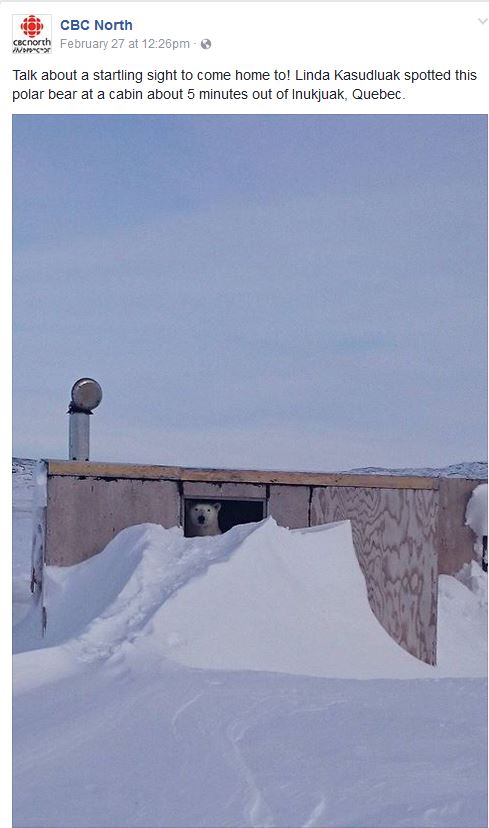
Late February is still the dead of winter in the Arctic, a time when most polar bears are at their leanest and out on the sea ice trying to find seals – and that means yesterday’s report of a “very fat” polar bear onshore outside Inukjuak is unusual at face value – but my followup inquiry revealed details that make it even more startling.

bear-onshore-end-feb-2017_cbc-photo-facebook

CBC North facebook entry 27 Feb 2017

At my request, CBC North reporter Priscilla Hwang reached out to the hunter involved, who is the mayor of the community. She was told the incident took place on Saturday 25 February 2017 and the very fat bear in the story was actually a young, subadult female.

Subadults are more likely to be in poorer condition than adults at any time of year, due to their lack of hunting experience and competition with adult males. So to see a young bear that’s very fat before the feeding begins is quite astonishing: it suggests that feeding opportunities out on Hudson Bay have been very good over the winter and/or this bear was a savvy hunter despite her youth.

According to the mayor’s report, this community hasn’t had a bear onshore in nearly 30 years. Polar bears in Hudson Bay travel with the retreating ice to the western and southern shores, so with some exceptions, bears usually only have access to the east coast during winter through spring.

Last winter saw an extraordinary number of reports of bears on shore in winter, most of them causing trouble (see summary here). This Inukjuak sighting is the second I’ve come across this year – the other was in Svalbard (a female with cubs). Whether this new pattern is due to more bears or lack of hunting leading to bears having less fear of people – or a bit of both – it’s not yet possible to say.

So under the circumstances, the mayor of Inukjuak’s decision to kill this bear for the protection of the community seems quite reasonable (given the extensive resources required in Svalbard to drive their problem bears away rather than kill them).

Excerpts from the CBC story, and some maps and charts, are below.
Continue reading

Polar bear habitat update for Canada at mid-February

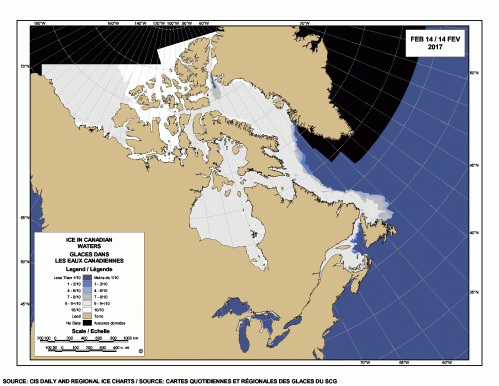
Mid-February is the tail end of the winter fast for polar bears. Sea ice is approaching it’s maximum global extent but local maximum extents may vary. Most of the sea ice in Canada is locked in already but two regions still vary at this time of year: the Labrador Sea off Labrador and Newfoundland – where polar bears come to feed on an abundance of newborn harp seals – and the Gulf of St. Lawrence, where polar bears have not been spotted in more than 60 years. sea-ice-extent-canada-2017-feb-14_cis

There is almost certainly enough ice for harp seals to give birth in the Gulf this year, if the ice holds (despite some premature hand-wringing by seal biologists). There is more ice in the Gulf and off Newfoundland this year than there was in 2013 (see map below). Continue reading

New paper updates lack of trend in W Hudson Bay breakup/freeze-up dates to 2015

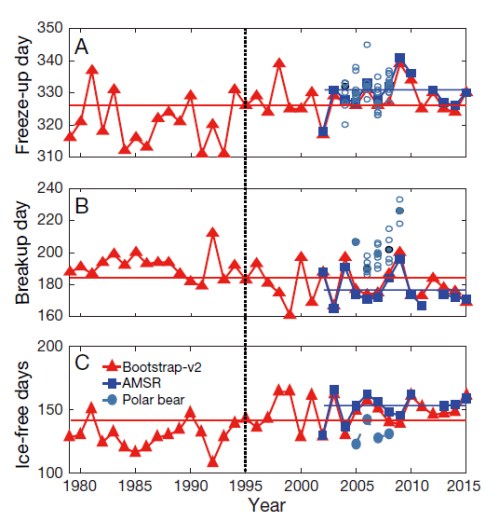
A newly-published paper shows that there has been no trend in the time Western Hudson Bay polar bears spent onshore between 2001-2015 due to sea ice conditions at breakup or freeze-up (previously available to 2010 only), despite the marked decline of global sea ice since 2007.

castro-de-la-guardia-et-al-derocher-2017-fig-3-no-caption

Figure 3 from Castro de la Guardia and colleagues (2017) showing freeze-up and breakup dates and ice-free days 1979-2015 for Western Hudson Bay. Figure with caption, copied below, explains symbols.

Previously, a 2007 paper by Eric Regehr and colleagues for WHB bears up to 2004, which was used to support the US bid to list polar bears as ‘threatened’ with extinction, concluded that between 1984 and 2003, bears were spending 3 weeks longer onshore than they did in the 1980s.

The big news from Castro de la Guardia et al. (2017) is that polar bears spent longer onshore from 1979-2015 by … 3 weeks. That is, no change from the situation in 2004. Wow!

Note the population size of the entire WHB subpopulation has also not declined since 2004 and is currently estimated at about 1030, based on a 2011 aerial survey (Stapleton et al. 2014).

Thanks to Andrew Derocher for the heads-up tweet.

From the abstract (my bold):

We found that the ice-free period in this region lengthened by 3 ± 0.8 wk over the period 1979−2015. Polar bears migrated onshore 2 wk earlier and offshore 1 wk later in the period 2005−2015 than in 1980−1989.

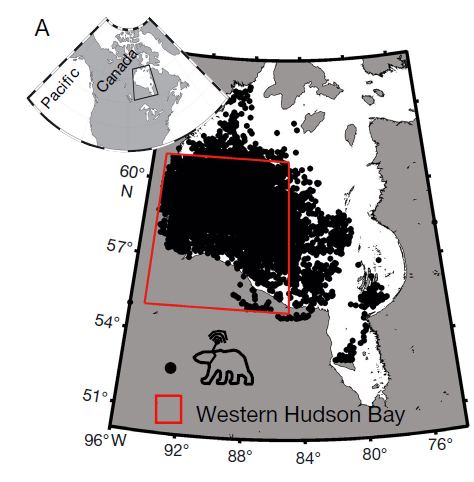
Here is the region in question, illustrated by Fig. 1 from the paper:

castro-de-la-guardia-et-al-derocher-2017-fig-1a-locationThe significant information contained in this paper is breakup and freeze-up dates and length of the ice-free period data for 2010-2015, which has been unavailable until now. More excerpts and comments below, including Figure 3 with its caption. Continue reading
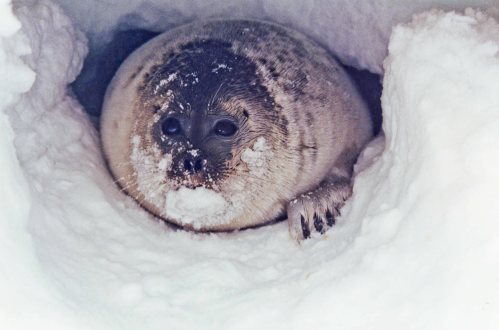
Svalbard polar bears thrive in part due to ringed seal pups in the spring pack ice

Few people know that Arctic ringed seals (Phoca hispida, aka Pusa hispida) give birth and breed in the offshore pack ice in the spring, as it is seldom mentioned by either seal or polar bear specialists.

While it is true that some ringed seals give birth in stable shorefast ice close to shore, many others give birth well offshore in thick pack ice – where polar bears also live and hunt in the spring but where few Arctic scientists ever venture – and the existence of pack ice breeding ringed seals is one of the reasons that polar bears are such a resilient species.

ringed-seal-in-snow-cave_b-kelly-wikipedia

Ringed seal pup in a snow cave, B. Kelly photo (Wikipedia).

As a consequence, despite fears expressed by Ian Stirling, low shorefast ice and associated snow around Svalbard this winter (and any time in the past) is not necessarily a hindrance to polar bear survival because there are ringed seal pups available out in the surrounding pack ice – where bearded seals also give birth.

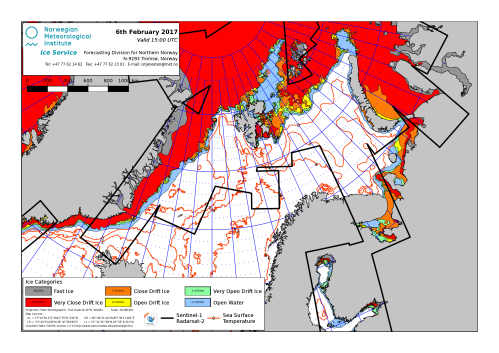
Of course, ringed seals pups are also available to Svalbard polar bears in the shorefast ice in the Franz Josef Land archipelago to the east (see map below) but it is the pups born in the offshore pack ice that are of interest here. The existence of pack ice breeding ringed seals may be why Norwegian biologists do not currently monitor ringed seals in the Barents Sea, despite many years of poor ice conditions around Svalbard in spring – this simply is not a species of concern.

barents-sea-ice-2017-feb-6_nis

The fact that distinct ringed seal ecotypes (or habitat-specific morphotypes) exist in the Arctic – one that gives birth and breeds in shorefast ice and another that gives birth and breeds in offshore pack ice, perhaps driven by competition for limited shorefast ice habitat – is a phenomenon a colleague and I discussed in a peer-reviewed book chapter published several years ago. Have a look at the excerpt below and see what you think.

Save

Continue reading

Polar bears onshore in Svalbard in most dangerous season for bear attacks

Yesterday marked the first report I’ve found for polar bears onshore this winter, in a potentially dangerous repeat of a pattern that has become all-too common in recent years (especially last year) with bear populations booming virtually everywhere (but especially around Svalbard).

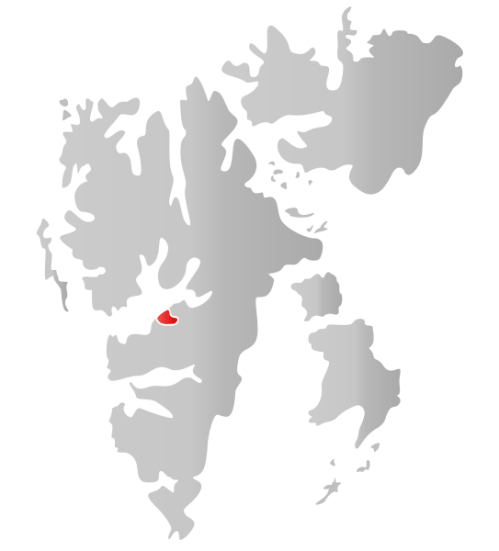
longyearbyen_sm_location_wikipedia

This is the leanest time of year for polar bears – fat Arctic seal pups won’t be available for another 2-3 months and meals for polar bears are hard to come by – and that makes the bears especially dangerous.

So, despite the marked lack of sea ice around Svalbard this winter, a female polar bear with two cubs were reported near the community of Longyearbyen (still enduring 24 hours of darkness) – on the west coast of the archipelago (see map above), where sea ice has been virtually non-existent for years (see map below).

Svalbard ice 2017 Jan 17_NIS.png

It appears these bears traveled overland from ice off the east coast. There is no mention in any of the reports that the bears were thin or in poor body condition, or had so far caused any of the problems for which desperately hungry polar bears are famous. However, one dog-sledding guide had a frightening encounter in the dark in this on-going saga that began over the weekend (details and photos below). Continue reading