Category Archives: Population

Critical evidence on W Hudson Bay polar bears still not published after 25 years

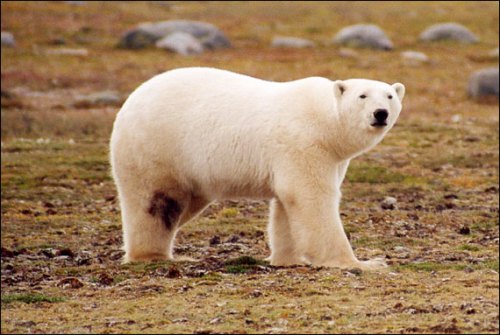
Polar bear researchers have been doing capture/recapture studies in Western Hudson Bay for decades yet most of the data claimed to be critical for assessing effects of human-caused global warming on this species have not been published. I raised this point in one of my early blog posts (27 Sept 2012) but the situation has not changed in 6 years. Here’s an update.
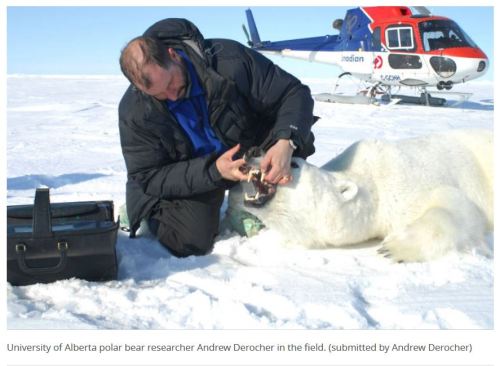
Derocher in the field in WH_CBC story 2016

From CBC story 14 Sept 2016.

Years ago now, in an oft-cited paper, Stirling and Derocher (2012) claimed to summarize the evidence that climate warming was negatively impacting polar bear health and survival. Several life history parameters were considered crucial, particularly body condition.

Despite almost a dozen papers (and perhaps more) on various aspects of WH polar bear health and life history studies based on capture/recapture data published since 2004  (e.g. Castro de la Guardia 2017; Lunn et al. 2016; Pilfold et al. 2017), none have reported the body condition data that supposedly support the claim that sea ice loss is having a severe impact — and the same is true for litter size, proportion of independent yearlings, and cub survival.1
continue reading

Southern Hudson Bay polar bear region shows slight decline after decades of low sea ice

A newly-published paper by Martyn Obbard and colleagues in the journal Arctic Science claims a 17% decline in abundance of polar bears in the Southern Hudson Bay region after years of reduced sea ice and declining body condition (Obbard et al. 2018). The decline in numbers was not statistically significant but an additional statistical analysis (“Monte Carlo simulation”) not applied to any other estimate in recent years suggested the decline could be real, so a real decline is what was reported to the press.

James Bay polar bear_ministry of Ontario_Walton photo

Only one Canadian Press story has so far been circulated amongst outlets in the media (published hours after the paper appeared online, not at the same time), suggesting there was no press release issued for this study. Odd, that — especially if the decline is as real and significant as the authors suggest.

While no evidence was provided for a correlation of this decline in numbers to recent (2012-2016) sea ice decline, previous evidence from the region (Obbard et al. 2016) showed a decline in body condition was correlated only with much later than usual freeze-up, a situation that did not occur from 2012 to 2015 (freeze-up was late in the fall of 2016 but occurred months after the Obbard et al. (2018) survey was completed).

Moreover, the paper reports that a decline in survival of yearling cubs (from 12% of the population in 2011 to 5% in 2016) was not associated with especially poor sea ice conditions in spring. We are likely to see a follow-up paper next year reporting the body condition and sea ice data from this study (as for the previous survey: Obbard et al. 2015, 2016), but there is no suggestion in this paper that body condition declined further from 2011/2012 levels or that sea ice conditions deteriorated markedly enough after 2012 to precipitate a population decline.

UPDATE 11 June 2018: See below, more recent versions of population and status assessment maps has been issued by Environment Canada that conclude Southern Hudson Bay is “likely declined.”

Continue reading

Activist laments ESA listing of polar bears in 2008 failed to achieve her political goals

The activist lawyer primarily responsible for polar bears being listed as ‘threatened’ on the US Endangered Species List (ESA) in 2008 is frustrated that those efforts have not generated her preferred political action. Kassie Siegel also claims in another 10 years it will be too late to save polar bears from extinction — despite clear evidence to the contrary.

Walking bear_129029633_web size

In an emotional rant over at The Hill with a predictably hysterical headline, Siegel perhaps reveals more than she should about her motivation (“Keeping fossil fuels in the ground is the only way to save polar bears ravaged by climate change,” 26 May 2018).

Continue reading

Status of Canadian polar bears updated map from Environment Canada

During a meeting of polar bear range states (Canada, Russia, Greenland, Norway, and the USA) in late January 2018 to discuss conservation issues, Canada — home to ~2/3 of the world’s polar bears — included in its presentation an updated population status and trend map approved by the Polar Bear Technical Committee in its presentation. This 2017 map replaces one from 2014 but is not yet available on the Environment Canada website.

Lunn et al 2016 EA cover image WH bear

UPDATE 11 June 2018: More recent versions of population and status assessment maps, published by Environment Canada 6 June 2018, conclude Southern Hudson Bay and Western Hudson Bay subpopulations have “likely declined.” See 11 June post here for more details and copies of the maps.

Contine reading

Polar bear numbers, margins of error, & consequences for conservation status

Large margins of error in polar bear population estimates means the conservation status threshold of a 30% decline (real or predicted) used by the US Endangered Species Act and the IUCN Red List is probably not valid for this species.

Polar_Bear_Biologist_USFWS_working_with_a_Bear_Oct 24 2001 Amstrup photo

Several recent subpopulation estimates have shown an increase between one estimate and another of greater than 30% yet deemed not to be statistically significant due to large margins of error. How can such estimates be used to assess whether population numbers have declined enough to warrant IUCN Red List or ESA protection?

What do polar bear population numbers mean for conservation status, if anything?

Continue reading

Polar bear specialist Mitch Taylor on accountability in polar bear science

Polar bear specialist Mitch Taylor emailed me and others his response to the New York Times article that appeared Tuesday (10 April) about the Harvey et al. (2018) BioScience paper attacking my scientific integrity. Here it is in full, with his permission, and my comments. Don’t miss the footnote!

Mother with cubs Russia_shutterstock_71694292_web size

Continue reading

Steve Amstrup is lying to the media about my critique of his 2007 model

Until now, my scientific paper post at PeerJ Preprints for review, about the failure of Steve Amstrup’s 2007 USGS polar bear survival model (Crockford 2017), has been formally ignored by Amstrup and his colleagues. But now Amstrup and his colleagues have taken to lying to the media about my analysis because he can’t refute it in a scholarly manner.

Mother with cubs Russia_shutterstock_71694292_web size

Amstrup was quoted by Erica Goode in her New York Times article on the Harvey et al. (2018) BioScience attack paper published Tuesday (10 April 2018: “Climate Change Denialists Say Polar Bears Are Fine. Scientists Are Pushing Back”):

“Dr. Amstrup, however, said that according to the National Snow and Ice Data Center, the average September sea ice extent for the years 2007 to 2017 was 4.5 million square kilometers, “nowhere near the low levels projected it would be by the middle of the century.”

“To say that we already should have seen those declines now when we’re not early [sic] to the middle of the century yet is absurd,” he said.” [my bold]

And over at the online outlet Mashable (11 April 2018: “Climate scientists fight false polar bear narrative pushed by bloggers”), reporter Mark Kaufman quoted Jeff Harvey, lead author of the BioScience paper on the issue, although Harvey is hardly an authority:

“(Harvey noted Crockford misunderstood and then mischaracterized this prediction).”

Amstrup also presented a lame critique of the portion of my Financial Post 27 February 2018 op-ed that dealt with his 2007 predictions, published 2 March 2018 by Climate Feedback (self-proclaimed “fact checkers”), that is easily refuted because it’s a blatant lie. He’s saying 2015 sea ice models are relevant to his 2007 predictions that used 2005/2006 sea ice models.

Continue reading

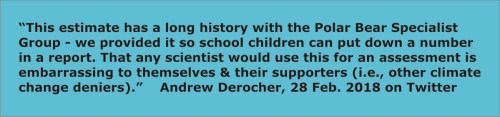
Polar bear population numbers are for kids, says specialist Andrew Derocher

Polar bear specialists made global population numbers the focus of the world’s attention when they predicted a dramatic decline and possible extinction of the species. But now that the numbers have increased slightly rather than declined, the same scientists say global numbers are meaningless: the public should give those figures no credence and anyone who cites global population numbers should be mocked.

NBC 2015_3 there will soon be a big decline in polar bear numbers snap

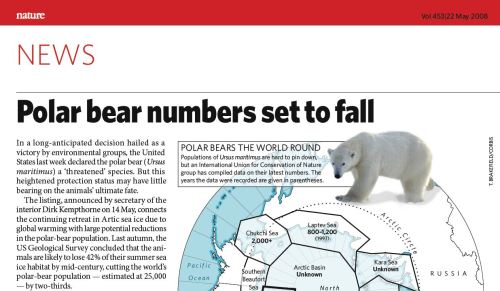
See the screen shot from a 2015 NBC news video above and another from the science journal NATURE in 2008 below (Courtland 2008):

Courtland 2008 headline

Yet, below is a recent message from one of the world’s most vocal polar bear specialists, four years after a similar incident raised the public’s ire:

Derocher tweet 2018 Feb 28 quote

However, you can’t make a plausible prediction of future survival without an estimate of present population size: not even today’s worst journalists would buy it, nor should they.
Continue reading

Amstrup & colleages can’t refute my critique of their 2007 polar bear survival model, Part 2

Polar bear specialists Andrew Derocher and Steven Amstrup recently spent inordinate energy trying to refute the opinion piece I’d written for the Financial Post in celebration of International Polar Bear Day last month, ignoring my fully referenced State of the Polar Bear Report for 2017 that was released the same day (Crockford 2018) and the scientific manuscript I’d posted last year at PeerJ Preprints (Crockford 2017).

polar_bear_USFWS_fat Chukchi Sea bear

Their responses use misdirection and strawman arguments to make points. Such an approach would not work with the scientific community in a public review of my paper at PeerJ, but it’s perfect spin for the self-proclaimed “fact-checking” organization called Climate Feedback. The result is a wildly ineffective rebuttal of my scientific conclusion that Amstrup’s 2007 polar bear survival model has failed miserably.

This is Part 2 of my expose, see Part 1 here.
Continue reading

My Financial Post op-ed: Polar bears keep thriving even as global warming alarmists keep pretending they’re dying

One powerful polar bear fact is slowly rising above the message of looming catastrophe repeated endlessly by the media: More than 15,000 polar bears have not disappeared since 2005. Although the extent of the summer sea ice after 2006 dropped abruptly to levels not expected until 2050, the predicted 67-per-cent decline in polar bear numbers simply didn’t happen. Rather, global polar bear numbers have been stable or slightly improved.

lying-bear-shutterstock_244419640_cropped_web-size.jpg

The polar bear’s resilience should have meant the end of its use as a cherished icon of global warming doom, but it didn’t. The alarmism is not going away without a struggle. Continue reading