Category Archives: Population

Polar bear population now officially 13,071-24,238 says IUCN Polar Bear Specialist Group

Without fanfare of any kind (so far), the IUCN Polar Bear Specialist Group (PBSG) has just announced, via a notice posted on its website, that it has revised the population estimate for polar bears to 18,349 (range 13,071-24,238), based on a new status table posted today.

The average is down slightly from the 2009 estimate of 19,747 (which was officially stated as “20,000-25,000”), but that “decline” is an illusion.

As for the 2005 and 2009/2010 status tables, they do not add up the columns to give the totals — you have to do that yourself, which is how I got the numbers above. There is no mention of a change to the global estimate total in any of the “announcements” on their website.

As occurred in 2005 and 2009
, an overall reduction in the total was achieved primarily through removal of an estimate present on their tables since 1993 (Laptev Sea, “800-1200”). Changing this estimate to zero reduced the average total by 1,000 but does not reflect a real-world change.

In addition, four subpopulation estimates were reduced, three of them only slighty (details below) and three subpopulation estimates (Foxe Basin, Western Hudson Bay and Southern Hudson Bay) were increased to reflect recent aerial survey results. Two others were increased slightly.

A new column has been added to the status table, again without explanation, called the Trend relative to historic level (approx. 25-yr past).” Although only seven out of 19 subpopulations had anything like an accurate estimate in 1989, four are now considered to have been “not reduced” while three are considered “reduced.” Why this is considered meaningful enough to add to the table is not clear.

The PBSG say they have decided to update the status table independent of their meetings, which means that no written report or document will be made available to explain any changes — the “justifications” will only be available online.

These are the people we are supposed to trust to provide honest and accurate information about the status of polar bears worldwide. The changes in the status table provided today, which have been made without oversight of any kind, hardly inspire confidence in the information they provide. See what you think.
Continue reading
Foxe Basin polar bear status – another stable population

Foxe Basin_PBSG

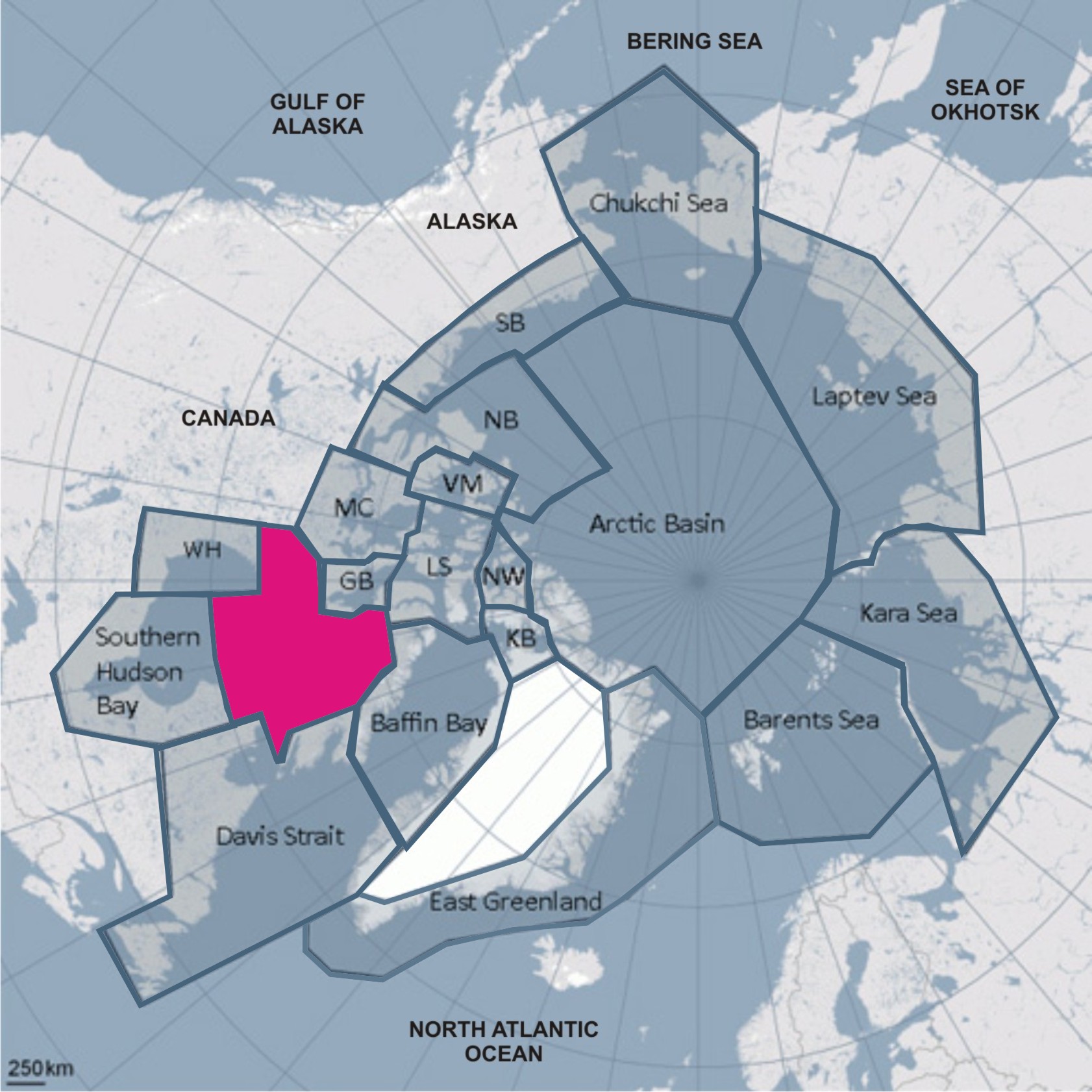
Figure 1. Polar bear subpopulation regions defined by the Polar Bear Specialist Group, Foxe Basin marked.

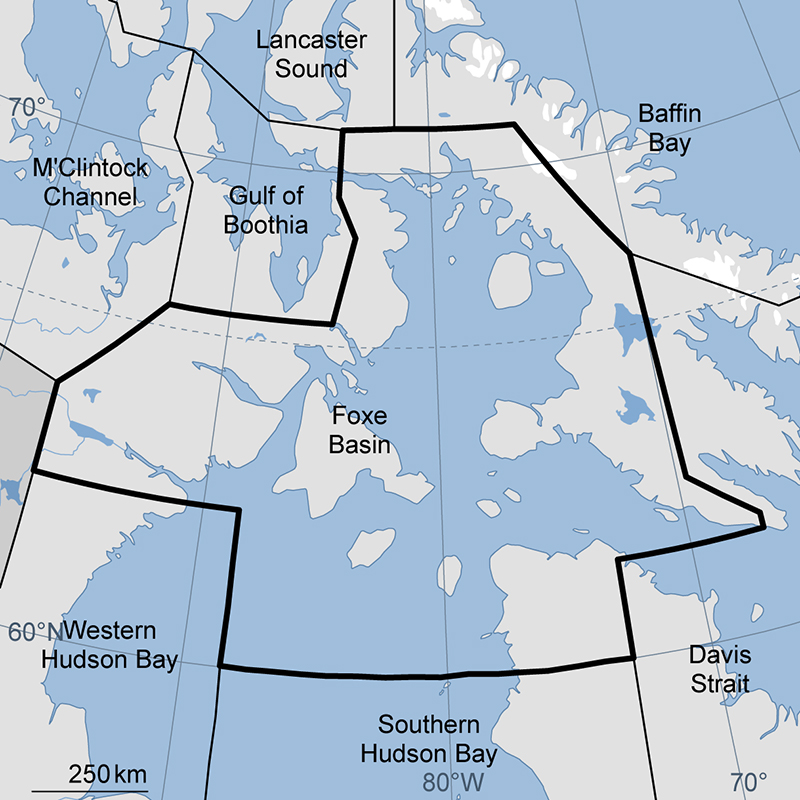
Foxe Basin is a large subpopulation region (Fig. 1), with a total area of 1.18 million square km (Vongraven and Peacock 2011). It comprises Northern Hudson Bay and western Hudson Strait, and the area between western Baffin Island and eastern Melville Peninsula, with a large island (Southampton Island) in the middle (Figs. 2 and 3).

Figure 1. Foxe Basin polar bears subpopulation region, courtesy IUCN PBSG

Figure 1. Foxe Basin polar bears subpopulation region, courtesy IUCN PBSG

Continue reading

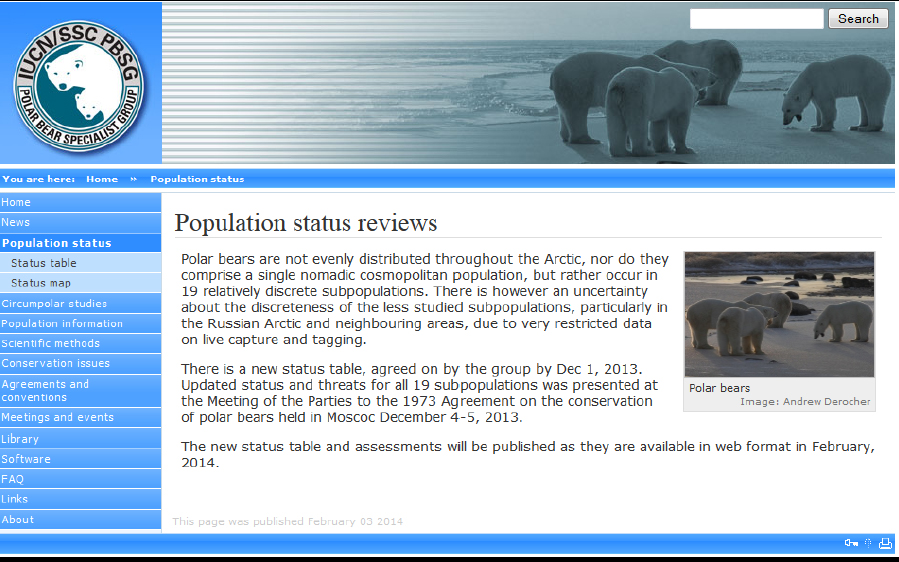
Polar Bear Specialist Group population status update – officially postponed

I kept a close watch on the website of the IUCN Polar Bear Specialist Group (PBSG) over the weekend to see if an actual population status update might eventually appear (see my last post).

Nothing all weekend, but today (Monday, February 3), the “Population status – Status table” tab (where the 2010 status table was inserted on Friday), returned an error message — the out-of-date status table put up on the day an updated one was promised was simply gone.

However, I noticed that the last sentence of the original December 16, 2013 “Population status reviews announcement had been changed, without any indication that it had been amended.

From December 16, 2013 until February 2, 2014 that last sentence said:

“The new status table and assessments will be published as they are available in web format no later than February 1, 2014.

Now it reads:

“The new status table and assessments will be published as they are available in web format in February, 2014.” [my bold]

The date stamp on this page is February 3, 2014, see screen cap below.

What do you call this — “Bayesian transparency”? I think it means a polar bear population status update may be forthcoming…sometime.

PBSG Population status reviews_Feb 3 2014 notice

Polar Bear Specialist Group population status update is much ado about nothing

I cannot for the life of me fathom why the IUCN Polar Bear Specialist Group (PBSG) bothered to insert an announcement on their website back in mid-December, promising an updated polar bear status assessment, since the posted January 31 “update” is nothing of the sort — there have been no changes of any consequence.

It therefore appears I interpreted the oddly worded announcement incorrectly and none of the anticipated changes were forthcoming. Baffling, to say the least. Have a look at the new updated documents that were posted yesterday and see what you think.

Continue reading
New polar bear population status documents completed but have been withheld

I suggested in my last post of 2013 that the biologists of the IUCN Polar Bear Specialist Group (PBSG) might have learned some lessons over the last year about the folly of withholding evidence, fudging data, and trying to hide good news. However, it appears that was wishful thinking.

In the course of writing the essay on my top posts of 2013, I went to the PBSG website to check something, and blow me over with a feather, found an announcement that had been added a few weeks ago (December 16, 2013) without a whisper to the media.

The old PBSG page, “Population status” – which used to say “The total number of polar bears worldwide is estimated to be 20,000 – 25,000” – has been replace by a notice entitled “Population status reviews.

The former estimate population estimate (“20,000 – 25,000”) can no longer be found on the website and no other figure is offered.

The sidebar menu option “Status table” says “will be published soon.”

I’ve copied the short PBSG notice in its entirety below (pdf here):
Continue reading

Zoos use myth of disappearing polar bears to breed them in captivity

Ironically, just as I was about to remind readers that we are entering the peak period of polar bear births around the Arctic (see previous post, “December is polar bear nativity month”), I came across an article about breeding polar bears in captivity — getting the bears to give birth in zoos.

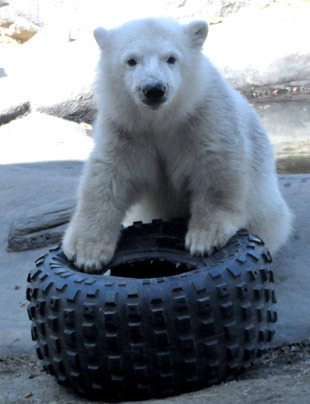
Hudson the polar bear cub moved in January 2013 from the Toronto Zoo, where he was hand-raised after being rejected by his mother, to the Assiniboine Park Zoo, Winnipeg. The Assiniboine Park Zoo were also the recent recipients of a cub orphaned when its mother was shot in the aftermath of a polar bear attack in Churchill.

Hudson the polar bear cub is a zoo-born polar bear. He moved in January 2013 from the Toronto Zoo, where he was hand-raised after being rejected by his mother, to the Assiniboine Park Zoo, Winnipeg. The Assiniboine Park Zoo were also the recent recipients of a cub orphaned when its mother was shot after a polar bear attack in Churchill. Photo from Toronto Zoo.

The newspaper article I saw was all about how technically difficult the generation of polar bear cubs has been for the Toronto Zoo (Canada) but it was the premise for the breeding program itself that caught my attention: to save them from extinction.

The zoo is not waiting until the bears are down to the last few hundred (or even thousands) – no, the zoo is starting now, while polar bears are as plentiful as they have been in the last 40 years, to prepare for their demise.
Continue reading

Eemian excuses: the warm was different then, polar bears were fine

Today I’ll discuss the response by Polar Bears International representative Steven Amstrup to a comment submitted during their recent “webchat” at The Guardian (Wednesday, November 6), which had to do with the fact that polar bears survived warm periods in the geological past, particularly interglacials.

[Here’s a pdf file of all the questions that were answered by PBI staff: PBI webchat Q&A, also available here]

This is the comment (the first portion of #4 on my list), submitted by MarkBLR:

There was a paper in Science magazine last year (link …) indicating that polar bears became a distinct species about 600kya (+/- 300k years).

This means that they have survived at least two (and possibly eight) previous inter-glacials, in particular the Eemian (130kya to 110kya), when temperatures in the Arctic were 5 to 8 degrees Celcius warmer than current temperatures for several thousand years.

Note that their numbers apparently decreased significantly during the Eemian, and slowly increased as temperatures cooled, but “climate change” was not enough on its own to make them extinct. [my bold]

[We can perhaps forgive Mark for not being able to spell “Celsius” correctly, but Amstrup (see below) has no excuse. The paper in Science Mark refers to is Hailer et al. 2012, discussed in a previous post here. Note that the actual question Mark asked is not included here because Amstrup responded to this portion of his comment only]

Amstrup tries to convince Mark and other readers that polar bear resilience through Eemian warming is irrelevant to the issue of future survival, which I’ll demonstrate is not the case at all.

Here is what Amstrup had to say:
Continue reading

Baffin Bay polar bear population survey done, results due end 2014

From this story in today’s Alaska Dispatch (via CBC NewsEye on the Arctic), November 11, 2013, which adds a few more details regarding the progress of ongoing population surveys and the next PBSG meeting:

“The Nunavut government has wrapped up three years of fieldwork on Baffin Bay polar bears, and is preparing to release a new population estimate sometime next year….
Continue reading

Lancaster Sound – a rarely-mentioned region with a large polar bear population

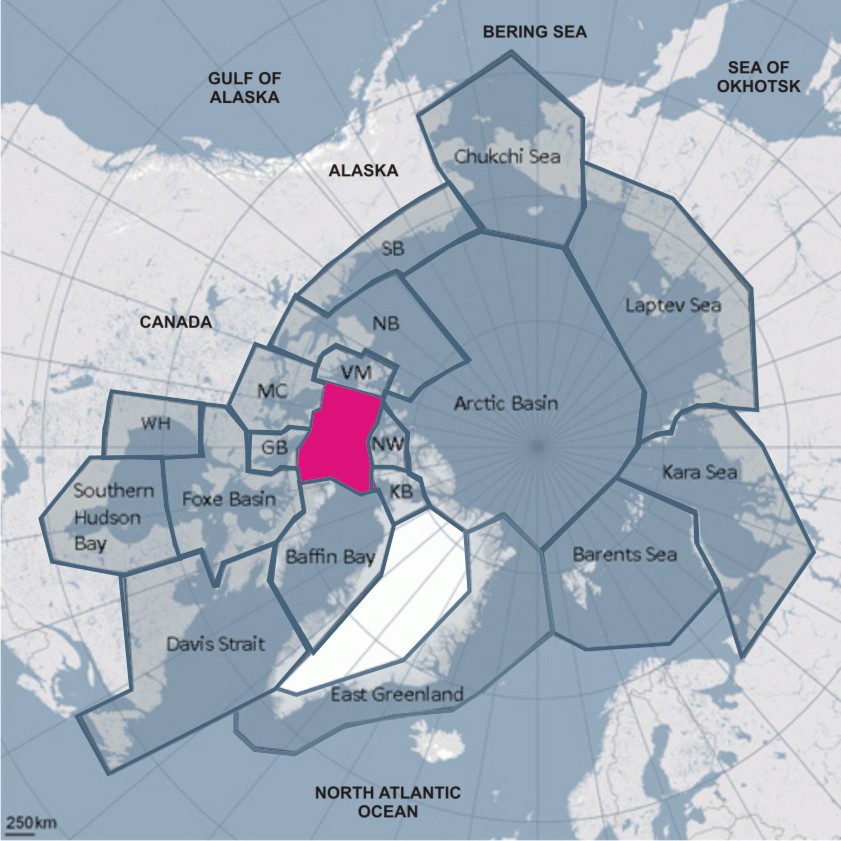
The polar bear subpopulation designated as Lancaster Sound lies at the eastern entrance to the Northwest Passage in the Canadian High Arctic (Fig.1). We rarely hear about it but this region has one of the largest polar bear populations anywhere in the Arctic – only the Barents Sea and Foxe Basin have higher estimated population sizes.

Figure 1. Lancaster Sound, magenta. Map courtesy Polar Bear Specialist Group, additional labels added.

Figure 1. Polar bear subpopulations with Lancaster Sound marked. Map courtesy IUCN Polar Bear Specialist Group, additional labels added.

Lancaster Sound includes the communities of Arctic Bay on northwestern Baffin Island and Resolute Bay on Cornwallis Island. Devon Island, which lies on the northern boundary, has no permanent communities, although two research stations are present (see here and here). A more detailed map showing the exact boundaries is available in Vongraven and Peacock (2011).

The eastern portion of Lancaster Sound is generally clear of ice by late summer (hence the Northwest Passage) but the western third of the region not only retains pack ice later in the season but some multiyear ice remains throughout the year.

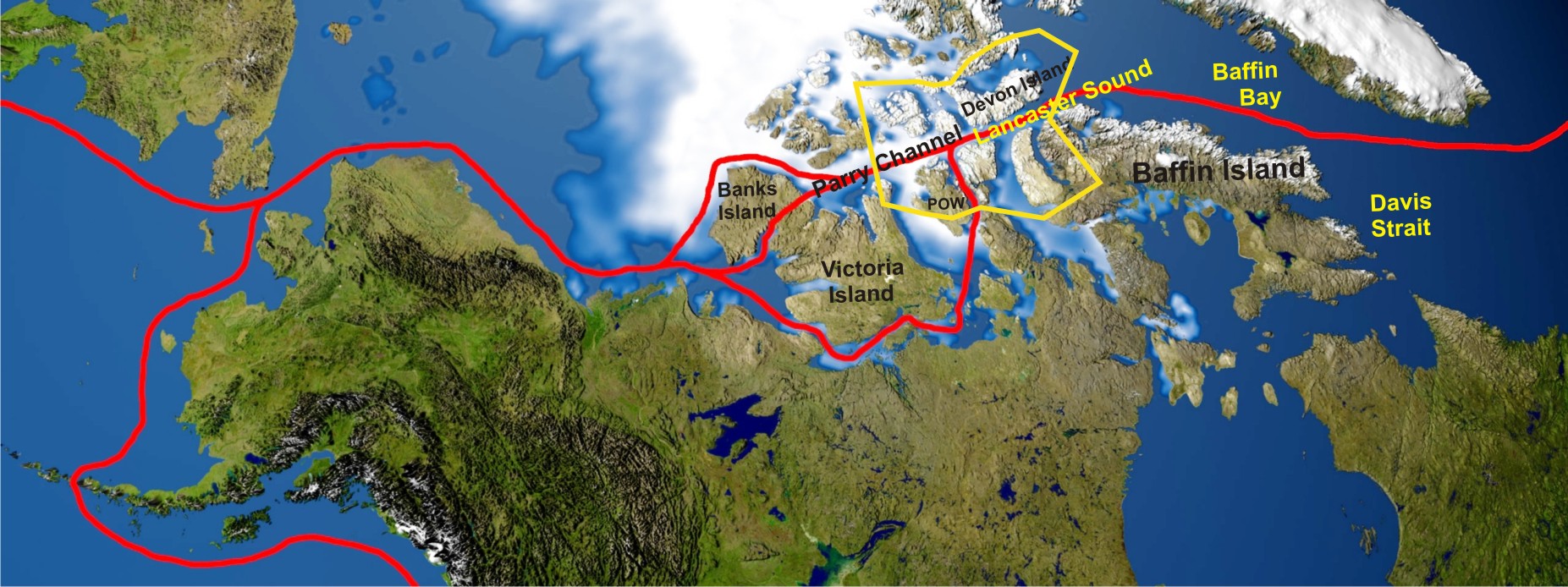
The proximity of Lancaster Sound to Baffin Bay and the eastern Northwest Passage (Fig.2) undoubtedly exposed polar bears there to hunting by European whalers during the 1800s and early 1900s (see previous post here, especially Fig. 5), from which the population appears to have recovered.

On the other hand, the proximity of Lancaster Sound to oil and gas reserves further north in the High Arctic generated much-needed funds for polar bear biologists in the mid-to-late 1970s to collect essential baseline data for the entire region (Schweinsburg et al. 1982; Stirling et al. 1979, 1984; Stirling and Latour 1978).

Figure 2. The main Northwest Passage route starts at Lancaster Sound and runs east through Parry Channel because these waterways routinely clear of ice in late summer. The approximate boundary of the Lancaster Sound polar bear subpopulation (area ~490,000 km2) is marked in yellow; POW is Prince of Wales Island. Map from Wikipedia, labels added.

Figure 2. The main Northwest Passage route starts at Lancaster Sound and runs east through Parry Channel because these waterways routinely clear of ice in late summer. The approximate boundary of the Lancaster Sound polar bear subpopulation is marked in yellow; POW is Prince of Wales Island. Map from Wikipedia, labels added. Click to enlarge.

Continue reading

Barents Sea polar bear status and sea ice declines

So far, I’ve not discussed the Barents Sea subpopulation in very much detail, except in comparison to other groups. For example, the Barents is considered to be the same type of sea ice “ecoregion” as the Chukchi Sea and the Southern Beaufort (discussed here). Previous studies on the Barents Sea polar bear population (Derocher 2005) indicate it may have recovered from extreme levels of overhunting (discussed here) and had stabilized, or was increasing very slowly, as early as 2002 (discussed here) — similar to what has happened in Davis Strait (discussed here).

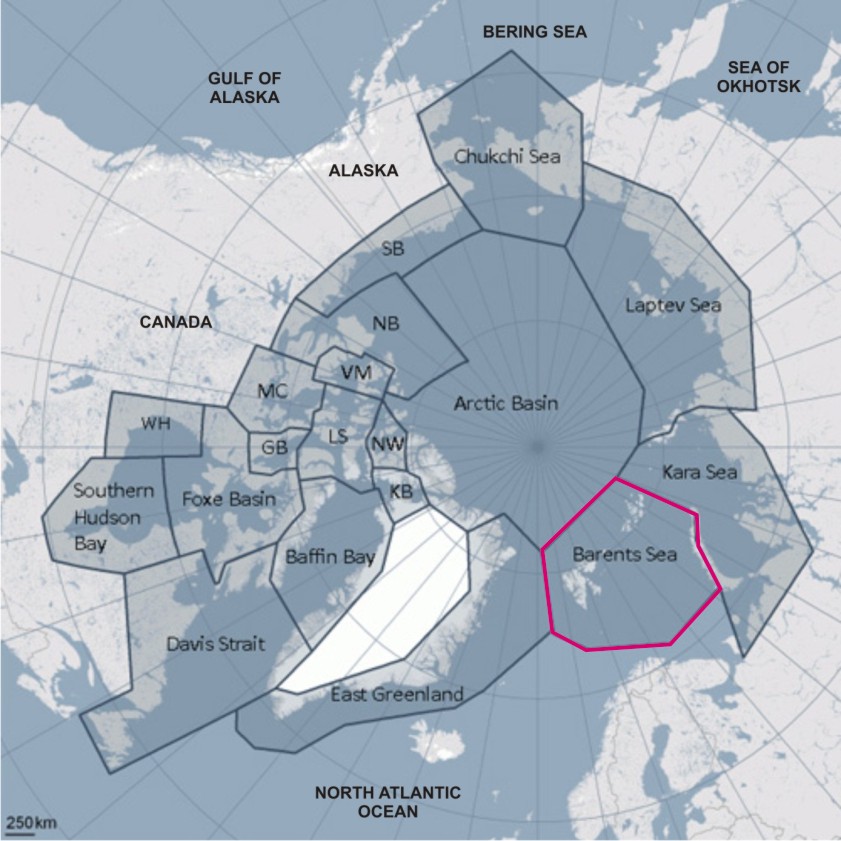
Figure 1. Polar bear subpopulations, with the Barents Sea region highlighted; map courtesy the IUCN Polar Bear Specialist Group (PBSG), extra labels added.

Figure 1. Polar bear subpopulations, with the Barents Sea region highlighted; map courtesy the IUCN Polar Bear Specialist Group (PBSG), extra labels added.

The most recent Barents Sea population estimate was done in 2004 (2,650; range ~1900-3600), based on an aerial survey (Aars et al. 2009). Aerial surveys are the only practical method of establishing population counts in regions like this where many bears never set foot on land. The previous estimate for the Barents (1982) was “2,000-5,000” but its accuracy was considered “poor” (discussed here).

The IUCN Polar Bear Specialist Group (PBSG), in their most recent report, lists the Barents Sea population as “data deficient” for status, current trend and estimated risk of decline within 10 years (Obbard et al. 2010:62, Table 1) and the “notes” for this entry say:

Population estimate is based on a new aerial survey. There was likely an increase in the subpopulation size after 1973 until recently. Current growth trend is unknown.

This 2004 estimate is now almost a decade old and potentially no longer an accurate representation of what’s happening in the Barents Sea. The most up-to-date information has not yet been published but it is available online. It’s eye-opening to say the least, if only that it appears to be yet another example of a polar bear population that is so far not showing signs of being harmed by sea ice declines, as I’ve discussed before (here).

[Update October 15, 2013: I’ve simplified the text discussion and figure regarding the Aars and Andersen denning study from the original posted]

Continue reading