Posted onNovember 7, 2017|Comments Off on Problem bear report for Churchill might be second-last one this year
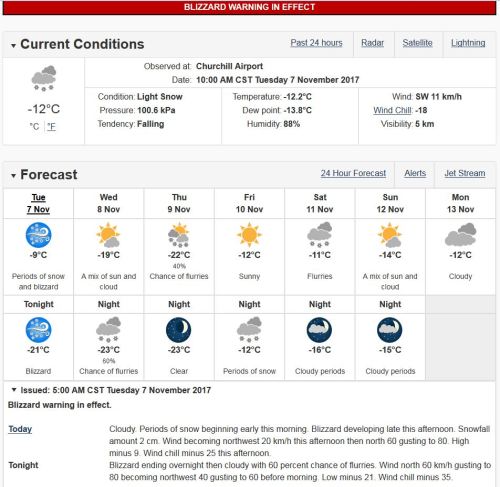
Good news for Western Hudson Bay polar bears that have been getting into trouble in Churchill, Manitoba: the seasons looks to be almost over. Only a few more days of “Polar Bear Week” likely remain, as sea ice will build along the shoreline in response to severe cold and the north winds expected later today.
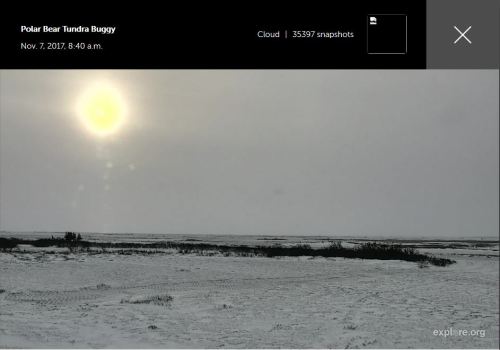
This morning near Churchill, from one of the tundra buggies, post at Explore.org:
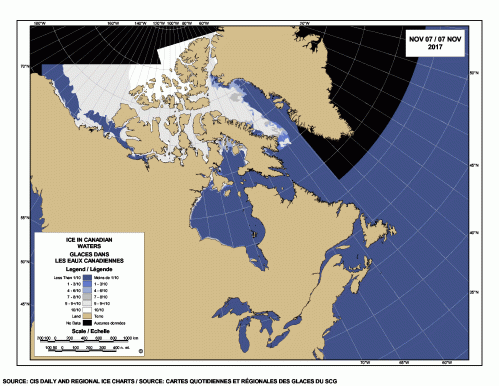
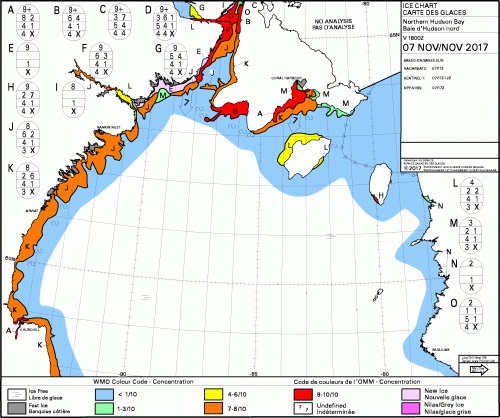
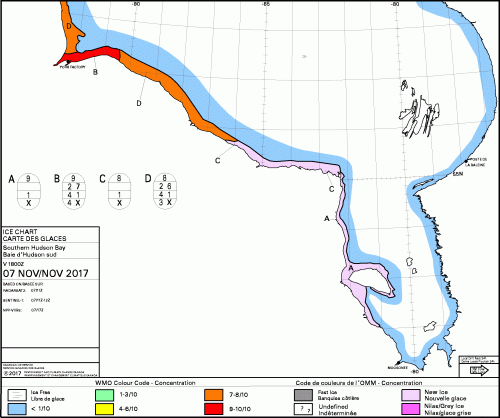
Sea ice at 7 November, will be updated so check back:
Ice forming all the way into James Bay (Southern Hudson Bay), as shown by the daily ice concentration charts for 7 November 2017 (Northern and Southern Hudson Bay) of ice thicker than 15 cm:
Posted onNovember 2, 2017|Comments Off on Early freeze-up in progress on Hudson Bay – what a difference a year makes
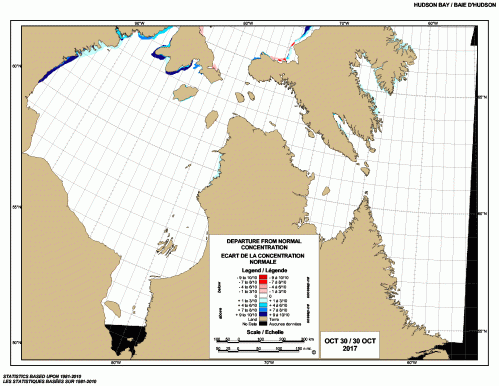
In contrast to 2016, when freeze-up along Western Hudson Bay was about as late as its ever been (early December), ice is already forming along the shore of northern Hudson Bay. There is much more ice than usual for this date, indicated by the dark blue in the latest weekly ice chart below:
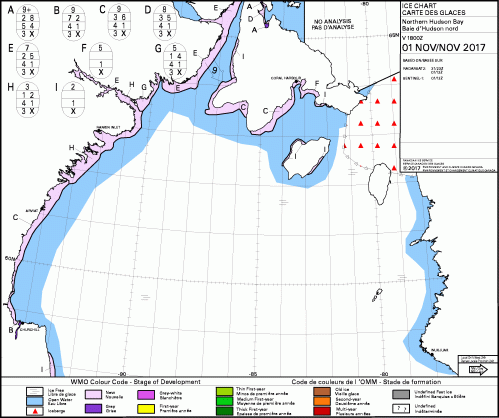
The ice is still thin, as the chart below indicates, but that’s how freeze-up starts. As long as strong winds don’t blow the ice away (as it sometimes does at this stage), the ice gets thicker day by day — and advances further and further off shore. Polar bears get out on the ice as soon as they are physically able, when the ice is about 3-4 inches thick (about 10 cm) or less.
Below is a video of a bear traversing that thin ice yesterday (1 November 2017), near Churchill. Is this a portend of a freeze-up date as early as occurred in the 1980s? Continue reading
Comments Off on Early freeze-up in progress on Hudson Bay – what a difference a year makes
Posted onOctober 24, 2017|Comments Off on Death of the polar bear as climate change icon validates Mitch Taylor’s skepticism
You could call it karma — the death of the polar bear icon after the shameful hubris of polar bear experts back in 2009.
That year, the IUCN Polar Bear Specialist Group booted 20-year member Mitch Taylor out of their organization, explaining that his skeptical views on human-caused global warming were “extremely unhelpful” to their polar bear conservation agenda.
It’s now clear that Mitch Taylor was right to be skeptical of sea ice models based on pessimistic climate change assumptions; he was also right to be more optimistic than his PBSG colleagues about the ability of polar bears to adapt to changing sea ice conditions (Taylor and Dowsley 2008), since the bears have turned out to be more resilient than even he expected.
Fat polar bears — not starving ones — dominate photos taken in recent years. The total failure of polar bear numbers to crash as predicted in response to the abrupt decline in summer sea ice in 2007 and persistent low summer sea ice levels since then (Crockford 2017), is vindication for Mitch Taylor. It’s time someone said so.
Posted onOctober 1, 2017|Comments Off on Fat healthy polar bear update: hundreds of not-starving bears attracted to dead whale
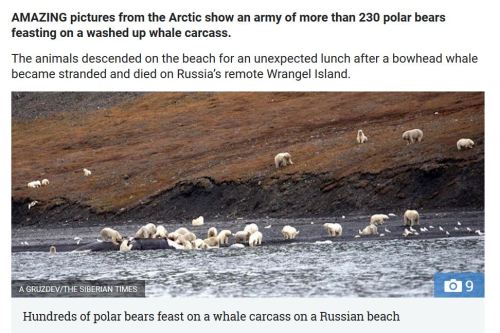
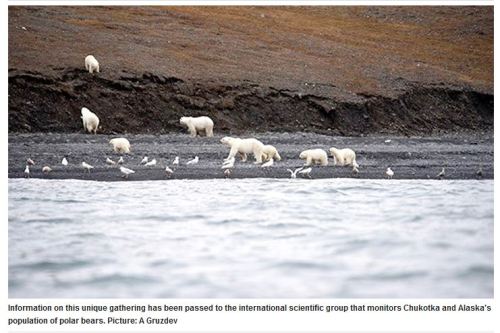
Are the hundreds of polar bears spending the summer on Wrangel Island in the Chukchi Sea starving and desperate for any scrap of food? Hardly! Photos taken by Russian tourists on a cruise ship (19 September 2017) show a huge number of already-fat, healthy bears converging on a dead bowhead whale washed up on a beach. Most of these bears would have been without food since at least early August, when the last sea ice disappeared around the island, and will return to the ice by November.
The extraordinary sight was witnessed by tourists on an Arctic cruise aboard the Finnish-built MV Akademik Shokalskiy.
A source at Wrangel Island Nature Reserve said: “There were at least 230 polar bears, including single males, single females, mothers with cubs and even two mothers with four cubs each.”
Experts called the sight of so many polar bears together “unique”.
The huge number could in fact amount to as much one per cent of the entire world’s population of the creatures.
Tourists initially thought the bears were a flock of sheep after viewing them from a distance, The Siberian Times reports.
But as the boat drew closer, the lucky holidaymakers realised what they were witnessing.
Fat cubs of the year are seen in the photo below, from the Siberian Timesstory:
A self-proclaimed science-based news site (LiveScience,29 September) that picked up the story of this unique event had the temerity to suggest the bears might have been “hungrier than usual” due to global warming.
It deliberately conflates predictions of future starving bears due to low sea ice levels with this observation of many obviously not-starving bears checking out an attractive food source (my bold):
“It’s unclear, however, whether climate change had made these particular bears hungrier than usual. The frequency of starving polar bears is expected to increase as the climate warms and sea ice declines — not just because of climate change directly, but because ice loss is taking away seals, their main food source, Steven Amstrup, chief scientist at Polar Bears International, a nonprofit research organization dedicated to studying polar bears, told Live Science in 2015.”
Except that there is no evidence that ice loss is “taking seals away” — certainly not in the Chukchi Sea. Chukchi Sea seals have been found to be doing better with less ice than they were when there was more ice in the 1980s.
More below, including the location of Wrangel Island and sea ice maps.
UPDATE 2 October 2017: Sea ice in the Chukchi Sea has been lower this summer than over the last few years but the polar bears spending the ice-free season on Wrangel Island are still in good to excellent condition:
Posted onSeptember 19, 2017|Comments Off on Breaking: 2016 W. Hudson Bay polar bear survey shows the population is still stable
A just-released report on the most recent (2016) survey shows Western Hudson Bay polar bear numbers were still stable despite predictions that this subpopulation would be wiped out completely (reduced to zero) due to low Arctic sea ice.
The authors of the report on the August 2016 aerial survey of the Western Hudson Bay polar bear subpopulation (Dyck et al. 2017) state clearly that the only trendsthey could find were that the number of adult males increased somewhat over 2011 estimates and the number of females either declined or remained stable. The overall population estimate was a bit lower (11% less) compared to the 2011 survey but the difference is not statistically significant. Therefore, the population status must be stable.
[cf. Foxe Basin [stable], from 2009-2010 survey (Stapleton et al. 2016) litter size was 1.54]
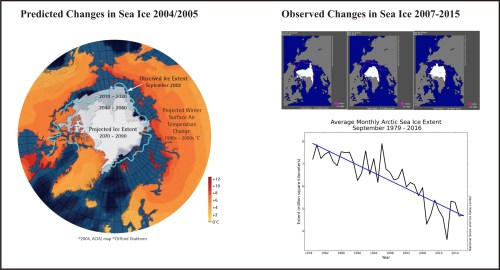
An 11% decline in WH numbers since 2011 is most definitely NOT the decline to ZERO (extirpation) we were told to expect with Arctic sea ice as low as it has been since 2007 (Crockford 2017, see list of annual minimum extents 2007-2017 here).
Note: The percentage decline from 2011 to 2016 for Western Hudson Bay polar bears is 11%, NOT 18% asclaimed recently by Andrew Derocheron twitter: it is not appropriate to compare the official 2011 estimate of 1030 (Stapleton 2014) to the 2016 estimate of 842 because the methods used to generate the estimates were different (Dyck et al. 2017). The authors of the report state that the estimate for 2011 that’s comparable to 2016 is 949.
An 11% decline from 1030 would be 917 bears, a statistically insignificant decline that is also biologically insignificant and therefore, so slight as to indicate a stable population.
Posted onSeptember 10, 2017|Comments Off on Problem bear reports confirm Churchill polar bears are in excellent condition
Now that all bears are ashore for the season, the folks at the Polar Bear Alert program in Churchill note in their report for week 7 (21-27 August, 2017) that the bears ashore are in excellent condition(confirming reports on the first bears ashore in July):
Rather marked contrast to the pessimistic spin on conditions from the field a few months ago:
[yes, a few bears fail to make it through the winter, especially young bears; but that has always been the case — it’s not a sign of human-caused global warming catastrophe]
Last week’s problem bear report also confirmed news from theChurchill Polar Bearswebsite a few weeks ago that showed several images of very fat bears:
See below for last year’s report for week 7 and this year’s report for week 8 (28 August-3 September). Western Hudson Bay polar bears that come ashore near Churchill, Manitoba are starting their third month on land this week, out of the five months or so they have spent ashore in recent years (about 3 weeks more than in the 1980s, no longer than they did in 2004 — conditions have not been getting worse).
Kind of makes you wonder: is Al Gore’s recent climate change movie, An Inconvenient Sequel: Truth to Power, tanking at the box office because he couldn’t include polar bears as an example of the effects of human-caused global warming as he did in his award-winning 2007 effort? Did too many polar bears doom Gore’s 2017 movie?
Conclusions in the video about the predictions of polar bear decline vs. the current status of polar bears and sea ice are documented in my 2017 published paper:
Crockford, S.J. 2017. Testing the hypothesis that routine sea ice coverage of 3-5 mkm2 results in a greater than 30% decline in population size of polar bears (Ursus maritimus). PeerJ Preprints 19 January 2017. Doi: 10.7287/peerj.preprints.2737v1 Open access. https://peerj.com/preprints/2737/
Comments Off on Video: Death of a Climate Icon, the polar bear’s demise as a useful poster child
Posted onAugust 23, 2017|Comments Off on Fat polar bears [and lots of them] drive public confidence in future of the species
What is causing the death of the polar bear as a climate change icon? Fat bears are part of it, but mostly it’s the fact that polar bear numbers haven’t declined as predicted.
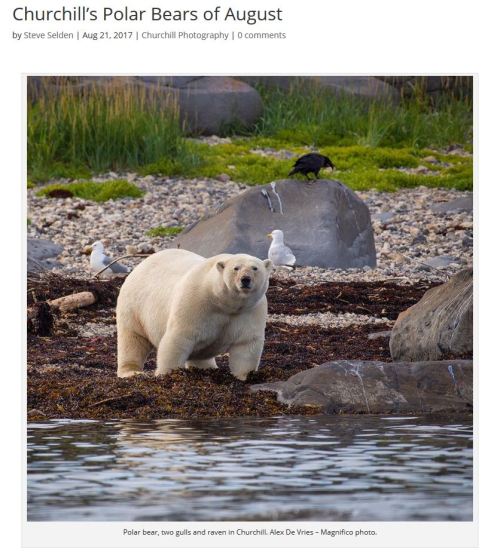
Western Hudson Bay polar bears around Churchill, Manitoba appear mostly in good shape this summer despite thevery late freeze-up last fall, including the very fat bear caught on camera below (see more great pictures here):
Not only have we been seeing pictures of fat bears rather than starving bears in recent years butthere are lots of them, in Western Hudson Bay and other seasonal sea ice regions where there should be none (if the models had been correct). No wonder polar bears arefalling out of favour as an icon for catastrophic human-caused global warming.
[Here’s another picture of a fat bear, this one from Svalbard]
Excuses for why the public is no longer worried about the future of polar bears include a recent claim by climate scientist Michael Mann that “by making polar bears and penguins the poster child for climate change, we have wrongly conveyed that this is some exotic problem far off.”
But none of these apologists acknowledge the simple truth: the models that predicted catastrophefor polar bears due to diminished summer sea ice turned out to be wrong. The sea ice declined but polar bears flourished. Polar bears in seasonal sea ice ecoregions like Western Hudson Bay and Baffin Baydidn’t die offdue to climate change as people were told would happen — why should they believe any of the other scare stories?
In and around Churchill, where tourists flock to see Western Hudson Bay polar bears up close and personal, one bear in good condition recently ran through town:
Overall, there have been fewer problems or conflicts this year in Churchill compared to last (after 6 weeks of onshore living), see below.
Polar bears are no longer a useful global warming icon because they are thriving despite diminished sea ice: Churchill area polar bears are a good example.
Posted onJuly 31, 2017|Comments Off on Churchill polar bear report 24-30 July rather boring compared to last year
This is the third week of reports from the Churchill Polar Bear Alert Program but not much in the way of excitement or information, although more bears must be ashore by now.
Compare to last year at this time, when there was much more activity:
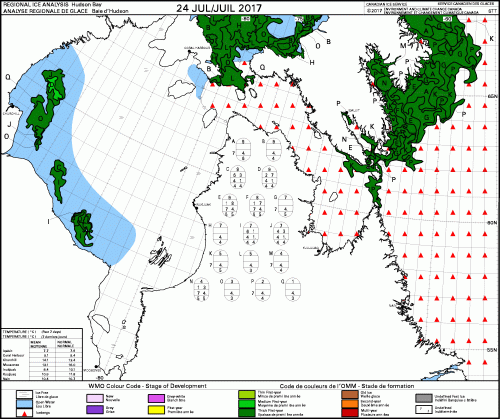
There was still some thick ice lingering off the coast of Western Hudson Bay last week, as this weekly ice chart shows:
Comments Off on Churchill polar bear report 24-30 July rather boring compared to last year
Posted onJuly 24, 2017|Comments Off on Churchill polar bear report 17-23 July 20: those ashore appear to be in great shape
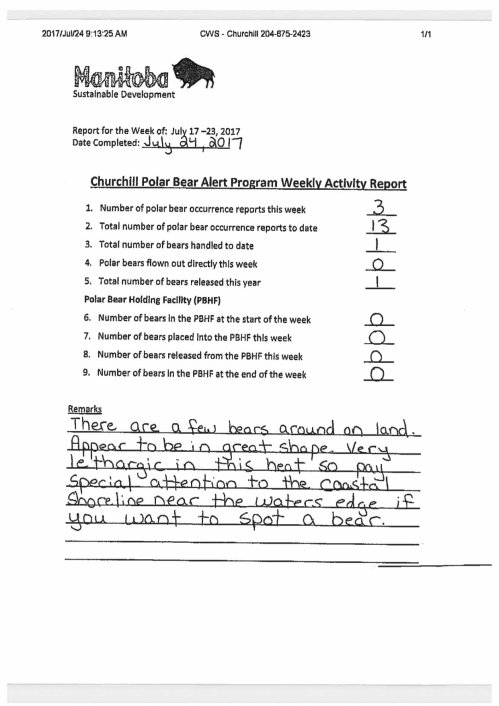
Just out from the City of Churchill: few polar bears reported onshore for the week of 17-23 July 2017 (week 2) but those seen “appear to be in great shape.”
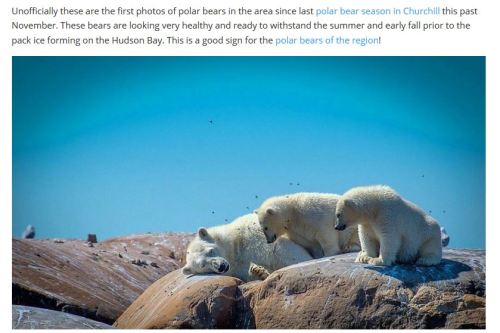
Update 24 July 2017 12:20 PM: Just spotted this blog report from “Churchill Polar Bears”that I somehow missed last week, which includes what seems to be the first polar bear photo’s of the season (of a sow and two chubby cubs) that are also in fine condition.
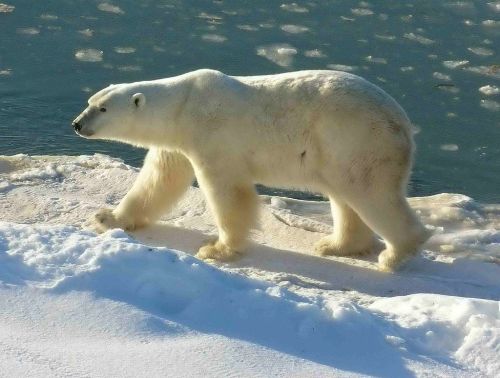
The photos were taken by Churchill photographer and guide Alex De Vries on Thursday 13 July and I hope he doesn’t mind my including one of those here as documentary evidence of the good body condition of this mother and both her cubs — see more photos at the Churchill Polar Bears blog post dated 14 July here.
Compare last week’s PB Alert report above to last year’s (below):
Comments Off on Churchill polar bear report 17-23 July 20: those ashore appear to be in great shape
Watch polar bear habitat reform in the Canadian Arctic: “last 10 days” Canadian Ice Service animation (works anytime) HERE.
See Quote archive for details.


 A self-proclaimed science-based news site (LiveScience,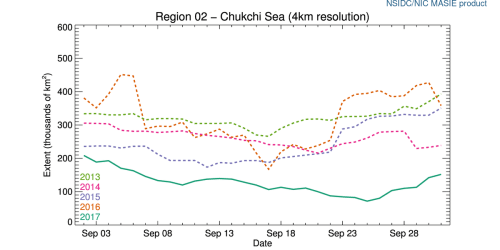



 The photos were taken by Churchill photographer and guide Alex De Vries on Thursday 13 July and I hope he doesn’t mind my including one of those here as documentary evidence of the good body condition of this mother and both her cubs — see more photos at the Churchill Polar Bears blog post dated 14 July






You must be logged in to post a comment.