Category Archives: Sea ice habitat

Polar bear habitat update for Canada at mid-February

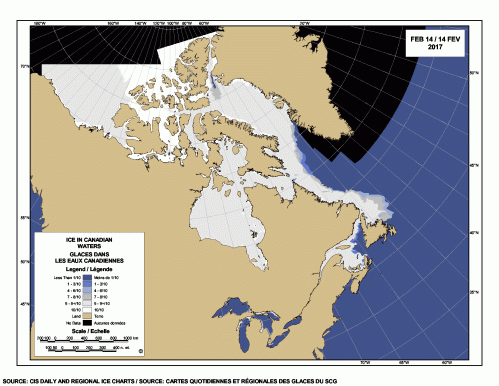
Mid-February is the tail end of the winter fast for polar bears. Sea ice is approaching it’s maximum global extent but local maximum extents may vary. Most of the sea ice in Canada is locked in already but two regions still vary at this time of year: the Labrador Sea off Labrador and Newfoundland – where polar bears come to feed on an abundance of newborn harp seals – and the Gulf of St. Lawrence, where polar bears have not been spotted in more than 60 years. sea-ice-extent-canada-2017-feb-14_cis

There is almost certainly enough ice for harp seals to give birth in the Gulf this year, if the ice holds (despite some premature hand-wringing by seal biologists). There is more ice in the Gulf and off Newfoundland this year than there was in 2013 (see map below). Continue reading

New paper updates lack of trend in W Hudson Bay breakup/freeze-up dates to 2015

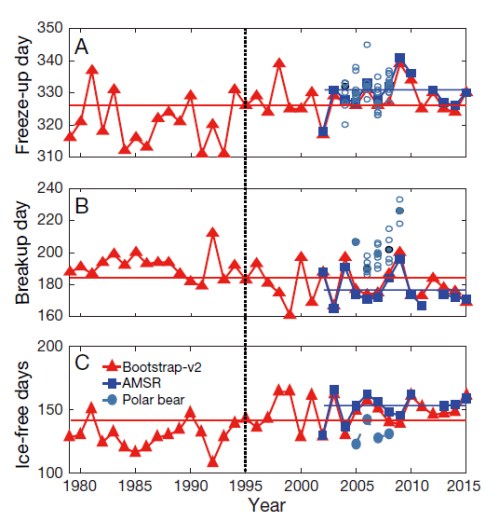
A newly-published paper shows that there has been no trend in the time Western Hudson Bay polar bears spent onshore between 2001-2015 due to sea ice conditions at breakup or freeze-up (previously available to 2010 only), despite the marked decline of global sea ice since 2007.

castro-de-la-guardia-et-al-derocher-2017-fig-3-no-caption

Figure 3 from Castro de la Guardia and colleagues (2017) showing freeze-up and breakup dates and ice-free days 1979-2015 for Western Hudson Bay. Figure with caption, copied below, explains symbols.

Previously, a 2007 paper by Eric Regehr and colleagues for WHB bears up to 2004, which was used to support the US bid to list polar bears as ‘threatened’ with extinction, concluded that between 1984 and 2003, bears were spending 3 weeks longer onshore than they did in the 1980s.

The big news from Castro de la Guardia et al. (2017) is that polar bears spent longer onshore from 1979-2015 by … 3 weeks. That is, no change from the situation in 2004. Wow!

Note the population size of the entire WHB subpopulation has also not declined since 2004 and is currently estimated at about 1030, based on a 2011 aerial survey (Stapleton et al. 2014).

Thanks to Andrew Derocher for the heads-up tweet.

From the abstract (my bold):

We found that the ice-free period in this region lengthened by 3 ± 0.8 wk over the period 1979−2015. Polar bears migrated onshore 2 wk earlier and offshore 1 wk later in the period 2005−2015 than in 1980−1989.

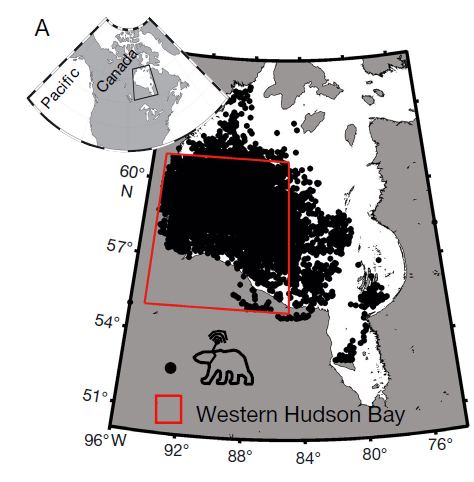
Here is the region in question, illustrated by Fig. 1 from the paper:

castro-de-la-guardia-et-al-derocher-2017-fig-1a-locationThe significant information contained in this paper is breakup and freeze-up dates and length of the ice-free period data for 2010-2015, which has been unavailable until now. More excerpts and comments below, including Figure 3 with its caption. Continue reading

Svalbard polar bears thrive in part due to ringed seal pups in the spring pack ice

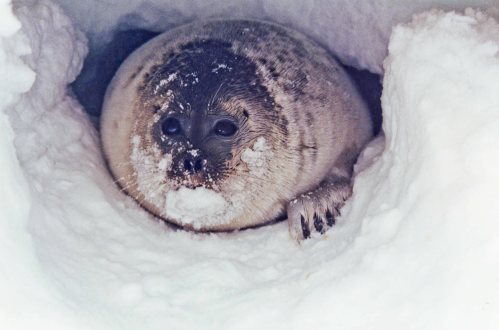
Few people know that Arctic ringed seals (Phoca hispida, aka Pusa hispida) give birth and breed in the offshore pack ice in the spring, as it is seldom mentioned by either seal or polar bear specialists.

While it is true that some ringed seals give birth in stable shorefast ice close to shore, many others give birth well offshore in thick pack ice – where polar bears also live and hunt in the spring but where few Arctic scientists ever venture – and the existence of pack ice breeding ringed seals is one of the reasons that polar bears are such a resilient species.

ringed-seal-in-snow-cave_b-kelly-wikipedia

Ringed seal pup in a snow cave, B. Kelly photo (Wikipedia).

As a consequence, despite fears expressed by Ian Stirling, low shorefast ice and associated snow around Svalbard this winter (and any time in the past) is not necessarily a hindrance to polar bear survival because there are ringed seal pups available out in the surrounding pack ice – where bearded seals also give birth.

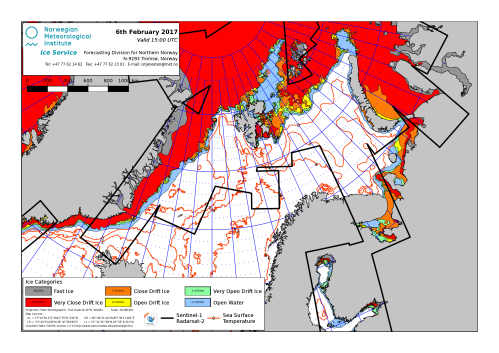
Of course, ringed seals pups are also available to Svalbard polar bears in the shorefast ice in the Franz Josef Land archipelago to the east (see map below) but it is the pups born in the offshore pack ice that are of interest here. The existence of pack ice breeding ringed seals may be why Norwegian biologists do not currently monitor ringed seals in the Barents Sea, despite many years of poor ice conditions around Svalbard in spring – this simply is not a species of concern.

barents-sea-ice-2017-feb-6_nis

The fact that distinct ringed seal ecotypes (or habitat-specific morphotypes) exist in the Arctic – one that gives birth and breeds in shorefast ice and another that gives birth and breeds in offshore pack ice, perhaps driven by competition for limited shorefast ice habitat – is a phenomenon a colleague and I discussed in a peer-reviewed book chapter published several years ago. Have a look at the excerpt below and see what you think.

Save

Continue reading

Listen to the evidence: polar bears are thriving in current sea ice habitat

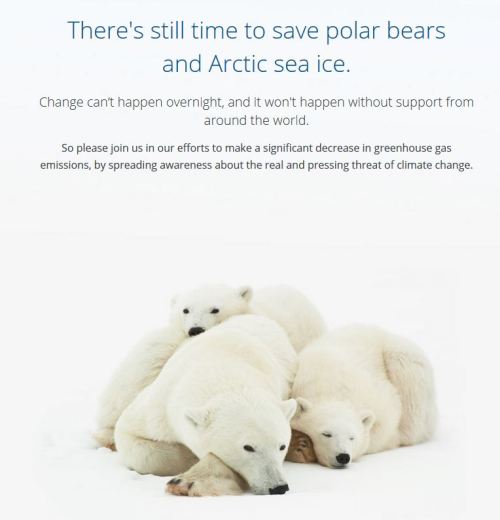
Oddly, activist organization Polar Bears International recently updated their website and now suggest there is still time to save polar bears and sea ice – even though the IUCN Red List documented more polar bears alive in 2015 than at any time in the last 50 years, despite the recent decline of summer sea ice – and even more bizarrely, call for a public uprising.

2017-pbi-save-polar-bears-and-sea-ice

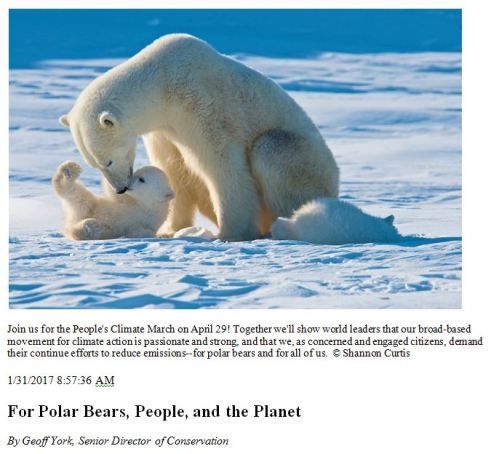
Polar Bears International (with three polar bear scientists on staff and other as active advisors) suggest that people who love polar bears should march the streets on Earth Day with scientists to demand (as concerned and engaged citizens) that world leaders take them seriously.

2017-peoples-climate-march-in-april-for-polar-bears-pbi-plea

Wow. I’ve been a career scientist for more than 40 years and I have to say, this is the oddest phenomenon I’ve encountered being advanced in the name of science. To me, it shows how disconnected these people are from what science is meant to be and what scientists are meant to do. Not just the polar bear scientists but the others like them that are behind this proposed march.

I recommend this blog post by Willis Eschenbach – an excerpt below.

Continue reading

US biologist’s defense of flawed polar bear predictions is an embarrassment to science

A few days ago in a radio interview, a senior US Fish & Wildlife biologist repeated the tall tale that Southern Beaufort Sea polar bear numbers declined in recent years due to loss of summer sea ice. But restating this egregious misinformation does not make it true.

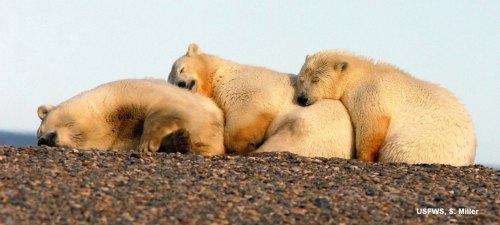
polarbears-arcticnatlwildliferefuge-suzannemiller-usfws_labeled_sm

The Southern Beaufort population did decline between 2001 and 2006 but it was due to natural causes (thick ice in spring from 2004 to 2006) – it had nothing to do with recent summer sea ice loss and Eric Regehr knows it.

There is no evidence that the population decline continued after 2006, so it cannot be said to be still declining. Moreover, the situation in the Southern Beaufort does not support the predictions made by Regehr and his colleagues that polar bear populations will decline precipitously if summer sea ice declines further.

My recently published paper demolishes the message of doom for polar bears and the misinformation it’s based upon: it’s free and written in straight-forward scientific language.

Crockford, S.J. 2017. Testing the hypothesis that routine sea ice coverage of 3-5 mkm2 results in a greater than 30% decline in population size of polar bears (Ursus maritimus). PeerJ Preprints 19 January 2017. Doi: 10.7287/peerj.preprints.2737v1 Open access. https://peerj.com/preprints/2737/ (pdf here).

Here’s an excerpt of the nonsense broadcasted on KNOM Radio Alaska by Regehr and transcribed for their website (29 January 2017) [my bold]: Continue reading

Polar bear habitat update: as much sea ice in 2017 as 2006 at 18 January

Sea ice charts for 18 January from NSIDC Masie show exactly as much sea ice in 2017 as there was back in 2006 – 13.4 mkm2.

masie_all_zoom_4km-2017-jan-18

Continue reading

New paper asks: Has recent sea ice loss caused polar bear populations to crash?

A paper published today finds that predictions of polar bear population crashes due to summer sea ice loss are based on a scientifically unfounded assumption.

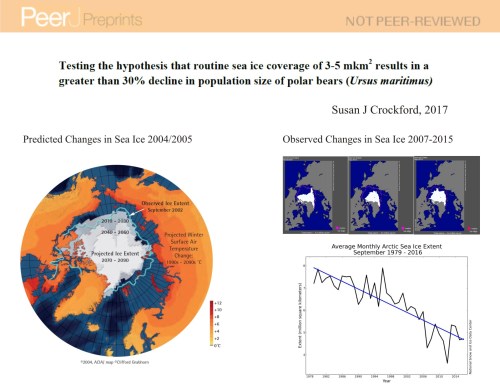
crockford-2017-title-page-graphic

[The graphic above was created by me from the title page and two figures from the paper]

Specifically, this paper of mine addresses the basic premise upon which predicted population declines linked to modeled habitat loss made by polar bear specialists back in 2006 and 2008 (by the International Union for the Conservation of Nature, IUCN, and the US Fish and Wildlife Service, USFWS), and concludes that when assessed as a testable hypothesis against data collected since then, it must be rejected.

The forum for this paper is PeerJ Preprints,  which I found while looking for recent research papers about ringed seals. I discovered that Canadian ringed seal biologist Steven Ferguson recently used this service, which is free, open access, accepts review commentary, and will show up on Google and Google Scholar searches.

Ferguson et al. 2016. Demographic, ecological and physiological responses of ringed seals to an abrupt decline in sea ice availability. DOI:10.7287/peerj.preprints.2309v1 Pdf here. https://peerj.com/preprints/2309/

I decided that if this publication forum was good enough for Ferguson and his Arctic research community, it was good enough for me.

Crockford, S.J. 2017. Testing the hypothesis that routine sea ice coverage of 3-5 mkm2 results in a greater than 30% decline in population size of polar bears (Ursus maritimus). PeerJ Preprints 19 January 2017 and 2 March 2017. Open access. Version 3 is the latest and most up-to-date,  https://doi.org/10.7287/peerj.preprints.2737v3

Continue reading

Fake news on polar bear survival predictions is political posturing

I call this fake news because it’s not news – media headlines around the world today (New York Times, Washington Post, DailyMail) are trumpeting the release of a final version of a draft report released with similar fanfare more than a year ago, announced today by the US Fish & Wildlife Service in the official US government publication, Federal Register.

biggest-threat-to-polar-bears-is-global-warming-nyt-headline_9-jan-2017

Without action on climate change, say goodbye to polar bears” is exactly the kind of sensationalized nonsense I address in my new detailed science book, Polar Bears: Outstanding Survivors of Climate Change (announced here, discussed here).
Continue reading

Communicating polar bear science requires a rational approach

My most requested public lecture, Polar Bears: Outstanding Survivors of Climate Change, has been hugely popular with audiences in my Canadian home town of Victoria, British Columbia, and my newly-released book with the same title (based on that lecture) promises to be similarly successful. Here are some thoughts on both.
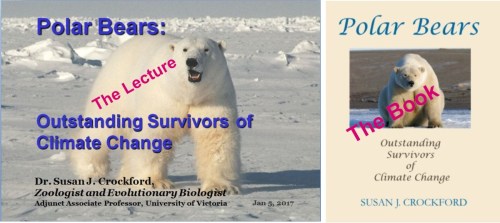
crockford_outstanding-survivors_lecture-vs-book-jan-2017

Recently (5 January 5, 2017), I gave another free lecture about polar bears to a local non-profit organization through my university’s Speakers Bureau. I’ve been doing this since 2009, although the shear volume of requests has been much higher this past year than previously. As before, my lecture was warmly received and audience members asked questions indicating they had been listening with an open mind. A colleague I spoke to expressed surprise at that outcome, given where I live.

Keep in mind that Victoria is home to litigation-prone IPCC climate scientist turned BC provincial Green Party politician Andrew Weaver (in whose riding I happen to reside) as well as one of the many targets of fake Nobel Laureate Michael Mann and his over-sensitive ego, veteran climate scientist Tim Ball (who defends the defamation lawsuit filed against him by Mann at trial in Vancouver, B.C. 20 February 2017,  an event which defender of free speech and fellow defendant against Mann’s litigious wrath, Mark Steyn,  has said he’ll be attending). And yes, in a sort of home-town science brawl, Weaver also sued Tim Ball, but that case has not yet gone to court. Victoria is also the constituency of our lone federal Green Party Member of Parliament, Elizabeth May. Canadian journalist Donna Laframboise once described Victoria as “one of the most left-leaning corners of the country.

So it is into this virtual lion’s den of anthropogenic global warming champions that I venture, several times a month, to enlighten adults, teachers, and students who have been left with the impression that there are only a few hundred starving polar bears left in the world.1

The secret to the kind of reception I receive – even in my town – is to present the relevant facts without emotional overtones and let audiences make up their own minds about what they think of the situation.

This latest lecture was not only well received but several audience members bought copies of my kid-friendly Polar Bear Facts and Myths that I had for sale (reviewed here by Kip Hansen).  One member came up afterwards to say he’d been dreading what he’d anticipated would be another polar-bears-are-doomed diatribe but was very pleased at my even-handed, scientific approach.

That’s why I decided to fashion my first fully referenced polar bear science book – and take it’s title – from my most successful public lecture. Audience responses over the years indicated to me that a simple summary would be an appealing approach. Questions from audience members over the years suggested which topics might need a more detailed explanation in the book. The lesson I learned from my lecturing experience was that my book needed a focused style, plenty of color images, and an affordable price.

Consider the table of contents for the new book, where each chapter covers only a few pages:

1. Polar bear & sea ice basics
2. Feasting/fasting life of polar bears
3. Evolution & climate change
4. Conservation & protection
5. Failure of the polar bear predictions
6. Biggest threat to polar bears
7. Summary
8. Conclusions

I expect I’ll get some negative fake reviews posted on Amazon for Polar Bears: Outstanding Survivors of Climate Change from the self-appointed moral-high-ground troll network (as they did for Polar Bear Facts and Myths). That’s to be expected for a topic like this. Honest criticism from readers might also be generated, of course, and that’s something all writers can expect, and should welcome.

That said, the best way to counter biased or unconstructive reviews is with honest, heartfelt reviews from readers who have actually read the book. If any of you that have ordered a copy of this book but would like to see a pdf review document in order to post an immediate review, use the contact me form at “Comments/Tips.”

Both Polar Bears: Outstanding Survivors of Climate Change and Polar Bear Facts and Myths are now available in paperback and various ebook formats, including epub and pdf. The little spin-off for preschoolers (Polar Bears Have Big Feet) – because why shouldn’t the little kids have a fear-mongering-free polar bear book with great pictures too? – is available in paperback only.

Footnote

  1. Without exception, every teacher of every school class I have spoken to in Victoria in the past year has been absolutely astonished to learn that the official global population estimate for polar bears is now 22,000-31,000, the highest estimate in 50 years. Virtually all expressed their appreciation for pointing out that simple fact. Hence, Polar Bear Facts and Myths is aimed at those misinformed children, while Polar Bears: Outstanding Survivors of Climate Change is aimed at their teachers, parents, and other influential relatives.

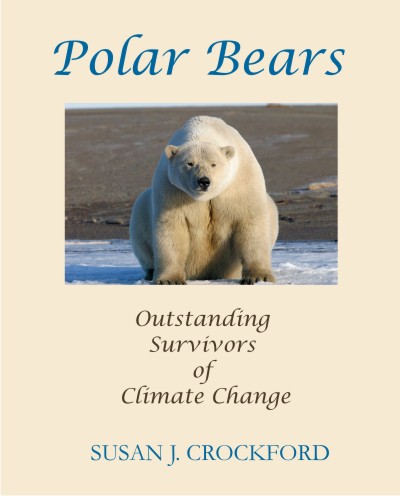
Announcing the release of Polar Bears: Outstanding Survivors of Climate Change

It’s here! The book that explains, in just enough detail, why polar bears are thriving despite the gloomy prognostications of the data collectors and future survivor modelers.

os_small

Here is all the science you need to know to understand contemporary polar bear issues of sea ice loss and species extinction. It contains the most up-to-date information available in an easy to digest format, with references to back it up. Continue reading