Tag Archives: Amstrup

Less Svalbard polar bear habitat during the early Holocene than now

Svalbard in the western Barents Sea has recently had less sea ice extent than it had in the 1980s, especially in the west and north, but this is not unprecedented.

Svalbard polar bear_Aars August 2015-NP058930_press release

New evidence from clams and mussels with temperature-sensitive habitat requirements confirm that warmer temperatures and less sea ice than today existed during the early Holocene period about 10.2–9.2 thousand years ago and between 8.2 and 6.0 thousand years ago (based on radio carbon dates) around Svalbard. Barents Sea polar bears almost certainly survived those previous low-ice periods, as they are doing today, by staying close to the Franz Josef Land Archipelago in the eastern half of the region where sea ice is more persistent.

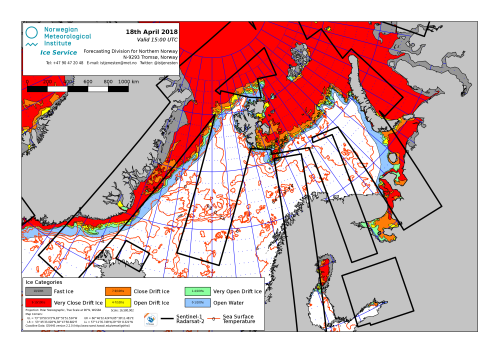
As this sea ice chart for 18 April 2018 shows, ice this month has been virtually absent from the west and north coasts of the Svalbard Archipelago, while Franz Josef Land to the east is surrounded by highly concentrated pack and land-fast ice.

Barents Sea ice 2018 April 18 NIS

From a new paper by Jan Mangerud and John Svendsen (2018) [my bold]:

Svalbard, located between 74° and 81°N, is the warmest place on Earth at this latitude (Drange et al., 2013). This is because of the North Atlantic Current and large-scale atmospheric circulation which transport warm water and air masses from lower latitudes northwards across the Atlantic and along the coast of Norway to Svalbard (Figure 1). Yet, during the Holocene Thermal Maximum, the climate of Svalbard was considerably warmer than at present.

The transition from Younger Dryas cold to Holocene Thermal Maximum warm conditions took place very rapidly, according to records from nearby Greenland (Taylor et al. 1997), warming in “steps” of about five years each over a period of about 40 years. This was at least as fast, if not faster than, recent Arctic warming between the 1980s and 2015. And since polar bears of the Barents Sea and adjacent Arctic areas appear to have survived this change to Holocence Thermal Maximum conditions, it challenges the notion that recent warming has been (or will be) too fast to allow polar bears to survive without huge changes in their present distribution (Amstrup et al. 2007).
Continue reading

Polar bear specialist Mitch Taylor on accountability in polar bear science

Polar bear specialist Mitch Taylor emailed me and others his response to the New York Times article that appeared Tuesday (10 April) about the Harvey et al. (2018) BioScience paper attacking my scientific integrity. Here it is in full, with his permission, and my comments. Don’t miss the footnote!

Mother with cubs Russia_shutterstock_71694292_web size

Continue reading

Steve Amstrup is lying to the media about my critique of his 2007 model

Until now, my scientific paper post at PeerJ Preprints for review, about the failure of Steve Amstrup’s 2007 USGS polar bear survival model (Crockford 2017), has been formally ignored by Amstrup and his colleagues. But now Amstrup and his colleagues have taken to lying to the media about my analysis because he can’t refute it in a scholarly manner.

Mother with cubs Russia_shutterstock_71694292_web size

Amstrup was quoted by Erica Goode in her New York Times article on the Harvey et al. (2018) BioScience attack paper published Tuesday (10 April 2018: “Climate Change Denialists Say Polar Bears Are Fine. Scientists Are Pushing Back”):

“Dr. Amstrup, however, said that according to the National Snow and Ice Data Center, the average September sea ice extent for the years 2007 to 2017 was 4.5 million square kilometers, “nowhere near the low levels projected it would be by the middle of the century.”

“To say that we already should have seen those declines now when we’re not early [sic] to the middle of the century yet is absurd,” he said.” [my bold]

And over at the online outlet Mashable (11 April 2018: “Climate scientists fight false polar bear narrative pushed by bloggers”), reporter Mark Kaufman quoted Jeff Harvey, lead author of the BioScience paper on the issue, although Harvey is hardly an authority:

“(Harvey noted Crockford misunderstood and then mischaracterized this prediction).”

Amstrup also presented a lame critique of the portion of my Financial Post 27 February 2018 op-ed that dealt with his 2007 predictions, published 2 March 2018 by Climate Feedback (self-proclaimed “fact checkers”), that is easily refuted because it’s a blatant lie. He’s saying 2015 sea ice models are relevant to his 2007 predictions that used 2005/2006 sea ice models.

Continue reading

Climate mauling, polar bears, and the self-inflicted wounds of the self-righteous

The BioScience paper “Internet blogs, polar bears, and climate-change denial by proxy” (Harvey et al. 2018) is a smack-talk response to my pointing out that polar bear numbers did not plummet as predicted when mid-century-like sea ice conditions arrived unexpectedly in 2007 (Crockford 2017). Here is why this shoddy piece of work will go down in history as a self-inflicted wound for the polar bear community (and biologist co-authors Ian Stirling and Steven Amstrup) and an own-goal for their wanna-be climate-hero friends, Stephan Lewandowsky, Jeff Harvey, and Michael Mann.
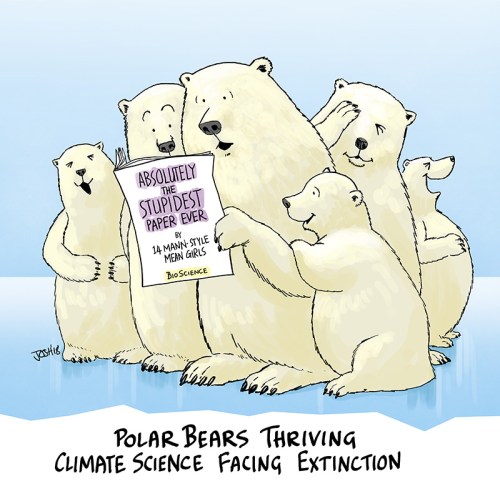
idea 1 final…absolutely the stupidest paper I have ever seen published” tweeted climate scientist Judith Curry, Emeritus Professor of Earth and Atmospheric Sciences at Georgia Institute of Technology (“Georgia Tech”).

Dr. Curry is a favourite target of colleague Michael Mann’s penchant for derogatory name-calling. Ironically, Mann often promotes something he calls the “Serengeti Strategy,” which he described to US Congress in 2017 in presenting himself as a victim of abused by others [my bold]:

“I coined the term “Serengeti Strategy” back in 2012 in “The Hockey Stick and the Climate Wars” to describe how industry special interests who feel threatened by scientific findings—be it tobacco and lung cancer, or fossil fuel burning and climate change—single out individual scientists to attack in much the same way lions of the Serengeti single out an individual zebra from the herd. In numbers there is strength, but individuals are far more vulnerable. Science critics will therefore often select a single scientist to ridicule, hector, and intimidate. The presumed purpose is to set an example for other scientists who might consider sticking their neck out by participating in the public discourse over certain matters of policy-relevant science.” Michael Mann, 2017 Congressional testimony.

Mann thinks others are using this strategy against him but if he had half an ounce of self-awareness he’d see it’s exactly what he and his long list of colleagues are doing with the Harvey et al. BioScience attack on me. Intimidation by numbers is the only rational explanation for a roster of 14 when two incompetent researchers could have produced a similar result.

Polar bear specialists Ian Stirling and Steven Amstrup knew they didn’t have a valid argument to refute my paper (Crockford 2017; Crockford and Geist 2018) on their failed polar bear survival model (Amstrup et al. 2007), which their responses to my International Polar Bear Day (27 February 2018) Financial Post op-ed revealed to the world (see here and here with references).

So when ignoring me didn’t work – or, more accurately, when the world started paying too much attention to me, by their own admission (Harvey et al. 2018:3) – they teamed up with Michael Mann, Jeff Harvey, and Stephan Lewandowsky (all with previous form attacking colleagues who don’t share their views) to publish an academic paper attacking my scientific integrity. In the words of Terence Corcoran, I was “climate mauled.”

Judith Curry stated recently (14 February 2018), regarding the Mann lawsuit against Rand Simberg, Mark Steyn and the National Review vs. the attacks on her integrity:

“Mann’s libelous statements about me (because he is a scientist with many awards) are far more serious than say Rand Simberg’s statements about Mann.”

In other words, like the attack on me in the Harvey paper (used to libel other internet bloggers by association), when senior scientists like Mann, Stirling, and Amstrup use derogatory and defamatory language against a colleague it’s a serious breach of professional ethics that impacts careers. Harvey et al.’s attack against me may be worse than those against Curry at a Congressional Hearing because it has been entered into the scientific literature in my own field.1

However, I expect BioScience (read mostly by teachers, students, and the general public, and therefore widely subscribed to by public libraries) was the only outlet willing to publish such unprofessional tripe. The editor’s refusal to retract the paper after numerous complaints about the language and the quality of the scientific content, tells you all you need to know about the journal’s low, sectarian standards. For example, the notice showing the two corrections they were willing to make at the end of March 2018 had to be pulled because such an egregious error occurred (it was posted to the wrong journal) it got the attention of online watchdog Retraction Watch! [Still not fixed as of 8 April]
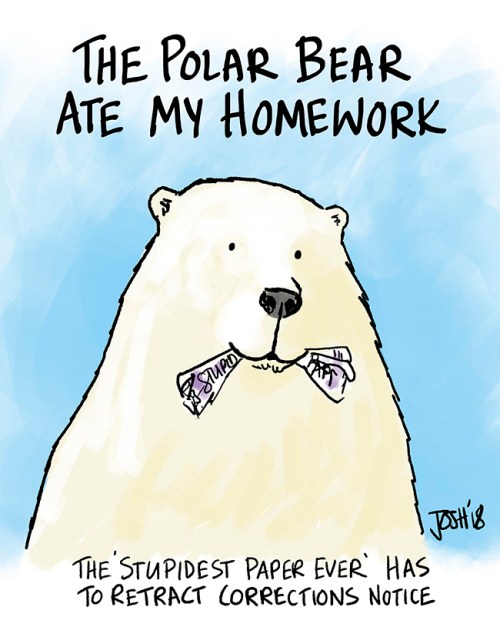
Polar bear paper correction retraction_5 April 2018

It also tells us quite a lot about the bias of its publishers, the American Institute of Biological Sciences.

Did you know, for example, that this organization has an “actionbioscience” program that provides free idealogically biased content aimed at kids and teachers that’s not particularly different from the biased content produced (without references) for kids and teachers by activist conservation outfit Polar Bears International (employer of Harvey et al. co-author Steve Amstrup)? The AIBS actionbioscience program currently includes an out-of date, alarmist essay by litigious Center for Biological Diversity employee Shaye Wolf on the plight of penguins (from 2009) as well as one by pessimistic polar bear specialist Andrew Derocher (from 2008) .

If you are able, please support the work I do here at PolarBearScience, some of which will go to Josh for these fabulous cartoons:

Here is a list of issues regarding the Harvey et al. paper as well as responses to it: some of these you won’t have heard before. Because this is a long summary post, for convenience I offer it here also in pdf form (latest version with a few typos/spelling errors corrected): Climate mauling, polar bears, and self-inflicted wounds of the self-righteous.”

Continue reading

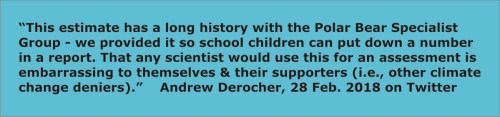
Polar bear population numbers are for kids, says specialist Andrew Derocher

Polar bear specialists made global population numbers the focus of the world’s attention when they predicted a dramatic decline and possible extinction of the species. But now that the numbers have increased slightly rather than declined, the same scientists say global numbers are meaningless: the public should give those figures no credence and anyone who cites global population numbers should be mocked.

NBC 2015_3 there will soon be a big decline in polar bear numbers snap

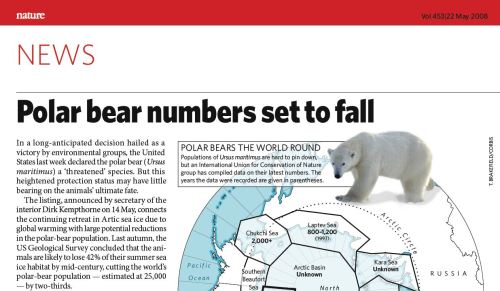
See the screen shot from a 2015 NBC news video above and another from the science journal NATURE in 2008 below (Courtland 2008):

Courtland 2008 headline

Yet, below is a recent message from one of the world’s most vocal polar bear specialists, four years after a similar incident raised the public’s ire:

Derocher tweet 2018 Feb 28 quote

However, you can’t make a plausible prediction of future survival without an estimate of present population size: not even today’s worst journalists would buy it, nor should they.
Continue reading

Amstrup & colleages can’t refute my critique of their 2007 polar bear survival model, Part 2

Polar bear specialists Andrew Derocher and Steven Amstrup recently spent inordinate energy trying to refute the opinion piece I’d written for the Financial Post in celebration of International Polar Bear Day last month, ignoring my fully referenced State of the Polar Bear Report for 2017 that was released the same day (Crockford 2018) and the scientific manuscript I’d posted last year at PeerJ Preprints (Crockford 2017).

polar_bear_USFWS_fat Chukchi Sea bear

Their responses use misdirection and strawman arguments to make points. Such an approach would not work with the scientific community in a public review of my paper at PeerJ, but it’s perfect spin for the self-proclaimed “fact-checking” organization called Climate Feedback. The result is a wildly ineffective rebuttal of my scientific conclusion that Amstrup’s 2007 polar bear survival model has failed miserably.

This is Part 2 of my expose, see Part 1 here.
Continue reading

Amstrup & colleages can’t refute my critique of their 2007 polar bear survival model, Part 1

It’s been more than a year since I first published my scientific manuscript at PeerJ Preprints (a legitimate scientific forum) on the failure of Amstrup’s 2007 USGS polar bear survival model (Crockford 2017), a year waiting in vain for the polar bear community to comment. They either couldn’t be bothered or knew they couldn’t refute it – I haven’t known for sure which. But I do now.

Beaufort Sea male polar bear USGS_2005 Amstrup photo

Polar bear specialists didn’t comment because they couldn’t refute it in the scholarly manner required by PeerJ: all they could do is tear it down with derision, misdirection and strawman arguments.

I know this because the damage control team for the polar-bears-are-all-going-to-die-unless-we-stop-using-fossil-fuels message wasn’t activated over my fully-referenced State of the Polar Bear Report for 2017 (Crockford 2018) released on International Polar Bear Day last month, but for a widely-read opinion piece I’d written for the Financial Post published the same day (based on the Report) that generated three follow-up radio interviews.

By choosing to respond to my op-ed rather than the Report or my 2017 paper, biologists Andrew Derocher and Steven Amstrup, on behalf of their polar bear specialist colleagues1, display a perverse desire to control the public narrative rather than ensure sound science prevails. Their scientifically weak “analysis” of my op-ed (2 March 2018), published by Climate Feedback (self-proclaimed “fact checkers”), attempts damage control for their message and makes attacks on my integrity. However, a scientific refutation of the premise of my 2017 paper, or The State of the Polar Bear Report 2017, it is not (Crockford 2017, 2018).

Derocher further embarrasses himself by repeating the ridiculous claim that global polar bear population estimates were never meant for scientific use, then reiterates the message with added emphasis on twitter:

Derocher tweet 2018 Feb 28 quote

Just as the badly written Harvey et al. (2017) Bioscience paper said more about the naked desperation of the authors than it did about me or my fellow bloggers, this attempt by the polar bear community’s loudest bulldogs to discredit me and my work reveals their frustration at being unable to refute my scientifically supported conclusion that Amstrup’s 2007 polar bear survival model has failed miserably (Crockford 2017).

Part 1 of my detailed, fully referenced responses to their “analysis” of my op-ed are below.  Part 2 to follow [here]. Continue reading

Archive of 2007 USGS reports supporting 2008 ESA listing for the polar bear

The administrative reports used in 2007 to support the decision to list polar bears as ‘threatened’ under the US Endangered Species Act (ESA) in 2008 disappeared from the US Geological Survey website several years ago. I have archived them here in pdf format to make them easy to find for anyone wishing to access the accuracy of the models, data, and assumptions made in 2007.

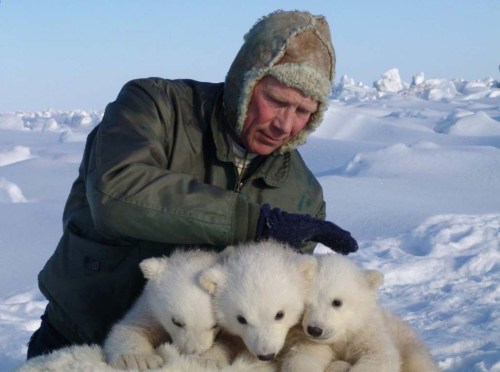
Amstrup w triplet_Prudhoe Bay 2005_USGS_sm

Steven Amstrup in 2005, then lead USGS polar bear biologist, with triplet cubs, Prudhoe Bay, AK.

This is a housekeeping post meant for future reference. I’ve included citations for the relevant sea ice projection papers used in the models presented in the 2007 documents and a few other related reports from the same time period. Continue reading

Blog uses my polar bear info but no link to PBS means they are ‘science-based’

According to Harvey and colleagues (2017), any internet posting that discusses polar bears without a link to PolarBearScience or a mention of my name can be considered a ‘science-based’ blog. But they missed an obvious catch: bloggers who use my content without attribution.

Churchill Polar Bears dot org_header

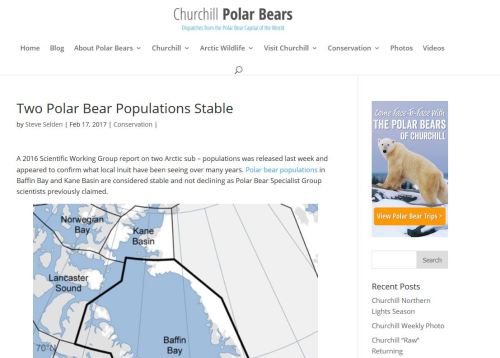
For example, so-called ‘science-based’ blog Churchill Polar Bears, written by Churchill polar bear guide Steve Seldon, used text and two of the four figures provided in a 15 February 2017 post at PolarBearScience to create a Churchill Polar Bears post on 17 February but did not include a single link to PolarBearScience indicating that’s where he got his information (Wayback machine link here).

Churchill polar bears blog headline 17 Feb 2017

A few would not consider this plagiarism but most do. That is to say, failure to attribute a source when work or information is not your own is a big no-no in science, as it is in all of academia.

Consider this evidence: Continue reading

Two technical critiques of the Harvey et al. polar bear Bioscience attack paper

Not much time for blogging, but two technical critiques  of the Harvey et al. paper have recently been posted, which you might like to read at your leisure. I will update this post when I can if more critiques appear plus I’ve provided a list of previous posts (my and others) on this issue.

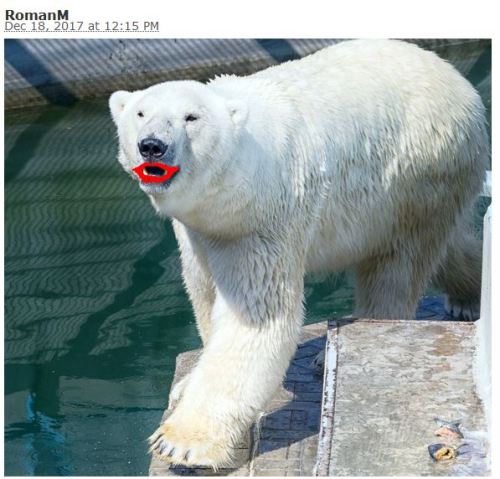
Polar Bears, Inadequate data and Statistical Lipstick (18 Decemeber 2018, RomanM writing at ClimateAudit)

McIntyre guest blog on Harvey paper photo led_RomanM 18 Dec 2017

Polar bear attack paper invalidated by non-independent analysis” (Cross posted 14 December 2017 at ClimateScepticism from the blog of Shub Nuggarath, 12 December 2017).

UPDATE 19 December 2017: Richard Tol has posted a draft of his critique, which was itself updated 20 December “Lipstick on a bear” in which he concludes:

“In sum, Harvey et al. (2017) play a statistical game of smoke and mirrors. They validate their data, collected by an unclear process, by comparing it to data of unknown provenance. They artificially inflate the dimensionality of their data only to reduce that dimensionality using a principal component analysis. They pretend their results are two dimensional where there is only one dimension. They suggest that there are many nuanced positions where there are only a few stark ones – at least, in their data. On a topic as complex as this, there are of course many nuanced positions; the jitter applied conceals the poor quality of Harvey’s data. They show that these is disagreement on the vulnerability of polar bears to climate change, but offer no new evidence who is right or wrong – apart from a fallacious argument from authority, with a “majority view” taken from an unrepresentative sample. Once the substandard statistical application to poor data is removed, what remains is a not-so-veiled attempt at a colleague’s reputation.”

UPDATED 20 December 2017: Lead author of the Bioscience attack paper Jeff Harvey talked to an Amsterdam newspaper about the backlash to the paper, original Dutch and English translation here.

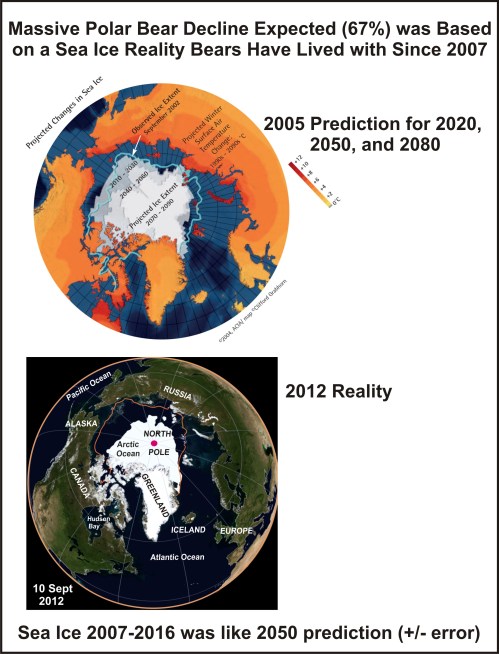
Fig 3 Sea ice prediction vs reality 2012

Predicted sea ice changes (based on 2004 data) at 2020, 2050, and 2080 that were used in 2007 to predict a 66% decline in global polar bear numbers vs. an example of the sea ice extent reality experienced since 2007 (shown is 2012). See Crockford 2017 for details.

Read a short summary of the paper that Harvey et al. don’t want you to know about here:

Crockford, S.J. and Geist, V. 2018. Conservation Fiasco. Range Magazine, Winter 2017/2018, pg. 26-27. Pdf here.

The paper they don’t want you to read is here:

Crockford, S.J. 2017. Testing the hypothesis that routine sea ice coverage of 3-5 mkm2 results in a greater than 30% decline in population size of polar bears (Ursus maritimus). PeerJ Preprints 2 March 2017. Doi: 10.7287/peerj.preprints.2737v3 Open access. https://doi.org/10.7287/peerj.preprints.2737v3

The paper being criticized (Harvey et al. 2017, in press: “Internet blogs, polar bears, and climate-change denial by proxy”, Bioscience, open access) is available here.  There is a supplementary data file available here and the data for the principal component analysis is available here  and (h/t to R. Tol), the R code is available here

More on this after Christmas but for now a list of previous blog posts of mine and others is provided below. Continue reading