Tag Archives: body condition

Add human graves to the list of things that attract polar bears to communities

A report last week that a polar bear dug a human cadaver out of a coffin buried in the cemetery on the west coast of Hudson Bay did not get the media attention it perhaps deserved: it takes the term ‘grisly’ to a new level.

Early arrival of polar bears at Nunavut hamlet prompts early monitoring: One bear digs into burial plot at Arviat cemetery (NunatsiaqOnline, 29 August 2016).

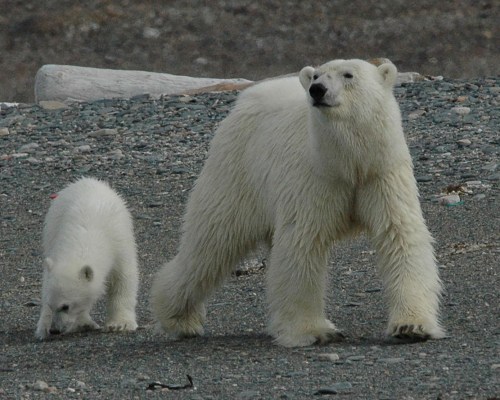
mother-and-cub-on-beach_Stirling

Quotes from the story, a map, and comments on problem bears below.
Continue reading

Tracking polar bears in the Beaufort Sea in July & sea ice comparison with 2007/2012

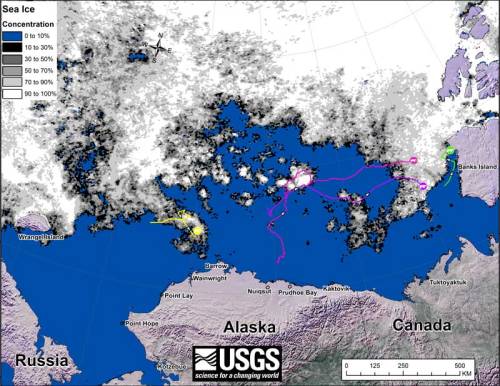
Only four Alaskan polar bear females had USGS satellite collars left transmitting locations in the Beaufort Sea and all four of these bears were on the ice during July, 2016. The same was true in June and May.

Beaufort tracking USGS bear-movements-July 2016 sm

Original caption: “Movements of 4 satellite-tagged polar bears for the month of July, 2016. Polar bears were tagged in 2015 and 2016 on the spring-time sea ice of the southern Beaufort Sea. All 4 of these bears have satellite collar transmitters. Polar bear satellite telemetry data are shown with AMSR2 remotely-sensed ice coverage from 31 July, 2016.” Original here.


There looks like a lot of open water for this time of year but in terms of absolute extent there is somewhat less ice than there was in 2007 and only slightly less than 2012, according to NSIDC Masie charts. And of course, what we know is that polar bears of the Chukchi Sea and the Southern Beaufort not only survived the low ice summers of 2007 and 2012, they thrived: CS bears were in great condition and reproducing well, and BS bears were recovering from the devastating thick ice conditions of the 2004-2006. Have a look at the maps below. Continue reading

Polar bears off the ice in W. Hudson Bay are “well fed and in great shape” this year

Churchill_Polar_Bear_2004-11-15 Wikipedia

Reports from Seal River, just north of Churchill at Churchillwild, at July 26 were crowing about seeing lots of bears onshore, with a veritable beehive of activity the weekend of 16/17 July:

“This has without a doubt been Churchill Wild’s most spectacular start to the summer polar bear watching season. …Bear numbers are up spectacularly this year and all are looking very fat and healthy, perhaps much to the chagrin of climate change “experts.” Our best day for the seductive white carnivores over the past week featured 21 polar bears sighted between the Lodge and our whale swim spot!

The ice pack, which was still visible a week ago [i.e, 17 July or so], has finally dissipated and pushed a large number of bears on to our coastline here at Seal River, with the end result being many very happy cameras!” [my bold]

And in Churchill proper, the Polar Bear Alert program has issued three reports so far this season (courtesy the Town of Churchill), which confirm that bears in the Polar Bear Capital of the World are also in great shape.

For the week of July 11-17, 2016:

“Bears are off the sea ice and on land. They are looking well fed and in great shape.”

See all three PBA reports below, compared to one from last year at this time (as well as a map and some ice charts).

More fat, healthy bears than last year, enough to keep the Polar Bear Alert folks hopping and tourists in the north happy. Sure doesn’t sound like a suffering population to me. Continue reading

Condition of S Hudson Bay polar bears varies with freeze-up only says new study

Despite the fact that the polar bears of Southern Hudson Bay (SHB) live further south year round than any others, a recent study found their average body weight has declined relatively little since the 1980s. There has been no decline in the size of the population over that time either. Perhaps that’s why there was neither a press release nor a massive media blitz when this paper came out earlier this month.

James Bay female and cub_Ontaro Govt

Remarkably – despite what we are told about how critical breakup dates are to polar bear health and survival in Hudson Bay – this study found that for SHB bears, the small decline in body condition index correlated only with freeze-up dates, not breakup dates or length of the ice-free season. They also found that regional breakup and freeze-up dates relevant to polar bears in this area was the day when ice cover reached 5% (not 50%).

In other words, SHB polar bears left the ice (or returned to it) when the average ice  cover near the coast was about 5%. This finding is yet more evidence that the meteorological definition of “breakup” (date of 50% ice cover) used by many researchers (see discussion here) is not appropriate for describing the seasonal movements of polar bears on and off shore.

Continue reading

Discovery News spreads old misinformation about W. Hudson Bay polar bears

In a just-released Discovery News piece, Kieran Mulvaney (4 November 2015, “In the polar bear capital, an uncertain future) repeated three misleading statements about Western Hudson Bay polar bears that keep making the rounds, despite the fact they have been laid to rest by the latest scientific reports on  (Lunn et al. 2013, 2014; Stapleton et al. 2014). I reviewed these just a few weeks ago.
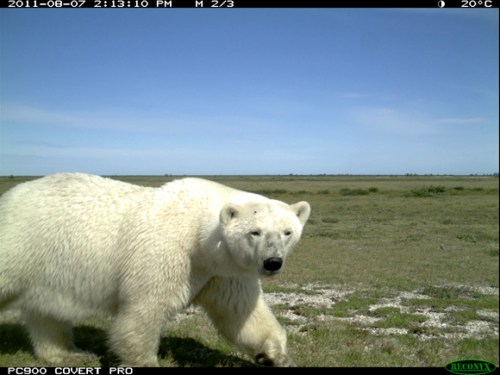
Western Hudson Bay bear, Wakusp National Park, August 2011.

Western Hudson Bay bear, Wakusp National Park, August 2011.

1) “Climate change is causing the bay’s ice to melt earlier and freeze later, causing bears to spend longer a shore.”

Not true. Lunn and colleagues stated explicitly that there has been no trend in either break up or freeze-up of WHB sea ice since 2001. Although there has been large variability in dates, that lack of trend that has continued to this year.

2 & 3) “As a consequence, Churchill’s polar bears are decreasing in number (from approximately 1,350 three decades ago to roughly 900-1,000 now) and in physical condition.”

This deliberately misleading statement avoids the fact that the latest surveys found roughly the same number of bears in 2011 as in 2004 (the estimate used by the IUCN Polar Bear Specialist Group for WHB is 1030) when different counting methods were taken into account. The ~900 bear estimate came from the mark-recapture survey, which left out a portion of the range that the aerial survey covered, hence the official estimate of 1030.

In addition, there has been no scientific assessment of body condition or cub survival since before the last population estimate in 2004 – polar bear “experts” keep telling journalists there are declines but have yet to produce any data to support those claims. The latest surveys did not collect data on body condition or cub survival.

Mulvaney’s misinformation is almost certainly the result of spending time in Churchill with activist Polar Bears International spokesperson Steve Amstrup and activist climate scientist Katherine Hayhoe doing webcasts (e.g. “Challenges of communicating climate change”).  

Mulvaney is clearly not a journalist or a science writer: if he was, he would do some research of his own and stop believing as gospel every word that activist scientists feed him. They are using him as a mouth-piece and sadly, Discovery News is buying it all and presenting it as science.

[Hayhoe, by the way, blocked me on twitter earlier this morning for making one observational comment, my first-ever to her account, in response to a conversation about polar bear population numbers. This is what I said that Hayhoe does not want her followers to know:

“Stop wanton slaughter, #’s go up, works for all species. S Beaufort #polarbear #s dipped due to thick spring #seaice”

Both statements are true and supported by scientific literature. But Hayhoe is all about “climate communication” which appears not to allow science to intrude.]

References
Lunn, N.J., Regehr, E.V., Servanty, S., Converse, S., Richardson, E. and Stirling, I. 2013. Demography and population assessment of polar bears in Western Hudson Bay, Canada. Environment Canada Research Report. 26 November 2013. PDF HERE

Lunn, N.J., Servanty, S., Regehr, E.V., Converse, S.J., Richardson, E. and Stirling, I. 2014. Demography and population assessment of polar bears in Western Hudson Bay, Canada. Environment Canada Research Report. July 2014. PDF HERE [This appears to be the version submitted for publication]

Stapleton S., Atkinson, S., Hedman, D., and Garshelis, D. 2014. Revisiting Western Hudson Bay: using aerial surveys to update polar bear abundance in a sentinel population. Biological Conservation 170:38-47. http://www.sciencedirect.com/science/article/pii/S0006320713004618#

Beaufort Sea swimming polar bears far from land but not very far from sea ice

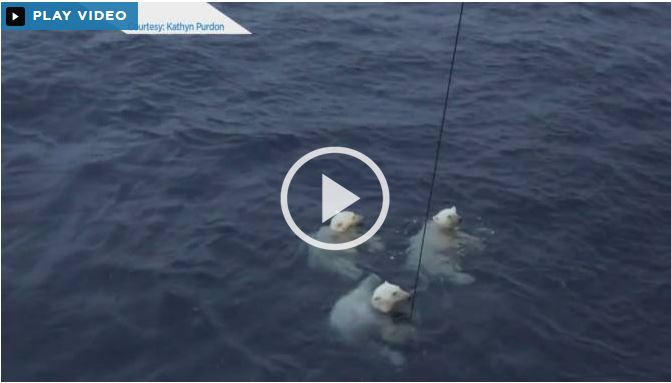
Recent accounts of an encounter with a curious polar bear female and her two older cubs in the Beaufort Sea on 16 September give contradictory details about the position of sea ice at the time. The same researcher told one reporter that the ship was 240 km from land, another that it was 240 km from the sea ice, and in another account (that he wrote himself), said the ship had been far from land and sea ice.

Beaufort swimming polar bears_Sept 30 2015_Global news

University of Victoria (Canada) chemical oceanographer Jay Cullen said on the expedition web site:

“After arriving on station and beginning work the crew noticed three polar bears in the water together which swam around to the ship when our water sampling system was nearly 3500 meters below the surface. The ship was located far from sea ice and land. Indeed, Arctic sea ice extent was the fourth lowest on record this year and there has been speculation that this imposes stress on polar bears which rely on the ice to hunt.”  [my bold]

But the maps below show that at the time of the incident (taken from the expedition web site) and the NSIDC Masie sea ice map for 16 September 2015, the ship [the CCGS Amundsen, acting as a research vessel] was actually quite close to an isolated large patch of sea ice, although further from the edge of the main pack. A patch of sea ice plenty big enough for a polar bear to rest upon – no wonder the bears did not appear stressed.

And the polar bear biologist Cullen consulted (Dr. Andrew Derocher) implied by his response that the bear was indeed far from sea ice. Reminds me of the swimming polar bear off the Hibernia oil platform off Newfoundland March 2015, which turned out to be not far from ice at all. See what you think.
Continue reading

Summer refuge for polar bears in Arctic Basin only 0.3 mkm2 below its possible maximum

At the seasonal minimum 2015, the Arctic Basin was still almost full of sea ice, down only 0.3 mkm2 below the maximum it could ever be.

Healy Aug 24 2015 Polar-Bear III Tim Kenna

Remember that spending the summer in the Arctic Basin for most polar bears is just like sitting on the western shore of Hudson Bay – they are all waiting for the refreeze. In either location, they might find something to eat, they might not.

Below are NSIDC MASIE sea ice maps for 10 April 2015 (as big as it gets, basin filled) vs. 17 September 2015: Continue reading

Barents Sea polar bears in excellent condition say Norwegian biologists

Conditions this year (2015) in the Barents Sea were excellent according to the polar bear researchers who work there (“Polar bears were as fat as pigs”).

Barents Sea bear 2015 August Cobbing_NPI
A new survey just completed for a population count showed the bears were are in excellent condition – except the injured ones, of course, which some news organizations are promoting as evidence of harm from global warming-induced sea ice changes because an activist photographer  – not scientists – said so.

Continue reading

Arctic Basin polar bears – researchers spot fat pregnant female from icebreaker

Researchers in the Arctic Basin yesterday spotted a hugely fat pregnant polar bear female on broken ice over water about 2,500 meters deep. Some people seem to find this surprising but it’s what I discussed last week.

Healy Aug 24 2015 Polar-Bear VI Tim Kenna

Photo above by Tim Kenna from aboard the Coast Guard cutter Healy. Researchers are in the area as part of the TRACES of Change in the Arctic” program. Another perspective on the bear and the location it was spotted on 24 August 2015 below, as well as some background on Arctic Basin bears.
Continue reading

In 1999, climate change apparently threatened Western Hudson Bay polar bears

Now, not so much. Here is a 16- year old CBC TV special on Churchill polar bears – listen to Ian Stirling and reporter Eve Savory use the early breakup of sea ice on Hudson Bay in 1999 to hype the alarm about Western Hudson Bay polar bears. Watch Stirling in action darting and measuring bears and bemoaning the good old days of the 1980s, claiming the “bears are sending a signal from the ecosystem.

Watch this archived copy of “The Shrinking Bears of Hudson Bay and compare his claims to what has actually happened in the 16 years since then. It runs just over 15 minutes.

Climate change threatens polar bears 2_CBC 1999

“Just as the ice is shrinking in Hudson Bay, so are its polar bears. Climate change has shortened the season for winter ice, a crucial period for the bears to feast on seals and build up their fat reserves. And so, over the 18 years that wildlife biologist Ian Stirling has been studying them, the polar bears have become skinnier and their offspring fewer. In this 1999 report for CBC-TV’s The National, Stirling says once their habitat is gone, there’s nowhere else the Hudson Bay polar bears can go.” [my bold – see notes below]

Program: The National [Canadian Broadcasting Company, CBC]
Broadcast Date: Sept. 23, 1999
Duration: 16:39

Stirling has continue to make these claims since 1999, yet no updated evidence has been provided. There is no plausible evidence that the decline of polar bear numbers in Western Hudson Bay was due to sea ice changes caused by human-caused global warming (Crockford 2015) or that continued declines in condition of bears or litter size have  occurred. Note that the latest survey of Western Hudson Bay polar bears found no trend in either breakup or freeze-up dates since 2001 (Lunn et al. 2013) and that the population is now stable.

Ice coverage charts and breakup dates graph below, for context.
UPDATE ADDED – see below
Continue reading