Tag Archives: Churchill

Fat polar bears [and lots of them] drive public confidence in future of the species

What is causing the death of the polar bear as a climate change icon? Fat bears are part of it, but mostly it’s the fact that polar bear numbers haven’t declined as predicted.

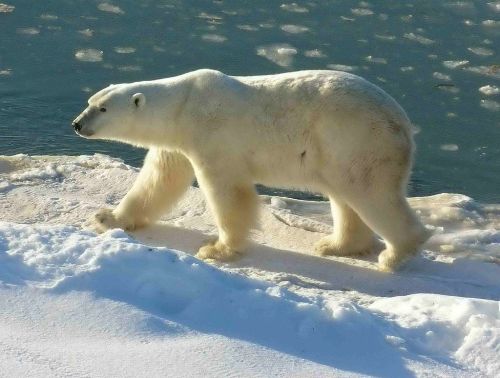
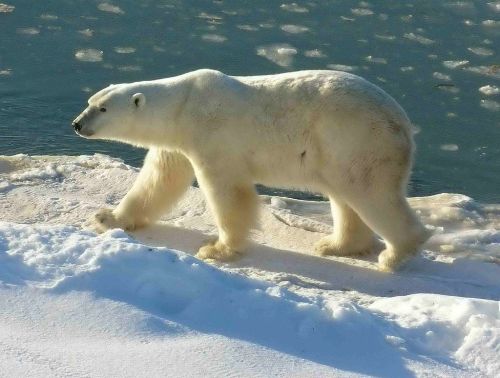
Western Hudson Bay polar bears around Churchill, Manitoba appear mostly in good shape this summer despite the very late freeze-up last fall, including the very fat bear caught on camera below (see more great pictures here):
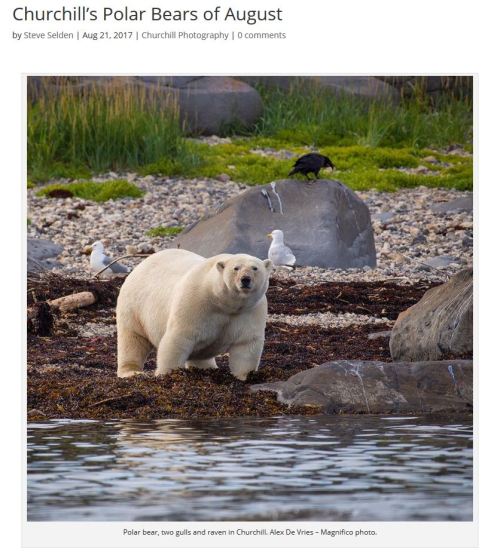
Churchill_PolarBears_FAT bear post_21 Aug 2017

Not only have we been seeing pictures of fat bears rather than starving bears in recent years but there are lots of them, in Western Hudson Bay and other seasonal sea ice regions where there should be none (if the models had been correct). No wonder polar bears are falling out of favour as an icon for catastrophic human-caused global warming.

[Here’s another picture of a fat bear, this one from Svalbard]

Excuses for why the public is no longer worried about the future of polar bears include a recent claim by climate scientist Michael Mann that “by making polar bears and penguins the poster child for climate change, we have wrongly conveyed that this is some exotic problem far off.

But none of these apologists acknowledge the simple truth: the models that  predicted catastrophe for polar bears due to diminished summer sea ice turned out to be wrong. The sea ice declined but polar bears flourished. Polar bears in seasonal sea ice ecoregions like Western Hudson Bay and Baffin Bay didn’t die off due to climate change as people were told would happen — why should they believe any of the other scare stories?

In and around Churchill, where tourists flock to see Western Hudson Bay polar bears up close and personal, one bear in good condition recently ran through town:

Overall, there have been fewer problems or conflicts this year in Churchill compared to last (after 6 weeks of onshore living), see below.

Polar bears are no longer a useful global warming icon because they are thriving despite diminished sea ice: Churchill area polar bears are a good example.
Continue reading

Churchill polar bear reports still showing fewer problems than last year

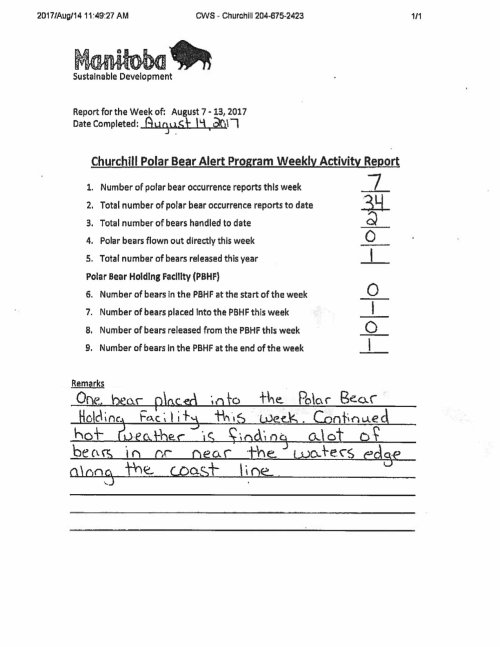
Churchill, Manitoba’s Polar Bear Alert Program is still reporting many fewer problems with polar bears onshore than it did last year at the same point in the ice-free season (week 5, 7-13 August):

Churchill PB reports_week 5_ Aug 7-13_2017

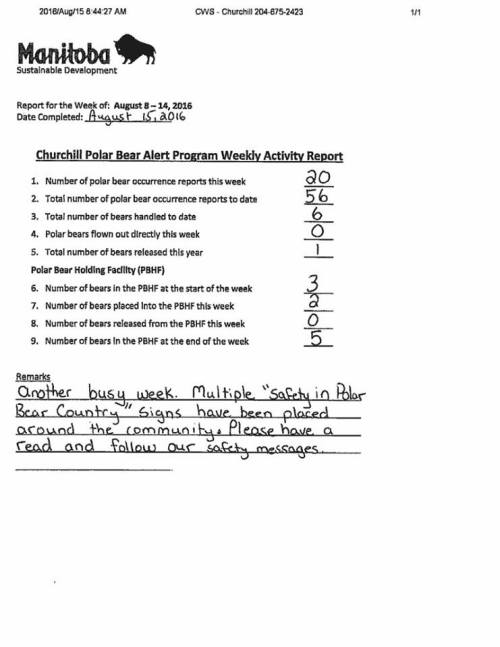
Compare to week five last year (2016), when bears came ashore in excellent condition:

2016 Aug 8-14_week 5

Although it’s been warmer than average recently (25.4 degrees C yesterday, expected to reach 29 degrees C today and 28 degrees C tomorrow), according to Environment Canada weather records, that’s not even close to an August record-breaker temperature for Churchill. Continue reading

Churchill polar bear reports to 6 August show fewer problems than last two years

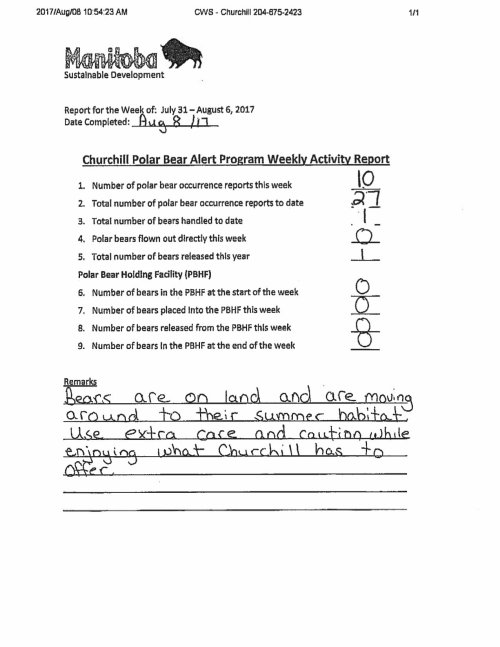
Churchill, Manitoba Polar Bear Alert Program problem bear reports for weeks 3 (24 July – 30 July 2017) and 4 (31 July – 6 August 2017) show much less activity and fewer problems in this Western Hudson Bay location than were reported for the last two years (2016 and 2015) at the same time (relative to the first reports of the season):

Churchill PB reports_week 4_ July 31- Aug 6_2017

Compare 2017 to last year (2016) at this time, where the problem bear report claims numbers were similar to 2015 (for which I don’t have a week 4 report), with more bears handled and placed in “jail”:

2016 Aug 1-7_week 4

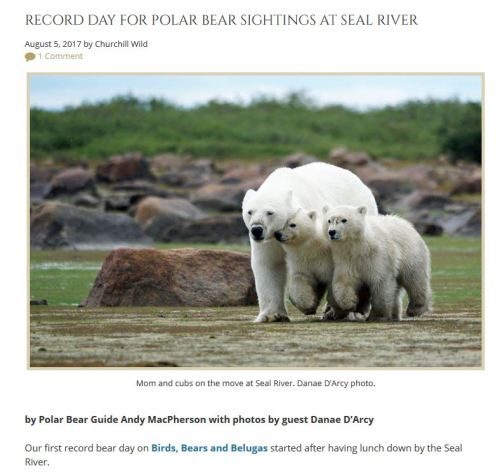
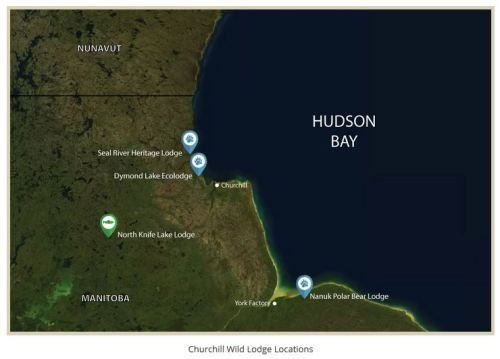
But most Western Hudson Bay bears are at their highest body weight when they come off the ice in early summer and present little risk to humans who keep their distance — few bears cause any real problems this time of year. Compare the above problem bear reports to the blog post from Seal River Lodge, just north of Churchill (5 August 2017, from Churchill Wild Eco-Lodge), which reports seeing 11 bears in one day of viewing. Great photos at this post confirm those bears are in good physical condition and interacting with each other without bothering people.

Seal River polar bear report for 2017 Aug 5

Seal River Lodge location 2017

Continue reading

Churchill polar bear report 24-30 July rather boring compared to last year

This is the third week of reports from the Churchill Polar Bear Alert Program but not much in the way of excitement or information, although more bears must be ashore by now.

Churchill PB reports_week 3_ July 24-30_July 2017

Compare to last year at this time, when there was much more activity:

2016 July 25_31_week 3

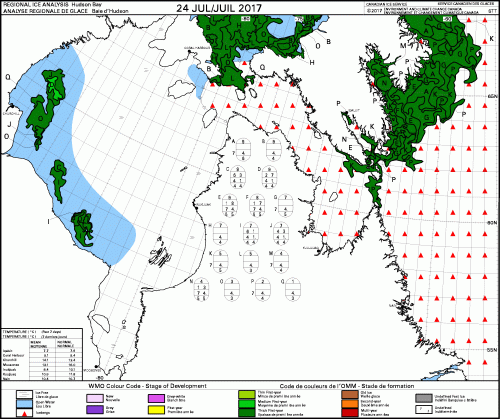
There was still some thick ice lingering off the coast of Western Hudson Bay last week, as this weekly ice chart shows:

Hudson Bay ice weekly stage of development 2017_July 24

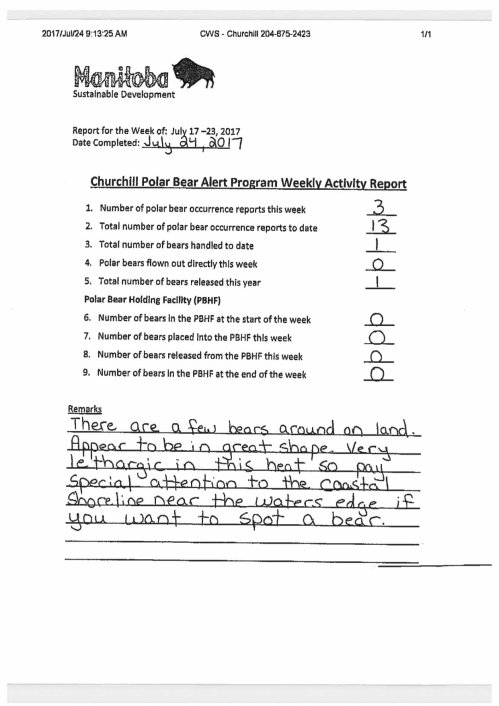
Churchill polar bear report 17-23 July 20: those ashore appear to be in great shape

Just out from the City of Churchill: few polar bears reported onshore for the week of 17-23 July 2017 (week 2) but those seen “appear to be in great shape.”
Churchill PB reports_week 2_ July 17-23_2017

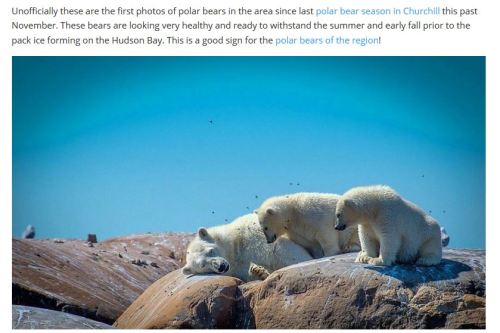
Update 24 July 2017 12:20 PM: Just spotted this blog report from Churchill Polar Bears” that I somehow missed last week, which includes what seems to be the first polar bear photo’s of the season (of a sow and two chubby cubs) that are also in fine condition.

ChurchillPolarBearsDotOrg_July 14 2017 Alex De Vries photoThe photos were taken by Churchill photographer and guide Alex De Vries on Thursday 13 July and I hope he doesn’t mind my including one of those here as documentary evidence of the good body condition of this mother and both her cubs — see more photos at the Churchill Polar Bears blog post dated 14 July here.
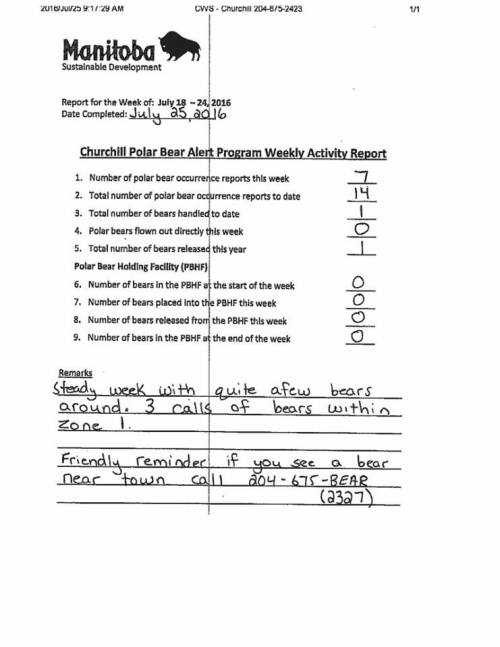
Compare last week’s PB Alert report above to last year’s (below):

2016 July 18_24_week 2

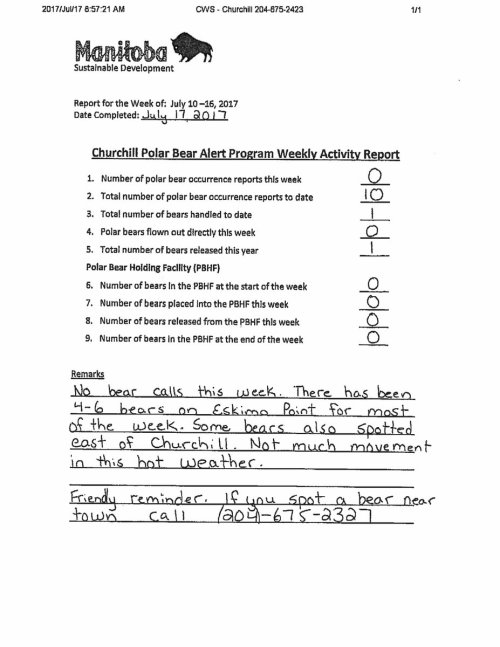
Problem polar bears of Churchill: first report of the season similar to 2016

The first activity report of the Churchill Polar Bear Alert Program has been released for 2017. It comes on the same week as last year’s (so about the same dates for first bears ashore both years), and reports pretty much the same activity.

Churchill PB reports_week 1_ July 10-16_July 2017

Odd that this year’s report contains no mention whatsoever of the condition of the bears as did last year’s (see below), which may have brought criticism for spoiling the media ‘message’ that WHB bears are suffering because of reduced sea ice. Better no comment at all than good news, eh?

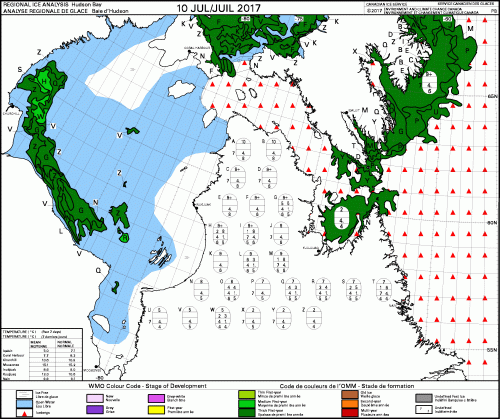
Sea ice for the week of 10 July off Western Hudson Bay this year consisted of a broad strip of thick first year ice (>1.2m thick) just off shore.

Hudson Bay weekly ice stage of development 2017 July 10

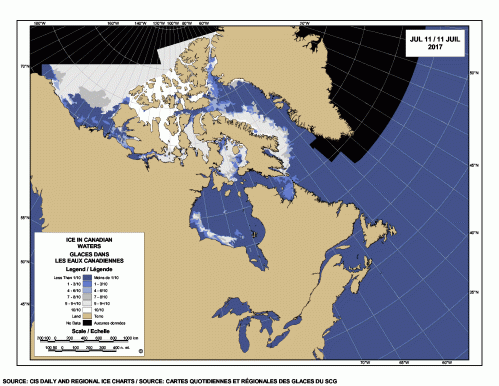
The ice charted above looked like this on a standard ice map:

Sea ice Canada 2017 July 11

There are no other reports that I could find of polar bears ashore along the coast of Western Hudson Bay, so these bears must be the first wave.

Continue reading

Western Hudson Bay polar bears reportedly still on ice as of 17 July 2017

Today, polar bear biologist Andrew Derocher posted a progress report via twitter on the annual journey ashore of the Western Hudson Bay bears tagged by his University of Alberta research team that shows virtually all of the bears are still out on the sea ice.

Churchill_Polar_Bear_2004-11-15 Wikipedia

After months of gloomy reports on the state of the Hudson Bay sea ice, it’s clear from the map Derocher posted (below) that only one bear out of 12 still transmitting has come ashore so far, although he comments that “some tags haven’t reported lately” (the purple icons are ear tags put on males &/or young bears while the blue icons are collars put on adult females):

Oddly, the same comment was made almost a month ago about these same bears and the suggestion was made that these animals “may be swimming to shore”:

Money quote: Today Derocher remarked that “bears may be shifting behaviour to stay out on less ice” to explain why the tagged bears have still not come ashore as he expects them to do.

Perhaps if he used a different ice chart, it might make more sense (see below). However, the same thing has been happening year after year: WHB polar bears stay on the ice much longer than Derocher predicts but he does not change his expectations or the type of ice chart he uses to track the bears.

As I’ve pointed out before (because this is what field researchers have stated), polar bears have a tough time catching seals after about mid-June or so but they may still prefer to be on the sea ice than on land, even if it’s low concentration ice.

Continue reading

Polar bears of W Hudson Bay utilizing a substantial patch of thick first year ice

There’s been no word as yet, either from tour operators or polar bear researchers, that Western Hudson Bay polar bears have come ashore for the summer/fall season. Andrew Derocher reported at the end of June that the bears tagged by his team were still on the ice and as I write this, has not yet reported them ashore.

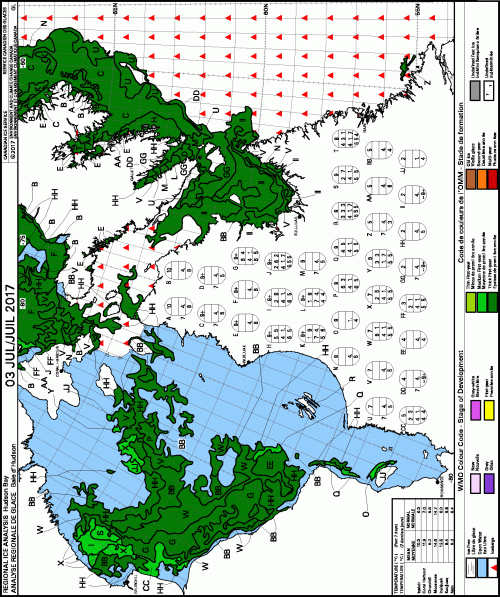
That pattern is consistent with the presence of thick ice along the west coast of the Bay — from well north of Churchill to the south of Wapusk National Park — for the last few weeks. The weekly chart for 3 July 2017 below from the Canadian Ice Service shows that virtually all of the ice remaining is thick first year ice (>1.2m, dark green on this map):

Hudson Bay weekly ice stage of development 2017 July 3

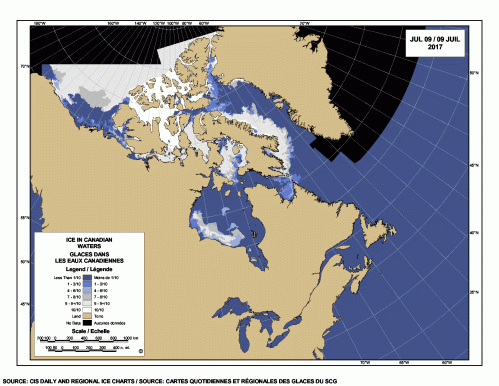
By the 9 July, the extent of this patch of ice was somewhat reduced but still a very prominent feature over the Bay, suggesting that if adult seals are using this ice as a refuge while molting, some bears may still be attempting to hunt even though their success rate may not be very high:

Sea ice Canada 2017 July 9

Bottom line: As has been the pattern for more than a decade, 2017 will not go down in history as an especially early year for WHB polar bears coming off the ice for the summer/fall season but instead may be as late as last year, when lots of bears were reported off the ice by mid-July at Seal River (just north of Churchill), all in excellent condition.

It remains to be seen if the condition of bears will be as good this year as they were in 2016, given the late start to the season. But it does mean that the lack of trend in breakup dates since 2001 continues: breakup of the sea ice in WHB since 2001 has been about one week later than it was before 1998 (Castro de la Guardia 2017; Cherry et al. 2013; Lunn et al. 2016).

If some polar bear struggle to survive this year it will be due to the late freeze-up date last fall combined with challenging winter conditions over Hudson Bay, not because of an early breakup of the sea ice.

And while it is certainly true that the overall trend in time spent onshore by WHB polar bears since 1979 has increased by about three weeks, the lack of a continued trend since 2001 is not what was expected or predicted, especially given the marked decline in global sea ice levels that have made headlines since 2007 (Crockford 2017), and the predictions of how devastating such low levels of ice would be to polar bears in areas like Hudson Bay that have to deal with a total disappearance of sea ice in summer and early fall.

Continue reading

Polar bear counts for W Hudson Bay: ‘core’ area numbers are not comparable

Polar bear population estimates for Western Hudson Bay have recently become contentious because one specialist has been making statements that confuse the issue. As we all wait for the release of the report on the WHB aerial survey of 2016, it’s worth going over the recent history of these counts and what they have revealed.

Churchill_Polar_Bear_2004-11-15 Wikipedia

The official count for bears in WHB (used by the IUCN Polar Bear Specialist Group, the IUCN Red List, and Environment Canada) is 1030, based on an aerial survey of the entire region conducted in 2011 (Stapleton et al. 2014).

Since last year, Andrew Derocher (University of Alberta) has been telling any media pundit who will listen that WHB polar bears have declined from about 1200 bears in the 1980s to only 800 or so bears today (one example here) — a statement that is clearly not true.  In recent months, however, whether due to complaints from the public or from his colleagues, he’s qualified that statement by saying it’s the number of bears in the “core” area of WHB that has declined.

But is Derocher’s revised statement a clear scientific interpretation of the facts? Have a look at the details below and see if you come to the same decision I have: that it’s not possible to compare WHB ‘core’ area polar bear population estimates over time.

Continue reading

Polar bear mating season winds down with lots of sea ice habitat available

Habitat for polar bears is abundant worldwide as the prime feeding season passes its peak and mating season for sexually mature bears winds down.

JR1_1266.tif

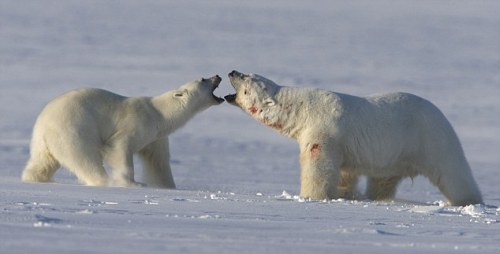
Battle among polar bear males for the right to mate, from this 2011 DailyMail story here.

There is much more ice than usual around Svalbard in the Barents Sea and off Newfoundland and southern Labrador, home to ‘Davis Strait’ bears. There have been no media reports of polar bears onshore anywhere (since the third week of April in Newfoundland and late January in Svalbard).

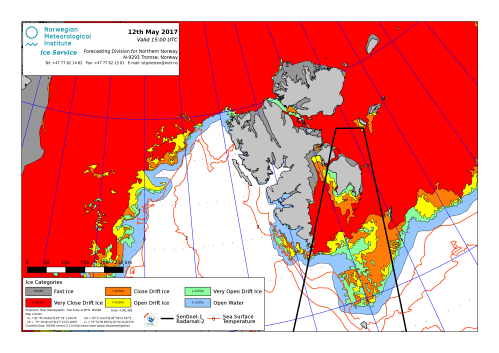
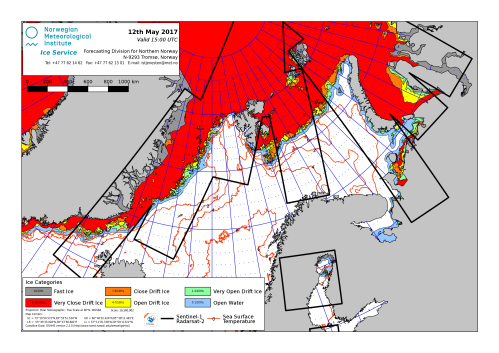
Sea ice map below for 12 May 2017:

Svalbard ice extent 2017 May 12_NIS

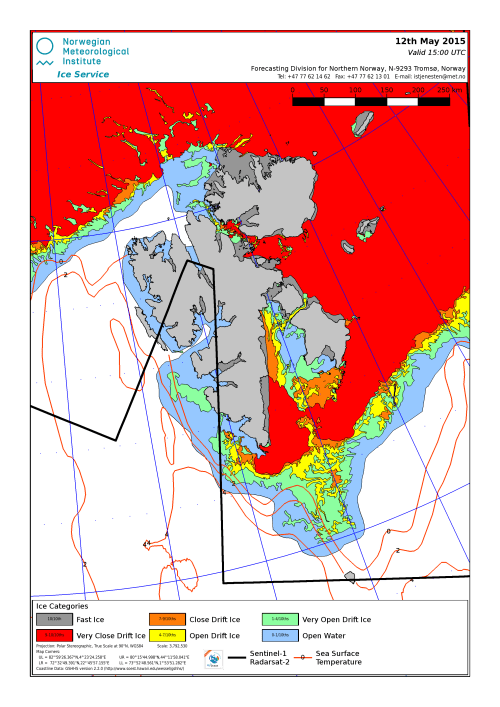
Compare the extent and concentration of ice around Svalbard above (at 12 May 2017) to conditions that prevailed on the same date in 2015 (below), considered a “good ice” year for local polar bears (and the year of the last population size count which registered an increase over the 2004 count):

Svalbard ice extent 2015 May 12_NIS

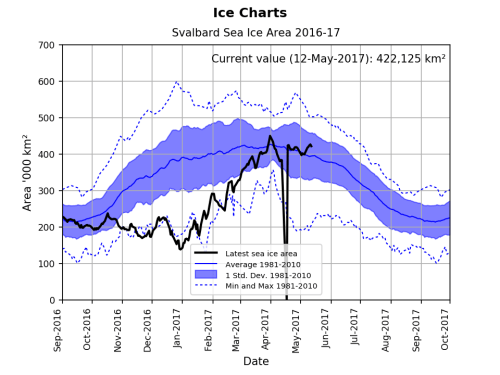
There hasn’t been this much ice in the area at this point in the season for many years, especially to the north of Svalbard, and levels since late April have been above even the long-term average (disregard the huge downward blip, which is clearly a sensor malfunction of some kind):

Svalbard ice extent 2017 May 12 graph_NIS

In fact, ice is pretty solid throughout the Barents Sea and East Greenland at this time:

Barents Sea ice extent 2017 May 12_NIS

Across the Atlantic, the situation is similar, with unseasonably heavy sea ice off eastern North America and the Southern Beaufort Sea.

Continue reading