Tag Archives: Davis Strait

Thriving Foxe Basin and Davis Strait polar bears threaten nesting sea birds

UPDATE February 11, 2014. A reader (Kevin, at “Afton’s Waterfowl List”) has pointed out an error in Fig. 3, where I inadvertently labeled the bars on the upper graph as ending in 2011 instead of 2012 (the Pembroke graph ends at 2011. sigh..). I have corrected the figure and the text that refers to it, but do not believe it affects the overall conclusion. See for yourself. Thanks Kevin — and Alan for getting in touch!

Another round of press release inspired news stories emerged last week insisting that polar bear predation on ground-nesting birds during the summer ice-free period is evidence that they are nutritionally stressed by global warming.

A few weeks ago it was snow goose eggs in Western Hudson Bay – this time it’s thick-billed murre (Uria lomvia) and common eider (Somateria mollissima) eggs in Foxe Basin and Hudson Strait (e.g. see the story at Canada’s National Post and a short summary provided by Science [and it’s not even their paper!]). The source of the media attention this time is a newly-published paper by Samuel Iverson and colleagues (Iverson et al. 2014).
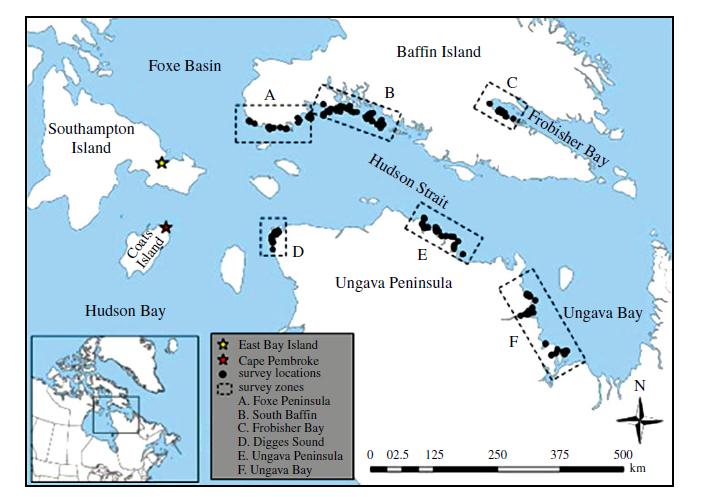
Figure 1. From Iverson et al. 2014 (their Fig.1), “map of the study area.” Most of the study sites are within the Foxe Basin polar bear subpopulation region (see Fig. 2 below), although the Ungava Peninsula (E), Ungava Bay (F) and Frobisher Bay (C) sites are in the Davis Strait subpopulation.

Figure 1. From Iverson et al. 2014 (their Fig.1), “map of the study area.” Most of the study sites are within the Foxe Basin polar bear subpopulation region (see Fig. 2 below), although the Ungava Peninsula (E), Ungava Bay (F) and Frobisher Bay (C) sites are in the Davis Strait subpopulation.

Polar bears have always preyed on ground-nesting sea bird and goose eggs while onshore (see Kelsey Eliasson’s take on the situation around Churchill, at his PolarBearAlley blog). The issue in this case is whether the increase in predation can be unquestionably blamed on reduced sea ice cover and nutritionally-stressed bears – that is, predation increases that correlate with year-to-year sea ice changes and bears in poor condition found consuming bird eggs.

As I did for the “polar bears eat more caribou and snow geese than they used to” press release, I refused to take the PR or the news stories at face value and went to the published paper and its supplemental data (it’s open access, see it for yourself here).

What I see in this paper is a spurious sea ice correlation and no data on the condition of the few bears observed consuming eggs. There is also no mention of the fact that polar bear numbers have increased in part of the study area (Davis Strait) or that bears in Foxe Basin and southern Davis Strait have been found to be in very good condition and reproducing well (Rode et al. 2014; Peacock et al. 2013). See my analysis below and judge for yourself.
Continue reading

The scientific abomination that is the “Circumpolar Monitoring Framework for Polar Bears”

I keep coming across mentions of a grandiose plan for future polar bear research and conservation called the “Circumpolar Monitoring Framework for Polar Bears.”

This “framework” plan was referred to extensively at the recent International Polar Bear Forum (aka the “Meeting of the Parties” that signed the 1973 conservation treaty) held in Moscow, December 3-6, 2013 (see posts about the meeting here, here, and here). In fact, government representatives of all Arctic nations present at that meeting agreed in principle to support the proposed plan.

No media reports that I’ve come across after the Moscow polar bear meeting explained what the “monitoring framework” involved, so I’ve composed a brief summary and commentary, aided by some images from Dag Vongraven’s presentation in Moscow (Vongraven 2013; pdf here).

In short, Arctic government representatives at the Moscow forum agreed that all future polar bear research should be constrained by the premise that increases in global temperatures over the next century will occur exactly as predicted by climate models and will negatively affect polar bears precisely as predicted by models devised by polar bear biologists. Under the plan, subpopulations that are already showing predicted effects of global warming will get the bulk of research funds, while regions that are paradoxically not responding as predicted will get much less money for research and survey efforts. 

This strategy proposes a coordinated research plan that is blatantly agenda-driven: implementing it would seriously compromise the usefulness of all research results generated for decades to come. I don’t think it’s anything close to being a scientifically valid plan, but decide for yourself. 

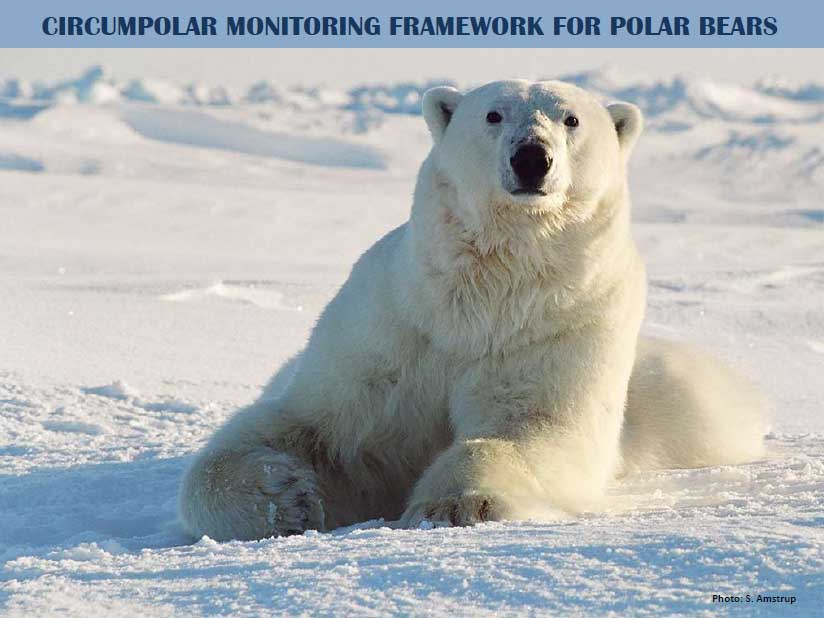
Figure 1. Vongraven 2013, Slide 1.

Figure 1. Vongraven 2013, Title slide.

Continue reading

Polar bear habitat update, end of November 2013

Freeze-up in the Arctic (~October-November) is important to polar bears because for those animals that have spent the ice-free period on shore (not all do), it marks the end of their summer fast — they can finally resume seal hunting.

Polar bears in the most southern regions, like Southern Hudson Bay, Western Hudson Bay, and Davis Strait (see Fig. 1), routinely experience the longest ice-free period. As these bears all spend the summer on shore, they appreciate a timely return of the ice.

 Figure 1. Polar bear subpopulations defined by the IUCN Polar Bear Specialist Group (PBSG), with a few extra labels added. I’ve rotated the original map 90 degrees (right) to make it easier to relate to the ice maps below. WH is Western Hudson Bay. Courtesy PBSG.  Click to enlarge.


Figure 1. Polar bear subpopulations defined by the IUCN Polar Bear Specialist Group (PBSG), with a few extra labels added. I’ve rotated the original map 90 degrees (right) to make it easier to relate to the ice maps below. WH is Western Hudson Bay; SB is Southern Beaufort. Courtesy PBSG. Click to enlarge.

Southern Hudson Bay bear populations routinely experience an ice-free season that is just as long as it is for Western Hudson Bay bears. However, Southern Hudson Bay polar bears numbers have remained stable over the last 30 years. Some folks insist that Western Hudson Bay bear numbers are shrinking to a worrisome degree, despite indications that the recent decline could be nothing more than a return to sustainable levels after a rapid population increase in the late 20th century (similar to changes documented for the Davis Strait and Barents Sea subpopulations).

Have a look at how sea ice – essential polar bear hunting habitat – has developed within these regions over the last 10 days or so (end of November 2013) and how November 2013 compares to November 1979. The ice maps tell the freeze-up story.
Continue reading

Polar bear habitat virtually everywhere now

What did I tell you, back in mid-September?

Have a look at all the polar bear habit, ten days shy of the end of November!

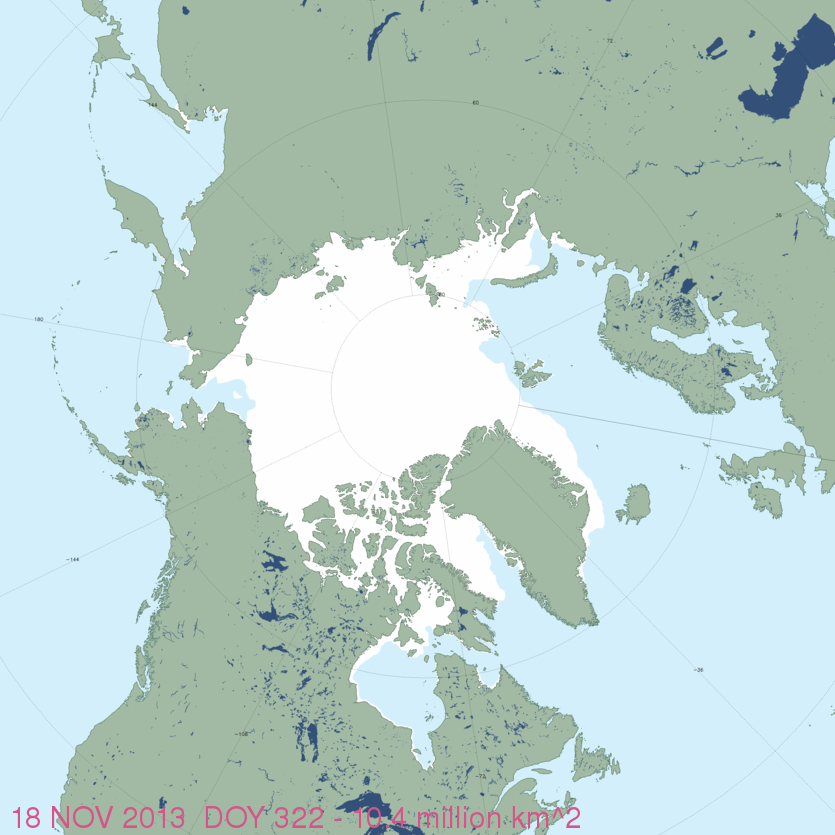
Figure 1. MASIE sea ice extent for November 18, 2013 (using US National Ice Center data). You have to look closely but there is indeed ice forming around Svalbard (just above the tip of Greenland) and in James Bay (southern Hudson Bay). Click to enlarge. High resolution map here.

Figure 1. MASIE sea ice extent for November 18, 2013 (using US National Ice Center data). You have to look closely but there is indeed ice forming around Svalbard (just above the tip of Greenland) and in James Bay (southern Hudson Bay). Click to enlarge. High resolution map here.

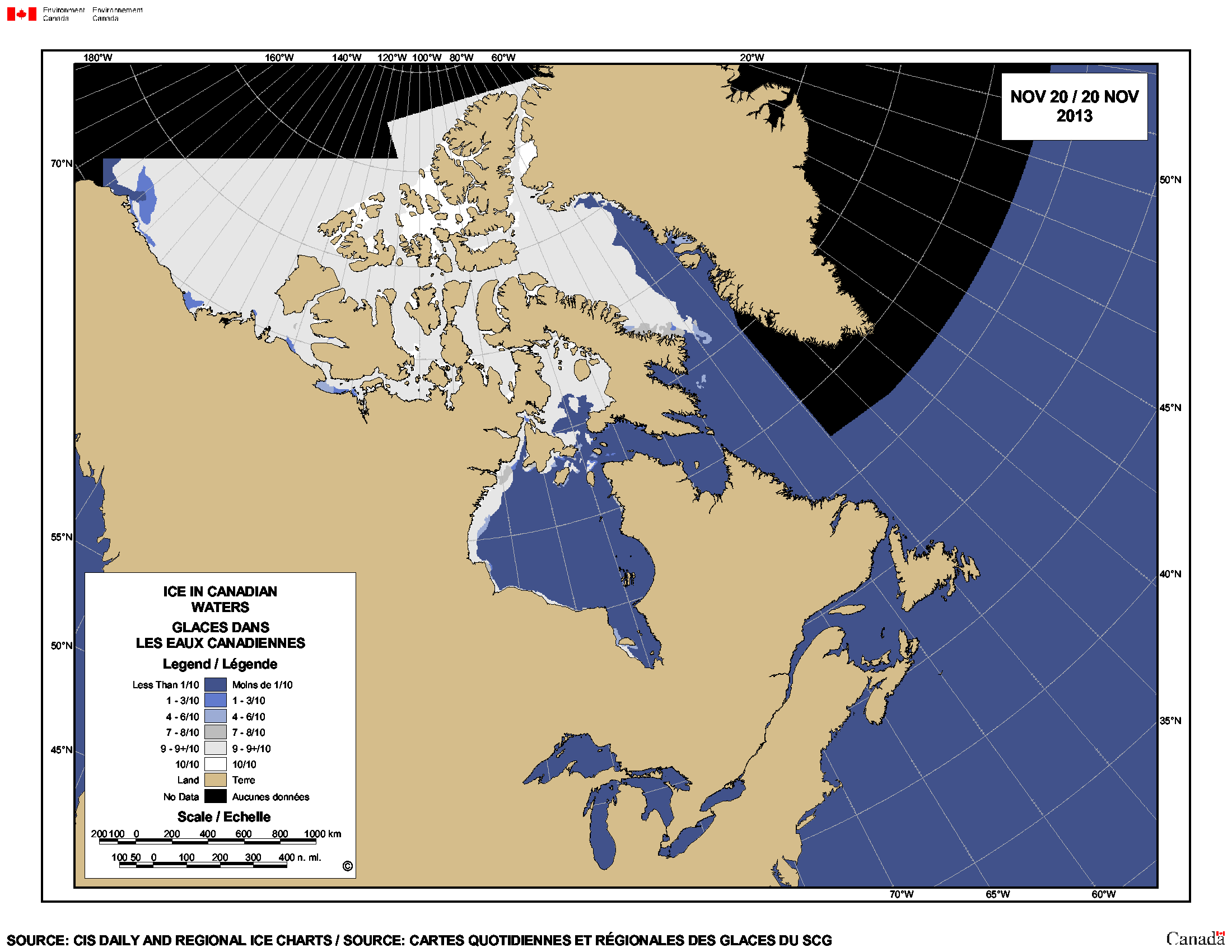
Figure 2. Canadian Ice Service map. Good amounts of ice developing in northern Hudson Bay, Foxe Basin and Davis Strait (between southern Greenland and Baffin Island), with ice forming along the shore in James Bay (the southern-most region where polar bears are on-shore at the moment). Click to enlarge.

Figure 2. Canadian Ice Service map. Ice developing rapidly in northern Hudson Bay, Foxe Basin and Davis Strait (between southern Greenland and Baffin Island), with ice also forming along the shore in James Bay (the southern-most region where polar bears are onshore at the moment). Click to enlarge.

Challenging “save the polar bear” propaganda

[Updates: Note correction to point 6 and links added at the end of the post]

Polar Bears International has mustered the UK newspaper, The Guardian, to provide free publicity for a “save the polar bear” propaganda event coming up tomorrow, November 6.

From The Guardian Environment Blog:

“On Wednesday, 6 November at 10am EST and 3pm GMT you will have a chance to ask a scientist [Steven Amstrup] and a conservationist [Krista Wright] about the latest research on the state of polar bears – and the efforts to protect them.”

The “participants” of this webchat are Polar Bears International (PBI) employees. PBI is a lobbyist organization that uses its influence to pressure politicians and supposedly impartial scientific organizations, like the IUCN Polar Bear Specialist Group (PBSG), to make decisions that fit their agenda. The PBI rallying cry is “Save Our Sea Ice.They are committed to promoting legislation to curtail supposed effects of anthropogenic global warming and are using polar bears as a tool to do so.

Dr. Steve Amstrup is now a full-time, professional activist and spokesperson for PBI (Chief Scientist and Vice President”), a job he took on after a long career as a polar bear biologist. Arranging “webchats” like this is part of the job he is now paid to do.

Krista Wright has a Bachelors degree in Outdoor Education and has worked for NGOs for more than 20 years. She joined PBI in 2009 and is now the Executive Director (i.e., an administrator). She is described as “a passionate conservationist who is deeply concerned about the effects of global warming on polar bears, the Arctic, and the planet.She brings emotion to this event, not science.

Below I dissect some of the fear-mongering background presented at The Guardian, one point at a time; Guardian quotes are in italics, numbered; my responses are below, with links to pertinent previous posts that are fully referenced:

[Links to video and the webchat Q & A have been added at the end of this post as updates]

Continue reading

Lancaster Sound – a rarely-mentioned region with a large polar bear population

The polar bear subpopulation designated as Lancaster Sound lies at the eastern entrance to the Northwest Passage in the Canadian High Arctic (Fig.1). We rarely hear about it but this region has one of the largest polar bear populations anywhere in the Arctic – only the Barents Sea and Foxe Basin have higher estimated population sizes.

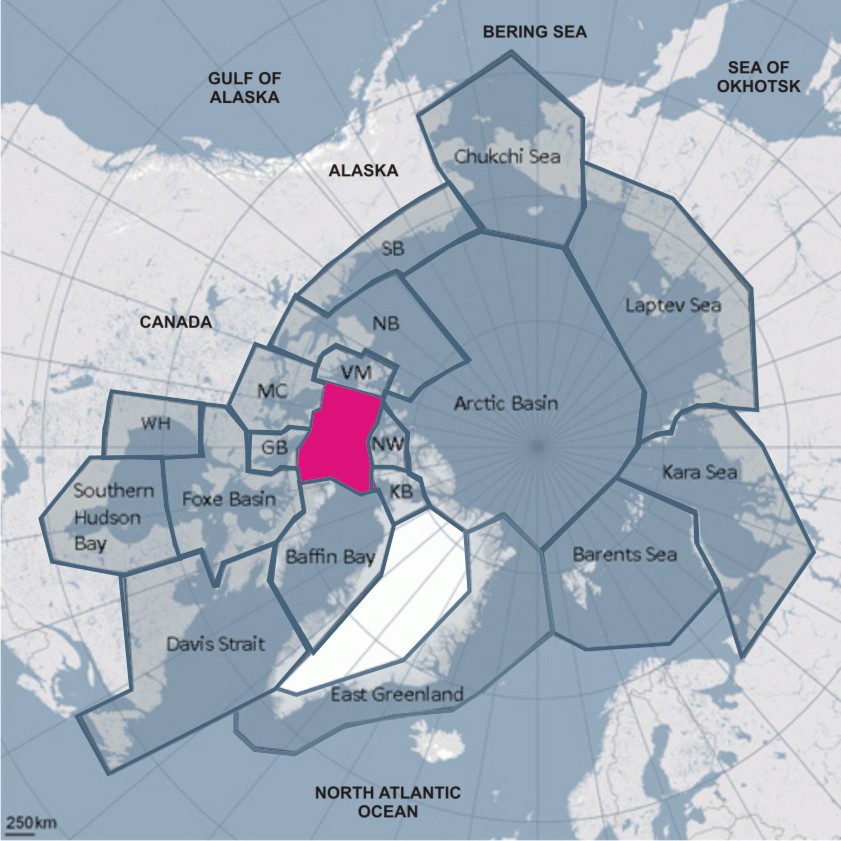
Figure 1. Lancaster Sound, magenta. Map courtesy Polar Bear Specialist Group, additional labels added.

Figure 1. Polar bear subpopulations with Lancaster Sound marked. Map courtesy IUCN Polar Bear Specialist Group, additional labels added.

Lancaster Sound includes the communities of Arctic Bay on northwestern Baffin Island and Resolute Bay on Cornwallis Island. Devon Island, which lies on the northern boundary, has no permanent communities, although two research stations are present (see here and here). A more detailed map showing the exact boundaries is available in Vongraven and Peacock (2011).

The eastern portion of Lancaster Sound is generally clear of ice by late summer (hence the Northwest Passage) but the western third of the region not only retains pack ice later in the season but some multiyear ice remains throughout the year.

The proximity of Lancaster Sound to Baffin Bay and the eastern Northwest Passage (Fig.2) undoubtedly exposed polar bears there to hunting by European whalers during the 1800s and early 1900s (see previous post here, especially Fig. 5), from which the population appears to have recovered.

On the other hand, the proximity of Lancaster Sound to oil and gas reserves further north in the High Arctic generated much-needed funds for polar bear biologists in the mid-to-late 1970s to collect essential baseline data for the entire region (Schweinsburg et al. 1982; Stirling et al. 1979, 1984; Stirling and Latour 1978).

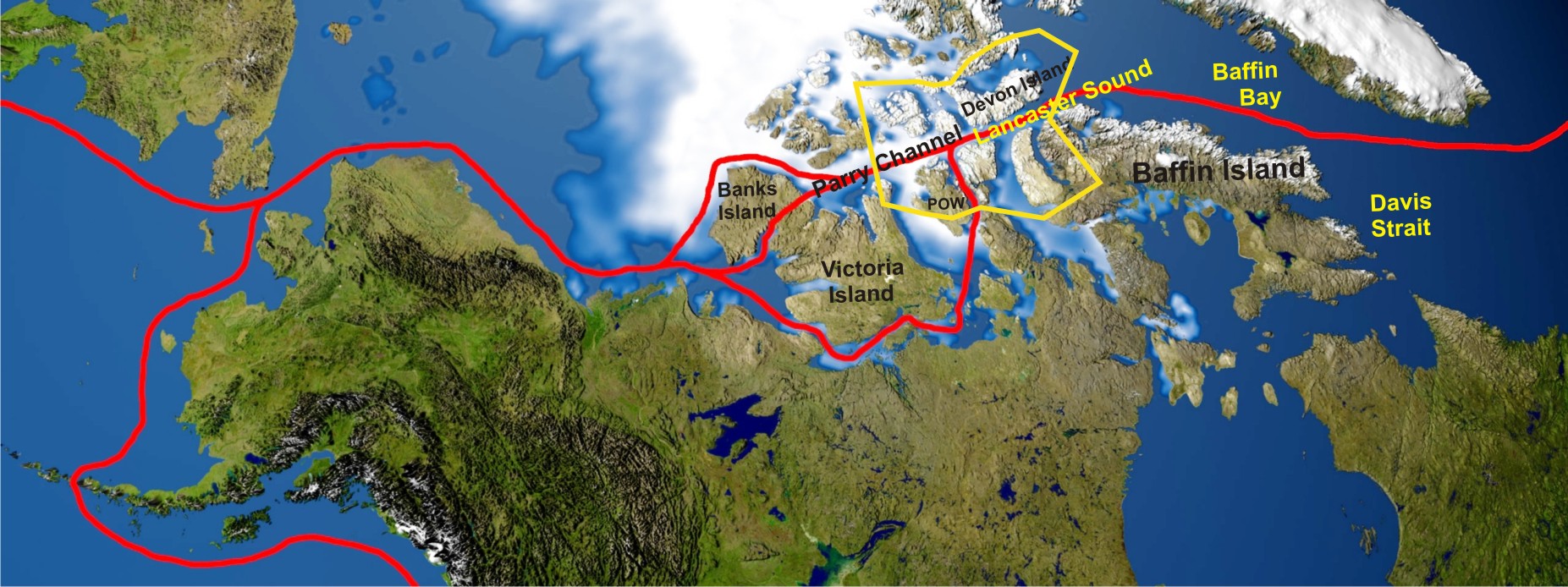
Figure 2. The main Northwest Passage route starts at Lancaster Sound and runs east through Parry Channel because these waterways routinely clear of ice in late summer. The approximate boundary of the Lancaster Sound polar bear subpopulation (area ~490,000 km2) is marked in yellow; POW is Prince of Wales Island. Map from Wikipedia, labels added.

Figure 2. The main Northwest Passage route starts at Lancaster Sound and runs east through Parry Channel because these waterways routinely clear of ice in late summer. The approximate boundary of the Lancaster Sound polar bear subpopulation is marked in yellow; POW is Prince of Wales Island. Map from Wikipedia, labels added. Click to enlarge.

Continue reading

What polar bear habitat could look like in another 5-6 weeks

According to the National Snow and Ice Data Center (NSIDC, Sept. 20 report), the annual sea ice minimum extent was reached on Sept. 13, 2013.

At 5.10 million square kilometers, this year’s low was a whopping 1.69 million square kilometers above the minimum extent for 2012 (which was the lowest since 1979) and well within two standard deviations of the 1979-2010 average. (Two standard deviations: “Measurements that fall far outside of the two standard deviation range or consistently fall outside that range suggest that something unusual is occurring that can’t be explained by normal processes”).

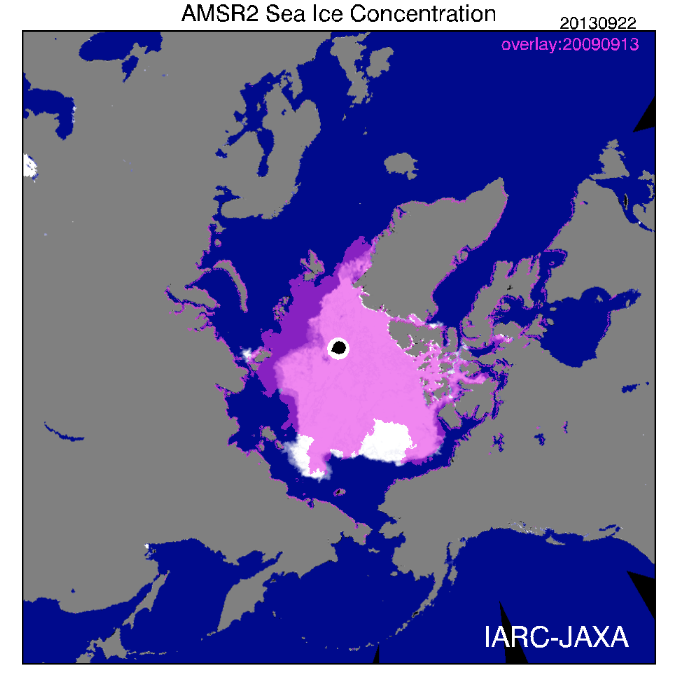
The minimum extent for 2013 is virtually indistinguishable from the minimum for 2009, which was 5.13 million square kilometers. The ice was distributed a bit differently in 2009 – more in the east and less in the west — than it was this year (see Fig. 1 below).

Figure 1. Using the JAXA “Sea ice monitor” feature, I plotted the date the 2013 minimum was reached (September 13, 5.10 million square kilometers, white) with an overlay (purple) for the same date back in 2009 (September 13, 2009, 5.13 million square kilometers), when that year’s minimum was reached (according to the NSIDC report). Areas of overlap are pink.

Figure 1. I used JAXA to plot the date the 2013 minimum was reached (September 13, 5.10 million square kilometers, white) with an overlay (purple) for the same date back in 2009 (September 13, 2009, 5.13 million square kilometers), when that year’s minimum was reached. Areas of overlap are pink.

You’ll know from previous discussions here that the annual minimum reached in late summer has little impact on polar bear health and survival (see excellent summary of the evidence for that here). What matters most to polar bears is the presence of ample ice in spring and early summer (March-June), which is their critical feeding period.

But after the fast that many polar bears endure over the height of the summer, they are eager to get back onto the ice and resume hunting. When in the fall does that become possible?

I wondered what the similarity in extent for 2013 and 2009 might tell us about polar bear habitat development over the next month or so.

In other words, what might polar bears this year expect in the way of sea ice development by say, the end of October? When might they be able to start hunting?

Continue reading

Polar Bear Specialist Group meeting postponed until 2014

[Update October 14, 2013: correction regarding Davis Strait population estimate, noted below]

I heard via the grapevine that the IUCN Polar Bear Specialist Group (PBSG) meeting, tentatively slated to be held this July (Obbard et al. 2010), has been postponed until 2014. [That will be the 16th Working Meeting, as they are called]

Word has it that shifting the meeting forward will allow the group time to put together a new population estimate that will incorporate recent survey results.

So which subpopulations are slated to be updated?

Figure 1. Polar bear subpopulations defined by the Polar Bear Specialist Group (PBSG). Note that Baffin Bay, Davis Strait, Western Hudson Bay and Southern Hudson Bay are all similar in that they become ice-free by early fall (the September minimum) or before.

Polar bear subpopulations defined by the Polar Bear Specialist Group (PBSG). Courtesy the PBSG.

As far as I can determine, there are at least two that haven’t quite been finished: Baffin Bay and Southern Beaufort. The Baffin Bay survey was supposed to be completed this spring, so the numbers just need to be crunched. Southern Beaufort has a survey in progress, planned to continue through the fall of 2013.

Here are some comments on the 2012 Southern Beaufort field season (USFWS Newletter 2013:17):

“The number of polar bears observed in 2012 was high relative to similar surveys conducted over the past decade. During August and September surveys, the majority of bears were observed east of Prudhoe Bay, primarily near Kaktovik. Body condition appeared relatively normal for this time of year with most bears reported to be in average condition.” [my bold] [see previous post here re: Kaktovik bears]

There are new counts for Foxe Basin (estimated at ~2,580 bears, similar to the early 1990s estimate of ~2,200; Stapleton, Peacock and Garshelis 2012) and Western Hudson Bay (estimated at ~1,000 bears, similar to the 2004 estimate of ~935; Stapleton, Atkinson et al. 2012) based on aerial surveys. These numbers have not yet been incorporated into the global total, although the studies suggest both of those populations have been stable since the last survey.

CBC News (June 26, 2012):

“A study has found that the polar bear population in the Foxe Basin region of Nunavut is stable and the bears are in good health.

The territorial government did an aerial survey of the bear population in 2009 and 2010. The survey results show the population is about the same size as it was in 1990 – about 2,580 bears.” [my bold]

There is also the new population estimate for Davis Strait (Peacock et al. 2013) that needs to be incorporated into the global total – in this case, there has been an increase from the previous estimate (up from ~1,400 to ~2,158). [corrected Oct. 14 2013] The population increase for Davis Strait has already been incorporated into the current global estimate. The new numbers were available by 2009 (the time of the last PBSG meeting) but the peer-reviewed publications (with all of the pertinent details) were not produced until recently (2012-2013, discussed here and here).
Continue reading

How and why great news about Chukchi polar bears has been suppressed

A new peer-reviewed report (Rode et al. 2014 [in print] 2013, accepted), released last month (announced here), documents the fact that polar bears in the Chukchi Sea are doing better than virtually any other population studied, despite significant losses in summer sea ice over the last two decades – even though the Polar Bear Specialist Group (PBSG) said this population was declining (Obbard et al. 2010).

Rode and Regehr 2010_Chukchi_report2010_Fig1_triplets_labelled

Rather than this good news being shouted far and wide, what we’ve seen so far is a mere whisper. The strategy for suppressing the information appears to have several parts: make it hard to find; don’t actively publicize it; down-play the spectacularly good nature of the news; minimize how wrong they were; keep the focus on the future.

Something similar happened with the newly-published paper on Davis Strait bears (Peacock et al. 2013, discussed here and here) but the news there wasn’t quite so shockingly different from expected. The suppression of good news stands in marked contrast to anything with a hint of bad news, which gets reported around the world — for example, Andrew Derocher and colleagues and their prepare now to save polar bears” policy paper in February, 2013.

US Fish & Wildlife biologist Eric Regehr, co-investigator of the Chukchi study and co-author of the newly-published report, wrote an announcement about the paper. It wasn’t a real press release, since it was not actually sent to media outlets. It was a statement, with a brief summary of the paper, posted on a regional US Fish & Wildlife website, with no mention of lead author Karyn Rode. Not surprisingly, lack of active promotion = no media coverage.

The posted announcement also down-played how well the Chukchi bears are doing. In fact, the news documented in the paper is much better than any of them let on: Chukchi polar bears are doing better than virtually all other populations studied.

But Regehr also had to do some damage control to counter the evidence this paper contains of how wrong they had all been — not only about the Chukchi population today but about their predictions for polar bears in the future.

After all, the computer models used to predict a dire future for polar bears combined the Chukchi Sea with the Southern Beaufort, as having similar ice habitats (“ice ecoregions”). The published paper and Regehr’s statement now say these two regions are very different and that polar bear response to loss of sea ice is “complex” rather than a simple matter of less summer ice = harm to polar bears. Regehr goes on to say that polar bear scientists expected this would happen. I call total BS on this one, which I explain in full later (with a map).

Finally, Regehr’s statement emphasizes that good news for 1 subpopulation out of 19 today should not be celebrated because the overall future for polar bears — prophesied by computerized crystal balls — is bleak. Focus on the future, they say. Did they forget that for years they’ve been telling us that polar bears are already being harmed and that this foreshadows what’s to come? Now we have the results of yet another peer-reviewed study showing bears not being harmed by declines in summer ice (see the full list here).

So, in the end, all of this double-talk and contradiction is not just about suppressing this particular paper. There’s much more at stake.

The Rode et al. Chukchi paper is strong evidence that their predictions of a grim future for polar bears – based on theoretical responses to summer sea ice declines that should already be apparent – have been refuted by their own studies. It’s no wonder they want to keep the media away from this story.

Details below.  [Update September 11, 2013: another news outlet picks up the story, see Point 2 below]

Continue reading

Ten out of ten polar bears being tracked this summer in the Beaufort Sea are on the ice

PB_male on ice_Regehr USFWS_March 2010_labeledTracking Beaufort Sea polar bears over the summer — what can it tell us about how important the position of summer sea ice relative to the shoreline in this region is to these bears? Do Beaufort Sea bears get stranded on shore like the polar bears in Davis Strait and Hudson Bay?

Polar bear biologist Eric Regehr (with the US Fish & Wildlife Service, or FWS) has a team working with US Geological Survey researchers (USGS) in the southern Beaufort tracking where adult female polar bears go throughout the year. This is part of on-going research in the Beaufort and Chukchi Sea (see previous post here; see also Fish & Wildlife 2009; Polar Bear News 2010 and 2013; Rode and Regehr 2010, pdfs below; and just out, the “accepted” version of the Rode et al. paper discussed here, and announced in my last post here).

The researchers have been posting a summary map at the end of each month on the USGS website showing the tracks of the females they fitted with radio collars the previous spring — for 2013, and back to 2010. They can’t put collars on male bears because their necks are larger around than their heads, so a collar would just slip off.

I’ve posted the July 2013 track map below, which shows all ten bears out on the ice, and the previous month (June 2013) to compare it to (the August map should be out shortly). I’ve included a few maps from 2012 to allow you to compare this year’s results to the situation last summer.

The August tracks should be available after the Labour Day weekend – check back next week to see where the bears have been this month. I’ll post the map here or you can go to the USGS website directly. [UPDATE Sept 4, 2013: The August map is up, posted here.]

Continue reading