Tag Archives: PBSG

Global polar bear population size is about 26,000 (20,000-32,000), despite PBSG waffling

The IUCN Polar Bear Specialist Group admits its global population estimate is simply a qualified guess with a large potential error.  So perhaps it’s time to acknowledge that for the purpose of comparing polar bears to other species of concern, the upper limit for polar bear numbers worldwide could be more than 30,000?
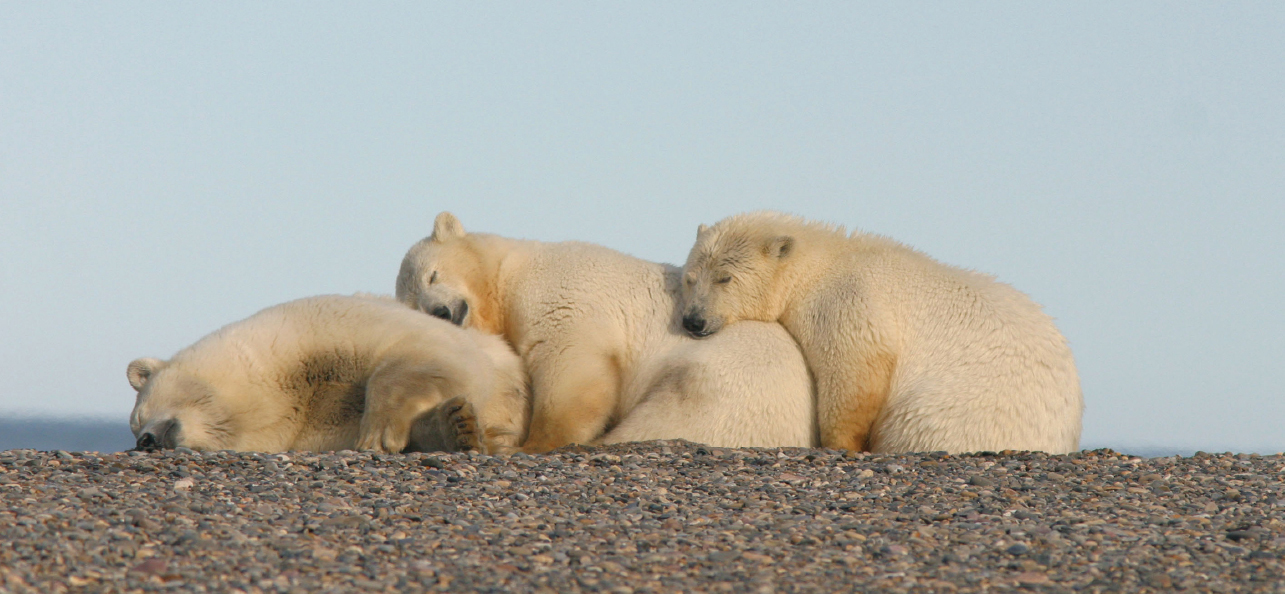
Polar bears USFWS_cover PolarBearNews2013_2014

See previous posts on this global population size issue (here and here); updated information below, including the most recent IUCN PBSG statement.

UPDATE 1 September 2015: here is an updated graph of polar bear population numbers that undo the “subtractions” of the PBSG between 2001 & 2013, giving a final global estimate of about 26,000. Click to enlarge:
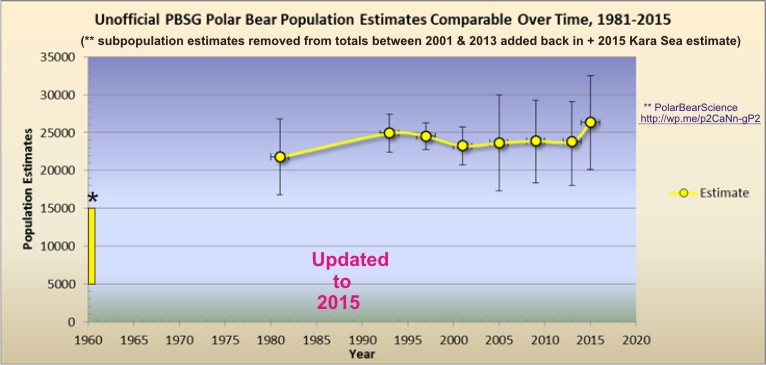
Crockford unofficial polar bear numbers to 2015 Sept 1 FINAL

UPDATE 25 November 2015: The 2015 update of the IUCN Red List for polar bears essentially concurs with my assessment about polar bear numbers. They estimate the current global population is 20,000-31,000 (average of 25,500, see below, without considering the number of bears in the Arctic Basin, so not far off my assessment) but say the trend in the population is “Unknown.”
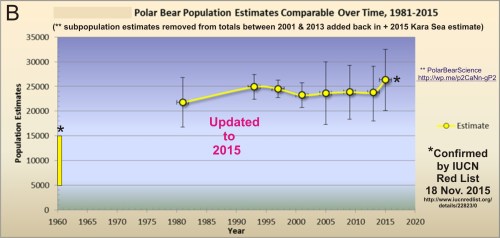
Crockford OFFICIAL polar bear numbers to 2015_IUCN concurrs Nov 18

UPDATE 23 February 2017: A new population estimate update is available based on three new survey counts that add about 2,000 bears to the average total, bringing it to almost 30,000 (28,500). Details here.

Continue reading

University newspaper misleads readers on status of Western Hudson Bay polar bears

Even though polar bear experts admit there has been no trend in sea ice breakup or freeze-up dates since 2001 – and both Canadian and International experts say this subpopulation is stable – the public is still being misled about the status and condition of polar bears in Western Hudson Bay.

WHB status 2015 IUCN PBSG_PolarBearScience

The latest example of misinformation about Western Hudson Bay polar bears appears in a feature story carried by the campus newspaper of York University (Ontario, Canada), meant to highlight the work of biology graduate student Luana Sciullo.1
Continue reading

PolarBearScience has been ‘Carbon Briefed’ – success at last!

Not just anyone warrants the attention of the European rapid response team: only those who get media attention and refuse to stay ‘on message’ about global warming issues get the Carbon Brief treatment.

Pidcock tweet on polar bears at 5 March 2015 6_20PM Pacific

After years of being ignored, I have finally been acknowledged as a worthy adversary [a force to be reckoned with] by those who spin the science of polar bears.

Carbon Brief folks got their knickers in a knot over my “Twenty Good Reasons Not to Worry about Polar Bears” blog post that the Global Warming Policy Foundation released as a Briefing Paper (pdf here). All timed for release on International Polar Bear Day (27 February 2015), which got mainstream media attention galore in the UK.
Continue reading

IUCN Specialist Group quietly adds “sea ice changes” to their polar bear status table

In late January, the IUCN PBSG made significant changes to its polar bear status table but did not think it was worth bringing to the public’s attention via a tweet, press release or note on their web site’s home page.

Hudson Bay female with cub_Wapusk_Thorsten Milse_Gov CA

What changes? Well, while the group did not see fit to agree with all of Environment Canada’s assessments (e.g. listing Davis Strait bears as “likely increasing” compared to the PBSG’s “stable”, see full list here), it did upgrade their status of Western Hudson Bay bears to ‘stable’ (which EC did back in June 2014).

More significantly, however, they also added two metrics of sea ice change to their assessment table, presumably because alongside ‘human-caused removals’ (which they also track in their tables)1, sea ice changes are supposedly critical ‘threats’ to polar bear health and survival.

So critical, in fact, that they’ve only just now gotten around to measuring it consistently across polar bear territory. Funny thing is, they cite no document that shows the sea ice change calculations for each subpopulation region, nor who generated them.

Let me be clear: no one has ever generated such a sea ice metric before – it is a unique PBSG construct that you will find nowhere else. By providing no documentation that lays out the calculations for inspection, the PBSG are simply insisting the public accept their unpublished, non-peer-reviewed work on faith. Details below.
Continue reading

East Greenland polar bears – said to be the most polluted but appear to be doing just fine

I’ve not written much about this subpopulation before but with the flurry of interest over “weakened” penis bones and toxic chemicals, I thought it was time to remedy the situation.

East Greenland Scorsby Sound March 2011 on Kap Tobin, Rune Dietz (press photo) Rune Dietz

East Greenland Scorsby Sound March 2011 on Kap Tobin, Rune Dietz, press photo

Continue reading

Polar bear gene flow blamed on melting ice is another model result that doesn’t make sense

Polar bear researchers just published a study that suggests polar bears have moved around the Arctic in direct response to recent sea ice changes — a conclusion I suggest you take with a grain of salt and a raised eyebrow.

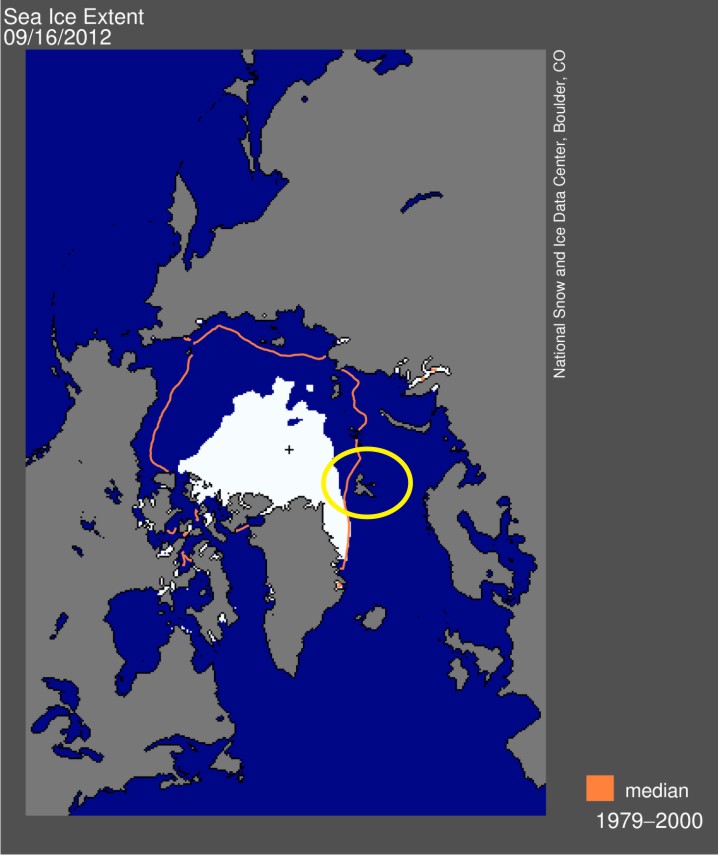
That’s because they have also proposed, among other things, that the Svalbard Archipelago was a sea ice refugium during warm interglacial periods, and could be again if the Arctic warms as predicted. That they would accept and promote such a model-based conclusion, which has no relationship with reality, calls their scientific judgment into question.

Svalbard as a potential warm refugium_Jan 8 2015_PolarBearScience

Based on genetic model results, the Svalbard Archipelago (circled) has been proposed as a sea ice refugium for polar bears during previous warm Interglacial periods and during predicted sea ice declines in the future. Yet most years since 1979 (2014 was one exception), this region has been ice free during the summer, making Svalbard a decidedly poor candidate for retaining sea ice when it’s much warmer than today.

Continue reading

IUCN Polar Bear Specialist Group out-lived its usefulness 20 years ago

The IUCN Polar Bear Specialist Group (PBSG) should have been disbanded in 1996, the year polar bears were down-graded from a status of ‘vulnerable to extinction’ to ‘lower risk – conservation dependent’ (now called ‘least concern’) on the IUCN Red List.

Bumpersticker from Cambridge Bay, Nunavut, courtesy Joe Prins.

Bumpersticker from Cambridge Bay, Nunavut, courtesy Joe Prins.

Polar bears had recovered from previous decades of wanton over-hunting — by all measures used by the International Union for the Conservation of Nature, they were a conservation success story.

Why did the IUCN and Arctic governments not break up the PBSG back in 1996? Leaving the group intact once polar bears were down-graded to ‘least concern’ simply made its members desperate to justify their existence. That’s precisely what we’ve seen over the last 20 years — PBSG members working tirelessly to ensure the organization didn’t go extinct.

pbsg logo

In fact, polar bears are in no more danger of extinction now than they were in 1996, despite dedicated efforts of the PBSG to convince the world otherwise. Take a look at the history and see if you come to a different conclusion.
Continue reading

Kara Sea: first-ever polar bear count suggests about 3,200 bears live there

The first-ever population estimate for polar bears in the Kara Sea is an astonishing 3,200 bears (range 2,700-3,500). Russian researchers report the results in a new paper (Matishov et al. 2014, in English).

Kara Sea_PBSG

Polar bear counts were made during late winter/early spring (approximately January to April) from ice-breakers between 1997 and 2013. Females with cubs (whether one or two) were noted. The counts were extrapolated to give a total for the entire region (as is usual for all such surveys).

The question is, will the IUCN Polar Bear Specialist Group (PBSG) consider this new polar bear count to be reliable or complete enough to include in their next IUCN assessment?

Continue reading

Recent S. Beaufort polar bear count was a cherry-picked result – new evidence

New evidence has come to light that mark-recapture field work used to calculate a new population estimate for Southern Beaufort polar bears did not conclude in 2010 as implied in a widely-publicized paper last month but continued until 2013.

Amstrup w triplet_Prudhoe Bay 2005_USGS_sm

Steve Amstrup in S. Beaufort, 2005 (USGS photo), co-author of Rode et al. paper.

As I discussed previously, last month’s widely-hyped paper (Bromaghin et al. 2015 in press) – which reported a decline of ~40% between 2004 and 2010 (based on spring mark-recapture work) – was contradicted by fall survey counts that suggested strongly a population rebound would have been apparent if the mark-recapture work had continued another two years.

A new paper by Karyn Rode and colleagues (which includes Bromaghin and others (e.g. Amstrup) from the previous paper), summarized in a USGS press release issued on Monday and published online Tuesday, utilized comprehensive data collected during mark-recapture work carried out in spring from 1982 to 2013 in the Southern Beaufort Sea.

This new paper used the same kind of comprehensive data as Bromaghin and colleagues – from the same season, in the same region – to assess potentially negative effects of the mark-recapture research method itself, up to 2012 and beyond.

More on the Rode et al. conclusions later1 – for the moment, what is important is that the work described in the paper confirms that spring mark-recapture work on polar bears in the Southern Beaufort continued beyond 2010. Bromaghin and colleagues didn’t end their mark-recapture work prematurely — they actually left data collected in 2011 and 2012 out of their population estimate analysis when they had to have known the population had not finished rebounding from the 2004-2006 decline.
Continue reading

Amstrup knows his polar bear predictions are flawed – but continues to promote them

The largest conservation organization in the world says that predictive models developed by polar bear biologist Steven Amstrup are utterly unsuitable for scientifically estimating future populations. Earlier this year, mathematical modeling experts  at the International Union for the Conservation of Nature, who maintain the Red List of Threatened Species, made it clear that Amstrup’s models (used in 2008 to convince the US Fish and Wildlife Service to list polar bears as ‘threatened’ due to predicted global warming) do not meet IUCN standards.

I’d say this makes Amstrup’s polar bear projections (Amstrup et al. 2008, 2010) no more scientifically useful than a crystal ball prophesy, but you wouldn’t know it by his recent actions — or the silence of his fellows.

crystal ball_3c

Continue reading