Tag Archives: population estimate

Status of Canadian polar bear populations has been changed – more good news

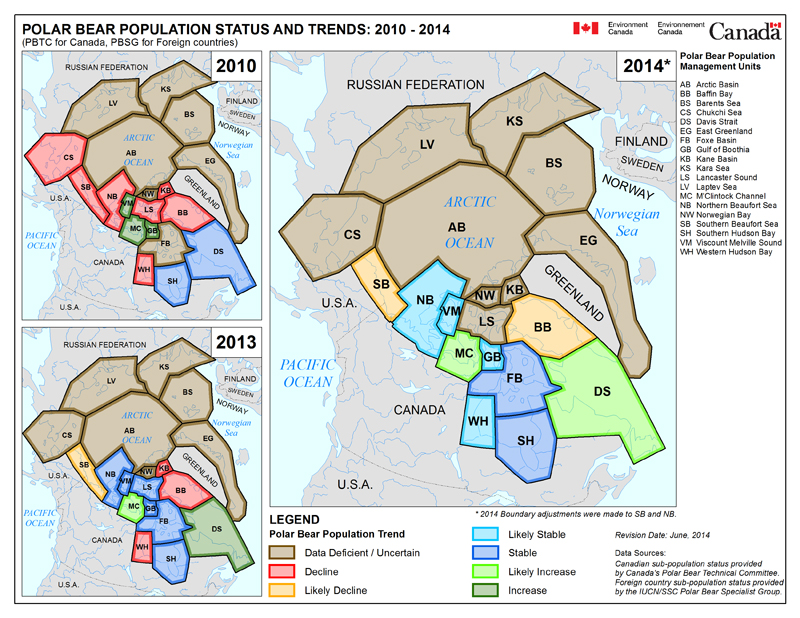
According to maps dated June 2014, Environment Canada (EC) has changed the trend status of several Canadian subpopulations — without any announcement or publicly-available documents explaining the basis of the changes.

Figure 3. "Series of Circumpolar Polar Bear Subpopulation and Status Trend Maps 2010, 2013 & 2014" Note the asterisk below the 2014 map, which is dated "June 2014" and is different in its status assessment from the one released in February 2013 by the PBSG. Original here.

Figure 1. Environment Canada’s “Map 4: Series of Circumpolar Polar Bear Subpopulation and Status Trend Maps 2010, 2013 & 2014.” Original here.

And would it surprise you to learn that virtually all of these status changes reveal more good news about polar bears?
Continue reading

Beaufort Sea polar bear subpopulation boundary has been changed

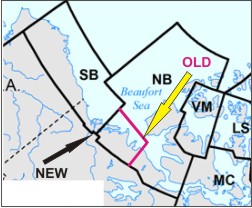
Environment Canada recently posted a set of maps on its website that show it has moved the boundary between the polar bear subpopulation it shares with the USA — without a word to the media or a note anywhere.

EC S_N Beaufort boundary change Sept 8 2014_cropped PolarBearScience

Continue reading

Tracking polar bears in the Beaufort Sea – September 2014 map

Here is the September 2014 follow-up to my post on the July 2013 track map for female polar bears being followed by satellite in the Beaufort Sea by the US Geological Survey (USGS) – “Ten out of ten polar bears being tracked this summer in the Beaufort Sea are on the ice.”

See that post for methods and other background on this topic, and some track maps from 2012 (also available at the USGS website here).

The USGS track map for September 2014 is copied below (Fig. 1).

At the end of September, with sea ice starting to rebuild, it appears there were 8 bears on the ice and three on land.

The situation for September was not very much different from August, except that two of the 11 bears (up from one) were on the ice in the Chukchi Sea in September, a phenomenon that was recently acknowledged to have affected the last population estimate for the Southern Beaufort subpopulation.

Continue reading

M’Clintock polar bear survey’s first year plagued by fog in an area thick with heavy ice

“Blizzards, we had fog — we had to sleep in the helicopter, on the sea ice one night, because we couldn’t fly anywhere,” Markus Dyck, senior polar bear biologist with the GN, told Nunatsiaq News Sept. 5.”

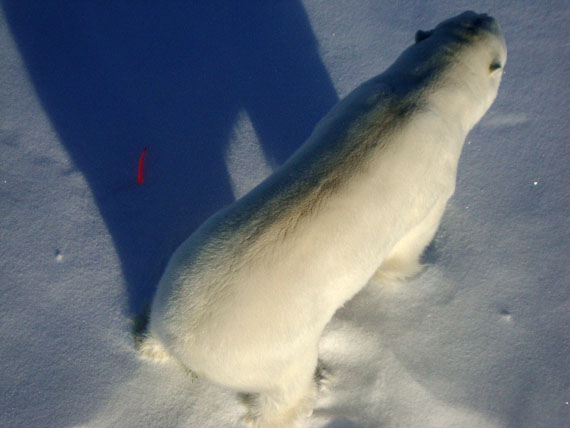
Polar bear with dart_bear_570_2012 Kane Basin_M Dyck photo

Fog was the theme of polar bear research this summer in Queen Maud Gulf, otherwise known as the M’Clintock Channel polar bear subpopulation region.

The ice has been heavy in that region as well, according to a the National Snow and Ice Data Center (NSIDC) and reported yesterday in another story (Heavy pack ice in NW Passage ice creates tough conditions this year: Pack ice clogs Queen Maud Gulf).

For maps showing where M’Clintock Channel and Queen Maud Gulf actually are, see the maps — and more quotes — below.
Continue reading

“The Politics of Polar Bears” lengthy excerpt airs across Canada – cue the outrage

Umbrage alert! Last night, a half-length short form of the powerful and balanced documentary “The Politics of Polar Bears” aired across Canada on the CBC’s flagship TV news program, The National.

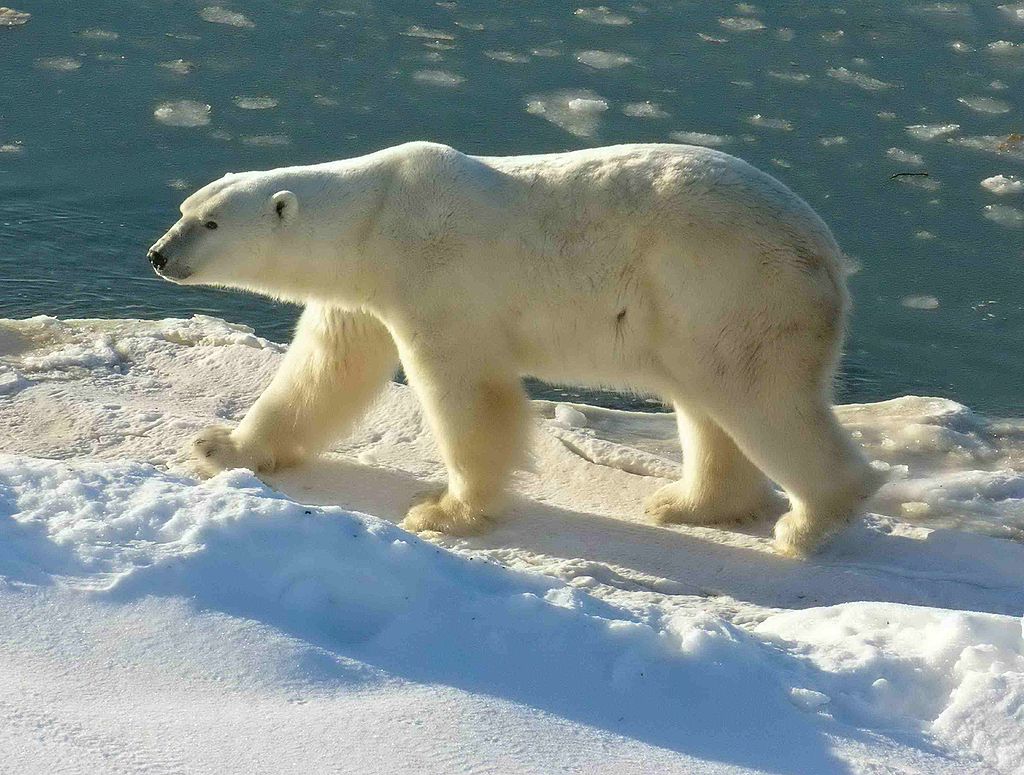
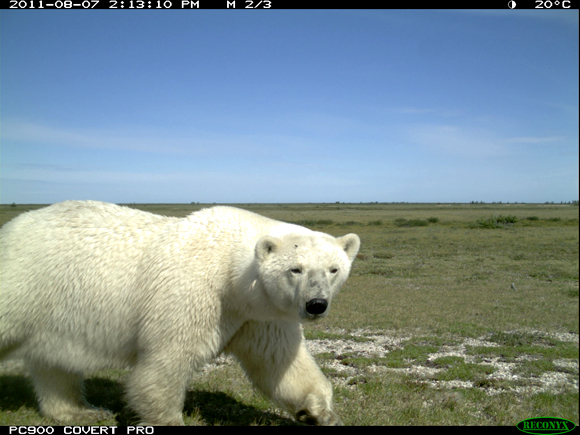
Polar_Bear_2004-11-15_Wapusk Nat Park_Wikipedia

Right after it aired, they followed up with a lengthy online summary by the producer of the film, Reg Sherren (Polar bears: Threatened species or political pawn?”, September 2, with video of the 19 minute short program). Check out the comments below it! Excerpts and my comments below.

[Links to the full length film here and in my previous posts here and here]

UPDATED April 27 2015: Video now available on Youtube, imbedded below Full length video no longer available, short one at CBC here.

Continue reading

Has the tide turned on polar bears as icons of global warming?

The CBC in Canada is pretty much a mirror image of the BBC in the UK, ABC in Australia and PBS in the US. So you might appreciate my shock at the almost unbelievable balance contained in the recently broadcasted CBC documentary, “The Politics of Polar Bears: Tracking the Celebrity Bear.

The film is a profound change from the hype and pessimism that has dominated the polar bear issue in Canada and abroad, supported unchallenged by the CBC. Finally, TV viewers were given some decently balanced perspective on the status of polar bears in  Western Hudson Bay.

If the take-away message tipped towards reason and optimism rather than panic over the status of polar bears, it’s because the evidence was strongly in that direction.

Politics of polar bears title

Continue reading

W Hudson Bay mark-recapture studies of polar bears were invalid, says peer-reviewed study

“Our results suggest that mark–recapture estimates may have been negatively biased due to limited spatial sampling. We observed large numbers of bears summering in southeastern WH, an area not regularly sampled by mark–recapture.” Stapleton et al. 2014.

Polar bear at Wapusk National Park (just south of Churchill) in August 2011. Courtesy Parks Canada.

Polar bear at Wapusk National Park in August 2011. Courtesy Parks Canada.

We’ve seen the results of this 2011 study before, in government report format. But now it’s been revamped, peer-reviewed and published in a respected scientific journal – it actually came out in February, without fanfare, but I’ve only just come across it.

Some excerpts below, with conclusions that should raise some eyebrows.

Continue reading

Southern Beaufort polar bear ‘decline’ & reduced cub survival touted in 2008 was invalid, PBSG now admits

It is now clear that the phenomenon of bears moving across Southern Beaufort Seapbsg logo subpopulation boundaries compromised the US decision to list polar bears as ‘threatened’ and the IUCN Polar Bear Specialist Group (PBSG) knows that was the case.

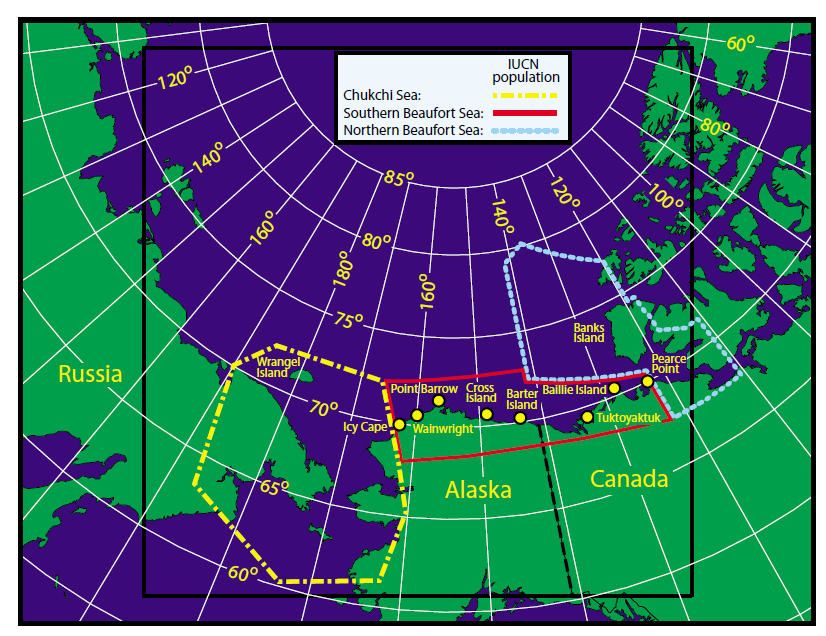
As I pointed out last week, the PBSG has admitted in their 2013 status table update (pdf here) that bears move around so much between the Chukchi Sea (CS), the Southern Beaufort (SB), and the Northern Beaufort (NB) subpopulations that major changes in the boundaries of the SB subpopulation are necessary (see Fig. 1 below).
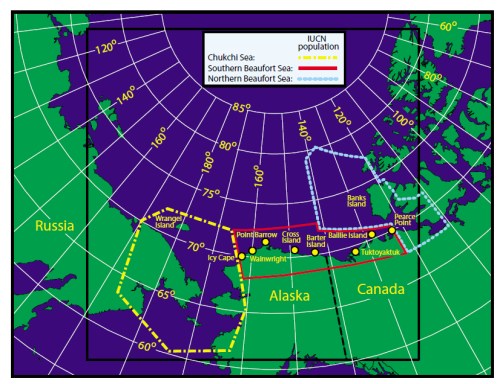
Figure 1. From the paper by Amstrup and colleagues (2005) describing the effect that movement of bears across subpopulation boundaries has on setting harvest quotas – and population estimates. Southern Beaufort boundary is solid red, Chukchi Sea is dashed yellow and Northern Beaufort is dotted light blue. “Point Barrow” is Barrow, AK (well inside the SB boundary). Click to enlarge.

Figure 1. From the paper by Amstrup and colleagues (2005) describing the effect that movement of bears across subpopulation boundaries has on setting harvest quotas and population estimates. Southern Beaufort (SB) boundary is solid red, Chukchi Sea (CS) is dashed yellow and Northern Beaufort (NB) is dotted light blue. “Point Barrow” is Barrow, AK (well inside the SB boundary). Click to enlarge.

Well, that’s not really news — changes to the SB boundaries were promised by the PBSG back in 2009 (Obbard et al. 2010), based on research by Steven Amstrup and colleagues published in 2001 and 2005. But now, in an astonishing admission, the PBSG have acknowledged that the last population survey for the SB (Regehr, Amstrup and Stirling, 2006), which appeared to register a decline in population size and reduced cub survival over time, did not take known movements of bears into account as it should have done.

In other words, that 2006 study almost certainly did not indicate bears dying due to reduced summer sea ice in the SB, as biologists said at the time — and which they presented as evidence that polar bears should be listed by the ESA as ‘threatened’ — but reflected capture of bears that were never part of the SB subpopulation and so moved out of the region.

As the PBSG said about the 2006 estimate:

“…it is important to note that there is the potential for un-modeled spatial heterogeneity in mark-recapture sampling that could bias survival and abundance estimates.” [my emphasis]

Spatial heterogeneity” means that the sampled bears could have come from more than one population, a possibility which violates a critical requirement of the statistics used to generate the population and survival estimates. “Un-modeled” means that the ‘movement of bears’ problem was not factored into the mathematical models that generated the 2006 population size and survival estimates as it should have been.

Ecologist Jim Steele pointed some of this out in his book and his guest post last year, so it’s not news that this was done.

What’s shocking is that the PBSG have now admitted that the ‘movement of bears’ issue essentially invalidates the 2006 population estimate and the much-touted ‘reduced survival of cubs.’ The reduced survival of cubs data from that SB study was a critical component of the argument that US bears were already being negatively impacted by global warming and thus, should be listed as ‘threatened’ under the ESA (US Fish & Wildlife Service 2008).

Since the population decline and reduced survival is now acknowledged to be unfounded — and perhaps deliberately so — I ask you this: will a new SB survey — soon to be released by the same lead author (Eric Regehr) — undo the broken trust in US and PBSG polar bear biologists? Continue reading

Polar bear population now officially 13,071-24,238 says IUCN Polar Bear Specialist Group

Without fanfare of any kind (so far), the IUCN Polar Bear Specialist Group (PBSG) has just announced, via a notice posted on its website, that it has revised the population estimate for polar bears to 18,349 (range 13,071-24,238), based on a new status table posted today.

The average is down slightly from the 2009 estimate of 19,747 (which was officially stated as “20,000-25,000”), but that “decline” is an illusion.

As for the 2005 and 2009/2010 status tables, they do not add up the columns to give the totals — you have to do that yourself, which is how I got the numbers above. There is no mention of a change to the global estimate total in any of the “announcements” on their website.

As occurred in 2005 and 2009
, an overall reduction in the total was achieved primarily through removal of an estimate present on their tables since 1993 (Laptev Sea, “800-1200”). Changing this estimate to zero reduced the average total by 1,000 but does not reflect a real-world change.

In addition, four subpopulation estimates were reduced, three of them only slighty (details below) and three subpopulation estimates (Foxe Basin, Western Hudson Bay and Southern Hudson Bay) were increased to reflect recent aerial survey results. Two others were increased slightly.

A new column has been added to the status table, again without explanation, called the Trend relative to historic level (approx. 25-yr past).” Although only seven out of 19 subpopulations had anything like an accurate estimate in 1989, four are now considered to have been “not reduced” while three are considered “reduced.” Why this is considered meaningful enough to add to the table is not clear.

The PBSG say they have decided to update the status table independent of their meetings, which means that no written report or document will be made available to explain any changes — the “justifications” will only be available online.

These are the people we are supposed to trust to provide honest and accurate information about the status of polar bears worldwide. The changes in the status table provided today, which have been made without oversight of any kind, hardly inspire confidence in the information they provide. See what you think.
Continue reading

Polar Bear Specialist Group population status update – officially postponed

I kept a close watch on the website of the IUCN Polar Bear Specialist Group (PBSG) over the weekend to see if an actual population status update might eventually appear (see my last post).

Nothing all weekend, but today (Monday, February 3), the “Population status – Status table” tab (where the 2010 status table was inserted on Friday), returned an error message — the out-of-date status table put up on the day an updated one was promised was simply gone.

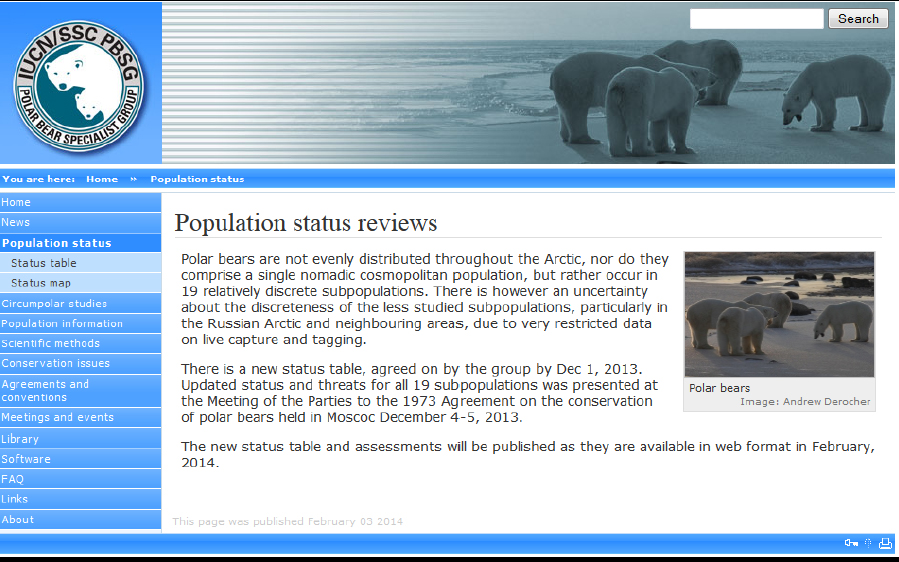
However, I noticed that the last sentence of the original December 16, 2013 “Population status reviews announcement had been changed, without any indication that it had been amended.

From December 16, 2013 until February 2, 2014 that last sentence said:

“The new status table and assessments will be published as they are available in web format no later than February 1, 2014.

Now it reads:

“The new status table and assessments will be published as they are available in web format in February, 2014.” [my bold]

The date stamp on this page is February 3, 2014, see screen cap below.

What do you call this — “Bayesian transparency”? I think it means a polar bear population status update may be forthcoming…sometime.

PBSG Population status reviews_Feb 3 2014 notice