Tag Archives: sea ice

Churchill polar bear report 17-23 July 20: those ashore appear to be in great shape

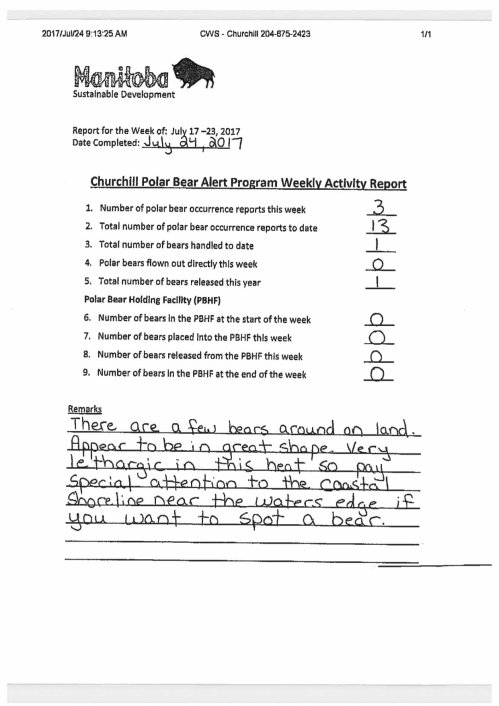
Just out from the City of Churchill: few polar bears reported onshore for the week of 17-23 July 2017 (week 2) but those seen “appear to be in great shape.”
Churchill PB reports_week 2_ July 17-23_2017

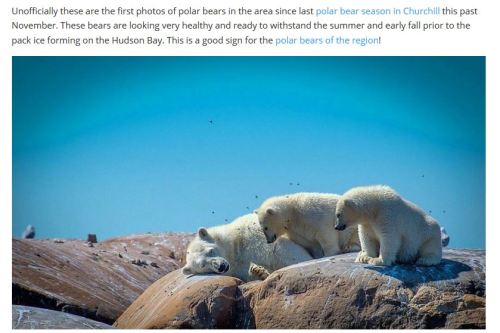
Update 24 July 2017 12:20 PM: Just spotted this blog report from Churchill Polar Bears” that I somehow missed last week, which includes what seems to be the first polar bear photo’s of the season (of a sow and two chubby cubs) that are also in fine condition.

ChurchillPolarBearsDotOrg_July 14 2017 Alex De Vries photoThe photos were taken by Churchill photographer and guide Alex De Vries on Thursday 13 July and I hope he doesn’t mind my including one of those here as documentary evidence of the good body condition of this mother and both her cubs — see more photos at the Churchill Polar Bears blog post dated 14 July here.

Compare last week’s PB Alert report above to last year’s (below):

2016 July 18_24_week 2

Problem polar bears of Churchill: first report of the season similar to 2016

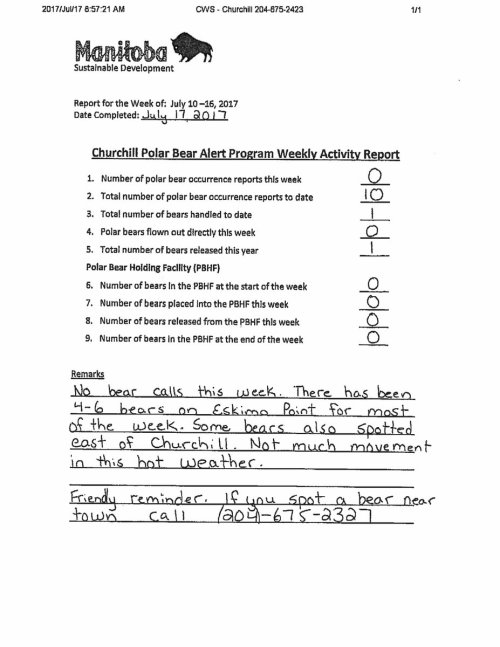
The first activity report of the Churchill Polar Bear Alert Program has been released for 2017. It comes on the same week as last year’s (so about the same dates for first bears ashore both years), and reports pretty much the same activity.

Churchill PB reports_week 1_ July 10-16_July 2017

Odd that this year’s report contains no mention whatsoever of the condition of the bears as did last year’s (see below), which may have brought criticism for spoiling the media ‘message’ that WHB bears are suffering because of reduced sea ice. Better no comment at all than good news, eh?

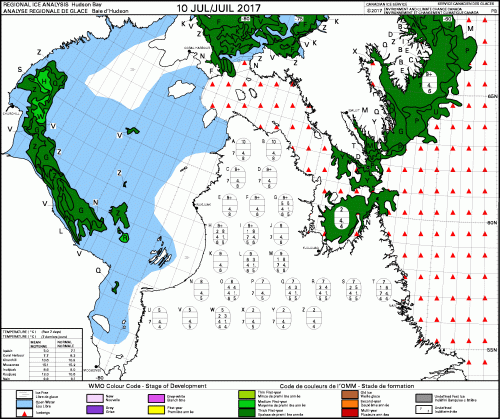
Sea ice for the week of 10 July off Western Hudson Bay this year consisted of a broad strip of thick first year ice (>1.2m thick) just off shore.

Hudson Bay weekly ice stage of development 2017 July 10

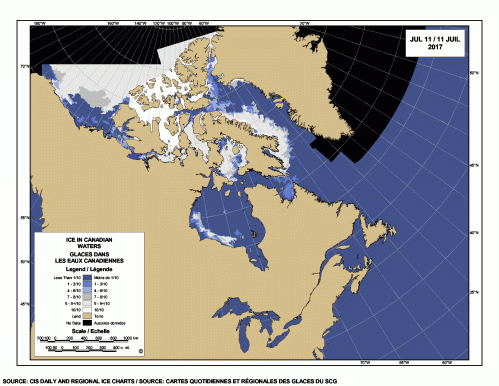
The ice charted above looked like this on a standard ice map:

Sea ice Canada 2017 July 11

There are no other reports that I could find of polar bears ashore along the coast of Western Hudson Bay, so these bears must be the first wave.

Continue reading

Western Hudson Bay polar bears reportedly still on ice as of 17 July 2017

Today, polar bear biologist Andrew Derocher posted a progress report via twitter on the annual journey ashore of the Western Hudson Bay bears tagged by his University of Alberta research team that shows virtually all of the bears are still out on the sea ice.

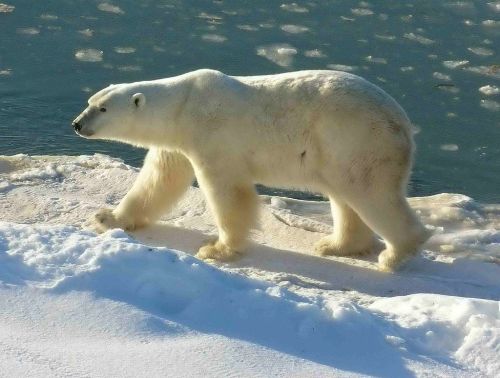
Churchill_Polar_Bear_2004-11-15 Wikipedia

After months of gloomy reports on the state of the Hudson Bay sea ice, it’s clear from the map Derocher posted (below) that only one bear out of 12 still transmitting has come ashore so far, although he comments that “some tags haven’t reported lately” (the purple icons are ear tags put on males &/or young bears while the blue icons are collars put on adult females):

Oddly, the same comment was made almost a month ago about these same bears and the suggestion was made that these animals “may be swimming to shore”:

Money quote: Today Derocher remarked that “bears may be shifting behaviour to stay out on less ice” to explain why the tagged bears have still not come ashore as he expects them to do.

Perhaps if he used a different ice chart, it might make more sense (see below). However, the same thing has been happening year after year: WHB polar bears stay on the ice much longer than Derocher predicts but he does not change his expectations or the type of ice chart he uses to track the bears.

As I’ve pointed out before (because this is what field researchers have stated), polar bears have a tough time catching seals after about mid-June or so but they may still prefer to be on the sea ice than on land, even if it’s low concentration ice.

Continue reading

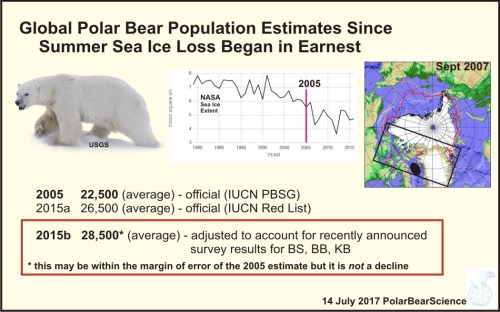
Abrupt summer sea ice decline has not affected polar bear numbers as predicted

Yes, Arctic sea ice has declined since satellite records began in 1979 but polar bears have adjusted well to this change, especially to the abrupt decline to low summer sea ice levels that have been the norm since 2007.
Global pb population size sea ice 2017 July PolarBearScience

Some polar bear subpopulations have indeed spent more time on land in summer than in previous decades but this had little negative impact on health or survival and while polar bear attacks on humans appear to have increased in recent years (Wilder et al. 2017), the reasons for this are not clear: reduced summer sea ice is almost certainly not the causal factor (see previous post here).

Ultimately, there is little reason to accept as plausible the computer models (e.g. Atwood et al. 2016; Regehr et al. 2016) that suggest polar bear numbers will decline by 30% or more within a few decades: even the IUCN Red List assessment (Wiig et al. 2015) determined the probability of that happening was only 70%.

Arctic sea ice has never been a stable living platform (Crockford 2015): it shifts from season to season, year to year, and millennia to millennia. Without the ability to adapt to changing conditions, Arctic species like polar bears and their prey species (seals, walrus, beluga, narwhal) would not have survived the unimaginably extreme changes in ice extent and thickness that have occurred over the last 30,000 years, let alone the extremes of sea ice they endured in the last 200,000 years or so.

Some biologists continue to hawk doomsday scenarios for polar bears due to summer sea ice loss but the truth is that their previous predictions based on sea ice declines failed so miserably (e.g. Amstrup et al. 2007) that it’s impossible to take the new ones seriously — especially since the basic assumptions that caused the first predictions to fail have not been corrected, as I’ve stated in print (Crockford 2017:27):

In summary, recent research has shown that most bears are capable of surviving a summer fast of five months or so as long as they have fed sufficiently from late winter through spring, which appears to have taken place since 2007 despite marked declines in summer sea ice extent.

The assumption that summer sea ice is critical feeding habitat for polar bears is not supported.

Recent research shows that changes in summer ice extent generally matter much less than assumed in predictive polar bear survival models of the early 2000s as well as in recent models devised to replace them (Amstrup et al. 2010; Atwood et al. 2016a; Regehr et al. 2015; Regeher et al. 2016; Wiig et al. 2015), while variations in spring ice conditions matter more.

As a consequence, the evidence to date suggests that even if an ‘ice-free’ summer occurs sometime in the future ­ defined as sea ice extent of 1 million km2 or less (Jahn et al. 2016) ­ it is unlikely to have a devastating impact on polar bears or their prey. [my bold]

The abrupt drop in summer sea ice that occurred in 2007 was not predicted by experts to occur until mid-century yet the predicted decimation of polar bears worldwide expected under those conditions (a loss of 2/3 of the global total, to only about 6660-8325 bears) not only did not happen, it did not come even close to happening (Crockford 2017; see also my recent books, Polar Bear Facts & Myths, and Polar Bears: Outstanding Survivors of Climate Change, sidebar).

Instead, the global population grew from about 22,550 bears in 2005 to about 28,500 bears in 2015. And while this might not be a statistically significant increase (due to the very wide margins of error for polar bear estimates), it is absolutely not a decline.

The present reality is that low summer sea ice cover since 2007 has not caused polar bear numbers to decline and therefore, polar bears are not a species in trouble. This suggests that even if the Arctic should become briefly ice-free in summer in the future, polar bears are likely to be only minimally affected and not become threatened with extinction. Polar bears are outstanding survivors of climate change: recent research and their evolutionary history confirm this to be true.

Continue reading

Polar bears of W Hudson Bay utilizing a substantial patch of thick first year ice

There’s been no word as yet, either from tour operators or polar bear researchers, that Western Hudson Bay polar bears have come ashore for the summer/fall season. Andrew Derocher reported at the end of June that the bears tagged by his team were still on the ice and as I write this, has not yet reported them ashore.

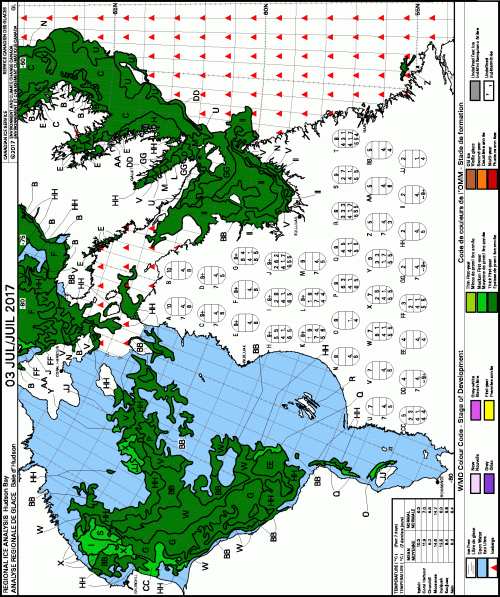
That pattern is consistent with the presence of thick ice along the west coast of the Bay — from well north of Churchill to the south of Wapusk National Park — for the last few weeks. The weekly chart for 3 July 2017 below from the Canadian Ice Service shows that virtually all of the ice remaining is thick first year ice (>1.2m, dark green on this map):

Hudson Bay weekly ice stage of development 2017 July 3

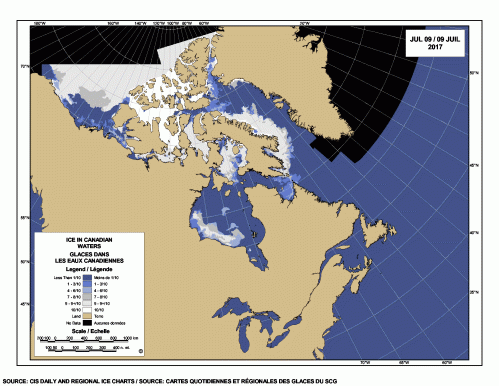
By the 9 July, the extent of this patch of ice was somewhat reduced but still a very prominent feature over the Bay, suggesting that if adult seals are using this ice as a refuge while molting, some bears may still be attempting to hunt even though their success rate may not be very high:

Sea ice Canada 2017 July 9

Bottom line: As has been the pattern for more than a decade, 2017 will not go down in history as an especially early year for WHB polar bears coming off the ice for the summer/fall season but instead may be as late as last year, when lots of bears were reported off the ice by mid-July at Seal River (just north of Churchill), all in excellent condition.

It remains to be seen if the condition of bears will be as good this year as they were in 2016, given the late start to the season. But it does mean that the lack of trend in breakup dates since 2001 continues: breakup of the sea ice in WHB since 2001 has been about one week later than it was before 1998 (Castro de la Guardia 2017; Cherry et al. 2013; Lunn et al. 2016).

If some polar bear struggle to survive this year it will be due to the late freeze-up date last fall combined with challenging winter conditions over Hudson Bay, not because of an early breakup of the sea ice.

And while it is certainly true that the overall trend in time spent onshore by WHB polar bears since 1979 has increased by about three weeks, the lack of a continued trend since 2001 is not what was expected or predicted, especially given the marked decline in global sea ice levels that have made headlines since 2007 (Crockford 2017), and the predictions of how devastating such low levels of ice would be to polar bears in areas like Hudson Bay that have to deal with a total disappearance of sea ice in summer and early fall.

Continue reading

Svalbard polar bear habitat higher than average – here’s what that looks like

Polar bear habitat around Svalbard in the Barents Sea is currently slightly above average for 23 June 2017: this short post records what that amount of ice looks like according to the Norwegian Ice Service (NIS).

Svalbard ice extent 2017 June 23_NIS from archive

Compare to 2015 at the same date, the year that the last polar bear count was conducted for the Svalbard region, when many cubs were seen and the bears were reported in excellent condition:

Svalbard ice extent 2015 June 23_NIS from archive

Continue reading

W Hudson Bay polar bears won’t have an early breakup year, according to sea ice charts

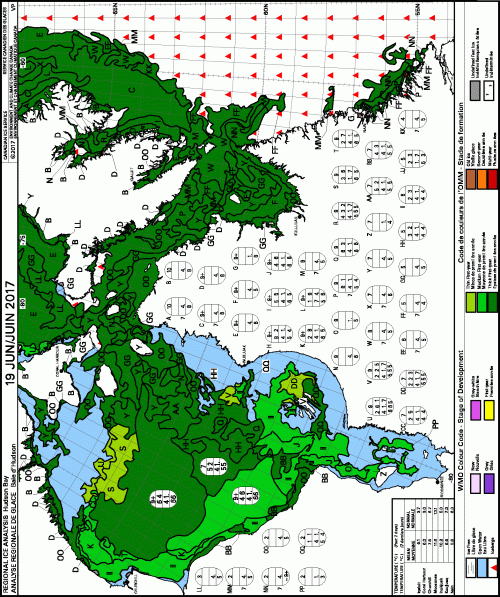
There is still a huge swath of highly concentrated thick first year ice (>1.2m) over most of Hudson Bay this week (19 June 2017) and even in the NW quadrant (the closest proxy we have for Western Hudson Bay), the weekly graph shows levels are greater than 2016, when WHB bears came off the ice in good condition about mid-July. All of which indicates 2017 won’t be an early sea ice breakup year for WHB polar bears.

Hudson Bay weekly ice stage of development 2017 June 19

There is thick first year ice (>1.2m, dark green) in patches along the west coast in the north and south. Thick first year ice also extends into Hudson Strait and Baffin Bay, with some medium first year ice (0.7-1.2m thick, bright green) along the central and southern coasts of WHB.  Note the red triangles incorporated into the thick ice of Hudson Strait in the chart above: those are icebergs from Greenland and/or Baffin Island glaciers. A similar phenomenon has been noted this year off northern Newfoundland, where very thick glacier ice became mixed with thick first year pack ice and were compacted against the shore by storm winds to create patches of sea ice 5-8 m thick.

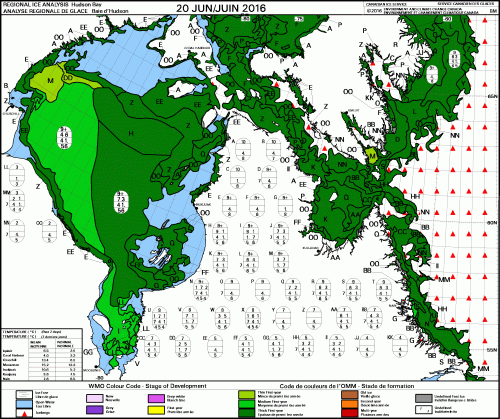
Compare the above to what the ice looked like last year at this time (2016 20 June, below). There is more open water in the east this year (where few WHB bears would likely venture anyway) but less open water around Churchill and Wapusk National Park to the south than there was in 2016:

Hudson Bay ice age weekly at 20 June 2016

We won’t know for several more weeks if most WHB bears will come ashore at about the same time as last year (early to mid-July) or whether they will be in as good condition as they were last year (because winter conditions may not have been similar).

But so far, sea ice conditions are not looking as dire as the weekly “departure from normal” chart (below, 19 June 2017) might suggest (all that “less than normal” red and pink, oh no!!):

Hudson Bay weekly departure from normal 2017 June 19 Continue reading

Heavy ice off East Coast 2017 caused by winds, cold temperatures, and icebergs

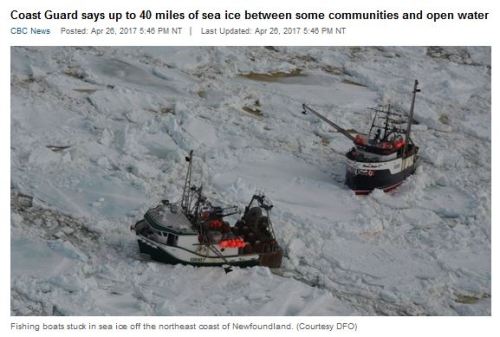
Heavy sea ice off Newfoundland and southern Labrador has been an issue for months: it brought record-breaking numbers of polar bear visitors onshore in early March and April and since then has hampered the efforts of fisherman to get out to sea.

Newfoundland fishing boats stuck in ice_DFO_May 26 2017 CBC

Let’s look back in time at how the ice built up, from early January to today, using ice maps and charts I’ve downloaded from the Canadian Ice Service and news reports published over the last few months.

The tour is illuminating because it shows the development of the thick ice over time and shows how strong winds from a May storm combined with an extensive iceberg field contributed to the current situation.

Bottom line: I can only conclude that climate change researcher David Barber was grandstanding today when he told the media that global warming is to blame for Newfoundland’s record thick sea ice conditions this year.  I suspect that because Barber’s expensive research expedition was scuttled, he simply had to find a way to garner media attention for his project — and the media obliged. Read to the end and decide for yourself.

Continue reading

USGS ‘treadmill’ paper repeats bogus claim that ice loss harmed polar bears

The newest polar bear science paper making the rounds courtesy the US Geological Survey, is a perfect example of a statistically-significant result with no biological significance. While the results are rather lame, the paper is dangerous because it repeats the disingenuous claim (see Crockford 2017) that Southern Beaufort Sea polar bear numbers declined in recent years due to summer sea ice loss.

polar_bear_rubble_ice_Mike Lockhart USGS_8 April 2011

The USGS authors (Durner et al. 2017) know this harm-from-summer-ice-loss assertion is not true for the Southern Beaufort subpopulation but the more papers they can get into print that say so, the more likely it will be believed — and the less likely readers will check older literature that documents the recent decline in polar bear numbers was due to a three year period (2004-2006) when thick ice conditions in spring made seal hunting a challenge, a repeat of a well-known phenomenon (e.g. Stirling et al. 1980; Stirling 2002) unique to this region that has been documented since the 1960s.

The Durner paper (USGS press releaseIncreased Sea Ice Drift Puts Polar Bears on Faster Moving Treadmill” published online 6 June ahead of print) spins the research results as potentially significant bad news but in so doing reveals how desperate they have become to make the public and their biology colleagues believe that Southern Beaufort polar bears, among others, are being negatively affected by summer sea ice loss (as per Stirling and Derocher 2012).

Durner, G.M., Douglas, D.C., Albeke, S.E., Whiteman, J.P., Amstrup, S.C., Richardson, E., Wilson, R.R. and Ben-David, M. 2017. Increased Arctic sea ice drift alters adult female polar bear movements and energetics. Global Change Biology. DOI: 10.1111/gcb.13746 http://onlinelibrary.wiley.com/doi/10.1111/gcb.13746/abstract [paywalled]

In fact, the Durner et al. paper does not document any harm to polar bears from the proposed ‘treadmill’ effect of more rapidly moving ice for the period 1999-2013 compared to 1987-1998, but instead uses models to suggest bears might have to eat one to three more seals per year to compensate for the extra energy needed to walk against the moving ice. That’s right: perhaps only 1 more seal per year out of the 50 or so they would usually consume (see Stirling and Øritsland 1995). In my opinion, that’s a pretty lame result for what one of the co-authors described as an immense amount of work.

News outlets have essentially used the USGS press release as a click-bait lede for another round of Trump-bashing with respect to the Paris climate change agreement, see here and here: the stories are hardly about polar bears at all. And predictably, polar bear activist and co-author Steven Amstrup (paid spokesperson for Polar Bears International, famous for their “Save Our Sea Ice” campaign) appears to be using the same approach: an up-coming call-in talk radio program at NPR’s Anchorage affiliate KSKA for Tuesday 13 June at 10:00 (Alaska time, see “Talk of Alaska”) is being billed as a discussion of “polar bears, climate change, and the Paris Accord” (h/t AK geologist). Continue reading

Breakup of sea ice on track in Canada as critical feeding period for polar bears ends

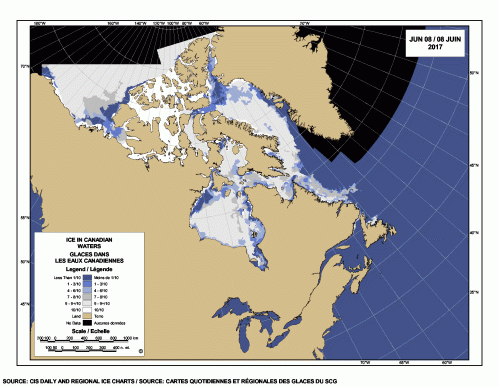
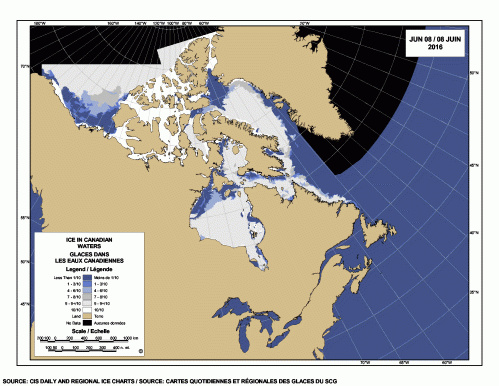
Relative to recent years and potential impacts on polar bear health and survival in Canada, there is nothing alarming in the pattern or speed of sea ice breakup for 2017, either over Hudson Bay, the southern Beaufort, or the eastern high Arctic.

Sea ice Canada 2017 June 8

Last year at this time (see map below), there was more open water in Hudson Bay and in the Southern Beaufort yet the polar bears came ashore in fine shape that summer and there was no hue-and-cry of dying bears anywhere. Breakup this year is on track to be about 3 weeks earlier than it was in the 1980s, as it has been since at least 2001, a conclusion reached by polar bear specialists (Castro de la Guardia et al. 2017; Lunn et al. 2016), who examined sea ice breakup to 2015.

Sea ice extent Canada 2016 June 8 CIS

Here are critical words to remember (more details here) from biologist Martin Obbard and colleagues (2016:29) on the relationship between body condition and sea ice for Southern Hudson Bay (SH) polar bears, which apply equally well to bears in other regions:

Date of freeze-up had a stronger influence on subsequent body condition than date of break-up in our study. Though models with date of freeze-up were supported over models with other ice covariates, we acknowledge that lower variability in freeze-up dates than in ice duration or break-up dates could have influenced the model selection process. Nevertheless, we suggest that a stronger effect of date of freeze-up may be because even though break-up has advanced by up to 3-4 weeks in portions of Hudson Bay it still occurs no earlier than late June or early July so does not yet interfere with opportunities to feed on neonate ringed seal pups that are born in March-April in eastern Hudson Bay (Chambellant 2010). Therefore, losing days or weeks of hunting opportunities during June and July deprives polar bears of the opportunity to feed on adult seals, but does not deprive them of the critical spring period (Watts and Hansen 1987) when they are truly hyperphagic. No doubt, the loss of hunting opportunities to kill adult seals has a negative effect on body condition, but it appears that for bears in SH a forced extension of the fast in late fall has a greater negative effect on subsequent body condition.” [my bold]

In other words, by mid-June at least (maybe earlier), polar bears have largely finished their intensive feeding that’s so critical to their survival over the rest of the year.

That’s why the latest count of SH polar bears (Obbard et al. 2015) showed a stable population (and see this recent post on WHB polar population estimates). But freeze-up was late last year and that’s what will make the difference to polar bears over the coming year.

Continue reading