Tag Archives: Stirling

Why is it that every decade, Eastern Beaufort sea ice gets really thick?

I’ve written before about the incidents of starving polar bears in the eastern portion of the Southern Beaufort Sea (here, here, and here). For two or three years every decade since the 1960s, shorefast ice in the Eastern Beaufort (Fig. 1) has become too thick and compressed in the spring for ringed seals to maintain their breathing holes, so most or all of them presumably go elsewhere — as seals did in Greenland when ice got too thick there (Vibe 1965). With few or no seal pups born during March and April in thick ice years, some bears had a hard time finding enough food: starving bears and dying cubs were the result.
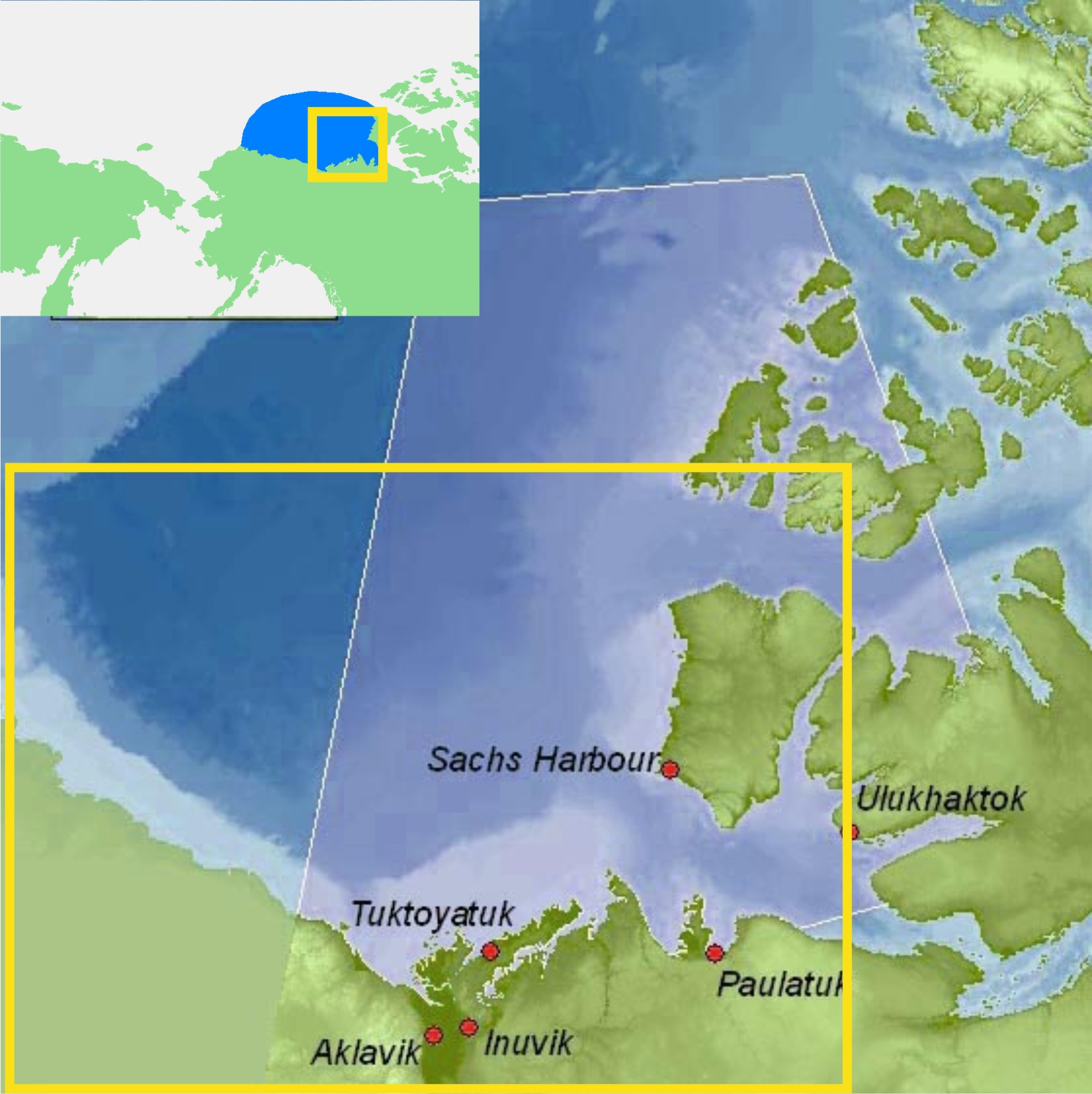
Figure 1. Eastern portion of the southern Beaufort Sea.  The communities of Tuktoyatuk (locally known as ‘Tuk’), and Sachs Harbour on southern Banks Island, have been useful starting points for polar bear research because they are accessible by plane via the larger community of Inuvik The light blue portions, e.g. along western Banks Island and the Eastern Beaufort/Yukon mainland coast, indicate shallow continental shelf areas (20 km wide in places) where extensive shorefast ice develops every winter. Main map from Beaufort Sea Partnership, inset map from Wikipedia.

Figure 1. ‘Eastern Beaufort’ (yellow square) polar bear study region.
The communities of Tuktoyatuk (locally known as ‘Tuk’), and Sachs Harbour on southern Banks Island have been used as base camps for polar bear research because they are accessible by plane via the larger community of Inuvik.
The light blue portions along western Banks Island and the Eastern Beaufort/Yukon mainland coast indicate shallow continental shelf areas (20 km wide in places) where extensive shorefast ice develops every winter.
Main map from Beaufort Sea Partnership, inset map from Wikipedia.

I’ve been trying to get my head around why this would happen in the Eastern Beaufort. Once or twice – maybe – but several times every decade? What on earth drives such a process?

So, I did some reading (actually, quite a lot of reading) and have what appears to be at least a partial answer.

All indications are that the occasional development of exceptionally thick spring ice in the Eastern Beaufort is the result of an entirely natural, cyclical phenomenon. However, some polar bear biologists are attempting to blame the latest episode (but not earlier ones) on increased amounts of open water in the Chukchi Sea during fall of the early 2000s. That doesn’t seem a plausible explanation to me, given the history of the sea ice in this region. Have a look.
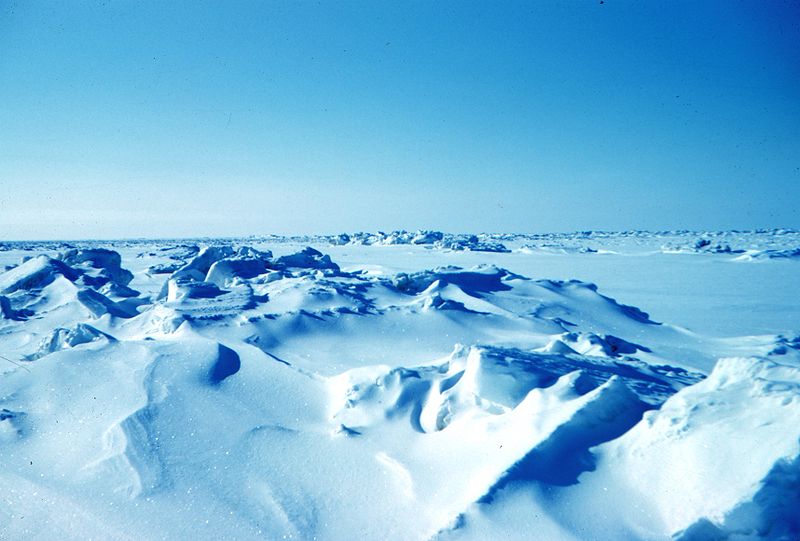
Figure 2. Beaufort sea pressure ridges, spring 1949. Courtesy Wikipedia (from NOAA “At the ends of the Earth” image collection #corp1014).

Figure 2. Beaufort sea pressure ridges, spring 1949. Courtesy Wikipedia (from NOAA’s “At the ends of the Earth” image collection #corp1014).

Continue reading

Davis Strait polar bears again: body condition declined while population increased

This is a short follow-up to my last post on Davis Strait polar bears.

Today I’ll highlight a paper published last year (Rode et al. 2012) that had three of the same co-authors as the Peacock et al. (2012) paper I discussed on Monday – Lily Peacock, Mitch Taylor, and Ian Stirling contributed to both papers. Rode et al. (2012) deals with the issue of body condition (relative degree of fatness) in polar bears vs. changing levels of sea ice over time, and if you’ll pardon the pun, adds even more weight to the conclusion that declines in summer sea ice do not necessarily spell the disaster for polar bears we have been told is inevitable.

A polar bear near Thule, NW Greenland. Note the decidedly chubby back end on this bear, who looks well prepared for winter. Photo by Robin Davies. [details at my Quote Archive, Featured Quote #6]

A polar bear in the summer of 2012 near Thule, NW Greenland (part of the Baffin Bay subpopulation). Note the decidedly chubby back end on this bear, who looks well prepared for winter. Photo by Robin Davies.
[details at my Quote Archive, Featured Quote #6]

Continue reading

Cannibalism update and insight on the timing of media hype

In my last post, I went over some of the spin and misrepresentation of fact contained in the claim by leading polar bear biologists Steven Amstrup, Ian Stirling and Andrew Derocher (Amstrup et al. 2006; Stirling and Derocher 2012) that cannibalism is on the increase because of the effects of global warming on Arctic sea ice.

I’ve had an opportunity to follow up on three points that puzzled me. Three relate to the Amstrup et al. paper that described three cases of cannibalism in the southeastern Beaufort Sea in 2004 and one to the incidents in western Hudson Bay in 2009. In the process, I found at least three more misrepresentations of fact and gained some insight on why these incidents of cannibalism were hyped so enthusiastically when they were. Continue reading

Cannibalism in polar bears: spin and misrepresentation of fact galore

In my next to last post, I discussed some of the anecdotal reports of den collapses included in the peer-reviewed summary of facts presented by biologists Ian Stirling and Andrew Derocher (2012) that supposedly support the premise that global warming is already having an impact on polar bear populations (discussed previously here, here, and here), prophesied to be even greater in the future. While they admit that such reports are not based on scientific studies, they nevertheless include them in their published list of global warming impacts, and not surprisingly, that is how others have interpreted them.

The same is true for their treatment of the phenomenon of cannibalism in polar bears. In that same paper, Stirling and Derocher (2012:2701) have a section called “Anecdotal observations consistent with predictions of the effects of climate warming.” This section begins with a discussion of cannibalism:

“There have been several well-publicized observations that are consistent with predictions of the effects of climate warming on polar bears, but cannot be statistically linked. For example, intraspecific aggression and cannibalism were predicted to increase in polar bears with climate warming (Derocher et al. 2004, Table 1). Observations of infanticide and cannibalism by thin adult males on land during the open water period have been documented (e.g., Lunn & Stenhouse, 1985; Derocher & Wiig, 1999; Amstrup et al., 2006; Stone & Derocher 2007). Such events have been known to occur for many years and, although their significance is unclear, there is some evidence suggesting the frequency of occurrence is increasing in areas where bears fast on land for extended periods. ” [my bold]

And this is the evidence for the supposed increase in occurrence:

“For example, in late summer and autumn 2010 [sic], there were eight observations of cannibalism on the western coast of Hudson Bay compared to one or two in the previous 5 years (I. Stirling, unpublished data).” [my bold; 2010 should be 2009 – more on this later.]

Were these observations of cannibalism made by polar bear researchers or someone else? Were there as many observers in the area in each of the five years prior to the year they occurred, as there were when these incidents were observed? We don’t know, because it’s unpublished data.

Stirling and Derocher have again included critical information in their list of facts that has not been published. I guess I’ll have to add “evidence for cannibalism” to my previous list of “Critical evidence on polar bears in W. Hudson Bay is unpublished” (see also “Stirling and Derocher’s sea ice trick) [there is more information available, but it’s not from peer-reviewed sources – more on this below]

In this post, I take a look at some of the evidence that is published, some of the media interviews and reports that followed, and the information that came from a press release issued by an advocate group. I’ve made a table summarizing the details of all recent papers and reported incidents, and some of them are described in more detail. In a footnote, I have a brief summary of why polar bears kill and eat each other.

These details reveal some rather shocking evidence of scientists misrepresenting evidence – in their peer-reviewed papers and in interviews with the media – and bathing their global warming prophesies in the blood-lust of cannibalism. It’s past time to shine a big bright light on the cannibal issue, so pardon the length of this post.

[See followup post April 19 here]

Continue reading

The two faces of polar bear biologists – Zac Unger interviews Amstrup and Stirling

Former firefighter Zac Unger has been in the news quite a lot over the last few months, promoting his new book, “Never Look a Polar Bear in the Eye” (see Zac’s website here, where you’ll find a list of some of the articles he’s written; the Canadian Geographic one is very good (“The truth about polar bears”) and was the one that originally caught my attention in early December 2012. One article that I’ve read is missing from that list, “Are Polar Bears Really Disappearing?” (Wall Street Journal, Feb. 8, 2013). There is a book review in the Winnipeg Free Press here (Feb. 2, 2013) and on climate scientist Judith Curry’s blog (Dec. 21, 2012), and an interview with Globe and Mail columnist Margaret Wente here from Feb. 23, 2013).

I’ve mentioned bits from some of these articles previously: Featured Quote #32 (Feb. 23, 2013) and in my Dec. 16, 2012 post, ‘Species-threatening’ population declines vs. polar bear declines.

In my last post, I promised a follow-up discussion on cannibalism in polar bears, as it has been promoted by polar bear biologists. I recalled a discussion of this by Unger, which I think makes a nice lead-in for my own essay, which I should have up in a few days.

Here is the money quote from Unger (with a link to the NBC interview with Amstrup and Stirling he is talking about). A lengthy excerpt from the article is below, for the context – it’s well worth a read:

[In 2008, after watching polar bear biologist Dr. Steve Amstrup give an interview on NBC News explaining “the evidence behind the decision to list the polar bear as threatened. Evidence like cannibalism.”] “Wait a second. Hadn’t Amstrup just finished telling me that the cannibalism thing was getting too much play by a bloodthirsty media?” Zac Unger, PS Magazine, Dec. 17, 2012 [2:40 min. NBC News video here]

Continue reading

Collapse of polar bear snow dens – Stirling and Derocher’s anecdotal evidence

In their summary of facts supposedly supporting the premise that global warming is already having an impact on polar bear populations (discussed previously here, here, and here), biologists Ian Stirling and Andrew Derocher (2012:2700) include a list of incidents of warm winter weather and/or “rain on snow events” that have led to the collapse of polar bear maternity dens and ringed seal birthing lairs.

Stirling and Derocher state that both polar bears and ringed seals (their primary prey) have a demonstrated

high vulnerability …to increased mortatily resulting from warm temperatures and rain. Such rain on snow events are predicted to increase as the climate warms in the Arctic (Hansen et al. 2011).”[my bold]

However, their so-called evidence for polar bears and ringed seals having a proven vulnerability to these events comes not from scientific studies but what they admit outright are anecdotal reports.

They describe four incidents, including one case of a maternity den collapse (involving a 6 yr old, probably first-time mother and two, 3-4 week old cubs) in the southern Beaufort in 1989, apparently caused by a bit of warm weather followed by heavy snow in late January (a picture of the dead bear is included, see below, just so we don’t forget that a bear died).

Continue reading

Stirling and Derocher’s sea ice trick – omitting facts to make polar bears appear endangered

Polar bear biologists Ian Stirling and Andrew Derocher continue to insist that western Hudson Bay (WHB) polar bears are already showing negative effects of reduced sea ice due to global warming. In their 2012 summary paper (Stirling and Derocher 2012), they updated someone else’s graph of global sea ice (to 2011) but used a graph for Hudson Bay (HB) ice breakup dates that ended in 2007. However, we know from other evidence that at least one of those years (2009) would have required extending the scale of the breakup date graph upwards and flattened the slope of the trend line. Updating the HB breakup date graph would not have supported Stirling and Derocher’s premise that polar bears in WHB are starving due to increasingly earlier sea ice breakup, so they simply left the data out (see Fig. 1).

In other fields, this is called fraud.

Is it fraud here? You decide.

I’ve expressed my outrage about this before (here and here), because we know from news reports that in 2009, breakup of Hudson Bay sea ice was unusually late: the Port of Churchill (in WHB) did not open for ship traffic until Aug. 12, a full three weeks later than average (July 21) – and the latest opening of the Port since records began in 1974.

I try not to keep thinking of Stirling and Derocher’s unscientific behaviour but was reminded of it again on Monday (March 4) when I attended a lecture at the University of Victoria given by paleoclimatologist Michael Mann. To my disbelief, Mann tried to argue that global temperatures predicted by NASA scientist James Hansen in 1988 have “closely resembled” actual temperatures since then – by presenting a graph of actual temperatures (observations) that ended in 2005, despite the fact that recent temperatures have not risen at the rate depicted in his graph (see previous post, #8). He did say, as an aside, that “you could argue that if the data were extended out to the present, the line might more closely resemble scenario C [a flat line]” but then continued with his story that observations were matching the ever-rising-temperatures of Hansen’s scenario B (see Figure 2 below).

For both parties – Stirling/Derocher and Mann – the recent data points left off their graphs did not fit their narrative: sea ice in Hudson Bay is not on a steady, precipitous decline and global temperatures have not continued to rise as predicted by Hansen in 1988. The graphs look like science, but they are not.

Continue reading

Ten good reasons not to worry about polar bears

IMPORTANT UPDATE March 13, 2013 Benny Peiser over at the Global Warming Policy Foundation has just posted an essay by well-known author Matt Ridley, entitled “We should be listening to Susan Crockford” which is included as a foreword to a pdf of this very post (“Ten good reasons not to worry about polar bears”), suitable for sharing. I encourage you to have a look.

[Update September 28, 2013: See also this follow-up post “Polar bears have not been harmed by sea ice declines in summer — the evidence.”]

Polar Bear-Cubs-Canada_Wallpaper

PB  logo colouredThis year marks the 40th anniversary of the signing of an international agreement to protect polar bears from commercial and unregulated sport hunting. The devastating decades of uncontrolled slaughter across the Arctic, including the Bering Sea, finally came to an end. And so in honor of International Polar Bear Day (Wed. February 27) – and because some activists are calling 2013 The Year of the Polar Bear – I’ve made a summary of reasons not to worry about polar bears, with links to supporting data. I hope you find it a useful resource for tuning out the cries of doom and gloom about the future of polar bears and celebrating their current success.

Continue reading

Where were the appeals to feed starving polar bears in 1974?

The so-called “policy paper” that polar bear biologist Andrew Derocher has been promoting over the last few weeks, which I commented on briefly when the press release came out, is still grabbing headlines. Online news outlets continue to run stories on this bizarre discussion of what officials might decide to do 40 years from now if global warming causes Western Hudson Bay polar bears to spend 6 months on land (Molnar et al. 2010), causing some of those polar bears to starve (see here, here, and here) – as if this is something likely to happen within the next couple of years.

But forget imagined future starvation: where was the media attention on the plight of starving polar bears back in 1974  and 1975 when polar bears were actually starving in large numbers in the eastern Beaufort Sea?

At least two of the co-authors of the paper getting all the attention – Drs. Ian Stirling and Nick Lunn – witnessed polar bears starving in the Beaufort in 1974 because of an especially cold winter and said nothing even though polar bear populations worldwide at the time were already low due to the wanton slaughter of previous decades. Did Stirling and Lunn humanely euthanize the bears they saw starving? Contact the media? [If they did, I’d like to know.] Appeal to governments to make a plan in case it happened again? Apparently not, because it did happen again, at least twice in the following two decades – with no attendant hue and cry then either. No, those Beaufort Sea bears starved to death, time and time again, without a word to the media from Ian Stirling and Nick Lunn.
Continue reading

Critical evidence on polar bears in W. Hudson Bay is unpublished

In my last post, Western Hudson Bay polar bears are not like the others – Part 1 I stopped at the point where the following question arose: “The documented decline in cub survival and condition of females documented above occurred between 1985 and 1992 – what about now?

I promised to address that question in a separate post because it revealed some interesting issues that deserve star billing.

What I found might surprise you: apparently, virtually all of the data supporting a decline in the western Hudson Bay polar bear population since 1985 has been collected but has not been published. This revelation came from none other than the 2012 summary by Ian Stirling and Andrew Derocher that I’ve mentioned before here.

[updated Sept. 28, 2012 – reference added, see below]

continue reading