Tag Archives: western hudson bay

Hudson Bay sea ice cover at early summer 2020 is similar to the 1980s

Don’t expect to hear this news from polar bear activists busy promoting the supposed threat to polar bears from declining Arctic sea ice but ice cover over Hudson Bay so far this summer has been very similar to what it was in the 1980s – often promoted as ‘the good old days’ for Western Hudson Bay polar bears. As of the end of June 2020, very concentrated ice (9/10-10/10) more than 1 metre thick still covered most of the bay and there was still no open water near Churchill along the west coast down into James Bay.
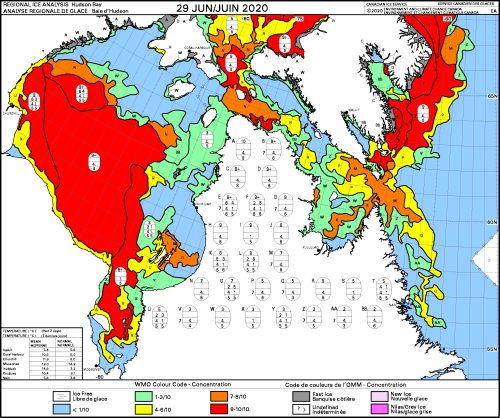
Hudson Bay weekly concentration 2020 June 29 PNG

Polar bear activists don’t like to have current Hudson Bay sea ice reality ruin their social and news media narrative that ‘polar bears are all gonna die’, so they instead emphasize the obsolete ‘declining trend’ for Western Hudson Bay breakup dates that haven’t been updated since 2015 (e.g. Castro de la Guardia et al. 2017; Lunn et al. 2016). They do this despite the fact their colleagues admit polar bears don’t catch many seals after late June (regardless of sea ice conditions) because it is past the peak spring feeding period (Obbard et al. 2016; Lippold et al. 2019). Like in the 1980s, in 2015 and 2019 some bears stayed on the ice until early August and 2020 is shaping up to be another 1980’s-like summer.
Continue reading

Polar bear habitat in Canada and eastern Alaska compared at end of June 2012-2020

Here is a quick compare and contrast of sea ice habitat for polar bears in Canada and the Southern Beaufort region of eastern Alaska near the end of June, 2012-2020.

Baffin Island Bylot Sound bear_smaller_shutterstock_1144169858

Similarities between Hudson Bay ice/open water in the sea ice charts below are striking. Ice cover at the end of June shown in these charts since 2012 reinforces the fact, documented in the peer-reviewed literature, that there has been no continued declining trend in dates of sea ice breakup for Western and Southern Hudson Bay since 1998 at least (Castro de la Guardia et al. 2017; Lunn et al. 2016). WH bears are still on the ice.

As a consequence, recent declarations of impending doom for Hudson Bay polar bears, based on claims of reduced population size and health of these subpopulations – which in any case are statistically insignificant for WH and SH (Obbard et al. 2018; Dyck et al. 2017) – must be due to some other cause (Crockford 2020).

In all areas, winds rather than melt due to increased temperatures drive much of the expansion of open water at this time of year.

Continue reading

No early breakup for W Hudson Bay sea ice again this year: polar bears still on the ice

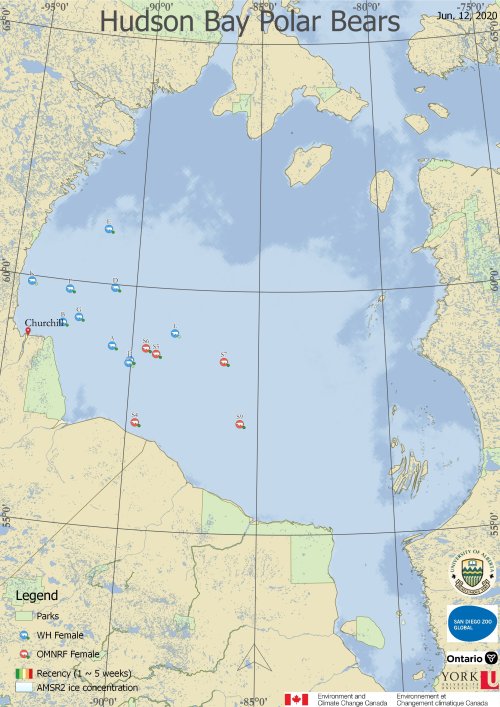
No early breakup of Hudson Bay sea ice again this year: there is still extensive thick first year ice over most of Hudson Bay and all female polar bears fitted with tracking collars in Western Hudson Bay are still on the ice:

W Hudson Bay polar bears still out on the ice that’s packed together by winds. AE Derocher, 12 June 2020

Dercocher June 12 2020 tracking map Hudson Bay

Breakup of Hudson Bay sea ice as it relates to polar bear movement to land has been about the same since 1999 (about 2 weeks earlier than in the 1980s) and this year is shaping up to be no different: there is still no declining trend in date of sea ice breakup in Western Hudson Bay despite repeated predictions of imminent doom. An especially ‘early’ breakup year would have bears ashore before 15 June. Last year (2019) the first WH bear onshore was caught on film 5 July and problem bears were not recorded onshore in Churchill until the 2nd week of July.

Continue reading

New report: Change coming to the Canadian Arctic — but it’s no looming catastrophe

A review of a newly-released (22 April 2020, on Earth Day) report commissioned by Canada’s Department of Fisheries and Oceans on the state of the Arctic seas published today in the National Post is a must read. It highlights the report’s emphasis that while the changes going on in our northern seas are indeed marked, they do not necessarily spell doom.

2019 DFO Arctic Report_Polar Bears from Summary document sent to media

Oddly, polar bears are primarily represented in the report by an overview account of the special case of Western Hudson Bay – an outlier among Canadian subpopulations – that puts special emphasis on the claimed decline in body condition blamed on recent sea ice changes that is not supported by any recent data (Crockford 2020).

Continue reading

State of the Polar Bear Report 2019: Are polar bear researchers hiding good news?

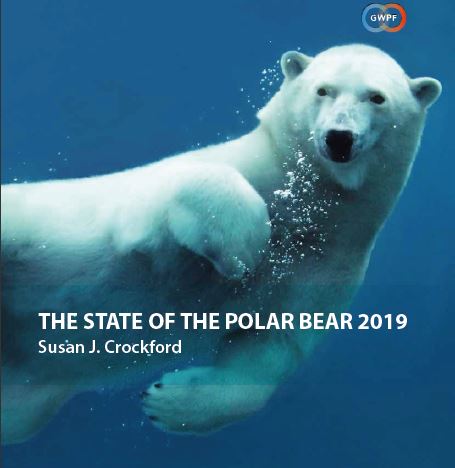
International Polar Bear Day is a good day to ask: Are polar bear researchers hiding good news? Extended lags in publishing polar bear counts and a failure to publish data on female polar bear body weights and cub survival in Western Hudson Bay for more than 25 years make it look like polar bear researchers are delaying and suppressing good news.

StatePB2019 cover image

In particular, the failure to report the data on cub survival and weights of female bears suggests that these health measures have not declined over the last two decades as claimed. If these figures are indeed the strongest evidence that sea ice loss due to climate change is harming Western Hudson Bay polar bears, why on earth have they not been made public? And why won’t a single journalist ask to see that data?
Continue reading

Polar bear activity picks up in Churchill as W Hudson Bay freeze-up time approaches

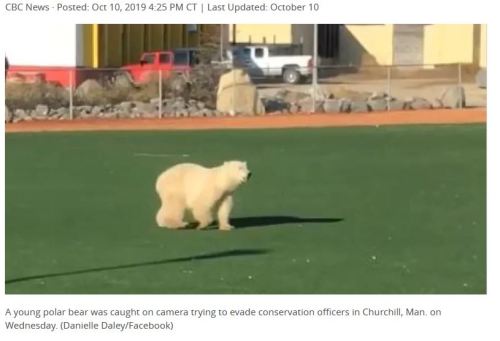
This is week 15 for most polar bears onshore near Churchill in Western Hudson Bay, which means they have been onshore for almost 4 months. Still, photos being circulated are still showing bears in excellent condition and we are just waiting to see if freeze-up this year is as early as it has been for the last two years.

polar bear churchill 9 Oct 2019 Danielle Daley photo

Continue reading

First polar bear spotted off the ice in Western Hudson Bay is fat and healthy

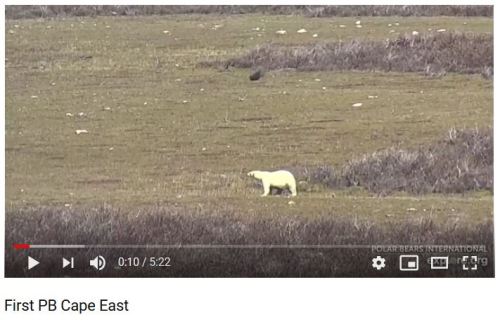
One of the first of hundreds of polar bears expected to come off the sea ice of Hudson Bay along the west and south coasts was captured on video on 5 July. This is only the first wave, as there is still so much ice remaining that most of the bears are likely to remain offshore: not because there is so much food available (few seals are caught at this time of year) but because the ice is where they are most comfortable.

Churchill_first polar bear at Cape Churchill 5 July 2019 on explore dot org cam screencap


Continue reading

Now 20 years with no trend in ice breakup dates for Western Hudson Bay polar bears

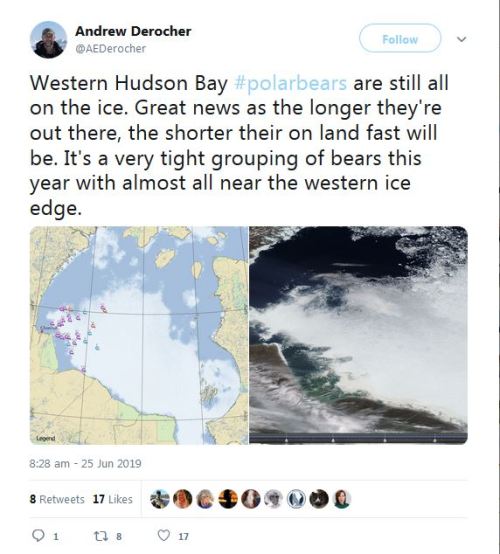
Straight from the horse’s mouth: all polar bear females tagged by researchers around Churchill in Western Hudson Bay last year were still on the ice as of 25 June. With plenty of ice still remaining over the bay, spring breakup will be no earlier this year than it has been since 1999. Contrary to predictions of ever-declining ice cover, the lack of a trend in sea ice breakup dates for Western Hudson Bay is now twenty years long (a hiatus, if you will) and yet these bears are repeatedly claimed to have been seriously harmed in recent years by a loss of sea ice.

Derocher 2019 WHB collared females 25 June all bears still on the ice

In fact, WH bears have faced relatively few ‘early’ years of sea ice breakup and breakup has never come before the 15th of June. The earliest recent spring breakup date did not come in 2012 – when sea ice hit a summer record low – but in 1999, when Hudson Bay sea ice suddenly began to melt by late June rather than mid-July (Cherry et al. 2013; Castro de la Guardia et al. 2017; Lunn et al. 2016). And this year, as has been the case since 1999, breakup looks to be about two weeks later (give or take a week or so, at around 1 July), than was the case in the 1980s and early 1990s.

In other words, there has been no escalation of breakup dates since 1999: there has been no declining trend in breakup dates for Western Hudson Bay polar bears for 20 years (and no trend in fall freeze-up dates either).

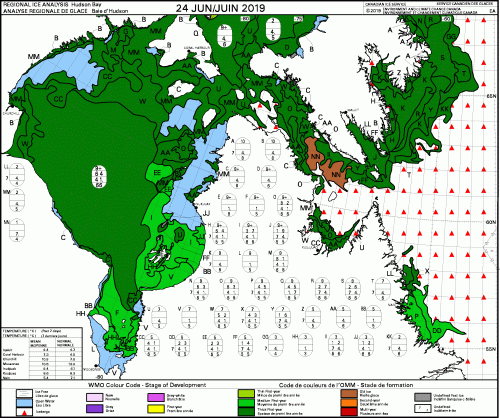
UPDATE 26 June 2019: Here is the latest sea ice chart for the week of 24 June 2019 from the Canadian Ice Service (all that dark green is thick first year ice >1 m thick):

Hudson Bay weekly stage of development 2019 June 24
Continue reading

More starving polar bear nonsense from National Geographic & a better video to watch

This time National Geographic’s ‘Hostile Planet’ series laughably claims a fat polar bear that’s caught a beluga calf off the coast of Western Hudson Bay has been saved from starvation! The message: here is a prime example of climate change pushing a species to its limit. This is nonsense, of course: polar bears hunting beluga whales from rocks has nothing to do with climate change or desperately hungry bears. More importantly, there is a much better video of the action that is both more informative and truthful.
Polar bear hunting beluga_Nat Geo 11 April Hostile Planet clip starving

See both below and decide which you’d prefer your kids or grandkids to watch.

Continue reading

International Polar Bear Day: a time to admit the species is not threatened with extinction due to reduced sea ice habitat

Times have changed: where once many scientists worried that polar bears could not survive an Arctic with 40% less ice, now the concern is that people of the Arctic might not be able to keep themselves safe from growing numbers of increasingly fearless bears.

International Polar Bear Day is tomorrow, 27 February. It’s a good time to reconsider polar bear conservation in light of current realities. Polar bears are not threatened with extinction by loss of sea ice habitat but continue to thrive in spite of it (Crockford 2017).

Polar bear Aug 2017 near area where June 19 2018 bear was spotted Gordy Kidlapik

Fat bear in August 2017 outside Arviat, Nunavut. Gordy Kidlapik photo.

Tomorrow, the 2018 State of the Polar Bear Report will be released. But for now, see some of the failed claims below.

Continue reading